
EPISODE · Mar 24, 2026 · 13 MIN
The Bottom Line
from Meditate Your Face Off · host Cara Lai
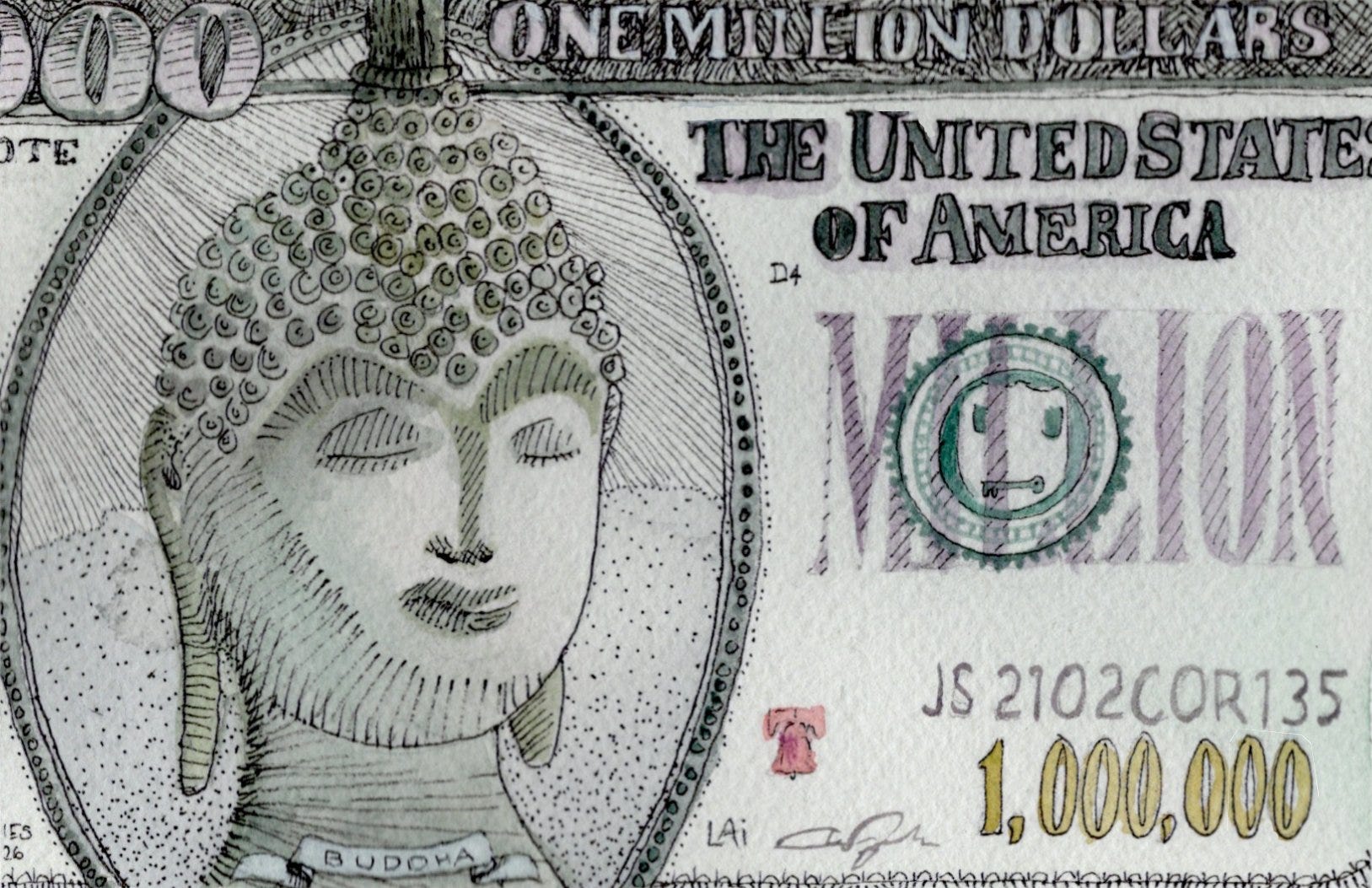
The above is a guided meditation to help you move from scarcity mentality, to abundance mentality. Below is me reading the essay that follows:Scroll to the end of this post for a cool podcast called “Money, Meet Meaning” where I talk about my relationship with money, and how scarcity mentality has shifted towards abundance as I’ve deepened in practice. This article comes from that. I’d love to hear your comments in the chat — feel free to share your own relationship with money and any insights or edges you’ve bumped up against when it comes to money:Most of us have a fraught relationship with money. We’re afraid of not having enough, we want more than we need, we associate it with happiness and well-being; and as much as we hate to admit it, a lot of what we do is motivated by it. Why? We believe that well-being can be found externally, and money is the best way we’ve found of taking control, or at least having a sense of control, over our external reality. If you’re cold, you can buy a space heater. Better yet, buy a house in California. If you’re sick, you can pay for treatment. If you’re bored, you can buy a phone (or really, buying anything new will do the job of temporarily suspending boredom). If you’re uncomfortable in any way, we’ve devised a way for you pay money to get the thing that will change how you feel.Most of us were trained from a young age not to follow our passions, but to earn money. Kindergarten used to be mostly play-based, now most kids are expected to be able to read by the end of it. Arts and humanities programs have been defunded in favor of STEM classes, not because more kids are passionate about math and science, but because STEM has a clear “this leads to jobs” narrative. When I was in grade school, there was a lot of pressure to get good grades, but it was rare for anyone to explain clearly to me why we had to learn what we were learning. (This was a problem for me, which eventually led to my current state of affairs as a deadbeat dharma teacher.) It’s hard to stay motivated when you have little or no meaningful connection to the stuff you’re learning.And if you really look into why we educate kids the way we do, it usually comes down to money. Get a good education, get a well-paying job, earn a lot of money. And live happily ever after? This is a very shallow (and misguided) vision for the younger generation that could use an update. What if we teach kids to follow what they’re passionate about?Deep down, none of us is actually passionate about money. Money is just a concept— pieces of paper, a number in a back account. What we really care about are things like joy, health, and connection. It’s true that some degree of financial or material security is important to get our basic needs met, to maintain a sense of general well-being. But for many of us, money is a concept that’s gotten wildly conflated with our deepest longings and passions. And if we believe that our happiness depends on something in the material world like money, we’re going to suffer. Because like everything in the material world, money is impermanent, unsatisfying, and not in our control.What the dharma points to is that lasting well-being and peace is possible, but we have to look within, not at the material world. Everyone ends up learning the quadratic equation and memorizing capital cities, but what if it were more important to teach kindness, compassion, and generosity in school? The problem is that most of us don’t realize that those things are possible to teach in any way other than by invoking fear and shame. We tell kids they should share and be kind, and we punish them if they don’t.But the Buddha taught that kindness and generosity are intrinsically motivated. It feels good to be generous. In fact, he said that one experiences joy three times in a single act of generosity: in the thought of giving, the act of giving, and in the memory of having given.Turns out, if we pay attention to how we are feeling before, during, and after an act of generosity or an act of violence, that’s how we learn how to share and to be kind. Because it feels good to share, and it feels bad to cause harm. Mainstream society doesn’t realize this, so we come to the end of our ability to teach about kindness and generosity right around kindergarten or first grade.If we believe our happiness depends on something impermanent and unsatisfying (money, anything you can buy with money, other people’s behavior or opinion of us, anything in our sensory experience), we’ll continue to have a scarcity mentality. But if our happiness can come from giving and sharing, there will always be enough. In this way, there’s an abundance of joy available to us. And when we dwell in a mentality of abundance, we want to be generous, and thus begins a virtuous cycle that leads to a real, lasting satisfaction. Imagine how the world would be if we realized that happiness came from generosity instead of from getting and having. We’d stop competing and start sharing. Our pursuits wouldn’t leave us in a state of deprivation, but in increasing states of joy, abundance, and connection. How might you still be following the model of material success we were trained for in grade school? What endeavors are you pursuing that have nothing to do with your best interests? You get to put those down now. Rest your weary bones and regain your strength. Reclaim your power, your passion. Begin to trust that there is enough, and a world of abundance will open up to you. Real Awakening in Modern Life: Upcoming Online Mini RetreatHow could it be that the only people who get to wake up are the ones who have the resources to be on retreat all the time? This retreat is meant to upend this way of thinking, and expose how your life is exactly what you need to awaken.Join me on April 19th, 11am - 3pm ET. This is a public episode. If you'd like to discuss this with other subscribers or get access to bonus episodes, visit caralai.substack.com/subscribe
NOW PLAYING
The Bottom Line
No transcript for this episode yet
Similar Episodes
Mar 19, 2026 ·34m
Feb 18, 2026 ·11m
Feb 11, 2026 ·45m
Nov 12, 2025 ·35m
Oct 17, 2025 ·40m