
EPISODE · Nov 24, 2025 · 12 MIN
The Brain's Modular Wisdom
from James Maconochie | Architecture & Attention Podcast · host James Maconochie
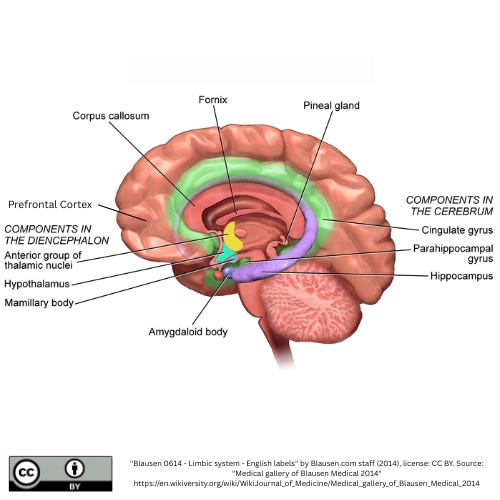
A recent post of mine on LinkedIn calculated something staggering: you could train GPT-4 thirty million times over with the energy evolution “spent” architecting the human brain.Thirty million times.Thanks for reading James Maconochie | Architecture & Attention! Subscribe for free to receive new posts and support my work.That number stopped me cold. Not because it’s precise, it’s a thought experiment, after all, but what it reveals is important: the brain’s magic isn’t brute force. It’s architecture.After 18 months studying cognitive science, neuroscience, and evolutionary biology, I’ve come to see something remarkable. We’re living in a moment where two forms of intelligence are meeting for the first time: one built from carbon and refined over four billion years, the other built from silicon and refined over a few decades.Both are extraordinary. But the real question isn’t which will win. It’s what they can teach each other about how intelligence actually works.The 30-Million-Fold Efficiency GapLet me back up to that energy calculation. I compared the total energy consumed by all human brains that have ever existed, what I call the Evolutionary Processing Unit (EPU), to the energy used to train a single GPT-4:- The EPU’s energy bill**: ~1.4 million TWh- GPT-4’s training cost**: ~50 GWhThe difference is a factor of approximately 30 million.This isn’t just big. It’s physically insurmountable for our current approach. You could train GPT-4 30 million times for the energy evolution spent optimizing the brain’s architecture.Which raises an obvious question: if intelligence were just about computational scale, wouldn’t we be closer to AGI by now? The persistence of AI’s limitations, common sense reasoning, causal understanding, continuous adaptation, suggests we’re missing something fundamental.Are we racing ahead with our silicon brains, or are we circling an older truth that evolution already solved?Evolution’s Four-Billion-Year R&D ProjectHere’s what I’ve learned: evolution didn’t create intelligence through raw computational power. It created intelligence through architectural innovation, refined across billions of years of trial and error.The human brain, what I call the Biological Processing Unit (BPU), is the product of that optimization process. Every species, every neuron, every failure was a data point in a computation so immense that even our fastest supercomputer, operating at 1.7 exaFLOPS, would need trillions of years to replicate it.And what did that process discover? Not a bigger processor. A better design.The Brain as Confederation, Not MonolithThe most striking thing I’ve learned about the brain’s architecture is that it isn’t a single, unified processor. It’s a confederation of specialized systems, each optimized for specific functions:- Sensory systems that filter and prioritize incoming information- Memory systems that consolidate and retrieve experience- Emotional systems that assess value and urgency- Motor systems that coordinate action- Executive function (the prefrontal cortex) that orchestrates these modules toward coherent goalsThis isn’t just division of labor. It’s a fundamentally different architectural principle than the monolithic models dominating AI today.Think about it: when you decide whether to accept a job offer, you’re not running a single massive calculation. Different parts of your brain are processing in parallel, one assessing financial implications, another evaluating social fit, another imagining future scenarios, while your executive function weighs these inputs against your values and makes a decision.This modular architecture provides several critical advantages:Specialization without brittleness: Each module can be optimized for its specific function without compromising the system’s overall flexibility. Your visual cortex is exquisitely tuned for pattern recognition, while your hippocampus specializes in episodic memory. Neither has to be good at the other’s job.Graceful degradation: When one module is damaged or overwhelmed, others can partially compensate. The brain’s wrinkled outer layer, the cerebral cortex, exhibits remarkable plasticity. When areas responsible for vision are damaged, neighboring regions can gradually take over visual processing functions. Stroke patients can sometimes relearn speech or movement as undamaged cortical areas rewire themselves to handle these tasks.Efficient resource allocation: Not every module needs to be “on” at full capacity all the time. Your brain dynamically allocates attention and energy based on context. Walking down a familiar street requires minimal conscious processing; walking down a dark alley in an unfamiliar city activates multiple systems simultaneously.Continuous learning at multiple scales: Different modules can update at different rates. Your motor cortex might refine a tennis serve over weeks of practice while your prefrontal cortex simultaneously updates its model of a colleague’s reliability based on a single conversation.The Coordination ChallengeBut here’s where it gets really interesting: having specialized modules isn’t enough. They need to work together.The prefrontal cortex serves as a dynamic orchestrator, not a top-down dictator, but rather like a conductor who knows which sections of the orchestra to bring forward at different moments. This coordination itself is learned and plastic, adapting based on experience and context.When you’re driving and a child runs into the street, your brain doesn’t deliberate. Visual cortex detects motion, emotional centers flag threat, motor systems execute braking, all coordinated so rapidly it feels instantaneous. That coordination is itself a learned pattern, refined through evolution and individual experience.What Current AI Architectures MissMost large language models are monolithic. They excel at the tasks they’re trained on, but they can’t easily:- Reason causally about interventions and counterfactuals- Learn continuously without catastrophic forgetting- Allocate resources dynamically based on problem difficulty- Explain their reasoning in terms humans can inspect and trust- Adapt strategies when operating outside their training distributionThese aren’t just implementation details. They’re symptoms of a fundamental architectural mismatch.The brain evolved these capabilities because it had to. Evolution optimized under severe resource constraints: limited energy, limited space, limited time to learn before predators struck. Monolithic processing wasn’t an option. Modularity wasn’t a design choice; it was survival.The Human Angle: Beyond ProcessingWhat makes this even more interesting is that the BPU doesn’t just process, it cares. It wonders. It gets curious.Curiosity, imagination, surprise, these aren’t inefficiencies that evolution failed to optimize away. They’re features, born to navigate uncertainty. Human intelligence thrives on ambiguity. We value metaphor and story because they compress complexity into meaning.AI can generate those patterns now, but it doesn’t yet understand them the way we do, because understanding requires something the BPU developed through embodied interaction with the world: causal reasoning.This is what Judea Pearl calls climbing the “ladder of causation”:- Seeing: observing correlations in data- Doing: understanding how interventions change outcomes - Imagining: reasoning about counterfactuals, about “what if”Current LLMs are remarkably good at the first rung. They excel at seeing patterns. But they lack the innate scaffolding for doing and imagining that the EPU built into the BPU through four billion years of embodied interaction with reality.A Different Path ForwardThis is why the 30-million-fold energy gap matters. It’s not just about efficiency, though as AI energy consumption threatens to overwhelm power grids, efficiency certainly matters. It’s about what that efficiency reveals: intelligence emerges from structure, not just scale.What if we built AI systems more like the brain? Not by slavishly copying every detail, we’re engineers, not neuroscientists, but by adopting the architectural principles evolution discovered:- Specialized modules for perception, memory, causal reasoning, and value assessment- Dynamic orchestration that learns coordination strategies- Continuous plasticity at multiple timescales- Embodied grounding in action and consequence- Resource constraints as design features, not bugsThis isn’t just theoretical. The research directions are clear: modular architectures, causal inference frameworks, continual learning systems, attention mechanisms that actually allocate scarce resources rather than just weighting inputs.The Recursive LoopIn a sense, the most promising path to artificial intelligence isn’t linear at all. It’s recursive, a feedback loop between two learning systems: one biological, one artificial.The BPU shows how to build intelligence under constraint. The GPU shows what’s possible with abundance. The question is whether we can learn from both, whether we can build systems that combine the architectural wisdom of evolution with the computational power of modern hardware.The goal isn’t to replicate the human mind. It’s to learn from it wisely. If the BPU is the teacher and silicon is the student, then the real lesson is humility.Intelligence grows not by scaling alone, but by listening, to the feedback of reality, to the signals of constraint, and to the wisdom evolution already embedded in us.What’s NextHere’s what humbles me most about this journey: the more I learn about the brain, the more in awe I am. Not as mysticism, but as engineering.Evolution ran a four-billion-year experiment with trillions of parallel trials, each one literally life-or-death. The BPU is the result: an architecture so elegant, so efficient, so robust that we’re only beginning to understand its principles.The path to AGI won’t be found by training ever-larger monolithic models. It will be found by learning from the master architect: evolution itself.Next week, I’ll explore attention, both as a technical mechanism in AI and as the human capacity that makes all learning, all understanding, all wisdom possible. Because if modularity is the brain’s architecture, attention is its operating system.---Notes & Further ReadingThe 30-million-fold energy efficiency calculation is detailed in my LinkedIn post from November 5, 2025.For the complete technical argument on evolutionary computation and modular AI architectures, see my research paper “Beyond FLOPS: The Evolutionary Processing Unit and the Roadmap to AGI” on my website.The foundational arguments about the ingredients of human intelligence appear in my earlier post, “AGI - The Human Angle”.Thanks for reading James Maconochie | Architecture & Attention! Subscribe for free to receive new posts and support my work. This is a public episode. If you would like to discuss this with other subscribers or get access to bonus episodes, visit jamesmaconochie.substack.com
Embed this episode
Ready to play
The Brain's Modular Wisdom
No transcript for this episode yet
Similar Episodes
No similar episodes found.
Similar Podcasts
No similar podcasts found.