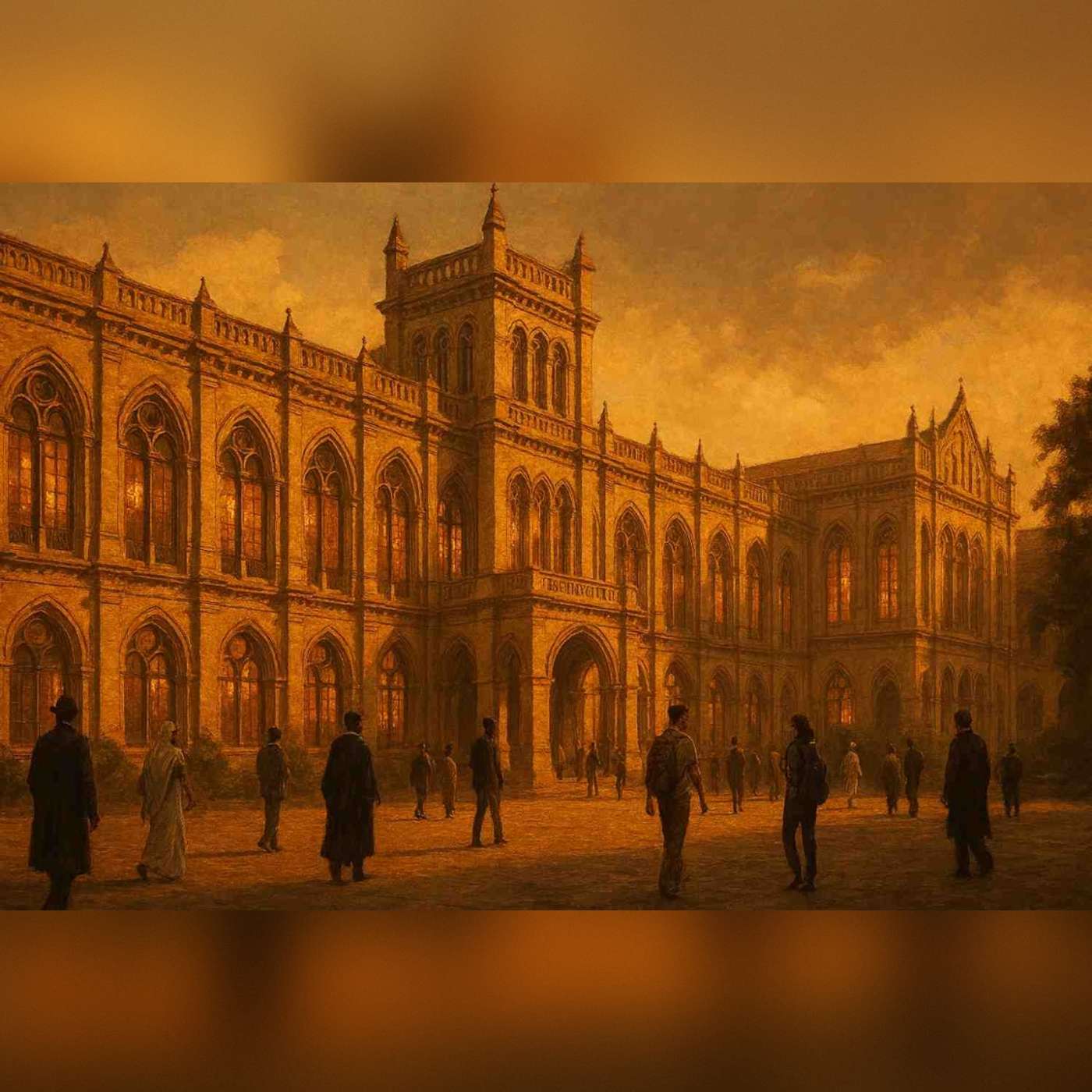
The Building in Kolkata That Produced Six Scientists Who Changed the World episode artwork

EPISODE · Jun 17, 2026 · 22 MIN

The Building in Kolkata That Produced Six Scientists Who Changed the World

from Incredible India Travel | Social Impact & Culture Tours · host 5 Senses Tours | Cultural Experiences & Social Impact Guides

There is a building on College Street in Kolkata.It was built in 1875. Its architecture is the confident Victorian Gothic of a colonial institution that expected to last. Tall windows. High ceilings. A sweeping central staircase. A laboratory called the Baker Laboratory that became one of the most productive scientific research spaces in Asia.Its name is Presidency College. And the list of people who studied and taught within its walls across a period of approximately seventy years is so extraordinary that if you compiled it without knowing it was true you would be accused of making it up.Jagadish Chandra Bose. The man who proved that plants have feelings and who transmitted the world's first wireless signal before Marconi, teaching in its laboratories.Prafulla Chandra Ray. The chemist who founded the Indian pharmaceutical industry and whose students would reshape modern physics, teaching beside him.Satyendra Nath Bose. The physicist whose paper Albert Einstein personally translated into German and whose name is now attached to the most fundamental class of particles in the universe, studying in its classrooms.Meghnad Saha. The astrophysicist whose equation explaining the chemical composition of stars transformed our understanding of the cosmos, studying beside Bose in the same year.CV Raman. The physicist who discovered the effect that bears his name and won India its first Nobel Prize in science, conducting his experiments in its Baker Laboratory.Amartya Sen. The economist whose work on poverty and human development won the Nobel Prize in Economics and whose name was given to him by Rabindranath Tagore, studying in its economics department decades later.Six individuals. One building. Physics. Chemistry. Astrophysics. The God Particle. The Raman Effect. The Nobel Prize for Economics.And almost no international tourist who visits Kolkata knows this building exists.This episode is the complete story of the most extraordinary concentration of scientific genius in modern Indian history, and the heritage trail in Kolkata that brings it to life.What You Will Discover in This EpisodeHow a single educational institution on College Street in Kolkata, founded as a result of a meeting in 1816 between progressive British and Bengali reformers, became the most intellectually productive building in the history of South Asia across nearly two centuriesThe complete story of Jagadish Chandra Bose, who demonstrated wireless transmission of electromagnetic waves in Calcutta in 1895, a full year before Marconi's celebrated demonstration in Britain, and who also invented the crescograph, an instrument that proved plants respond to heat, light and electrical stimuli in ways functionally analogous to animal nervous systemsThe story of Prafulla Chandra Ray, who founded Bengal Chemical and Pharmaceutical Works in 1901, the first pharmaceutical manufacturing company in India, while living with extraordinary personal simplicity and mentoring the two students who would go on to transform 20th century physicsHow Meghnad Saha, who grew up in poverty in rural Bengal with precarious access to education, developed the Saha Ionization Equation in 1920, a discovery that gave astronomers for the first time the ability to determine the chemical composition and temperature of stars from their light alone, transforming astrophysics from a descriptive science into a predictive oneThe extraordinary story of Satyendra Nath Bose, who in 1924 wrote a paper on quantum statistics that European journals rejected, and who responded by posting it directly to Albert Einstein, who recognised its significance immediately, translated it into German himself, and gave his name to the entire class of particles now known as bosons, including the Higgs boson discovered at CERN in 2012 and popularly known as the God ParticleThe discovery of the Raman Effect by CV Raman in 1928 in the Baker Laboratory at Presidency College, the phenomenon in which scattered light changes wavelength according to the molecular composition of the substance it passes through, a discovery so significant that Raman was reportedly confident enough of its impact to book his ticket to Stockholm before the Nobel committee had even made its decisionHow Amartya Sen, given his name by Rabindranath Tagore, used the Bengal Famine of 1943, a famine that killed between two and three million people while food was actually being exported from Bengal, to demonstrate that famines are caused by a failure of economic entitlement rather than a shortage of food, transforming global development economics and humanitarian policyThe extraordinary genealogy connecting all six scientists, in which Jagadish Chandra Bose and Prafulla Chandra Ray taught Satyendra Nath Bose and Meghnad Saha, who became classmates and lifelong collaborators, while CV Raman used the same Baker Laboratory that Bose established, and Amartya Sen studied economics in the same institution decades laterHow the Bengali scientists' work connects directly to daily life today, from the wireless technology in your phone, to the Raman spectroscopy used in pharmaceutical quality control and on Mars rovers, to the stellar composition calculations that depend on the Saha equation, to the global famine prevention policies built on Amartya Sen's theory of entitlementHow 5 Senses Tours brings the complete Bengali scientists heritage trail to life for international travellers through expert guided visits to Presidency College and the Baker Laboratory, the Bose Institute, the Indian Botanic Garden and the Indian MuseumExperience the Bengali Scientists Heritage With 5 Senses ToursThe building where six scientists who changed the world studied and taught is still standing on College Street in Kolkata. The Baker Laboratory where CV Raman discovered the effect that won him India's first Nobel Prize in science is still there. The Bose Institute, founded by Jagadish Chandra Bose in 1917 as the first multidisciplinary research institute in India, still preserves his original scientific equipment. And the Great Banyan Tree in the botanical garden that carries his name, a single tree over 250 years old covering more than three and a half acres, is still growing.Our Kolkata tours cover the complete Bengali scientists heritage trail including Presidency College, the Bose Institute and the Indian Museum, connecting the most extraordinary concentration of scientific genius in modern Indian history to the living city where it happened. Book at https://5sensestours.com/home-kolkata-tours/For travellers extending their Bengal heritage experience, our Sundarbans wildlife tour covers the extraordinary mangrove ecosystem of the Bengal delta where Royal Bengal tigers swim between islands. Book at https://5sensestours.com/tour/sundarban-wildlife-tour/For a customised private Bengali scientists heritage journey, contact us at www.5sensestours.com5 Senses Tours is recognised by India's Ministry of Tourism, winner of the Tripadvisor Travellers Choice Award and the Outlook Responsible Tourism Award. Every tour is private, expert-guided and completely customised for your group.

There is a building on College Street in Kolkata.It was built in 1875. Its architecture is the confident Victorian Gothic of a colonial institution that expected to last. Tall windows. High ceilings. A sweeping central staircase. A laboratory called the Baker Laboratory that became one of the most productive scientific research spaces in Asia.Its name is Presidency College. And the list of people who studied and taught within its walls across a period of approximately seventy years is so extraordinary that if you compiled it without knowing it was true you would be accused of making it up.Jagadish Chandra Bose. The man who proved that plants have feelings and who transmitted the world's first wireless signal before Marconi, teaching in its laboratories.Prafulla Chandra Ray. The chemist who founded the Indian pharmaceutical industry and whose students would reshape modern physics, teaching beside him.Satyendra Nath Bose. The physicist whose paper Albert Einstein personally translated into German and whose name is now attached to the most fundamental class of particles in the universe, studying in its classrooms.Meghnad Saha. The astrophysicist whose equation explaining the chemical composition of stars transformed our understanding of the cosmos, studying beside Bose in the same year.CV Raman. The physicist who discovered the effect that bears his name and won India its first Nobel Prize in science, conducting his experiments in its Baker Laboratory.Amartya Sen. The economist whose work on poverty and human development won the Nobel Prize in Economics and whose name was given to him by Rabindranath Tagore, studying in its economics department decades later.Six individuals. One building. Physics. Chemistry. Astrophysics. The God Particle. The Raman Effect. The Nobel Prize for Economics.And almost no international tourist who visits Kolkata knows this building exists.This episode is the complete story of the most extraordinary concentration of scientific genius in modern Indian history, and the heritage trail in Kolkata that brings it to life.What You Will Discover in This EpisodeHow a single educational institution on College Street in Kolkata, founded as a result of a meeting in 1816 between progressive British and Bengali reformers, became the most intellectually productive building in the history of South Asia across nearly two centuriesThe complete story of Jagadish Chandra Bose, who demonstrated wireless transmission of electromagnetic waves in Calcutta in 1895, a full year before Marconi's celebrated demonstration in Britain, and who also invented the crescograph, an instrument that proved plants respond to heat, light and electrical stimuli in ways functionally analogous to animal nervous systemsThe story of Prafulla Chandra Ray, who founded Bengal Chemical and Pharmaceutical Works in 1901, the first pharmaceutical manufacturing company in India, while living with extraordinary personal simplicity and mentoring the two students who would go on to transform 20th century physicsHow Meghnad Saha, who grew up in poverty in rural Bengal with precarious access to education, developed the Saha Ionization Equation in 1920, a discovery that gave astronomers for the first time the ability to determine the chemical composition and temperature of stars from their light alone, transforming astrophysics from a descriptive science into a predictive oneThe extraordinary story of Satyendra Nath Bose, who in 1924 wrote a paper on quantum statistics that European journals rejected, and who responded by posting it directly to Albert Einstein, who recognised its significance immediately, translated it into German himself, and gave his name to the entire class of particles now known as bosons, including the Higgs boson discovered at CERN in 2012 and popularly known as the God ParticleThe discovery of the Raman Effect by CV Raman in 1928 in the Baker Laboratory at Presidency College, the phenomenon in which scattered light changes wavelength according to the molecular composition of the substance it passes through, a discovery so significant that Raman was reportedly confident enough of its impact to book his ticket to Stockholm before the Nobel committee had even made its decisionHow Amartya Sen, given his name by Rabindranath Tagore, used the Bengal Famine of 1943, a famine that killed between two and three million people while food was actually being exported from Bengal, to demonstrate that famines are caused by a failure of economic entitlement rather than a shortage of food, transforming global development economics and humanitarian policyThe extraordinary genealogy connecting all six scientists, in which Jagadish Chandra Bose and Prafulla Chandra Ray taught Satyendra Nath Bose and Meghnad Saha, who became classmates and lifelong collaborators, while CV Raman used the same Baker Laboratory that Bose established, and Amartya Sen studied economics in the same institution decades laterHow the Bengali scientists' work connects directly to daily life today, from the wireless technology in your phone, to the Raman spectroscopy used in pharmaceutical quality control and on Mars rovers, to the stellar composition calculations that depend on the Saha equation, to the global famine prevention policies built on Amartya Sen's theory of entitlementHow 5 Senses Tours brings the complete Bengali scientists heritage trail to life for international travellers through expert guided visits to Presidency College and the Baker Laboratory, the Bose Institute, the Indian Botanic Garden and the Indian MuseumExperience the Bengali Scientists Heritage With 5 Senses ToursThe building where six scientists who changed the world studied and taught is still standing on College Street in Kolkata. The Baker Laboratory where CV Raman discovered the effect that won him India's first Nobel Prize in science is still there. The Bose Institute, founded by Jagadish Chandra Bose in 1917 as the first multidisciplinary research institute in India, still preserves his original scientific equipment. And the Great Banyan Tree in the botanical garden that carries his name, a single tree over 250 years old covering more than three and a half acres, is still growing.Our Kolkata tours cover the complete Bengali scientists heritage trail including Presidency College, the Bose Institute and the Indian Museum, connecting the most extraordinary concentration of scientific genius in modern Indian history to the living city where it happened. Book at https://5sensestours.com/home-kolkata-tours/For travellers extending their Bengal heritage experience, our Sundarbans wildlife tour covers the extraordinary mangrove ecosystem of the Bengal delta where Royal Bengal tigers swim between islands. Book at https://5sensestours.com/tour/sundarban-wildlife-tour/For a customised private Bengali scientists heritage journey, contact us at www.5sensestours.com5 Senses Tours is recognised by India's Ministry of Tourism, winner of the Tripadvisor Travellers Choice Award and the Outlook Responsible Tourism Award. Every tour is private, expert-guided and completely customised for your group.

NOW PLAYING

The Building in Kolkata That Produced Six Scientists Who Changed the World

0:00 22:48

No transcript for this episode yet

We transcribe on demand. Request one and we'll notify you when it's ready — usually under 10 minutes.

Breaking News Show | eTurboNews Juergen Thomas Steinmetz News is relevant to the global travel and tourism industry, human rights and global issues.Breaking news when it happens and only from the source. Solving for Change MOBIA Technology Innovations Solving for Change welcomes business and technology leaders to share stories of bold business transformation within complex organizations. In an era when technology and markets are changing around businesses, the key to staying competitive is to evolve in response to those changes.  MOBIA’s Mike Reeves and Marc LeBlanc investigate business transformation, deconstructing the challenges, ambitions, and market disruptions that drive companies to embark on transformation journeys, and exploring their unique approaches to achieving meaningful outcomes.  What sparks leaders to pursue business transformation? How do they overcome the challenges along the way? What are the keys to creating enduring change?  Through in-depth conversations with business and technology leaders, Mike and Marc answer these questions and explore how businesses evolve by pulling four key transformation levers: people, process, technology, and culture. Cool Story Bro TheSneakyBros Welcome to *Cool Story Bro*, a dynamic podcast hosted by TheSneakyBros, where gaming takes center stage. Join us for engaging discussions, insights, and stories about your favorite games and gaming culture. Tune in for an entertaining exploration of the virtual world! RAISING THE BAR MUSICHYPEBEAST The RAISING THE BAR Podcast is dedicated to providing a fresh and unconventional broadcast platform for the biggest names in music and entertainment.The interview insight provided by the staff of MUSICHYPEBEAST separates us from the pack. The passion of RAISING THE BAR podcast is fueled by Millennial Music culture. Hosted on Acast. See acast.com/privacy for more information.

Frequently Asked Questions

How long is this episode of Incredible India Travel | Social Impact & Culture Tours?

This episode is 22 minutes long.

When was this Incredible India Travel | Social Impact & Culture Tours episode published?

This episode was published on June 17, 2026.

What is this episode about?

There is a building on College Street in Kolkata.It was built in 1875. Its architecture is the confident Victorian Gothic of a colonial institution that expected to last. Tall windows. High ceilings. A sweeping central staircase. A laboratory called...

Can I download this Incredible India Travel | Social Impact & Culture Tours episode?

Yes, you can download this episode by clicking the download button on the episode player, or subscribe to the podcast in your preferred podcast app for automatic downloads.
URL copied to clipboard!