
PODCAST · society
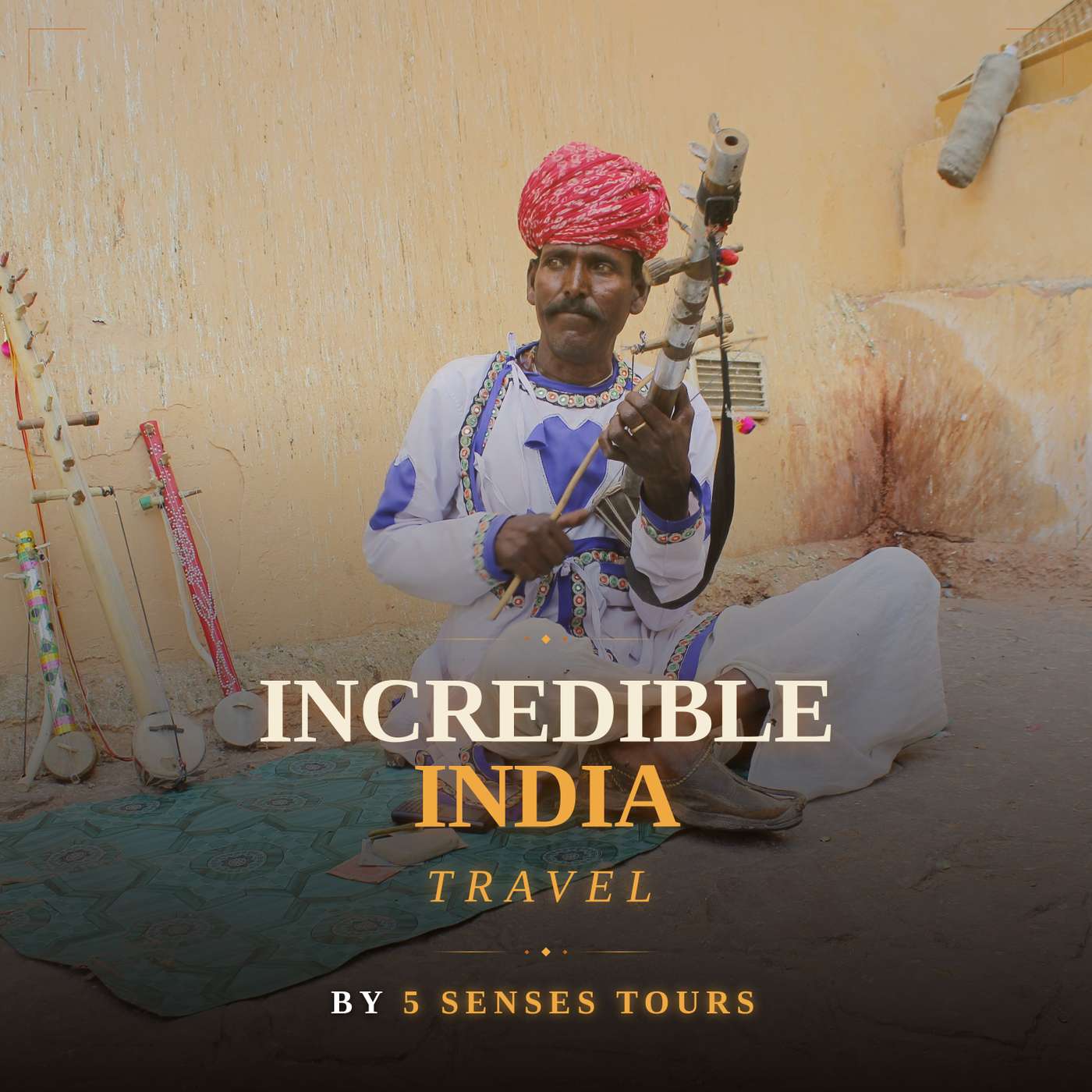
Incredible India Travel | Social Impact & Culture Tours
by Madhusudan Narayanan | 5 Senses Tours
India travel podcast exploring responsible tourism, deep cultural experiences, and experiential travel across incredible India. Your India travel guide for authentic, meaningful journeys.Created by Madhusudan Narayanan, founder of 5 Senses Tours, an inbound tour operator specialising in cultural and sustainable travel in India, and hosted by Debbie and Tim, this podcast takes you beyond the monuments to the real heart of the country. Each episode covers places to visit in India, hidden heritage sites, ethical community tourism, and off the beaten path adventures that celebrate Indian culture and support local communities.From the ancient forts of Rajasthan and the backwaters of Kerala to tribal Odisha and the Himalayan ashrams, this is responsible tourism India done right, immersive, purposeful, and unforgettable.Whether you are a first time visitor or a seasoned India traveller, we help you explore with purpose and respect.🎧 Subscribe now and start your journey.🌏 Plan your In
-
188
Pune Ganesh Festival: The Five Pandals That Helped Birth a Nation and Why Lokmanya Tilak Was the Greatest Political Genius of Colonial India
In 1893 the British colonial administration was watching Pune carefully.Large public gatherings were viewed with suspicion. Political meetings were monitored. Any organised assembly that could give voice to the growing feeling of nationalism was a threat to the colonial order. The freedom movement was still finding its form, largely confined to educated drawing rooms and English language newspapers, unable to reach the vast majority of ordinary Indians.Then Lokmanya Bal Gangadhar Tilak looked at something that had been happening quietly in Marathi homes for centuries and asked a question that would change the history of India.What if we did this in the streets?What the British could not ban was devotion. What they could not prevent was a religious celebration that every Hindu family in Pune already participated in. What they could not monitor without revealing their own suspicion of ordinary people's faith was a festival of a beloved deity who removes obstacles and blesses new beginnings.Tilak transformed a private home celebration of Lord Ganesha into a ten-day public festival that became the largest legally permitted public assembly in colonial India. From the pandal stage, poets could recite patriotic verses. Speakers could address thousands simultaneously. Ideas that could not be voiced in a political meeting could be expressed within the framework of a religious festival. The colonial administration could not intervene without appearing to suppress religion itself.Tilak had found the one door the British could not close.This episode is the complete story of the Pune Ganesh festival and the five Manache Ganpati, the five most honoured pandals of the festival, each with a history that reaches deeper into Pune than the festival itself.What You Will Discover in This EpisodeThe complete story of how Lokmanya Tilak transformed the Pune Ganesh festival in 1893 from a private home celebration into the most powerful instrument of nationalist mobilisation in colonial India, and why his specific genius lay in finding a cultural form that the British administration could not suppress without appearing to attack Hinduism itselfThe word Manacha and what it means in Marathi, why the five Manache Ganpati hold the highest ceremonial rank in the entire festival, and the precise order of precedence in the visarjan immersion procession that no other pandal in Pune can challengeKasba Ganpati, the first Manacha and the presiding deity of Pune itself, whose idol was installed in its temple by Jijabai and Shivaji Maharaj in approximately 1639, making it the most historically rooted of all five and the one whose authority over the city predates the festival by two and a half centuriesTambdi Jogeshwari, the second Manacha, set before a 15th-century temple of Goddess Durga whose Ganeshotsav status was personally bestowed by Tilak himself in 1893, and the extraordinary annual renewal tradition in which the idol is immersed every year and a fresh one installed the following yearGuruji Talim, the third Manacha and the most beautiful communal story in the entire festival, established in 1887, six years before Tilak's public festival, by a Hindu family and a Muslim family who shared a neighbourhood wrestling gymnasium, making it the oldest expression of Hindu-Muslim solidarity in the Pune Ganesh festival traditionTulshibaug Ganpati, the fourth Manacha, standing 13 feet tall and dressed in ornaments weighing over 80 kilograms, located in the densest commercial heart of old Pune where the Tulshibaug market transforms completely during Ganeshotsav into one of the most sensory intense festival environments in IndiaKesariwada, the fifth Manacha, established by Tilak himself in 1893 in his own residence, where the Kesari printing press that spread the nationalist message to Marathi-speaking India still stands alongside a freedom movement museum, making it the most historically weighted stop on the entire Pune Ganesh festival walk and the precise origin point of the public festival itselfDagdusheth Halwai Ganpati, technically outside the five Manache but arguably the most famous Ganesh in all of Maharashtra, adorned with gold and precious jewellery worth crores, and the story of the grief-stricken 19th-century sweet maker whose personal loss became the founding devotion of the wealthiest Ganesh mandal in the stateThe sensory reality of the Pune Ganesh festival, the dhol-tasha percussion that is felt in the chest as much as heard by the ears, the smell of marigold and mogra jasmine in the festival lanes, the ukadiche modak trail through the sweet shops of old Pune and the specific food universe of the Tulshibaug and Laxmi Road markets during GaneshotsavHow the 5 Senses Tours private guided walk of the five Manache Ganpati gives international visitors the historical, cultural and culinary context to experience one of India's most extraordinary festivals not as overwhelming spectacle but as a completely readable story of devotion, community and revolutionary geniusExperience the Pune Ganesh Festival With 5 Senses ToursThe five Manache Ganpati pandals are walkable from each other in the old city of Pune. But walking them without understanding what you are looking at, why the order of the five matters, what Kasba Ganpati has to do with Jijabai, what Guruji Talim has to do with a Hindu-Muslim friendship in a wrestling gymnasium in 1887 and what Kesariwada has to do with the birth of the Indian freedom movement, is to be present at an extraordinary story without the words to read it.Our Pune Ganesh festival walk covers all five Manache Ganpati, the historic lanes that connect them, the food of the festival and the complete story of how a ten-day religious celebration became the largest anti-colonial mobilisation in the history of the Indian freedom movement, concluding at Dagdusheth Halwai Ganpati.Book your private Pune Ganesh festival walk at https://5sensestours.com/tour/pune-ganesh-festival/5 Senses Tours is recognised by India's Ministry of Tourism, winner of the Tripadvisor Travellers Choice Award and the Outlook Responsible Tourism Award. Every tour is private, expert guided and completely customised for your group.
-
187
Sushruta: The Ancient Indian Surgeon Who Pioneered Plastic Surgery
Long before modern hospitals and plastic surgery clinics, an extraordinary tradition of surgical medicine was developing in ancient India.In this episode, we travel back more than two millennia to meet Sushruta, the ancient Indian physician traditionally associated with the Sushruta Samhita, one of the foundational texts in the history of surgery.Sushruta is particularly remembered for his detailed description of rhinoplasty — the reconstruction of the nose — using a skin flap. His work also discusses surgical instruments, wound treatment, anatomy, suturing and other procedures. Modern medical historians and surgical literature recognize the importance of his contribution to the history of reconstructive surgery.But the story is bigger than plastic surgery.What did surgery look like in ancient India? How did Sushruta train surgeons? What did the Sushruta Samhita actually describe? And how did an Indian technique for reconstructing the nose eventually become known in Europe as the “Indian method”?This episode explores the fascinating intersection of ancient Indian knowledge, medicine, surgery and the global history of science.A journey into a remarkable chapter of India's scientific and medical heritage.Topics covered:Sushruta and the Sushruta SamhitaThe history of plastic and reconstructive surgeryAncient Indian rhinoplastySurgical instruments and techniquesAnatomy and surgical training in ancient IndiaThe “Indian method” of rhinoplastyThe journey of Indian surgical knowledge to EuropeIndia's contribution to the history of medicineRead a blog on Sushruta at https://5sensestours.com/sushruta-the-worlds-first-plastic-surgeon/
-
186
Malpe Fishing Community: The Original Fishermen of the Karnataka Coast and Why They Are Being Pushed Out of the Sea They Have Always Fished
The boats leave before you are awake.By the time visitors arrive at Malpe harbour in the morning, the day's work has already been underway for hours. The fishing families of Malpe do not operate on tourist time. They operate on the rhythm of the sea, which means departures in the dark, returns determined by the catch, and the women at the harbour ready to receive, sort and sell before the sun climbs high enough to compromise what has been pulled from the water.Malpe is one of the most active fishing harbours on the Karnataka coast. Its covered fish market, where prawns and mackerel are laid out in the early hours by women vendors whose families have been in this trade for generations, is a working commercial operation, not a heritage display. The noise and the smell and the speed of the transactions happening around you are not constructed for visitors. They are the actual morning of a community that has fed the coastal Karnataka region for as long as anyone can trace.And that community calls itself the moola. The original fishermen of Dakshin Kannada. The word means original in Kannada. And they use it deliberately, because what is happening to them is not a natural evolution of their trade. It is a displacement. From the sea they have always fished. By forces they had no part in creating and over which they have no power.In 2005, 85 percent of the catch on the Karnataka coast was taken by the mechanised sector. The artisanal fishermen, working smaller traditional craft in the inshore waters, were left with the remainder. A regulation passed in 1994 reserves the ten-kilometre inshore zone for traditional fishermen. It has not been enforced. The operational costs of fishing, diesel, ice, boat maintenance, have doubled in recent years. The catch has not increased. And the younger generation is looking at what their parents earn and leaving for the city.This episode is the complete story of the Malpe fishing community.What You Will Discover in This EpisodeThe complete story of the Mogaveera fishing community of Malpe, their identity as the moola or original fishermen of Dakshin Kannada, their centuries-old relationship with the Karnataka coast, and what their daily working life actually involves from the pre-dawn departure to the morning's market transactions managed by the women of the communityHow the mechanised expansion of the Karnataka fishing industry from the 1960s onward, driven by government policy that prioritised production volume over sustainable management and the protection of traditional fisherfolk, has progressively squeezed the artisanal community out of the resource they built their entire culture aroundThe specific numbers that define the crisis, 85 percent of the catch taken by the mechanised sector, the 1994 ten-kilometre inshore zone regulation that exists on paper and has never been enforced, operational costs that have doubled in recent years without a corresponding increase in catch, and the steady outmigration of the younger generation toward urban employmentThe role of the women of Malpe as the commercial engine of the fishing operation, managing the daily sale of what the men bring from the sea at the covered harbour market, their knowledge of pricing and buyer relationships as essential to the community's livelihood as the fishing itself, and what it means that this knowledge and this role are both threatened when the fishing trade becomes unviableWhat the Malpe harbour actually looks like and sounds and smells like at full activity in the early morning hours, the ice loading, the net preparation, the return of the boats, the rapid transactions at the market, and why experiencing this in its actual working context rather than as a curated heritage display is the only honest way to understand what is at stakeThe wooden temple chariot procession ritual and the walk around Asthamata temple pond and the Malpe beach and shopping streets that form the social and cultural fabric of the community beyond the harbour, demonstrating that what is at risk in Malpe is not simply a livelihood but a complete way of life organised around the seaHow the 5 Senses Tours Coast to Canopy trail approaches the Malpe visit, timed around the real rhythm of the catch rather than a fixed visitor slot, with direct payment to the community after every visit creating a non-extractive income source tied to the fishermen's knowledge and way of life rather than their catchWhy a non-extractive income stream is specifically the right intervention for the Malpe community, a community that does not need more extraction from the sea but more income that is not dependent on it, and how the visit model creates exactly that without requiring any additional pressure on the resource the community is already struggling to accessHow the Malpe visit fits within the complete seven-day Coast to Canopy Regenerative Trail connecting the cotton weavers of Talipady, the jasmine farmers of Shankarapura, the fishing community of Malpe, the Vedic students of Swarnavalli Mutt and the temple priests of Banavasi across coastal Karnataka and the Western GhatsExperience the Malpe Fishing Community With 5 Senses ToursThe boats are already out. The women are already at the market. The ice is already loaded on the vessels preparing for the next departure. By the time you arrive at Malpe harbour on the Coast to Canopy trail, the community's day is already several hours old.That is the point. You are not visiting a performance of fishing life. You are entering a working harbour on the terms of the people who work it, at the hour when the work is actually happening, and hearing directly from the fishermen themselves what a day at sea involves and what they are up against.Our Coast to Canopy Regenerative Trail visits the Malpe fishing community as part of a seven-day private experience across coastal Karnataka and the Western Ghats. Groups are small, always private, never exceeding eight people, and 5 Senses Tours pays the community directly after every visit.For the complete Coast to Canopy Regenerative Trail across coastal Karnataka and the Western Ghats, contact us at https://5sensestours.com/5 Senses Tours is recognised by India's Ministry of Tourism, winner of the Tripadvisor Travellers Choice Award and the Outlook Responsible Tourism Award. Every tour is private, expert guided and completely customised for your group.
-
185
Shankarapura Mallige: The Jasmine That Wakes Before Dawn and the Farming Families Who Cannot Afford to Sleep In
The flowers have to come off the plants before the heat of the day.This is not a preference. It is biology.Jasmine blossoms at its most fragrant in the cool hours before sunrise, and a flower left unpicked past mid-morning in the coastal Karnataka heat loses both its scent and its market value within hours. So the farming families of Shankarapura are in the fields before the light changes, plucking in the dark by habit and by touch, filling their baskets before the rest of the world has had its first coffee.This is what the life of a jasmine farmer in Shankarapura actually looks like. Not the garlands at the temple. Not the fragrance that reaches you on a Udupi street on a wedding morning. The hours before all of that, in the dark, in the fields, with a basket and a deadline measured in degrees of temperature rather than minutes on a clock.And when the harvest is done and the baskets are full and the farming family arrives at the local katte auction market, the price their flowers will fetch that morning is determined by a conversation between traders that the farmer has no part in. A conversation that can set the price at Rs 840 per atti or Rs 90 per atti depending on demand signals from wholesalers in Mumbai and wedding planners in Mangaluru that the farmer had no way of knowing about when the plucking began at 4 am.This episode is the complete story of the Shankarapura mallige and the farming families whose entire financial year depends on a flower that cannot wait.What You Will Discover in This EpisodeThe complete story of the Shankarapura mallige, the Jasminum sambac variety of jasmine grown in Shankarapura and the surrounding villages of Pangala, Kurlkal, Moodubettu, Innanje and Shirva in Udupi district of coastal Karnataka, and why it holds a Geographical Indication tag that legally distinguishes it from every other jasmine grown anywhere elseWhy the jasmine must be harvested before dawn and what happens to both the fragrance and the market value of a flower that misses this window, and how this biological reality shapes every single morning of every farming family's year without exceptionThe katte auction market where the day's price is set by traders whose price decisions reflect demand from Mumbai, Mangaluru and Kerala that the farmer at the other end of the transaction had no visibility of when the pre-dawn harvest beganThe extraordinary price volatility that defines jasmine farming in Shankarapura, with documented swings from Rs 840 to Rs 90 per atti within a single day, and what this volatility means for families for whom jasmine represents up to 40 percent of household incomeThe seasonal precarity of jasmine farming, with summer yields ten times higher than winter yields, the dry season water stress between March and May that threatens the crop at exactly the moment when summer demand peaks, and the monsoon flooding and fungal blight that can devastate production in a matter of daysWhat the COVID-19 lockdowns revealed about the structural fragility of a farming community whose income depends entirely on weddings, temple offerings and social occasions that can be eliminated overnight by government order, and what the families did during the months when the jasmine kept blooming and the market ceased to existThe traditional technique of tying jasmine using banana fibre, still preferred for the highest-value wedding and temple garlands, and what it means that this technique is still practiced in Shankarapura when most of the commercial jasmine supply chain has moved to faster, cheaper binding methodsHow 5 Senses Tours built the Shankarapura visit as part of the Coast to Canopy Regenerative Trail, co-designing the visit with the farming families themselves rather than designing it and asking for their acceptance, timing it around the actual harvest schedule rather than a tourist-friendly hour, and structuring the payment model so that the community receives a guaranteed direct income from every visit regardless of what individual visitors choose to buyWhy the overnight stay at the dedicated jasmine homestay in Shankarapura, with an evening coastal cuisine cooking class, creates an economic relationship with the community that extends beyond the farm visit itself and keeps more of the travel spend within the farming household rather than in the wider accommodation economyHow the Shankarapura community fits within the complete seven-day Coast to Canopy Regenerative Trail alongside the cotton weavers of Talipady, the fishing families of Malpe, the Vedic students of Swarnavalli Mutt and the temple priests of BanavasiExperience the Shankarapura Jasmine Harvest With 5 Senses ToursThe jasmine plants at Shankarapura are flowering right now. The farming families will be in the fields again before sunrise tomorrow morning. And the price their flowers command at the katte tomorrow is something nobody in the field at 4 am knows yet.Our Coast to Canopy Regenerative Trail visits the jasmine farms of Shankarapura as part of a seven-day private experience across coastal Karnataka and the Western Ghats. The visit is timed around the actual harvest schedule, not a tourist-friendly hour. Guests join the farming families in the fields, learn the traditional banana fibre tying technique, visit the local auction market and stay overnight at the dedicated jasmine homestay. Groups are small, always private, never exceeding eight people, and 5 Senses Tours pays the community directly after every visit.For the complete Coast to Canopy Regenerative Trail across coastal Karnataka and the Western Ghats, contact us at https://5sensestours.com/tour/tour-coast-to-canopy-trail-coastal-karnataka-western-ghats/5 Senses Tours is recognised by India's Ministry of Tourism, winner of the Tripadvisor Travellers Choice Award and the Outlook Responsible Tourism Award. Every tour is private, expert guided and completely customised for your group.
-
184
Udupi Cotton Weavers: The Last Forty-Two Families Keeping a 200-Year-Old Craft Alive at Talipady
In 2017 the Kadike Trust conducted a survey of Udupi cotton saree weavers across two districts of coastal Karnataka.They found forty-two.Not forty-two workshops. Not forty-two cooperatives. Forty-two individual weavers still practising a craft that had once supported over five thousand weaving families in the same region.This is not a story about a craft that died. It is a story about a craft that is still alive, barely, in the hands of the families at the Talipady Weavers Society, and about what it would take for it to remain alive long enough for the next generation to inherit it.The Udupi cotton saree is not simply a cotton saree made in Udupi. It is a specific textile with a specific construction method that cannot be replicated on a power loom without losing the qualities that make it worth having. The sizing material is applied directly to the yarn while the weaving is in progress, a technique known as loom sizing, using a special brush made from the bristles of the fish tail palm tree. This on-loom sizing gives the finished cloth its distinctive crispness and shine. It reduces yarn breakage during weaving. And it cannot be automated. It is a manual process that requires the weaver's hands, eyes and spatial awareness at every moment of the work.When the last weaver who knows how to do this stops working, it is gone. Not preserved in a museum. Not documented in a manual. Gone.This episode is the complete story of the Udupi cotton weavers of Talipady.What You Will Discover in This EpisodeThe complete story of the Udupi cotton saree tradition, which once supported over five thousand weaving families across Dakshina Kannada and Udupi districts and now survives in the hands of forty-two weavers identified in a 2017 survey, and what happened to reduce a thriving cooperative tradition to the edge of extinction in the space of three decadesWhat makes the Udupi cotton saree technically distinct from any power loom imitation, including the specific on-loom sizing technique using a brush made from the fish tail palm tree, the single ply combed cotton yarn counts that give the cloth its distinctive weight and hand feel, and the cooperative tradition that Mahatma Gandhi's freedom movement established in Dakshina Kannada as the institutional structure for this craftHow the forces of post-liberalisation market flooding, including cheap power loom imitations sold under the Udupi name, eroded the economic case for handloom weaving in ways that the Geographical Indication tag and cooperative protections have not been sufficient to reverseWhy the younger generation of weaving families is leaving the craft and what the loss of each weaver means not simply in terms of production capacity but in terms of the embodied knowledge of loom sizing, yarn tension and the visual vocabulary of Udupi saree design that cannot be retrieved once the person who holds it stops practisingWhat the 5 Senses Tours Coast to Canopy trail actually looks like at Talipady, the weaving families deciding how much of their process to open to visitors, the complete production chain from yarn in the dyeing vat to warp thread on the working loom visible in a single visit, and what makes this different from a heritage display or a cultural performanceHow the direct payment model of the Coast to Canopy trail, in which 5 Senses Tours pays each community directly after every visit as a guaranteed part of the trip structure rather than something left to visitor goodwill, creates a dependable income stream that gives weaving families a genuine economic reason for the next generation to stay with the craftThe fish tail palm tree, whose bristles are used for the loom sizing brush and which is itself under threat in coastal Karnataka, adding an ecological dimension to the craft's precarity that connects the Udupi cotton saree tradition to the broader environmental story of the Western Ghats coastal landscapeHow the Talipady visit fits within the seven-day Coast to Canopy Regenerative Trail that connects the cotton weavers to the jasmine farmers of Shankarapura, the fishing community of Malpe, the Vedic students of Swarnavalli Mutt and the temple priests of Banavasi across a complete cross-section of the living craft and cultural heritage of coastal Karnataka and the Western GhatsExperience the Udupi Cotton Weavers With 5 Senses ToursThe loom at Talipady is still running. The fish tail palm brush is still being used. The forty-two weavers identified in 2017 are still working. And the families whose hands hold this tradition are still making the daily decision about whether to continue.The Coast to Canopy trail visits the Talipady Weavers Society as part of a seven-day private regenerative journey across coastal Karnataka and the Western Ghats. Groups are small, always private, never exceeding eight people, and every community on the trail receives direct payment from 5 Senses Tours after every visit.For the complete Coast to Canopy Regenerative Trail across coastal Karnataka and the Western Ghats, contact us at https://5sensestours.com/5 Senses Tours is recognised by India's Ministry of Tourism, winner of the Tripadvisor Travellers Choice Award and the Outlook Responsible Tourism Award. Every tour is private, expert guided and completely customised for your group.
-
183
Coast to Canopy: Seven Days Inside Five Communities That Are Keeping Karnataka's Living Traditions Alive
What does responsible tourism actually look like when it is done properly? Not the marketing version. Not the brochure version. The real version, where communities decide what they share, where the money goes back to the people whose knowledge and lives you are entering and where no experience is scripted for the comfort of visitors.This episode takes you inside the Coast to Canopy Trail, a seven day journey through coastal Karnataka and the Western Ghats built around five co-designed community partnerships: the Udupi cotton saree weavers of Talipady, the jasmine farming families of Shankarapura, the fishing community of Malpe, the eighty Vedic students of Swarnavalli Mutt in Sirsi and the priest community of the ancient Madhukeshwara Temple in Banavasi.Madhusudan Narayanan, founder of 5 Senses Tours and a certified Incredible India Tourism Facilitator recognised by India's Ministry of Tourism, walks through every day of the trail in detail, from joining jasmine farmers in the fields before sunrise to sitting in a five hundred year old pillared courtyard as Vedic chanting fills the air, from the Malpe fish market at 5 AM to the Agumbe rainforest with the Kalinga Centre for Rainforest Ecology and their decades long King Cobra conservation work.This is not a travel advertisement. It is a conversation about what travel can be when it is built around the communities it visits rather than merely passing through them.What You Will Hear in This EpisodeHow the Coast to Canopy Trail was built over years through genuine co-design with five Karnataka communities and why that process took as long as it did.What it actually means for a community to decide what they share with visitors and what they do not, and why that principle changes everything about the experience.The story of the Talipady weavers and why a dependable international market may be the only thing that keeps the next generation in the trade.Why jasmine farming in Shankarapura is seasonally precarious and what a single bad auction day means for a family that has grown jasmine for three generations.What a working fish market at Malpe Harbour looks and sounds and smells like at 5 AM and what the fishing community wants visitors to understand about their livelihood.Why the Swarnavalli Mutt schedules visits around the students' religious calendar rather than tourist convenience and what that single decision signals about the trail's values.The story of Banavasi, one of the oldest continuously inhabited towns in Karnataka, and what it means to walk through a temple with a priest who has devoted his life to maintaining a tradition that has continued for sixteen centuries.Why responsible tourism is not a marketing category but an architecture, a specific set of financial, relational and ethical decisions that either holds or it does not.Key Moments00:00 — Introduction: what responsible tourism actually means03:30 — The Talipady weavers: Udupi cotton sarees and the economics of an endangered craft09:15 — Shankarapura jasmine farms: plucking flowers at dawn and the auction market micro-economy16:40 — Malpe Harbour at 5 AM: the fishing community and life at sea23:00 — Agumbe rainforest: King Cobra conservation and the Western Ghats biodiversity crisis28:30 — Malnad cuisine: traditional pickle-making at Hebbar's, Ripponpet33:45 — Swarnavalli Mutt: eighty students, Vedic chanting and a five hundred year old tradition41:20 — Banavasi: Karnataka's most ancient living heritage and the priest community47:30 — How 5 Senses Tours pays each community directly and why the financial architecture matters52:00 — Planning your Coast to Canopy journeyResources and LinksBook the Coast to Canopy Trail: 5sensestours.com/tour/coast-to-canopy-trail-coastal-karnataka-western-ghats/Enquire about dates and pricing: 5sensestours.com/contact-button/Kalinga Centre for Rainforest Ecology, Agumbe: kingsofagumbe.comMuduvalli Heritage Homestay near Agumbe: muduvalliheritage.comSwarnavalli Mutt, Sirsi: Search Swarnavalli Math Sirsi for their current contact details.Madhukeshwara Temple, Banavasi: One of Karnataka's oldest continuously worshipped temples, 25 kilometres from Sirsi.5 Senses Tours: 5sensestours.com Outlook Responsible Tourism Award recipient Tripadvisor Travellers Choice 2025 Ministry of Tourism Recognised 4.9 Stars, 1,350 ReviewsAbout 5 Senses Tours5 Senses Tours is an award winning cultural tour operator recognised by India's Ministry of Tourism, founded by Madhusudan Narayanan with a single conviction: that the best way to travel is as a traveller and not as a tourist. The company has been guiding international travellers from the USA, UK, Australia and beyond through India's most extraordinary heritage destinations for over a decade, earning the Tripadvisor Travellers Choice Award, the Outlook Responsible Tourism Award and a 4.9 star rating across 1,350 reviews. Every tour is private, expert guided and completely customised for your group.About the HostMadhusudan Narayanan is the Founder and CEO of Five Senses Tours, a certified Incredible India Tourism Facilitator recognised by India's Ministry of Tourism. A BITS Pilani alumnus with a postgraduate degree in Communications from MICA Ahmedabad, he has spent over a decade transforming how international travellers experience India's living heritage. His personal curiosity ranges from Indian philosophy and wildlife to ancient Indian science and the expanding universe.
-
182
Tirupati Balaji Temple Tour: Why 100,000 Pilgrims Visit the World's Richest Temple Every Single Day
Every single day, without exception, one hundred thousand people climb the Tirumala Hills in Andhra Pradesh to stand before Lord Venkateswara.Not during festivals. Not during special occasions. Every ordinary day of every year.The Vatican receives approximately 9 million visitors annually. The Tirupati Balaji temple receives between 50,000 and 100,000 devotees every single day. The annual figure approaches 40 million. No religious site on earth receives more human beings in devotion.And the wealth that those devotees bring, in cash offerings, gold, jewellery and the extraordinary hair donation tradition that generates millions of rupees daily, has made the Tirumala Tirupati Devasthanams one of the wealthiest religious institutions in human history, with assets estimated at over three lakh crore rupees.But the story behind those numbers is even more extraordinary than the numbers themselves.Lord Venkateswara borrowed money from the god of wealth to marry his beloved and is still repaying the debt. Every offering made at Tirupati is understood by devotees as a contribution toward their deity's divine debt repayment. The devotion of millions of pilgrims across centuries has become the mechanism by which their beloved god works toward settling his cosmic account.In this episode we tell the complete story of the Tirupati Balaji temple tour. The legend of Venkateswara and Padmavati. The seven hills of Tirumala and their sacred significance as the seven hoods of Adishesha. The extraordinary hair offering tradition that generates 800 tonnes of donated hair annually and fuels a global beauty industry whose customers rarely know the sacred origin of what they are wearing. The darshan experience and what you will see in the inner sanctum. The celebrated Tirupati laddu prasadam with its GI tag. And everything you need to plan your Tirupati Balaji temple tour with 5 Senses Tours.What You Will Discover in This EpisodeThe complete legend of Lord Venkateswara, why he descended to earth, why he borrowed money from Kubera the god of wealth to marry Padmavati, and why every offering made at Tirupati is understood as a contribution toward his divine debt repaymentWhy the seven peaks of Tirumala are believed to be the seven hoods of Adishesha, the cosmic serpent on whom Lord Vishnu eternally rests, making the landscape itself the body of the divineThe extraordinary hair offering tradition at Tirupati, why devotees shave their heads as an act of surrendering their ego and vanity to Lord Venkateswara, and how 800 tonnes of donated hair are processed and auctioned annually, generating several hundred crore rupees for the temple trustWhy the Tirupati Balaji temple receives between 50,000 and 100,000 pilgrims every single day, making it the most visited religious site on earth, surpassing the Vatican, Mecca and every other pilgrimage destination in the world by a significant marginThe darshan experience, what happens inside the temple complex, what you will see in the inner sanctum, and why the brief moment before the deity carries a devotional intensity that pilgrims consistently describe as the most powerful spiritual experience of their livesThe celebrated Tirupati laddu prasadam, its GI tag that places it in the same protected geographical category as Darjeeling tea, the recipe that has not significantly changed in over two centuries, and why receiving it in the palm of your hand as you exit darshan is one of the most beloved moments of the entire pilgrimageThe dedicated NRI darshan facilities at Tirupati Balaji temple, what documents are required, and how 5 Senses Tours handles all advance registration and facilitation so NRI families can focus entirely on the devotional experienceThe best time to visit, how to reach Tirupati, and how to combine the Tirupati Balaji temple tour with the wider South India sacred circuitBook our Tirupati Balaji temple tour at 5sensestours.com. For the complete sacred India pilgrimage circuit, our Varanasi tours and our Bodhgaya Buddhist pilgrimage tour are also on the site. Explore our complete Pilgrimage category at https://5sensestours.com/category/pilgrimage/
-
181
Aryabhata: The Ancient Indian Mathematician Who Calculated the Earth's Rotation to Within One-Hundredth of a Second in 499 CE
In 499 CE a twenty-three-year-old mathematician in ancient Bihar finished writing a book.The book was 121 stanzas of Sanskrit verse. And in those 121 stanzas he made a series of claims about the universe that the rest of the world would spend the next thousand years catching up to.The Earth rotates on its own axis. The apparent westward movement of the stars across the night sky is not the stars moving. It is the Earth spinning.He calculated the Earth's sidereal rotation as 23 hours, 56 minutes and 4.1 seconds.The modern value, determined by atomic clocks and satellite geodesy, is 23 hours, 56 minutes and 4.091 seconds.The difference is less than one hundredth of a second.Copernicus proposed a heliocentric model in 1543. That is one thousand and forty-four years after this mathematician finished his book.His name was Aryabhata. And this episode is his complete story.What You Will Discover in This EpisodeThe complete biography of Aryabhata the mathematician, born in 476 CE in or near Kusumapura, the ancient city that is modern-day Patna in Bihar, who wrote the Aryabhatiya at the age of twenty-three in 499 CE and spent his working life as the head of an institution in the Gupta dynasty's capital at Pataliputra, where he is also believed to have set up an observatory at the Sun temple in Taregana, BiharThe specific argument Aryabhata used to propose that the Earth rotates, the boat and riverbank analogy in which he explained that the apparent westward movement of the stars is exactly analogous to the apparent backward movement of riverbanks seen from a moving boat, and the extraordinary precision of his calculation of the Earth's sidereal rotation to within one hundredth of a second of the modern valueThe calculation of pi to four decimal places in 499 CE and the Sanskrit word asanna that Aryabhata used to explicitly acknowledge that this was an approximation, implying an understanding that pi is irrational that would not be formally established in European mathematics until the 18th centuryThe correct scientific explanation for solar and lunar eclipses as shadow phenomena, Aryabhata's explicit rejection of the mythological demon explanation for eclipses and the extraordinary precision of his eclipse calculations demonstrated when French astronomer Guillaume Le Gentil found Indian eclipse calculations more accurate than his own European charts in Pondicherry in 1765The intellectual world that existed outside India in 499 CE, the Ptolemaic geocentric model that would remain dominant in European and Islamic astronomy for over a thousand years, and why the contrast between what Aryabhata was saying in Bihar and what the rest of the world believed makes his achievement so extraordinaryThe chain of mathematical influence that Aryabhata set in motion, directly influencing Bhaskara I who wrote the first circle for zero in 629 CE, Brahmagupta who formalised zero's arithmetic properties in 628 CE, and Varahamihira and Brahmagupta whose work would eventually reach Islamic astronomy through the Arabic translation of the Aryabhatiya at the end of the 8th centuryThe translation of the Aryabhatiya into Arabic at the end of the 8th century at the House of Wisdom in Baghdad, the route by which Aryabhata's mathematical tradition entered European science, eventually embedding itself in the Hindu-Arabic numeral system that the entire modern world uses for every number in every context todayThe ancient university of Nalanda in Bihar, where Aryabhata is believed to have studied, which at its peak housed over 10,000 students and 2,000 teachers from across Asia and was the greatest residential university in the ancient world before its destruction by Bakhtiyar Khilji in 1193 CEThe Bihar heritage circuit that 5 Senses Tours covers for international travellers, connecting Patna where Aryabhata worked to Nalanda where he studied to the Mahabodhi Temple at Bodhgaya where the Buddha attained enlightenment and the ancient city of Rajgir where the Buddha himself taughtHow the Aryabhata mathematician story connects to the complete ancient Indian science heritage trail that 5 Senses Tours documents across India, from the Iron Pillar of Delhi whose rust-free chemistry was solved by IIT Kanpur to Madhava's calculus in Kerala to Kanada's atomic theory in Gujarat to the Bengali scientists of Presidency College KolkataExperience the Aryabhata Mathematician Heritage With 5 Senses ToursThe city where Aryabhata calculated the Earth's rotation is Patna. The university where he studied is Nalanda, now a UNESCO World Heritage Site 90 kilometres from Patna. Both are accessible as part of the most extraordinary Bihar heritage circuit available from any tour operator in India.Our Patna tours cover the complete ancient Pataliputra heritage including the Kumrahar archaeological site and the full Bihar intellectual and historical landscape at https://5sensestours.com/home-patna-tours/Our Bodhgaya Buddhist pilgrimage tour covers the complete Bihar heritage circuit including the Mahabodhi Temple at Bodhgaya, Rajgir and Nalanda University at https://5sensestours.com/bodhgaya-buddhist-pilgrimage-tour-mahabodhi-rajgir-nalanda/Our Nalanda and Rajgir tour covers the UNESCO World Heritage archaeological sites where Aryabhata studied in full depth with expert cultural guides at https://5sensestours.com/tour/nalanda-rajgir/For the complete ancient Indian scientist heritage journey connecting Aryabhata's Bihar to Madhava's Kerala to Kanada's Gujarat to the Bengali scientists of Kolkata, contact us at https://5sensestours.com/5 Senses Tours is recognised by India's Ministry of Tourism, winner of the Tripadvisor Travellers Choice Award and the Outlook Responsible Tourism Award. Every tour is private, expert guided and completely customised for your group.
-
180
Sariska Tiger Reserve: The Forest That Hid the Pandavas, Imprisoned a Mughal Philosopher Prince and Brought Tigers Back From Zero
Three stories from the same forest.Three thousand years ago, the Pandava brothers sheltered somewhere in the Aravalli Hills during their twelve years of forest exile. The temple at Pandupol, which means gateway of the Pandavas in Sanskrit, marks the legendary spot where Bhima, the most physically powerful of the five brothers, encountered Hanuman in the form of an old monkey lying across his path. Bhima asked the monkey to move. The monkey challenged him to lift his tail. Bhima, who could move mountains, could not shift it by a fraction. The temple commemorating this moment of humbling is inside what is now Sariska Tiger Reserve, accessible on the jeep safari route.Three hundred and fifty years ago, Mughal emperor Aurangzeb built a fort inside these same Aravalli Hills and imprisoned his own brother in it.Dara Shikoh was the eldest son of Shah Jahan and the heir apparent to the Mughal throne. He was a philosopher who had translated the Upanishads into Persian, a poet who had argued that Islam and Hinduism shared a common mystical ground, a man his father loved above all his other sons. He was also, in the eyes of his orthodox younger brother Aurangzeb, a heretic.After a bitter war of succession that ended with the Battle of Samugarh in 1658, Dara was captured, imprisoned in Kankwari Fort in the heart of the Aravalli Hills, tried for apostasy and executed in 1659.Historians still ask what India might have looked like if the philosopher prince had won instead of the orthodox emperor.Twenty years ago, the last tiger in this forest was poached.By 2005 Sariska Tiger Reserve had been completely emptied of every single tiger it had. Zero. The first Project Tiger reserve in India to lose all its tigers to poaching. A crisis that shocked India and prompted a complete rethinking of how tiger reserves were managed.And today, fifty tigers move through the same Aravalli landscape.This episode tells all three stories.What You Will Discover in This EpisodeThe complete Mahabharata story connected to Sariska, the legend of Bhima's encounter with Hanuman at Pandupol, what the name Pandupol means in Sanskrit, and how a pilgrimage shrine associated with the Pandavas sits inside an active tiger reserve accessible only on a jeep safariThe complete story of Dara Shikoh, eldest son and heir apparent of Mughal emperor Shah Jahan, his extraordinary intellectual character as a philosopher who translated the Upanishads into Persian and argued for the harmony of Islam and Hinduism, his defeat in the war of succession at the Battle of Samugarh in 1658, his imprisonment in Kankwari Fort inside what is now Sariska Tiger Reserve, and his execution in 1659 on charges of heresyThe history of Sariska as the private hunting ground of the Maharajas of Alwar, who entertained guests including British royals until hunting was banned in 1955, and the story of the Sariska Palace built as a royal hunting lodge in the late 19th century that now operates as a heritage hotel inside the reserveHow Sariska became a Wildlife Sanctuary in 1955, a Project Tiger reserve in 1978, and how its tiger population was systematically destroyed by poaching, culminating in the complete absence of tigers by 2005, the most devastating single conservation failure in the history of Project TigerThe world's first successful wild tiger relocation programme launched in 2008, what it involved, why wildlife experts debated whether it could succeed, and how the tigers from Ranthambore settled, hunted, established territories and bred in their new Aravalli homeThe complete recovery story from zero tigers in 2005 to fifty tigers in 2025, including eleven adult males, fourteen adult females and twenty-five cubs, and what makes this one of the most extraordinary conservation turnarounds in the history of wildlife management anywhere in the worldThe complete wildlife profile of Sariska beyond tigers, including the substantial leopard population, striped hyena, jungle cat, four-horned antelope, chital, sambar, nilgai and over 220 bird species including the crested serpent eagle and Indian eagle-owlHow the two safari zones work, the difference between the Pandupol zone and the Kalighati and Slopka zones, the best times of year and day for tiger and leopard sightings and why two safaris are significantly more productive than oneHow 5 Senses Tours brings the complete Sariska experience to international travellers through private two-safari tours from Delhi, with overnight stays inside the reserve and naturalist guides who track tiger movements each morning before entering the forestExperience Sariska Tiger Reserve With 5 Senses ToursThe tigers are back. Fifty of them. In a forest that also contains a Mahabharata pilgrimage shrine, a Mughal prison fort and the ruins of a royal hunting lodge where British royals once came to shoot the animals that today define the reserve.Our Sariska Tiger Reserve and Alwar tour from Delhi combines two jeep safaris with an overnight stay inside the reserve and the Alwar royal heritage on the return journey at https://5sensestours.com/tour/sariska-alwar-from-delhi/For travellers visiting between October and March, the tour can be upgraded with a Fairy Queen train arrival in Alwar on the world's oldest working steam locomotive at https://5sensestours.com/fairy-queen-train-oldest-steam-locomotive-india-delhi-alwar/Our Neemrana Fort and Alwar tour from Delhi covers the complete Alwar royal heritage with overnight stay in a thousand-year-old fort and a visit to the 15th-century Neemrana Fort Palace at https://5sensestours.com/tour/neemrana-fort-alwar-from-delhi/For a customised private Sariska experience combining wildlife, Mughal history and Rajasthan royal heritage, contact us at https://5sensestours.com/5 Senses Tours is recognised by India's Ministry of Tourism, winner of the Tripadvisor Travellers Choice Award and the Outlook Responsible Tourism Award. Every tour is private, expert guided and completely customised for your group.
-
179
Iron Pillar Delhi: 1600 Years. Open Air. Zero Rust. The Mystery That IIT Kanpur Scientists Finally Solved
Leave a piece of iron in the open air.Within weeks it rusts. Within years the rust penetrates deep into the structure. Within decades the metal is compromised. This is so universal and so well understood that the entire modern steel industry is built around preventing it, through alloys, coatings, galvanisation and paint.And yet.In the courtyard of the Qutb Complex in Mehrauli, Delhi, a pillar of wrought iron 7.2 metres tall and weighing over six tonnes has been standing in the open air, exposed to Delhi's monsoon rains and summer heat and winter dew, for over sixteen hundred years.It has not rusted.Not virtually rust free in the sense that it is well preserved for its age. Virtually rust free in the sense that the surface of this pillar looks, to a casual observer, like iron that has been standing for a few decades rather than sixteen centuries. There is even evidence that it was hit at close range by a cannonball which merely put a dent in it.For most of those sixteen hundred years, the explanation was mysterious. Theories ranged from a lost alloy to divine protection to the specific spiritual energy of the site.Then in 2000, a metallurgist at the Indian Institute of Technology in Kanpur named R. Balasubramaniam published an analysis in the journal Corrosion Science that finally solved the mystery.The answer was not supernatural. It was not a lost technology. It was phosphorus.This episode tells the complete story of the Iron Pillar of Delhi, the king who commissioned it, the ironmakers who forged it, the accidental chemistry that has protected it for sixteen centuries and the scientists who finally understood why.What You Will Discover in This EpisodeThe complete story of what rust actually is, why iron normally cannot resist it and why the Iron Pillar of Delhi's sixteen centuries of open-air survival is one of the most extraordinary anomalies in the history of materials scienceWho commissioned the Iron Pillar and the critical distinction between Chandragupta II Vikramaditya of the Gupta Empire, who actually commissioned it in the 5th century CE, and Chandragupta Maurya of the Mauryan Empire, the king associated with Chanakya, who lived seven centuries earlier and had no connection to the pillarWhat the Iron Pillar actually is as a manufacturing achievement, how it was made by forge welding hundreds of small iron blooms hammered together while hot, and why no other country had the capability to produce an iron mass of this size and purity until the Industrial Revolution of the 18th centuryThe IIT Kanpur discovery of 2000, what metallurgist R. Balasubramaniam found when he analysed the thin passive film on the surface of the pillar, what misawite is and why a one-twentieth millimetre film of iron hydrogen phosphate hydrate has been blocking atmospheric corrosion for sixteen centuriesWhy the ancient Indian ironmakers had an unusually high phosphorus content of approximately one percent in their iron, compared to barely hundredths of a percent in modern steel, and why this was an accidental consequence of their use of bloomery furnaces without lime and fuel woods such as Cassia auriculata that were naturally high in phosphorusWhy modern metallurgy deliberately removes phosphorus from iron despite the Iron Pillar's evidence of its protective properties, and why the very improvement that made modern iron stronger in one respect eliminated the accidental property that made ancient Indian iron so extraordinarily corrosion resistantThe role of Delhi's specific climate as an unexpected partner in the pillar's preservation, how the cycle of intense monsoons followed by extreme dry heat strengthens the misawite layer, and why increasing air pollution in Delhi may be threatening the chemical equilibrium that has protected the pillar for sixteen centuriesThe Iron Pillar's extraordinary historical journey from its original installation as a Vishnudhvaja at Udayagiri in Madhya Pradesh in the 5th century CE, through its relocation to the Qutb Complex at Mehrauli centuries later, to its current position at the centre of a 12th-century Islamic mosque in a UNESCO World Heritage complexThe connection between the Iron Pillar and the broader Gupta Golden Age that also produced Aryabhata's calculation of pi and correct model of earth's rotation, Brahmagupta's rules for arithmetic with zero and negative numbers, and Kalidasa's Sanskrit poetryHow 5 Senses Tours brings the complete story of the Iron Pillar to life for international visitors as part of the Delhi heritage circuit and the wider ancient Indian science heritage trailExperience the Iron Pillar Delhi With 5 Senses ToursThe pillar is still there. The same iron. The same one-twentieth millimetre film of misawite doing its invisible work in the open air of the city. You can stand three feet away from it in the courtyard of the Qutb Complex and understand, if you arrive with the complete story, exactly what is happening on its surface and why it has been happening for sixteen hundred years.Our Delhi tours cover the complete heritage of the Qutb Complex including the Iron Pillar, the Qutb Minar, the Quwwat-ul-Islam mosque and the extraordinary layered history of Mehrauli, alongside the Red Fort, Humayun's Tomb and the complete Delhi heritage circuit at https://5sensestours.com/home-delhi-tours/For travellers who want the complete ancient Indian science heritage journey connecting the Iron Pillar to Kanada's atomic theory in Gujarat, Madhava's calculus in Kerala, the Bengali scientists of Presidency College Kolkata and the God Particle connection of Satyendra Nath Bose, our tours cover each of these destinations individually or as a complete customised circuit at https://5sensestours.com/5 Senses Tours is recognised by India's Ministry of Tourism, winner of the Tripadvisor Travellers Choice Award and the Outlook Responsible Tourism Award. Every tour is private, expert guided and completely customised for your group.
-
178
Lakshmi of Pompeii: The Indian Goddess Who Was Buried Under Mount Vesuvius for Nineteen Centuries and What She Tells Us About Ancient India's Global Trade
On the morning of August 24 in the year 79 CE, Mount Vesuvius erupted.By the following day the Roman city of Pompeii was buried under four to six metres of volcanic ash and pumice. Its buildings, its streets, its citizens and everything they owned were sealed beneath the debris of one of the most catastrophic volcanic eruptions in recorded history.In 1938, Italian archaeologist Amedeo Maiuri and his team were excavating a house in Pompeii next to a large dye works. They found the fragments of a small ivory statuette.When conservators reassembled those fragments they were looking at an Indian goddess.Twenty five centimetres tall. Carved from a single elephant tusk. A primary female figure flanked by two smaller attendants, nude except for a waist girdle and elaborate jewellery with elaborate conical earrings. A Kharosthi inscription on the base, the script of northwestern India, suggesting she had passed through the Gandhara region before reaching Italy.An Indian goddess, buried in volcanic ash since 79 CE, in a private home in one of the Roman Mediterranean's most prosperous trading cities.She is called the Lakshmi of Pompeii. And this episode is her complete story.What You Will Discover in This EpisodeThe complete story of the discovery of the Lakshmi of Pompeii in 1938 by Italian archaeologist Amedeo Maiuri, how the statuette was found in pieces and painstakingly reassembled by conservators, and how her discovery established the existence of flourishing trade networks spanning the Indian Ocean and Mediterranean SeaThe ongoing scholarly debate about who or what the statuette represents, whether she is Lakshmi the Hindu goddess of wealth and prosperity, a yakshi or female nature spirit in the Buddhist artistic tradition, or a syncretic figure blending Indian and Roman iconography, including the Naples museum's 2021 decision to relabel her from Pompeii Lakshmi to Ivory statuette representing an Indian goddessThe competing theories about where in India the statuette was made, from the widely accepted Bhokardan in Maharashtra where two similar ivory figurines were found, to Mathura in Uttar Pradesh, to the Gandhara region in present-day Pakistan or Afghanistan suggested by the Kharosthi inscription on her baseThe significance of her discovery location in a house next to a large dye works in Pompeii, the connection to indigo as a likely trade commodity between India and Rome, and what this tells us about the kind of merchant who probably owned herThe Periplus of the Erythraean Sea, the first-century CE Greek merchant's guide to sailing from Roman Egypt across the Indian Ocean to the ports of western India, and what it tells us in precise commercial detail about the trade network that carried the Lakshmi of Pompeii from Maharashtra to PompeiiThe port of Bharuch in Gujarat, the Barygaza of the Periplus and the greatest western emporium of the ancient Indo-Roman trade network, what it exported to Rome, what it imported from Rome, and why it was most likely the departure point for the statuette's journey across the Indian OceanThe inland Deccan trade routes of the Satavahana dynasty that connected the production cities of Maharashtra, including Paithan, Ter and Bhokardan, to the western ports, and how bullock carts carried the luxury goods of the Deccan plateau to the ships that sailed to RomeThe evidence for the scale of ancient Indo-Roman trade including Roman gold coins found at Indian sites, Roman wine amphorae discovered at Nevasa in Maharashtra, and the discovery that the ancient Indian iron-making tradition was already producing export-quality goods for the Roman luxury marketThe Indian sites that can be visited today to experience the physical heritage of this ancient global trade story, from the port of Bharuch in Gujarat to the Indus Valley sites of Dholavira and Lothal to the Muziris heritage circuit at Pattanam near Kochi in Kerala to the Satavahana heritage of MaharashtraHow 5 Senses Tours brings the complete ancient Indian trade heritage to life for international travellers through expert guided private experiences at the ports, inland cities and archaeological sites that formed the Indian side of the trade network that sent an ivory goddess to PompeiiExperience the Ancient Indian Trade Heritage With 5 Senses ToursThe Lakshmi of Pompeii is today in the National Archaeological Museum in Naples. But the ports that sent her, the inland cities whose craftsmen made her and the trading tradition that carried her across the Indian Ocean are still part of the living heritage of India.Our Ahmedabad tours cover the Gujarat heritage circuit including the region of ancient Bharuch, the most likely departure point for the statuette's journey to Rome, as well as the Indus Valley cities of Dholavira and Lothal at https://5sensestours.com/home-ahmedabad-tours/Our Dholavira tour covers the UNESCO World Heritage Indus Valley city in the Rann of Kutch, placing the Indo-Roman trade era within four thousand years of Gujarat maritime heritage at https://5sensestours.com/tour/dholavira-tour/Our Lothal tour covers the ancient Indus Valley port city near Ahmedabad whose dry dock is the world's earliest known at https://5sensestours.com/tour/lothal-tour/Our Kochi tours cover the complete Muziris heritage circuit at Pattanam near Kodungallur, where Roman gold coins and wine amphorae confirm the intensity of first-century Indo-Roman trade on the Kerala Malabar Coast at https://5sensestours.com/home-kochi-tours/For a customised private journey connecting the ancient Indian trade heritage from Gujarat to Kerala, contact us at https://5sensestours.com/5 Senses Tours is recognised by India's Ministry of Tourism, winner of the Tripadvisor Travellers Choice Award and the Outlook Responsible Tourism Award. Every tour is private, expert guided and completely customised for your group.
-
177
Fairy Queen Train: Ride One of the World's Oldest Working Steam Locomotives From Delhi to Alwar in Rajasthan
In 1855 three engineers in Leeds, England, built a steam locomotive for the East Indian Railway Company.They named their firm Kitson Thompson and Hewitson. The locomotive they built was designated East Indian Railway Number 22. It weighed 26 tonnes. It produced 130 horsepower. Its maximum speed was 40 kilometres per hour.That locomotive is still running today.One hundred and seventy one years after it left the Kitson Thompson and Hewitson factory in Leeds, the engine that became known as the Fairy Queen is still hauling passengers from Delhi Cantonment Station toward Alwar in Rajasthan on its seasonal heritage runs. In 1998 it was certified by the Guinness Book of Records as the world's oldest steam locomotive in regular service. It was awarded the National Tourism Award in 1999 for the most innovative and unique tourism project in India.The Fairy Queen is not a replica. It is not a restored reproduction. The locomotive was built by Kitson Thompson and Hewitson of England and worked on passenger and freight services for more than 55 years. The boiler that heats the water that produces the steam that drives the pistons that turn the driving wheels is the same boiler that was installed in Leeds in 1855. You are not riding a recreation of Victorian engineering. You are riding the Victorian engineering itself.This episode is the complete story of the Fairy Queen train, one of the most extraordinary heritage railway experiences available anywhere in the world.What You Will Discover in This EpisodeThe complete history of the Fairy Queen train from its construction by Kitson Thompson and Hewitson in Leeds in 1855 through its arrival in Calcutta, its designation as East Indian Railway Number 22 and its early service hauling light mail trains between Howrah and Raniganj in West BengalThe most dramatic period of the Fairy Queen's service, its use as a troop train during the Indian Rebellion of 1857, the first major armed uprising against British colonial rule, when the railways that had been built for commercial purposes became critical military logistics systems and Locomotive Number 22 found itself carrying soldiers toward one of the most consequential events in the history of the subcontinentHow the Fairy Queen was retired from active service in 1909, displayed outside Howrah Station for 34 years, moved to the Railway Zonal Training School at Chandausi in Uttar Pradesh in 1943, declared a national treasure by the Indian Government in 1972 and eventually moved to the National Rail Museum in New DelhiThe extraordinary restoration carried out at the Loco Works Perambur in Chennai in 1996 and 1997 that returned a locomotive which had not moved under its own steam for nearly ninety years to full operational condition, leading to its first commercial heritage run in July 1997 from Delhi to Alwar with an overnight stay at the Sariska PalaceThe Guinness Book of Records certification in 1998 as the world's oldest steam locomotive in regular service, what this means technically and honestly, including the important context that since 2011 a companion locomotive EIR-21 Express has also been restored to operational service, making two mid-19th century Indian locomotives among the oldest working steam engines anywhere on earthThe complete sensory experience of riding the Fairy Queen train at 40 kilometres per hour through the landscape between Delhi and Alwar, the sound of a coal-fired steam locomotive under load, the smell of coal smoke, the water stops at Victorian-era water towers along the route, and why this pace transforms the journey from transportation into something genuinely differentThe Rewari Railway Heritage Museum, built in 1893 and the only surviving steam locomotive shed in India, where the Fairy Queen is housed when not on its seasonal heritage runs alongside some of India's last surviving steam locomotivesThe royal city of Alwar at the end of the journey, the Bala Quila fort that was never conquered by the Mughal Empire rising 304 metres above the city, the extraordinary Rajput royal collections of the City Palace museum, the romantically situated Siliserh Lake and the refined funerary architecture of the Moosi Maharani ChhatriThe Sariska Tiger Reserve 37 kilometres from Alwar, one of the most extraordinary conservation recovery stories in Indian wildlife history, where a reserve that had lost every single one of its tigers to poaching in 2005 now has fifty tigers following the world's largest tiger relocation programme launched in 2008How the Fairy Queen train journey can be combined with the complete Neemrana Fort and Alwar heritage circuit or with our Sariska Tiger Reserve two-safari overnight tour to create one of the most completely distinctive two-day experiences available anywhere from DelhiHow 5 Senses Tours brings the complete Fairy Queen train heritage experience to international travellers as part of the Delhi and Rajasthan heritage circuitExperience the Fairy Queen Train Heritage With 5 Senses ToursThe locomotive built in Leeds in 1855 is waiting at Delhi Cantonment Station. The water towers along the route to Alwar are ready. The Bala Quila fort above Alwar is still standing exactly as it was when the Fairy Queen first made this journey. And the tigers of Sariska, fifty of them now where there were none just seventeen years ago, are moving through the Aravalli forest that lies 37 kilometres beyond the end of the line.Our Delhi tours cover the complete heritage of one of the world's most layered cities, the starting point for every Fairy Queen journey, at https://5sensestours.com/home-delhi-tours/Our Sariska Tiger Reserve and Alwar tour combines two jeep safaris, morning and afternoon, inside the fifty-tiger reserve with an overnight stay inside the forest itself, the perfect companion to a Fairy Queen train arrival at https://5sensestours.com/tour/sariska-alwar-from-delhi/Our Neemrana Fort and Alwar tour combines the complete Alwar royal heritage with an overnight stay in a thousand-year-old fort and a visit to the 15th-century Neemrana Fort Palace and its extraordinary medieval stepwell at https://5sensestours.com/tour/neemrana-fort-alwar-from-delhi/Our Jaipur tours cover the complete circuit of Rajasthan's most extraordinary royal state for travellers extending their journey beyond Alwar at https://5sensestours.com/home-jaipur-tours/For a customised private Fairy Queen heritage experience combining the train journey with the complete Alwar and Sariska circuit, contact us at https://5sensestours.com/5 Senses Tours is recognised by India's Ministry of Tourism, winner of the Tripadvisor Travellers Choice Award and the Outlook Responsible Tourism Award. Every tour is private, expert guided and completely customised for your group.
-
176
God Particle India: The Kolkata Physicist Whose Rejected Paper Made the Most Important Discovery in Physics Possible
On July 4 2012 scientists at CERN in Geneva announced one of the most significant discoveries in the history of physics.After a quest spanning nearly half a century, physicists had found the Higgs boson. The God Particle. The particle believed to give all other particles their mass. The particle without which there would be no atoms, no chemistry, no stars, no planets and no people. Rousing cheers and a standing ovation broke out as CERN Director General Rolf Heuer declared they had reached a milestone in their understanding of nature.The world's newspapers celebrated Peter Higgs, the British physicist who had theorised the particle's existence in 1964.Almost nobody mentioned the other name in the particle's full title.The Higgs boson. Two names. Peter Higgs. And Bose.Bose is Satyendra Nath Bose. Born in Kolkata in 1894. Student at Presidency College on College Street, where he sat in the same classroom as Meghnad Saha and was taught by Jagadish Chandra Bose and Prafulla Chandra Ray. Professor at Dhaka University in 1924, where he wrote a paper that the British Philosophical Magazine rejected without much thought.So he sent it to Einstein instead.The letter he sent began with the words Respected Sir, I have ventured to send you the accompanying article for your perusal and opinion. Einstein replied on a postcard dated July 2 1924 saying he had translated the paper himself and submitted it to Zeitschrift fur Physik, the leading physics journal in the world, and that it signifies an important step forward and pleases me very much.Imagine being so good at physics that the man who invented relativity becomes your personal translator.Einstein then extended Bose's work to atoms and predicted a new state of matter, what we now call a Bose-Einstein condensate. Every particle that follows Bose's statistical framework is called a boson. The photon is a boson. The gluon is a boson. The W and Z bosons carry the weak nuclear force. And the Higgs boson, the God Particle itself, is a boson.The God Particle India gave the world is embedded permanently in the name of the most important physics discovery of the 21st century.And Bose never won the Nobel Prize.This episode tells the complete story of Satyendra Nath Bose, the God Particle, and why a rejected paper sent from colonial India to a famous physicist in Berlin in 1924 made the Large Hadron Collider's greatest discovery possible.What You Will Discover in This EpisodeThe complete story of Satyendra Nath Bose, born in Kolkata in 1894, who studied at Presidency College alongside Meghnad Saha and was taught by Jagadish Chandra Bose and Prafulla Chandra Ray, two of the most consequential scientists in the history of Indian physicsHow Bose, while preparing a lecture on Planck's law of blackbody radiation at Dhaka University in 1923, became dissatisfied with existing derivations that smuggled in classical physics assumptions, and developed a completely new way to count identical quantum particles based on the realisation that photons are fundamentally indistinguishable from each otherWhy Bose's paper was rejected by the British Philosophical Magazine in late 1923, and what combination of self-confidence and intellectual courage led him to send it directly to Albert Einstein in Berlin with a letter asking Einstein to translate it and submit it for publication if he found it worthwhileThe precise content of Einstein's postcard reply dated July 2 1924, in which he confirmed he had translated the paper himself and submitted it to Zeitschrift fur Physik, calling it an important step forward that pleased him very much, making Einstein the personal translator of a paper that had been turned down by British journalsWhat Bose-Einstein statistics actually is, why the insight that identical quantum particles are fundamentally indistinguishable and can crowd into the same state is one of the deepest conceptual breakthroughs in all of quantum physics, and how Einstein extended Bose's framework from photons to atoms to predict the Bose-Einstein condensate, a new fifth state of matterThe complete division of all particles in the universe into bosons and fermions, what this fundamental division means, and why the Higgs boson being a boson means the God Particle belongs to the class of particles named after a Kolkata physicistWhy lasers, MRI machines, superconductors, GPS atomic clocks and quantum computers all exist because of Bose-Einstein statistics, making Bose's rejected 1924 manuscript one of the most consequential pieces of physics ever written in terms of its everyday technological applicationsThe story of the Higgs boson itself, what the Higgs field is, why particles acquire their mass through it, why Peter Higgs theorised its existence in 1964 and why finding experimental proof of it required building the 27-kilometre Large Hadron Collider beneath the French-Swiss borderWhy Satyendra Nath Bose was never awarded the Nobel Prize despite the foundational importance of Bose-Einstein statistics, and why the Indian government formally lamented that at least ten scientists have been awarded Nobel Prizes in the same field in which Bose made his foundational contributionHow CERN acknowledges India's connection to the God Particle, including Paolo Giubellino's statement that India is like a historic father of the project and the fact that over 100 Indian scientists work at CERN today as part of the ATLAS and CMS collaborations that detected the Higgs boson in 2012The Bose-Einstein condensate, the fifth state of matter first produced in a laboratory in 1995 seventy one years after Bose and Einstein predicted it, and why it is now central to the development of quantum computers, quantum sensors and the precision atomic clocks that will underpin the next generation of GPS and navigation systemsHow the God Particle India story connects to the complete Bengali scientists heritage trail at Presidency College in Kolkata and to the broader ancient Indian science heritage circuit that 5 Senses Tours covers across IndiaExperience the God Particle India Heritage With 5 Senses ToursThe building where Satyendra Nath Bose studied is still standing on College Street in Kolkata. Presidency College, built in 1875, is the single most intellectually productive building in the history of South Asian science, also producing Meghnad Saha, Jagadish Chandra Bose, Prafulla Chandra Ray, CV Raman and Amartya Sen across seventy extraordinary years.Our Kolkata tours cover the complete Bengali scientists heritage trail including Presidency College, the Bose Institute and the Indian Museum at https://5sensestours.com/home-kolkata-tours/Our Kolkata city tour is the most complete single-day private guided experience of Kolkata's extraordinary scientific and cultural heritage at https://5sensestours.com/tour/kolkata-city-tour/For travellers who want the complete ancient Indian science heritage journey connecting Kanada's atomic theory in Gujarat to Madhava's calculus in Kerala to the Bengali scientists of Kolkata, our Ahmedabad tours cover the Gujarat circuit at https://5sensestours.com/home-ahmedabad-tours/ and our Kochi tours cover the Kerala heritage at https://5sensestours.com/home-kochi-tours/For a customised private God Particle India heritage journey through the landscapes and institutions that shaped the most extraordinary scientific tradition in Asian history, contact us at
-
175
Ancient Indian Philosophy and Quantum Physics: What Three Nobel Laureates Proved and What the Upanishads Said Two Thousand Five Hundred Years Earlier
In October 2022 the Nobel Prize in Physics was awarded to three scientists for proving something that most people find genuinely difficult to believe.Two particles, once they have interacted, remain connected regardless of how far apart you separate them. Measure one and the other responds instantly. Not because they are sending signals. Not because one is physically affecting the other. But because, at some fundamental level, they are not actually separate at all.Einstein spent the last decades of his life insisting this could not be true. He called it spooky action at a distance and argued there must be hidden variables, some undiscovered mechanism that would restore common sense to physics. Alain Aspect, John Clauser and Anton Zeilinger spent fifty years proving Einstein wrong.What they established is that the universe does not satisfy what physicists call local realism. The assumption that separated things are fully independent of each other and have definite properties whether or not they are being measured. That assumption, which feels obviously true to anyone who has ever touched a table, is not a property of the universe at the quantum level.Two thousand five hundred years ago, ancient Indian philosophy arrived at a structurally similar conclusion through an entirely different route.Advaita Vedanta, the non-dual school of ancient Indian philosophy associated with the 8th-century philosopher Adi Shankaracharya, proposes that the apparent separateness of individual things is a feature of perceptual experience called maya rather than a feature of ultimate reality. That at the deepest level, reality is one and indivisible. That what appears separate was never fully separate.This is not a comparison that serious people dismiss lightly. Erwin Schrödinger was deeply and explicitly influenced by the Upanishads. Werner Heisenberg came to Calcutta in 1929 specifically to discuss these questions with Rabindranath Tagore. India's own nuclear physicist Raja Ramanna said openly that the discovery of quantum mechanics showed him the old Vedantic truth that the whole universe is one is essentially correct.But this episode is not going to tell you that ancient Indian philosophy predicted quantum mechanics or that quantum entanglement proves Advaita Vedanta. Because that is not true and saying it would be intellectually dishonest. What this episode is going to do is tell you precisely what is true and precisely what is not, and explain why the honest version of this comparison is more interesting than the exaggerated one.What You Will Discover in This EpisodeThe complete story of the Einstein-Bohr debate that began in 1927 and continued until Einstein's death, the most consequential intellectual argument in 20th-century physics, and why it set up the experiments that eventually won the 2022 Nobel PrizeWhat John Bell's 1964 theorem actually showed, why it was so important, and how it transformed a philosophical dispute about the meaning of quantum mechanics into an experimentally testable question for the first timeWhat John Clauser did in the early 1970s at Berkeley to test Bell's inequalities experimentally for the first time, what Alain Aspect did in 1982 at the Université Paris-Sud to close a critical loophole in Clauser's experiment, and what Anton Zeilinger did at the University of Vienna to extend quantum entanglement into quantum teleportation and multi-particle entanglementWhat local realism means, why its violation by quantum entanglement is so philosophically consequential, and why the Nobel Committee member Eva Olsson said the work has opened doors to another world and shaken the very foundations of how we interpret measurementsThe core claims of Advaita Vedanta as a philosophical tradition, what Brahman means, what maya means, what the Upanishadic formula Tat Tvam Asi means, and how this tradition of ancient Indian philosophy developed its account of non-duality through rigorous philosophical argument rather than simply mystical assertionThe three genuine structural similarities between ancient Indian philosophy and quantum physics, the challenge to the independence of apparently separate things, the questioning of the completeness of everyday perception, and the serious engagement with the role of the observer in constituting or revealing realityThe four honest limitations of the comparison, why quantum physics does not involve consciousness the way ancient Indian philosophy does, why quantum entanglement cannot be used to transmit information faster than light, why the two traditions are using completely different methodological foundations asking completely different questions, and why the scale at which quantum effects operate may be completely different from the scale at which ancient Indian philosophy makes its claimsErwin Schrödinger's deep and explicit engagement with the Upanishads, Werner Heisenberg's 1929 meeting with Rabindranath Tagore at Jorasanko Thakur Bari in Kolkata and what Heisenberg said about what that conversation gave him, and the broader tradition of Indian scientists including Raja Ramanna who connected quantum physics directly to the Vedantic traditionHow the conversation between ancient Indian philosophy and quantum physics connects to the broader ancient Indian science heritage trail that 5 Senses Tours covers across India, from Kanada's atomic theory in Gujarat to the Bengali scientists of Presidency College Kolkata to the Vedantic ashrams of Rishikesh and the Sanskrit scholarly tradition of VaranasiWhere to experience the living tradition of ancient Indian philosophy in India today and how 5 Senses Tours brings this extraordinary intellectual heritage to life for international travellersExperience Ancient Indian Philosophy Heritage With 5 Senses ToursThe places where the ancient Indian philosophical tradition was developed, argued and transmitted are still there.Rishikesh in Uttarakhand, where the Ganges descends from the Himalayan foothills onto the plains, is the most significant accessible centre of Vedantic learning in contemporary India, with ashrams and teaching institutions tracing lineages directly to the Advaita Vedanta tradition of Adi Shankaracharya. Our Rishikesh tours connect international travellers to the living tradition of ancient Indian philosophy in one of its most beautiful and most accessible settings at https://5sensestours.com/home-rishikesh-tours/Varanasi on the Ganges, a centre of Sanskrit scholarship and philosophical inquiry for over three thousand years, is where several of the most significant debates in the history of ancient Indian philosophy were conducted. Our Varanasi tours cover the complete heritage of the oldest continuously inhabited city on earth at https://5sensestours.com/home-varanasi-tours/Our Kolkata tours cover the complete Bengali scientists heritage trail including the Heisenberg-Tagore meeting location at Jorasanko Thakur Bari, Presidency College, the Bose Institute and the Indian Museum, connecting the modern scientific tradition of Bengal to the ancient philosophical tradition at https://5sensestours.com/home-kolkata-tours/Our Ahmedabad tours cover the complete Gujarat heritage circuit including Kanada's birthplace near Dwaraka, the Indus Valley sites of Dholavira and Lothal and the UNESCO World Heritage pols of Ahmedabad at https://5sensestours.com/home-ahmedabad-tours/For the complete ancient Indian philosophy and science heritage journey from Kanada'...
-
174
Chitradurga Fort: The Woman Who Defended It Alone With a Pestle, and the Fort That Held Out for Four Hundred Years
In 1779 Hyder Ali had been trying to take Chitradurga Fort for twenty years.Three sieges. Three failures.Against seven concentric walls. Nineteen iron-spiked gateways. Thirty-five secret passages. Two thousand watchtowers. And a water harvesting system so sophisticated that the fort never ran dry regardless of how long the siege lasted.He finally found the weakness.Not in the walls. Not in the gates. In a hole in the rock. A natural fissure in the granite hillside just large enough for one soldier to crawl through at a time. A chance sighting by one of his men had revealed it. His intelligence officers had confirmed it. And on the day the guard posted beside it went home for lunch, Hyder Ali sent his soldiers through.The guard's wife had gone to the nearby pond to fetch water.Her name was Obavva. What she had in her hand was a pestle, the heavy wooden implement used to grind grain. What she saw when she arrived at the pond was a soldier crawling through the hole into the fort.She did not run. She did not shout. She positioned herself at the exit of the hole and killed each soldier as he emerged, one at a time, moving each body quietly before the next man came through.The fort that seven walls, nineteen gateways and thirty-five secret passages had defended for four hundred years was defended, at its most critical moment, by a woman with a kitchen implement.This episode tells the complete story of Chitradurga Fort, one of the most formidable medieval military structures in India and one of the most completely unknown extraordinary forts in Karnataka.What You Will Discover in This EpisodeThe complete history of Chitradurga Fort, locally known as Elusuttina Kote or the fort of seven circles, from its earliest Ashokan era origins through the Chalukya and Hoysala periods to its peak as the most formidable hill fort in Karnataka under the Nayaka rulers between the 14th and 18th centuriesHow the Nayaka dynasty came to power as feudatories of the Vijayanagar Empire, how they navigated four centuries of shifting alliances between Mysore, the Marathas and the Mughals as each threatened to overwhelm their territory, and how this constant political pressure drove them to build the most comprehensively fortified military structure in the Deccan plateauThe specific military engineering genius behind Chitradurga Fort, its seven concentric walls each commanding a view over the lower walls outside it, its nineteen gateways designed with sharp internal bends to prevent battering rams and force attackers into point-blank defensive fire, its iron-spiked main gates to stop war elephants and its cascade of interconnected water reservoirs that filled one from the other as rainwater collected on the hillside and routed the overflow into the moat belowThe complete story of Onake Obavva, the guard's wife who in 1779 discovered Hyder Ali's soldiers attempting to infiltrate the fort through a hidden hole in the granite rock during her husband's lunch break and killed them one by one with the pestle in her hand, moving each body quietly before the next soldier came through, in one of the most extraordinary individual acts of military courage in the recorded history of KarnatakaWhy Hyder Ali, one of the most formidable military commanders in 18th-century Asia, had failed to take Chitradurga Fort across three separate sieges over twenty years, and how he finally succeeded in 1779 despite Obavva's defence, through a combination of sustained military pressure, Maratha betrayal and the political exhaustion of a small kingdom that had been fighting for its survival across three decades of constant assaultThe extraordinary interior of Chitradurga Fort, its eighteen temples including the Hidimbeshwara Temple whose connection to the Mahabharata tradition places this landscape within a mythological history considerably older than its military one, the Ekanathamma Temple built in the 15th century with its distinctive lamp pillar and swing arch, and the mosque built during Hyder Ali's brief period of rule that makes this one of the most quietly interesting examples of layered religious heritage at any single Karnataka heritage siteHow 5 Senses Tours brings the complete Chitradurga Fort experience to life for international travellers through full-day private guided tours from Bangalore and through the six-day Bewitching Ruins Trail that connects Chitradurga to the UNESCO World Heritage ruins of Hampi, the Daroji Sloth Bear Sanctuary and the extraordinary Chalukya cave temples of Badami, Aihole and PattadakalExperience Chitradurga Fort With 5 Senses ToursThe passage in the rock where Onake Obavva stood is still there. It still has her name. Onake Obavvana Kindi. Standing beside it, understanding how small it is, how completely it concentrated the entry of soldiers into a single unavoidable chokepoint, makes the story simultaneously completely credible and completely astonishing.The seven walls are still standing. The nineteen gateways with their iron-spiked doors and their sharp internal bends are still there. The eighteen temples within the upper fort are still there. The cascade of water reservoirs carved into the granite hillside is still visible. And the Karnataka government has formally declared Onake Obavva Jayanti on November 11 each year in honour of the woman whose name the passage carries.Our Chitradurga Fort day tour from Bangalore covers the complete fort complex with an expert cultural guide in a full-day private experience from Bangalore at https://5sensestours.com/tour/chitradurga-fort-from-bangalore/Our Bewitching Ruins Trail is the most complete way to experience Chitradurga alongside the wider Karnataka heritage landscape, combining the fort with the UNESCO World Heritage ruins of Hampi, the Daroji Sloth Bear Sanctuary and the extraordinary Chalukya cave temples of Badami, Aihole and Pattadakal across six extraordinary days from Bangalore at https://5sensestours.com/tour/bewitching-ruins-trail-hampi-6-days/Our Must Visit Places in Karnataka tour covers the complete Karnataka heritage circuit including Bangalore, Mysore, Hampi, Badami, Belur, Halebid, Aihole, Pattadakal, Talakadu and Chitradurga across eight days at https://5sensestours.com/home-bangalore-tours/For a customised private Chitradurga Fort heritage experience from Bangalore, contact us at https://5sensestours.com/5 Senses Tours is recognised by India's Ministry of Tourism, winner of the Tripadvisor Travellers Choice Award and the Outlook Responsible Tourism Award. Every tour is private, expert guided and completely customised for your group.
-
173
Kanada's Atomic Theory: The Ancient Indian Philosopher Who Discovered the Atom 2600 Years Before John Dalton
John Dalton is credited with discovering atomic theory in 1808.He was 2600 years late.In approximately 600 BCE, on a dusty road near what is now Dwaraka in Gujarat, a philosopher named Kanada was eating grain and thinking about division. He kept breaking the grain into smaller and smaller pieces. And at some point he reached a theoretical limit. The point at which the grain could no longer be divided without ceasing to be grain at all.He called it paramanu. Para meaning beyond. Anu meaning atom. Paramanu meaning that which is beyond division. The ultimate particle.Modern physics arrived at the same conclusion using particle accelerators and two centuries of experimental science. Kanada arrived at it by thinking very carefully about a piece of grain.This is not a story that most people know. The Western educational tradition credits atomic theory to the Greek philosopher Democritus in the 5th century BCE and its scientific formalisation to John Dalton in 1808. Kanada's name does not appear in most school curricula anywhere outside India. His Vaisheshika Sutras, which contain the most complete and most philosophically sophisticated atomic theory produced in the ancient world, are almost entirely absent from the standard history of science as taught in the USA, the UK and Australia.This episode tells the complete story of Kanada's atomic theory.What You Will Discover in This EpisodeThe complete story of how Kanada arrived at atomic theory on a dusty road in ancient Gujarat by thinking about the division of grain, and what this act of pure philosophical reasoning tells us about the depth and sophistication of ancient Indian intellectual traditionThe five specific claims of the Vaisheshika Sutras about the nature of atoms, including the eternal character of paramanu, the combination of atoms in definite ratios and the qualitative distinction between atoms of different substances, and how each of these claims maps onto the findings of modern physicsWhy Kanada proposed that atoms differ qualitatively between different substances while Democritus proposed they differ only quantitatively in shape and size, and why modern physics confirms that Kanada was closer to the truth of how fundamental particles actually behaveThe specific and important contribution of Democritus to atomic theory that Kanada's framework addressed differently, particularly the concept of the void through which atoms move, and why understanding both traditions gives a more complete picture of ancient atomic thinking than either tradition aloneWhy John Dalton deserves his title as the father of modern atomic theory not because he was the first to propose that atoms exist but because he was the first to connect atomic theory to measurable experimental evidence, introducing atomic weights and explaining the laws of chemical combination mathematicallyHow the Standard Model of particle physics, with its twelve qualitatively distinct fermions and four force-carrying bosons, has moved closer to Kanada's ancient insight than to the purely quantitative tradition of Dalton, vindicating across two and a half thousand years the philosopher who thought about grain on a dusty road in GujaratThe extraordinary connection between Kanada's ancient Gujarat and the Bengali scientists of Presidency College Kolkata who transformed modern physics, from Satyendra Nath Bose whose work on quantum statistics gave the boson class of particles its name to CV Raman whose Raman Effect won India its first Nobel Prize in scienceThe Gujarat heritage landscape where Kanada was born near Dwaraka at Prabhas Kshetra, and how 5 Senses Tours connects the birthplace of atomic theory to the extraordinary Indus Valley civilisation sites of Dholavira and Lothal that preceded him by two thousand yearsThe complete ancient Indian science heritage journey that 5 Senses Tours offers, connecting Kanada's Gujarat to the Bengali scientists of Kolkata in a single private guided experience through two and a half thousand years of the most extraordinary intellectual tradition in Asian historyExperience Kanada's Ancient Indian Science Heritage With 5 Senses ToursThe place where Kanada walked and thought about the division of matter is still there. Prabhas Kshetra near Dwaraka on the Gujarat coast. The same sacred landscape that is home to the Somnath Jyotirlinga, destroyed and rebuilt seventeen times and still standing on the Arabian Sea. The same coastline that the Indus Valley people of Dholavira and Lothal were trading from four thousand years ago when the rest of the world was still finding its feet.Our Dholavira tour takes you to the UNESCO World Heritage Indus Valley city on the island of Khadir in the Rann of Kutch, one of the five largest cities of the ancient world, at https://5sensestours.com/tour/dholavira-tour/Our Lothal tour covers the ancient Indus Valley port city near Ahmedabad whose dry dock is the world's earliest known at https://5sensestours.com/tour/lothal-tour/Our Ahmedabad tours hub covers the complete Gujarat heritage circuit with expert cultural guides who bring the full depth of the ancient Indian science story to life at https://5sensestours.com/home-ahmedabad-tours/Our Kolkata tours cover the complete Bengali scientists heritage trail including Presidency College, the Bose Institute and the Indian Museum, connecting the modern scientific tradition of Bengal to the ancient philosophical tradition of Gujarat at https://5sensestours.com/home-kolkata-tours/For the complete ancient Indian science heritage journey from Kanada's Gujarat to the Bengali scientists of Kolkata, contact us at https://5sensestours.com/5 Senses Tours is recognised by India's Ministry of Tourism, winner of the Tripadvisor Travellers Choice Award and the Outlook Responsible Tourism Award. Every tour is private, expert guided and completely customised for your group.
-
172
Indus Valley Script Decipherment: The 4000-Year-Old Mystery That AI, a Million Dollar Prize and a Race Between Scholars Is Finally Beginning to Crack
There is a seal in the collection of the National Museum in Delhi.It is approximately four centimetres square. It is made of steatite, a soft grey stone. It was carved somewhere in the Indus Valley between 2600 and 1900 BCE. And on its surface, above the carved image of a humped bull, there are five symbols.Nobody knows what they say.Not for lack of trying. Since the Archaeological Survey of India announced its first findings on the Indus Valley Civilisation in 1924, over 5000 inscriptions have been excavated from sites across present-day India, Pakistan and Afghanistan. Linguists, archaeologists, cryptographers, computer scientists and now artificial intelligence researchers have spent over a century attempting to decode them. None has produced a result that the scholarly community has accepted as definitively correct.The Indus Valley script remains the last major undeciphered writing system of an advanced ancient civilisation. It is older than Egyptian hieroglyphs. It is older than Mesopotamian cuneiform. It was used by a civilisation that built grid-pattern cities with indoor plumbing, standardised weights and a trade network reaching Mesopotamia and the Persian Gulf at a time when most of the world was still living in scattered agricultural settlements.And we still cannot read what its people wrote.But 2025 has brought this hundred-year mystery to its most urgent and most publicly charged moment. The Tamil Nadu government has offered a one million dollar prize for successful decipherment. Artificial intelligence researchers are applying deep learning algorithms to the script's structure with results generating genuine excitement in the field. And a researcher called Yajnadevam has published a cryptanalytic decipherment claiming to have read over 500 inscriptions in post-Vedic Sanskrit using methods borrowed from modern cryptography.The race to crack history's greatest code is at its most intense.What You Will Discover in This EpisodeThe complete story of the Indus Valley Civilisation, which flourished between approximately 3300 and 1300 BCE across an area larger than ancient Egypt and Mesopotamia combined, its grid-pattern cities, indoor plumbing, standardised weights, maritime trade network and the extraordinary sophistication that makes the silence of its script so consequentialWhy the Indus Valley script decipherment challenge is uniquely difficult, average inscription length of only four to five signs, no bilingual text equivalent to the Rosetta Stone, an unknown root language and a politically charged scholarly debate about whether the underlying language is Dravidian, Sanskrit or not a language at allThe AI revolution in Indus script research, including transformer models published in the Transactions of the Association for Computational Linguistics in 2025, deep learning tools that are producing genuine structural insights into the script's sequential patterns and the application of computer vision algorithms to digitise and standardise the entire inscription corpusThe Yajnadevam cryptanalytic decipherment of 2024, the most methodologically complete claim yet published, which treats the entire corpus of Indus inscriptions as a single large cryptogram using Claude Shannon's mathematical framework and claims readings of over 500 inscriptions in grammatically correct post-Vedic Sanskrit, along with the scholarly response and why it remains contestedThe Tamil Nadu one million dollar Iravatham Mahadevan Prize announced in January 2025, named after the most significant Indian scholar in the history of Indus script research, how it has transformed a century-old specialist debate into a global race and why it reflects Tamil Nadu's specific interest in the Dravidian hypothesisThe Dholavira signboard, the most extraordinary single Indus Valley inscription ever found, approximately ten feet long with ten large white gypsum characters mounted above the northern gateway of the ancient city of Dholavira in Gujarat so that every person entering the city would see it, still completely unread after four thousand yearsWhat the excavations at Dholavira reveal about the sophistication of the Indus Valley Civilisation even without reading a single word of its script, including the most sophisticated hydraulic engineering system of the ancient world, standardised city planning and a water management system capable of sustaining the city through multiple years of droughtThe three competing theories for the Indus script, the Dravidian hypothesis associated with Asko Parpola and Iravatham Mahadevan and supported by a Tamil Nadu study finding 60 percent sign similarity between Indus script and early Tamil Nadu graffiti markings, the Sanskrit hypothesis associated with the Yajnadevam decipherment and its contested relationship to the Aryan migration debate, and the non-linguistic hypothesis that the script may not encode a spoken language at allThe ancient port of Lothal near Ahmedabad in Gujarat, where the world's earliest known dry dock demonstrates the maritime engineering capability behind the Indus Valley trade network and where trade seals were used to authenticate cargo bound for Mesopotamia and the Persian Gulf four thousand years agoHow 5 Senses Tours brings the complete Indus Valley heritage to life for international travellers through expert guided experiences at the UNESCO World Heritage city of Dholavira and the ancient port of LothalExperience the Indus Valley Heritage With 5 Senses ToursThe gateway where the Dholavira signboard once stood is still there. The ancient dry dock at Lothal is still there. The seals in the museums are still not speaking. But for the first time in a hundred years of trying, the people who are working to make them speak are closer than they have ever been.Our Dholavira tour takes you to the UNESCO World Heritage city in the Rann of Kutch in Gujarat, where the most important Indus Valley inscription was found, with expert cultural guides who bring the complete story of the Indus Valley Civilisation and the decipherment challenge to life at the exact place where it happened, at https://5sensestours.com/tour/dholavira-tour/Our Lothal tour covers the ancient Indus Valley port city near Ahmedabad whose dry dock is the world's earliest known, at https://5sensestours.com/tour/lothal-tour/Our Ahmedabad tours hub covers the complete Gujarat heritage circuit connecting Dholavira and Lothal to the UNESCO World Heritage pols of Ahmedabad and the extraordinary stepwell at Rani ki Vav in Patan, at https://5sensestours.com/home-ahmedabad-tours/For a customised private Indus Valley heritage journey covering the complete Gujarat archaeological circuit, contact us at https://5sensestours.com/5 Senses Tours is recognised by India's Ministry of Tourism, winner of the Tripadvisor Travellers Choice Award and the Outlook Responsible Tourism Award. Every tour is private, expert guided and completely customised for your group.
-
171
Madhava: The Kerala Mathematician Who Invented Calculus 200 Years Before Newton and Whose Work May Have Reached Europe Through a Spy Network of Jesuit Missionaries
In 1666 Isaac Newton invented calculus.This is what most of the world was taught and what most of the world still believes.There is a problem with this version of events.A mathematician in Kerala had already done it. In the 14th century. And the Cambridge University Professor of Mathematics George Gheverghese Joseph has stated that the priority of Kerala developments in the calculus over that of Newton and Leibniz is now beyond doubt.His name was Madhava of Sangamagrama. He was born around 1340 CE in a small town near what is now Thrissur in Kerala. He died around 1425 CE, more than two centuries before Newton was born. And the mathematical tradition he founded, the Kerala School of Astronomy and Mathematics, produced infinite series expansions for sine, cosine, tangent and arctangent that are today formally known by the names of the European mathematicians who rediscovered them centuries after Madhava had already solved them.Madhava-Newton. Madhava-Leibniz. Madhava-Gregory. Madhava-Taylor.The names that appear in every university mathematics syllabus worldwide contain the name of a 14th-century Kerala mathematician as the first author. And almost nobody outside the mathematical history community knows this.But the story does not end with the mathematics. It ends with a question historians of science are still actively debating. Did the Jesuit missionaries who were active on the Kerala coast in the 15th and 16th centuries, trading from the ancient port of Muziris near Madhava's own birthplace, carry the Kerala calculus back to Europe in their manuscripts and letters? Did Newton and Leibniz build on mathematical foundations that an Indian mathematician had already laid?The answer is not yet proven. But the circumstantial evidence is extraordinary.What You Will Discover in This EpisodeThe complete story of Madhava of Sangamagrama, born around 1340 CE in Sangamagrama, present-day Irinjalakuda in the Thrissur district of Kerala, and how he founded the Kerala School of Astronomy and Mathematics that continued producing world-class mathematical work for over two hundred years after his deathHow Madhava built explicitly on the calculus concepts that Bhaskara II of Bijapur in Karnataka had described two centuries earlier in his Siddhanta Shiromani of 1150 CE, and why the distinction matters, Bhaskara II described calculus concepts in application, Madhava formalised calculus as a complete mathematical system, and together they represent the most significant contribution to the development of calculus made anywhere in the world before NewtonWhat an infinite series actually is and why Madhava's discovery that irrational quantities like pi can be expressed as infinite series of progressively smaller terms converging to an exact value is the foundational concept of modern mathematical analysis, the decisive step from finite to infinite procedures that Cambridge mathematicians have described as the kernel of modern classical analysisThe specific series for pi that Madhava discovered and that Leibniz independently rediscovered in 1676, today known as the Madhava-Leibniz series, and how Madhava used it to calculate pi correctly to eleven decimal places in 14th-century Kerala, a precision sufficient for almost every practical application including the GPS satellite navigation systems whose mathematics traces foundational concepts back to his workThe Gregory-Leibniz series for the arctangent function, taught in every university calculus course in the world, which was known in Kerala three hundred years before either James Gregory or Gottfried Leibniz was born, and why the attribution question is one of the most significant issues of intellectual priority in the history of mathematicsThe extraordinary transmission question, whether the Jesuit missionaries who arrived on the Kerala Malabar Coast in the 16th century, who were extraordinarily well educated men with strong mathematical backgrounds in active communication with the leading mathematical centres of Europe, were the channel through which Madhava's infinite series reached Newton and Leibniz, and why the circumstantial evidence is compelling even though documentary proof has not yet been foundThe ancient port of Muziris near Madhava's birthplace in the Thrissur district, one of the most commercially active ports on the Indian Ocean coast, where Roman amphorae, Mediterranean glass beads and coins confirm extraordinary ancient trading connections, and how the same port through which Roman merchants imported Indian pepper in the 1st century CE may have been the port through which Jesuit missionaries exported Indian mathematics to Europe in the 16th centuryHow 5 Senses Tours brings the complete Madhava and Kerala mathematical heritage to life for international travellers through expert guided experiences in the Thrissur district, the Muziris heritage circuit and the complete Fort Kochi heritageExperience Madhava's Kerala With 5 Senses ToursThe landscape where Madhava worked out the infinite series for pi on palm leaf manuscripts in 14th-century Kerala is the same landscape you look out over from a houseboat on the Kerala backwaters today.Our Kochi tours cover the complete Madhava and Muziris heritage circuit alongside the Jewish, Portuguese, Dutch and British heritage of Fort Kochi at https://5sensestours.com/home-kochi-tours/Our Fort Kochi heritage walk brings the most cosmopolitan port city in Asian history to life on foot at https://5sensestours.com/tour/fort-kochi-heritage-walk/Our Kochi food walk connects the extraordinary culinary heritage of the Malabar spice trade to the living food culture of Fort Kochi today at https://5sensestours.com/tour/kochi-food-walk/For travellers who want to experience the complete story of Indian mathematical genius from its Karnataka origins to its Kerala culmination, our Aurangabad tours cover the Deccan heritage of the Rashtrakuta dynasty that patronised Mahavira and produced the cultural tradition that Bhaskara II inherited at https://5sensestours.com/home-aurangabad-tours/For a customised private Kerala heritage journey connecting Madhava's birthplace, the Muziris archaeological site and the complete Fort Kochi heritage circuit, contact us at https://5sensestours.com/5 Senses Tours is recognised by India's Ministry of Tourism, winner of the Tripadvisor Travellers Choice Award and the Outlook Responsible Tourism Award. Every tour is private, expert guided and completely customised for your group.
-
170
Wheat vs Rice: How Two Grains Quietly Shaped Two Indias
Why does Punjab celebrate its new year in April with bonfires and a festival built around cut wheat, while Tamil Nadu celebrates its harvest festival in January, watching a pot of rice boil over with milk and jaggery.Why do the temples of the south rise in towering gopurams visible from a distance, while many temples of the north sit smaller and more intimately set into a riverbank or hillside.Why does the north's classical music tradition favour a single performer exploring a raga alone, while the south's classical tradition favours an ensemble in constant, audible dialogue with itself.One honest, well documented answer, among several that matter, turns out to be sitting on a plate in front of you at almost every meal.It is the grain.This episode traces how two different staple crops, wheat in the north and rice in the south, quietly shaped two different calendars, cuisines and artistic traditions across India over thousands of years, while being equally honest about where this theory holds up and where it does not.What You Will Discover in This EpisodeHow the Indus Valley Civilisation grew wheat and barley as winter staples and rice as a summer crop over four thousand years ago, and how archaeologists at Rakhigarhi found evidence of sophisticated seasonal multi-cropping that predates comparable evidence from Mesopotamia or EgyptWhy wheat ripens all at once in spring across the entire northern wheat belt, while rice, dependent on monsoon timing that varies by region, staggers its harvest across a much wider stretch of the calendarWhy Punjab's Baisakhi falls every April, marking the wheat harvest and the Punjabi new year, while Tamil Nadu's Pongal falls every January, named for the moment rice cooked with milk and jaggery boils over an earthen pot, and how Onam, Bihu and Nabanna each follow this same underlying logic across other regionsHow North Indian cuisine centres on wheat breads and dairy based gravies while South Indian cuisine centres on rice, fermented batters and coconut based dishes, and why neither tradition should be read as more or less communal than the otherWhy North Indian Nagara temples are built around a curved shikhara tower echoing a mountain peak with a small, dim sanctum at their centre, while South Indian Dravida temples rise in towering gopurams visible for miles, built around vast courtyards for grain storage, education and annual festivals, and why this difference likely reflects geography and centuries of stable patronage rather than any difference in devotionThe genuinely surprising case of Indian classical music, where the northern Hindustani tradition, born in royal courts, favours a single performer's unhurried solo exploration of a raga, while the southern Carnatic tradition, born in temples, favours a tightly coordinated ensemble in constant real time dialogue, a pattern that runs in the opposite direction from what the wheat and rice theory would predictThe honest limits of this entire theory, including why rice growing Bengal produced one of India's most distinguished intellectual traditions and why wheat growing Punjab is home to the deeply communal langar tradition, both of which complicate any simple version of this storyHow 5 Senses Tours brings the complete wheat belt and rice belt heritage circuit to life for international travellersExperience the Two Indias With 5 Senses ToursOur Delhi tours take you through the heart of India's wheat belt, the Indo-Gangetic plain that has grown wheat for over four thousand years, at https://5sensestours.com/home-delhi-tours/Our Kerala tours take you into the rice belt, where the August festival of Onam and centuries of paddy cultivation define the landscape, at https://5sensestours.com/tour/kerala-5-days/Our Kolkata tours and Kolkata city tour take you into rice growing Bengal, where the Nabanna festival celebrates the new rice harvest each winter, at https://5sensestours.com/home-kolkata-tours/ and https://5sensestours.com/tour/kolkata-city-tour/5 Senses Tours is recognised by India's Ministry of Tourism, winner of the Tripadvisor Travellers Choice Award and the Outlook Responsible Tourism Award. Every tour is private, expert guided and completely customised for your group.
-
169
Chanakya's 40 Ways to Steal: How Ancient India's Most Dangerous Book Catalogued Every Way to Rob a Government, and How a Librarian Found It Again Eight Hundred Years After It Vanished
In 1905, a young Sanskrit scholar named Rudrapatna Shamasastry was working through a heap of palm leaf manuscripts in the Mysore Oriental Library, doing the kind of routine cataloguing work a librarian does every day.Then he opened one written in the Grantha script, and the words stopped being routine.He was holding the Arthashastra. Chanakya's lost political treatise, written for the Mauryan Empire roughly twenty four centuries earlier. A book European scholars believed might never have survived, because it had vanished from circulation sometime around the 12th century and had not been seen by a single scholar anywhere on earth for nearly eight hundred years.Buried inside its second book is a chapter Chanakya titled, with characteristic bluntness, Detection of Embezzlement by Government Officials. In it, the man who helped build one of the largest empires in the ancient world catalogued, in exhaustive detail, exactly forty distinct ways a government treasury official could steal from the state.This episode tells the story of that chapter, the empire it was written to protect, and the librarian who rescued it from eight centuries of silence.What You Will Discover in This EpisodeThe complete story of Chanakya, also known as Kautilya, who helped a young Chandragupta Maurya build the first great political unification of the Indian subcontinent around 321 BCE, and his likely connection to the ancient university of TakshashilaThe forty distinct embezzlement techniques catalogued in Book Two, Chapter Eight of the Arthashastra, including mismatched gift records, phantom recipients and unrecorded raw materials, described with a precision that reads like a modern forensic accounting textbookChanakya's investigative method of separately interrogating every official connected to a suspicious transaction, the treasurer, the authoriser, the receiver, the payer, to prevent coordinated false testimony, a principle still used in fraud investigations todayThe honest limitation Chanakya built into his own system, comparing the near impossibility of catching a dishonest official to determining whether a fish swimming underwater has swallowed any of the water around itHow the Arthashastra, an influential and widely cited text for centuries, simply disappeared from circulation around the 12th century, vanishing so completely that an entire tradition of European scholarship grew up believing ancient India had learned its principles of statecraft from the GreeksThe story of Rudrapatna Shamasastry, born in 1868 on the banks of the Kaveri river, who mastered Sanskrit, Vedic literature, Prakrit, English, German and French before becoming the Mysore Oriental Library cataloguer who discovered the lost manuscript in 1905, published the Sanskrit edition in 1909, and completed the first English translation in 1915Why Shamasastry's discovery has been called an epoch making event in the history of the study of ancient Indian polity, and how it overturned a settled European assumption about where ancient India's statecraft came fromWhere the original palm leaf manuscript is preserved today, at the Oriental Research Institute in Mysore, alongside nearly sixty thousand other classical Indian manuscriptsHow 5 Senses Tours brings the complete story of Chanakya, Takshashila and the Mysore manuscript discovery to life for international travellersExperience Chanakya's Mysore With 5 Senses ToursThe palm leaf manuscript Shamasastry discovered in 1905 is still preserved at the Oriental Research Institute in Mysore, alongside the Mysore Palace and the city's deep Sanskrit scholarly tradition.Our Royal Mysore tour explores this heritage in full at https://5sensestours.com/tour/tour-of-mysore/Our Mysore day tour from Bangalore covers the same heritage as a convenient day trip at https://5sensestours.com/tour/mysore-tour/For a customised journey connecting Chanakya, Panini and the ancient university of Takshashila, contact us at https://5sensestours.com/5 Senses Tours is recognised by India's Ministry of Tourism, winner of the Tripadvisor Travellers Choice Award and the Outlook Responsible Tourism Award. Every tour is private, expert guided and completely customised for your group.
-
168
Panini: The World's First Programmer Wrote Code in Sanskrit, Twenty Five Centuries Before Computers Existed
In 1959 a computer scientist named John Backus invented a notation for describing the grammar of programming languages.It is called Backus Naur Form, and it is one of the foundational tools of modern computer science. Every programming language you have ever used was at some point defined using a descendant of this notation.In 1967 a researcher reading an old Sanskrit grammar wrote a letter to the Communications of the ACM, the most respected computer science journal in the world, to point out something extraordinary.Someone had already invented Backus Naur Form. Twenty five hundred years earlier. In Sanskrit.Panini was a scholar who flourished between 400 and 200 BC, and in order to describe the rules of Sanskrit grammar he invented a notation equivalent in its power to that of Backus.The researchers proposed a new name for the notation computer scientists had been using for nine years.The Panini Backus Form.This episode tells the story of Panini, the Sanskrit grammarian born near the Indus river in what is now Pakistan, who wrote a grammar so rigorous, so mechanical and so completely rule based that twenty five centuries later, computer scientists building the first programming languages discovered he had already solved their problem.What You Will Discover in This EpisodeThe complete story of Panini, born in Shalatula near Attock on the Indus river sometime between the 4th and 7th century BC, and his likely connection to the ancient university of Taxila, which also produced Chanakya, the strategist behind the Mauryan Empire, and Charaka, the father of Ayurvedic medicineThe structure of the Ashtadhyayi, Panini's eight chapter grammar of Sanskrit containing approximately 4000 sutras, generative rules that completely define the language mechanically rather than through memorised examples, in a structure modern linguists compare directly to a formal computer programming languageHow Panini classified 1700 basic linguistic elements into systematic categories using single letter symbolic markers called anubandhas, a technique functionally identical to how modern programmers define variable classes and apply functions across entire categories of dataThe 1967 letter to the Communications of the ACM in which researcher P Z Ingerman demonstrated that Panini's notation was structurally equivalent in power to Backus Naur Form, leading to the proposed term Panini Backus Form, and why this discovery mattered so much precisely because Backus had developed his notation independently, with no knowledge of Panini's workHow Panini's rule based grammar uses recursion, transformations and metarules, rules about rules, in an architecture that mirrors exactly how a modern compiler operates, where certain rules transform raw input and higher order rules determine which transformations apply and in which orderWhy Sanskrit, structured according to Panini's deterministic grammar, has become a subject of active research in modern artificial intelligence and large language models, with researchers finding that Panini's generative rules offer measurable computational efficiency advantages over languages that rely on memorised patternsThe honest and important distinction between what Panini actually achieved, a complete formal system describing an existing human language, and what Backus and Naur achieved, an artificial language built for a machine, and why the structural toolkit required to solve both problems with total precision turned out to be, almost exactly, the same toolkitHow Panini connects to India's broader ancient scientific tradition, including Kanada's atomic theory in Gujarat, the calculus described by Karnataka's mathematicians five centuries before Newton, and the modern physics achievements of Kolkata's Bengali scientists, forming an unbroken line of rigorous Indian thought spanning more than two thousand yearsHow 5 Senses Tours brings the complete ancient Indian science and intellectual heritage trail to life for international travellers through expert guided experiences connecting Delhi, Gujarat, Karnataka and KolkataExperience Panini's World With 5 Senses ToursPanini's birthplace near the Indus river sits within reach of one of the most historically layered regions accessible from northern India, and the broader story he belongs to stretches across the entire subcontinent.Our Delhi tours connect international travellers to the closest major gateway for exploring this ancient intellectual landscape at https://5sensestours.com/home-delhi-tours/Travellers who want to walk the same ground that shaped Kanada's atomic theory can extend their journey to our Ahmedabad tours in Gujarat at https://5sensestours.com/home-ahmedabad-tours/The calculus described by Karnataka's mathematicians five centuries before Newton comes alive through our Karnataka tours at https://5sensestours.com/home-karnataka-tours/The quantum physics breakthroughs of Kolkata's Bengali scientists are covered in full through our Kolkata tours at https://5sensestours.com/home-kolkata-tours/For a customised journey tracing the complete ancient Indian science and intellectual heritage trail, explore our full range of tours at https://5sensestours.com/5 Senses Tours is recognised by India's Ministry of Tourism, winner of the Tripadvisor Travellers Choice Award and the Outlook Responsible Tourism Award. Every tour is private, expert guided and completely customised for your group.
-
167
The Building in Kolkata That Produced Six Scientists Who Changed the World
There is a building on College Street in Kolkata.It was built in 1875. Its architecture is the confident Victorian Gothic of a colonial institution that expected to last. Tall windows. High ceilings. A sweeping central staircase. A laboratory called the Baker Laboratory that became one of the most productive scientific research spaces in Asia.Its name is Presidency College. And the list of people who studied and taught within its walls across a period of approximately seventy years is so extraordinary that if you compiled it without knowing it was true you would be accused of making it up.Jagadish Chandra Bose. The man who proved that plants have feelings and who transmitted the world's first wireless signal before Marconi, teaching in its laboratories.Prafulla Chandra Ray. The chemist who founded the Indian pharmaceutical industry and whose students would reshape modern physics, teaching beside him.Satyendra Nath Bose. The physicist whose paper Albert Einstein personally translated into German and whose name is now attached to the most fundamental class of particles in the universe, studying in its classrooms.Meghnad Saha. The astrophysicist whose equation explaining the chemical composition of stars transformed our understanding of the cosmos, studying beside Bose in the same year.CV Raman. The physicist who discovered the effect that bears his name and won India its first Nobel Prize in science, conducting his experiments in its Baker Laboratory.Amartya Sen. The economist whose work on poverty and human development won the Nobel Prize in Economics and whose name was given to him by Rabindranath Tagore, studying in its economics department decades later.Six individuals. One building. Physics. Chemistry. Astrophysics. The God Particle. The Raman Effect. The Nobel Prize for Economics.And almost no international tourist who visits Kolkata knows this building exists.This episode is the complete story of the most extraordinary concentration of scientific genius in modern Indian history, and the heritage trail in Kolkata that brings it to life.What You Will Discover in This EpisodeHow a single educational institution on College Street in Kolkata, founded as a result of a meeting in 1816 between progressive British and Bengali reformers, became the most intellectually productive building in the history of South Asia across nearly two centuriesThe complete story of Jagadish Chandra Bose, who demonstrated wireless transmission of electromagnetic waves in Calcutta in 1895, a full year before Marconi's celebrated demonstration in Britain, and who also invented the crescograph, an instrument that proved plants respond to heat, light and electrical stimuli in ways functionally analogous to animal nervous systemsThe story of Prafulla Chandra Ray, who founded Bengal Chemical and Pharmaceutical Works in 1901, the first pharmaceutical manufacturing company in India, while living with extraordinary personal simplicity and mentoring the two students who would go on to transform 20th century physicsHow Meghnad Saha, who grew up in poverty in rural Bengal with precarious access to education, developed the Saha Ionization Equation in 1920, a discovery that gave astronomers for the first time the ability to determine the chemical composition and temperature of stars from their light alone, transforming astrophysics from a descriptive science into a predictive oneThe extraordinary story of Satyendra Nath Bose, who in 1924 wrote a paper on quantum statistics that European journals rejected, and who responded by posting it directly to Albert Einstein, who recognised its significance immediately, translated it into German himself, and gave his name to the entire class of particles now known as bosons, including the Higgs boson discovered at CERN in 2012 and popularly known as the God ParticleThe discovery of the Raman Effect by CV Raman in 1928 in the Baker Laboratory at Presidency College, the phenomenon in which scattered light changes wavelength according to the molecular composition of the substance it passes through, a discovery so significant that Raman was reportedly confident enough of its impact to book his ticket to Stockholm before the Nobel committee had even made its decisionHow Amartya Sen, given his name by Rabindranath Tagore, used the Bengal Famine of 1943, a famine that killed between two and three million people while food was actually being exported from Bengal, to demonstrate that famines are caused by a failure of economic entitlement rather than a shortage of food, transforming global development economics and humanitarian policyThe extraordinary genealogy connecting all six scientists, in which Jagadish Chandra Bose and Prafulla Chandra Ray taught Satyendra Nath Bose and Meghnad Saha, who became classmates and lifelong collaborators, while CV Raman used the same Baker Laboratory that Bose established, and Amartya Sen studied economics in the same institution decades laterHow the Bengali scientists' work connects directly to daily life today, from the wireless technology in your phone, to the Raman spectroscopy used in pharmaceutical quality control and on Mars rovers, to the stellar composition calculations that depend on the Saha equation, to the global famine prevention policies built on Amartya Sen's theory of entitlementHow 5 Senses Tours brings the complete Bengali scientists heritage trail to life for international travellers through expert guided visits to Presidency College and the Baker Laboratory, the Bose Institute, the Indian Botanic Garden and the Indian MuseumExperience the Bengali Scientists Heritage With 5 Senses ToursThe building where six scientists who changed the world studied and taught is still standing on College Street in Kolkata. The Baker Laboratory where CV Raman discovered the effect that won him India's first Nobel Prize in science is still there. The Bose Institute, founded by Jagadish Chandra Bose in 1917 as the first multidisciplinary research institute in India, still preserves his original scientific equipment. And the Great Banyan Tree in the botanical garden that carries his name, a single tree over 250 years old covering more than three and a half acres, is still growing.Our Kolkata tours cover the complete Bengali scientists heritage trail including Presidency College, the Bose Institute and the Indian Museum, connecting the most extraordinary concentration of scientific genius in modern Indian history to the living city where it happened. Book at https://5sensestours.com/home-kolkata-tours/For travellers extending their Bengal heritage experience, our Sundarbans wildlife tour covers the extraordinary mangrove ecosystem of the Bengal delta where Royal Bengal tigers swim between islands. Book at https://5sensestours.com/tour/sundarban-wildlife-tour/For a customised private Bengali scientists heritage journey, contact us at www.5sensestours.com5 Senses Tours is recognised by India's Ministry of Tourism, winner of the Tripadvisor Travellers Choice Award and the Outlook Responsible Tourism Award. Every tour is private, expert-guided and completely customised for your group.
-
166
Mumbai to Pune Heritage Tour: The Extraordinary Victorian Railway That 42,000 Workers Built Through the Western Ghats and Changed India Forever
In 1854 a British engineer looked up at the Western Ghats and proposed building a railway through them.His superiors said no.He proposed it again. No. Again. No.For decades the answer was always some version of the same thing. The gradients were too steep. The terrain was too difficult. The engineering was impossible. The Western Ghats rose over 1800 feet in sixteen miles between the Konkan coastal plain and the Deccan Plateau, and no conventional railway locomotive could climb a gradient that severe without simply sliding back down the hill.But there was cotton on the other side of those hills. Vast quantities of extraordinary quality cotton growing on the Deccan Plateau, the cotton that the mills of Lancashire needed and that the port of Bombay could export to the world if only someone could find a way to get it down the mountain.Between 1856 and 1863 someone did.Forty-two thousand workers at the peak of construction. Twenty-five tunnels blasted through solid basalt by hand. Eight stone viaducts rising up to 160 feet above the valley floor. Fifty-four million cubic feet of rock excavated over seven years. And a reversing station at Khandala, a piece of Victorian railway engineering so unusual it has no equivalent anywhere else in India, that allowed trains to climb a gradient that every expert had declared impossible by switching direction in a zigzag pattern that traded distance for steepness.The Times of London called it one of the greatest triumphs of 19th-century civil engineering in the world.The tunnels are still there. The viaducts are still there. The trains still use them today. And the story of who built them, including a Victorian woman from Leek in Staffordshire who took over the construction contract after her husband died within a month of arriving in India and managed the most complex engineering project in Asia from England for seven years, is one of the most extraordinary and most completely untold stories in the history of Indian railway heritage.This is the complete story of the Bhor Ghat railway, the Mumbai to Pune heritage tour and the extraordinary human drama behind the engineering achievement that changed India forever.What You Will Discover in This EpisodeThe complete story of why the British East India Company needed to conquer the Western Ghats, the extraordinary commercial imperative of the Deccan cotton trade and how the American Civil War made the Bhor Ghat railway not just desirable but urgently necessary for the survival of the Lancashire textile industryThe specific engineering challenge of the Bhor Ghat, why the gradients of one in forty and in some sections one in thirty-seven were far beyond the capability of any conventional adhesion railway locomotive and what the specific technical solution, the reversing station at Khandala, actually involved and how it workedThe complete story of the construction between 1856 and 1863, the number of workers that grew from 10,000 in 1856 to over 20,000 in 1857 to a peak of 42,000 in January 1861, the conditions they worked in on bamboo scaffolding above drops of up to 160 feet, the cholera and malaria that swept through the crowded tent cities on the hillside and the several thousand who never came homeThe extraordinary story of Alice Tredwell, born in Leek Staffordshire in 1823, who took over the construction contract for the most difficult section of the Bhor Ghat railway after her husband Solomon died within a month of arriving in India, managed it for seven years from England through two appointed engineers, inherited £70,000 and chose to honour the contract rather than walk away, was described by a Victorian engineer as having assumed the contract with a remarkable degree of spirit and judgment, also photographed the construction in photographs now preserved in the archives of the Institution of Mechanical Engineers in London, completed the project successfully in 1863 and died four years later aged 44 without being mentioned in the Governor's opening ceremony speechThe opening ceremony at Khandala on April 21 1863 attended by the Governor of Bombay Sir Bartle Frere, the speech that celebrated the English engineers and compared the railway to the cave temples of ancient India while making almost no mention of Alice Tredwell or the tens of thousands of Indian workers whose labour and whose lives made the achievement possibleThe 25 tunnels and 8 stone viaducts of the Bhor Ghat railway, their specific engineering achievements and the extraordinary fact that they are still carrying the Mumbai to Pune railway traffic over 160 years after they were builtThe Karla and Bhaja Buddhist cave temples near Lonavala, carved from the same basalt cliffs that the Victorian engineers blasted through, funded by Buddhist merchants who used the same Bhor Ghat mountain pass two thousand years before the railway arrived, demonstrating that the route through the Western Ghats has been one of the most commercially significant geographical crossings in Indian history for over two millenniaThe Chhatrapati Shivaji Maharaj Terminus in Mumbai, the UNESCO World Heritage Victorian Gothic railway station that is the most direct physical connection between the Bhor Ghat story and the living city of Mumbai todayHow 5 Senses Tours brings the complete Mumbai to Pune heritage story to life for international travellers through expert guided experiences covering the Bhor Ghat railway landscape, the Mumbai heritage circuit and the Pune and Aurangabad heritage destinationsExperience the Bhor Ghat Railway Heritage With 5 Senses ToursThe tunnels that 42,000 workers blasted through solid basalt between 1856 and 1863 are still there. Every Mumbai to Pune train passes through them. The stone viaducts rising up to 160 feet above the Western Ghats valley floor are still there. The reversing station at Khandala is still there, largely abandoned, its overgrown stone platforms and track beds slowly being reclaimed by the forest. And the Karla cave temples that Buddhist merchants built with their trade profits from the same mountain pass two thousand years before the railway arrived are still there, the largest rock-cut chaitya hall in India, still receiving visitors who almost never know the extraordinary commercial and engineering history of the landscape around them.Our Mumbai tours cover the complete heritage of one of the world's most extraordinary cities, including the Chhatrapati Shivaji Maharaj Terminus UNESCO World Heritage building and the complete Victorian heritage of Bombay at https://5sensestours.com/home-mumbai-tours/Our Pune city tour covers the complete heritage of the Queen of the Deccan including Shaniwarwada, the seat of the Peshwa rulers of the Maratha Empire, at https://5sensestours.com/tour/pune-city-tour/Our Pune tours hub covers the complete range of Pune heritage experiences including the Karla Bhaja caves day trip from Pune at https://5sensestours.com/home-pune-tours/Our Aurangabad tours cover the complete Deccan heritage circuit including the UNESCO World Heritage Ajanta and Ellora caves, the Bibi Ka Maqbara and the Daulatabad Fort at https://5sensestours.com/home-aurangabad-tours/For a customised private Mumbai to Pune heritage journey that combines the Bhor Ghat railway landscape, the Mumbai Victorian heritage circuit and the complete Pune and Aurangabad Deccan heritage experience, contact us at www.5sensestours.com5 Senses T...
-
165
Heisenberg Tagore Kolkata: When the Uncertainty Principle Met the Upanishads
On the afternoon of October 4 1929 a 28-year-old German physicist arrived at the house of a 68-year-old Indian poet in Kolkata.The physicist had two years earlier published the uncertainty principle, one of the most philosophically disturbing discoveries in the history of science. It had shaken the foundations of physics so completely that he himself could not fully make peace with what he had found. The mathematics was unambiguous. The implications were overwhelming. And nothing in the Western philosophical tradition within which he had been educated gave him a framework for understanding what his own equations were telling him about the nature of physical reality.The poet was one of the most celebrated minds of the 20th century. Nobel laureate. Composer of the national anthems of both India and Bangladesh. The first non-European to win the Nobel Prize in Literature. And a philosopher whose understanding of the relationship between consciousness and reality, between the observer and the observed, between the individual and the universe, was rooted in the Upanishadic tradition that the Indian subcontinent had been developing for three thousand years.Their names were Werner Heisenberg and Rabindranath Tagore.They talked for hours at Tagore's ancestral home at Jorasanko in North Kolkata. And when Heisenberg left he wrote to his parents the following day. In the afternoon I was the guest of the Indian poet Rabindranath Tagore.Decades later Heisenberg told the physicist Fritjof Capra what those conversations had meant to him. After these conversations with Tagore he said some of the ideas that had seemed so crazy suddenly made much more sense. That was a great help for me.The man who had discovered that the act of observation changes the thing being observed found comfort and clarity in a philosophical tradition that had been saying exactly this for three thousand years. The most disturbing finding of 20th-century physics had already been anticipated by ancient Indian thought. And it took a conversation in a house in Kolkata to make the connection visible.This is the complete story of the Heisenberg Tagore Kolkata meeting. And it is one of the most extraordinary intellectual encounters in the history of modern science.What You Will Discover in This EpisodeThe complete story of Werner Heisenberg and the uncertainty principle, why the discovery he published in 1927 at the age of 26 was so philosophically disturbing that it left him searching for a framework within which to understand what his own mathematics had revealed, and why nothing in the Western philosophical tradition he had been educated in could provide that frameworkWho Rabindranath Tagore was and why his intellectual formation in the Upanishadic tradition of ancient India had given him precisely the philosophical tools that Heisenberg needed, tools for understanding the non-separation of observer and observed, the interconnectedness of all phenomena and the impermanence of apparently solid and separate objects that the Indian tradition had been developing for three thousand years before quantum mechanics arrived at the same conclusions through mathematicsThe precise account of how the October 4 1929 meeting came to happen, how Heisenberg was brought to Jorasanko by Debendra Mohan Bose the nephew of the extraordinary scientist Jagadish Chandra Bose, and what Heisenberg wrote to his parents the following morningThe specific philosophical parallels between the Upanishadic tradition and quantum mechanics that Heisenberg found so clarifying in the Jorasanko conversations, including the relationship between the uncertainty principle and the Upanishadic teaching about the non-separability of consciousness and the physical world, the connection between quantum entanglement and the concept of Indra's Net, and the parallel between the Copenhagen interpretation and the Advaita Vedanta understanding of how definite objects emerge from the unified ground of beingThe honest account of what the meeting did and did not mean, why Indian philosophy did not cause the discovery of the uncertainty principle since Heisenberg published it two years before he met Tagore, and why the comfort and clarity the conversations provided is nevertheless genuinely extraordinary and genuinely significantThe second great conversation between a 20th-century physics giant and Indian philosophy, the Einstein Tagore meeting of July 14 1930 in Berlin, the recorded exchange about the nature of reality published in the Modern Review in January 1931, and why Einstein and Tagore's famous disagreement about mind-independent reality maps precisely onto Einstein's disagreement with Bohr about the interpretation of quantum mechanicsWhy Tagore and Bohr were on the same philosophical side and Einstein was on the other, and what it means that an Indian poet-philosopher and a Danish physicist working from completely different traditions and completely different methods arrived independently at the same position on the deepest question in the philosophy of physicsThe Jorasanko Thakur Bari, the ancestral home of the Tagore family built in 1784 in North Kolkata, the birthplace of Rabindranath Tagore and the site of the Heisenberg conversations, now a museum and the campus of Rabindra Bharati University open Tuesday to Sunday from 10:30 am to 4:30 pmThe complete Kolkata intellectual heritage landscape that surrounds the Heisenberg Tagore story, including Presidency College where Jagadish Chandra Bose taught Satyendra Nath Bose and Meghnad Saha, the Bose Institute whose founder's nephew brought Heisenberg to Tagore's house, and the extraordinary Bengali scientific tradition that produced both the scientists who reshaped modern physics and the philosopher whose Upanishadic understanding gave Heisenberg the peace of mind to accept what he had discoveredHow 5 Senses Tours brings the complete Heisenberg Tagore Kolkata story to life for international travellers through expert guided heritage experiences at Jorasanko Thakur Bari, Presidency College, the Bose Institute and the complete intellectual landscape of one of Asia's most extraordinary citiesExperience the Heisenberg Tagore Heritage With 5 Senses ToursThe house where Heisenberg and Tagore talked is still standing in North Kolkata. The rooms where those October afternoon conversations happened are still there. The carved wooden screens still cast the same geometric patterns of amber light across the floor. And the city outside, with its extraordinary tradition of intellectual and cultural achievement that produced both the Bengali scientists who reshaped modern physics and the poet-philosopher whose ancient wisdom gave one of those physicists his peace of mind, is still one of the most rewarding heritage destinations in Asia for a traveller who arrives with the complete story.Our Kolkata tours cover the complete intellectual heritage of the city including Jorasanko Thakur Bari, Presidency College, the Bose Institute and the Indian Museum with expert cultural guides who bring every story to life at the physical place where it happened. Book at https://5sensestours.com/home-kolkata-tours/Our Varanasi tours cover the Kashi Vishwanath tradition of accumulated knowledge on the banks of the Ganges where the Upanishadic philosophy that Tagore articulated to Heisenberg was developed and maintained for three thousand years. Book at https://5sensestours.com/home-varanasi-tours/Our Bodhgaya tours cover the Buddhist philosophical tradition that developed alongside the Upanishadic tradition and whose own insights about consciousness and re...
-
164
Ancient Karnataka Mathematicians: They Invented Calculus Before Europe Was Ready
Europe discovered calculus in the 17th century.A mathematician from Bijapur in Karnataka had described its foundational concepts five hundred years earlier.Europe developed modern algebra in the Renaissance.A Jain mathematician working under a Rashtrakuta king in Karnataka had already written the most comprehensive algebra textbook in the ancient world.Europe credits the decimal system to the Arabs.A mathematician from Karnataka was the first person in recorded human history to write numbers using the Hindu decimal system with a circle for zero.And in a monastery somewhere in ancient Karnataka, a Jain monk was constructing a 600,000-verse literary work encoded entirely in numerical ciphers, using substitution and transposition matrices so sophisticated that modern cryptographers have identified them as precursors to contemporary block cipher encryption. After a thousand years the work has still not been fully decoded.Four scholars. One Indian state. Contributions to mathematics, astronomy, algebra, calculus, cryptography and the decimal system that changed the intellectual history of the world.In this episode we tell the complete story of all four ancient Karnataka mathematicians and the extraordinary heritage landscape where their work was done.We begin with Bhaskara I, the 7th-century mathematician who was the first person in recorded human history to write a zero as a circle, the single most consequential notational innovation in the history of mathematics. Every calculation performed on every computer, every smartphone and every financial system on earth traces directly to the moment Bhaskara I placed a small circle in a Sanskrit manuscript in Karnataka in 629 CE.We continue with Mahavira, the 9th-century Jain mathematician who worked at the court of the Rashtrakuta king Amoghavarsha and wrote the Ganitasarasangraha, the first text in recorded human history devoted entirely to mathematics. Mahavira was the first person to separate mathematics from astrology and astronomy and present it as an independent intellectual discipline deserving treatment on its own terms. The modern university mathematics department owes its institutional existence to this act of intellectual separation performed in Karnataka in 850 CE.We tell the extraordinary story of Kumudendu Muni, a Jain monk who was a contemporary of Mahavira at the same Rashtrakuta court and who wrote a 600,000-verse literary work encoded entirely in Kannada numerals. The Siribhoovalaya, as it is called, uses 27 by 27 numerical matrices with substitution and transposition ciphers that modern cryptographers have identified as structurally related to contemporary block cipher encryption systems. Only three of its twenty-six chapters have been decoded after a thousand years of existence. The rest of its content, which is believed to include knowledge of mathematics, chemistry, physics, metallurgy, astronomy, medicine and history, remains locked inside the numerical matrices of a monk who died in ancient Karnataka over a thousand years ago.And we reach the peak of the entire Karnataka mathematical tradition with Bhaskara II, born in Bijapur in 1114 CE, the greatest mathematician of medieval India. Bhaskara II described foundational concepts of differential calculus, including instantaneous velocity, the derivative and functions approaching limits, five hundred years before Isaac Newton and Gottfried Leibniz. He stated that division by zero produces infinity nine hundred years before the mathematics of limits was formally developed. He named his most beloved mathematical textbook after his daughter Lilavati and wrote it as if speaking directly to her, creating the most accessible and the most beautiful mathematical text of the 12th century in the process.What You Will Discover in This EpisodeHow Bhaskara I became the first person in recorded human history to write a zero as a circle in a Sanskrit manuscript in Karnataka in 629 CE and why this single notational innovation is the foundation of every number system, every calculation and every digital technology used anywhere in the world todayWhy Bhaskara I's insistence on proving mathematical rules rather than simply using them on the authority of predecessors makes him genuinely modern in his mathematical methodology and why this demand for demonstrated proof rather than inherited authority is the epistemological foundation of modern scienceThe complete story of Mahavira and the Ganitasarasangraha of 850 CE, the first text in recorded human history devoted entirely to mathematics, and why the act of separating mathematics from astrology and astronomy was an intellectual claim of extraordinary significance whose consequences are still visible in the structure of modern academic mathematicsWhy Mahavira was the first mathematician to state explicitly that the square root of a negative number exists and why this claim, made in Karnataka in the 9th century, anticipates the imaginary number theory that European mathematicians would not formally develop until seven centuries laterThe complete extraordinary story of Kumudendu Muni and the Siribhoovalaya, the 600,000-verse work written entirely in numerical characters using 27 by 27 matrix ciphers that modern cryptographers have formally identified as precursors to contemporary block cipher encryption systems at the Indian Science Congress in 2020Why only three of the twenty-six chapters of the Siribhoovalaya have been decoded after a thousand years of existence and what the decoded sections suggest about the extraordinary range of scientific and literary knowledge encoded in the remaining twenty-three chapters that are still locked inside their numerical matricesThe complete story of Bhaskara II and his foundational contributions to calculus, five centuries before Newton and Leibniz, including his description of instantaneous velocity, his understanding of functions approaching limits and his statement that division by zero produces infinityThe poignant story of Lilavati, Bhaskara II's daughter, the pearl from her nose ring that fell into the water clock and stopped the auspicious moment of her wedding from being marked, and the extraordinary mathematical textbook her father wrote in her name to console her, the most advanced mathematics in the world in the 12th century addressed to a woman as if in personal conversationThe extraordinary connection between the four ancient Karnataka mathematicians and the Rashtrakuta dynasty's architectural achievement at the Ellora Caves, where the Kailashnath Temple carved from a single cliff face was commissioned by the same king who patronised Mahavira and Kumudendu MuniHow 5 Senses Tours brings the complete ancient Karnataka mathematicians heritage trail to life for international travellers through expert guided experiences across Bijapur, the Rashtrakuta heartland, the Ajanta and Ellora caves and the complete Deccan heritage circuitExperience the Ancient Karnataka Mathematicians Heritage Trail With 5 Senses ToursEvery place described in this episode is still standing in India today. The landscape of Bijapur where both Bhaskara I and Bhaskara II were born. The Rashtrakuta heartland of Gulbarga where Mahavira wrote the first mathematics textbook and Kumudendu Muni encoded his extraordinary cryptographic masterpiece. The Ellora Caves where the Kailashnath Temple stands as the architectural expression of the same cultural tradition that produced four of the most significant mathematicians in human history.Our Aurangabad tours cover the complete Deccan heritage circuit including the Ellora Caves, the Ajanta Caves and the complete Rashtrakuta heritage landscape at
-
163
Nilgiri Mountain Railway: The Victorian Toy Train Still Climbing Asia's Steepest Track Through India's Blue Mountains
In 1854 a British engineer looked up at the Nilgiri Hills and proposed building a railway to the top.His superiors said no.He proposed it again. No. A third time. No. A fourth time. No.For forty-five years, through multiple proposals, multiple engineers, multiple committees and multiple rejections, the answer was always some version of no. The gradients were too steep. The terrain was too difficult. The engineering challenge was too great.In 1899 the first train finally climbed from Mettupalayam at the base of the hills to Coonoor in the Blue Mountains above, hauled by a Swiss steam locomotive using a rack-and-pinion mechanism borrowed from the Alpine railway tradition. A toothed rack between the rails. A pinion gear on the locomotive. A positive mechanical grip on the track that cannot slip regardless of how steep the gradient becomes.One hundred and twenty-seven years later that same mechanism is still in use. On the same tracks. Through the same sixteen tunnels and across the same 257 bridges. The Swiss steam locomotives are still hauling the steepest section. The wooden blue and cream coaches are still carrying passengers through the same forest gorges and tea-covered hillsides that every passenger on this railway has experienced since 1899.The Nilgiri Mountain Railway is a UNESCO World Heritage Site. It is the only rack-and-pinion railway in India. It is the steepest railway in Asia. And it is one of the most extraordinary travel experiences available anywhere in the subcontinent.In this episode we tell the complete story of the Nilgiri Mountain Railway. The forty-five year battle to build it. The Swiss engineers and the Victorian bureaucrats who argued about whether it was possible. The rack-and-pinion mechanism that made it possible. The sixteen tunnels cut through solid granite. The 257 bridges spanning deep forest gorges. The Bollywood connection that made this railway one of the most recognisable backdrops in Indian cinema history. And the complete guide to riding it today through the extraordinary Blue Mountains of South India.What You Will Discover in This EpisodeThe complete story of how the Nilgiri Mountain Railway took forty-five years to build from first proposal in 1854 to first service in 1899, the specific engineering challenges that caused decades of rejection and the Swiss rack-and-pinion solution that finally made the impossible possibleWhy the Nilgiri Mountain Railway is the steepest railway in Asia with a maximum gradient of 8.33 percent on the section between Mettupalayam and Coonoor, what this gradient feels like from inside the wooden coaches and why it required a completely different technology from any conventional railway in IndiaThe Swiss X Class steam locomotives that still haul the steepest section of the Nilgiri Mountain Railway today, not replicas and not restored antiques but working machines of the original design still performing the same engineering task they were built for in the 1890s on the same track through the same tunnelsThe sixteen tunnels of the Nilgiri Mountain Railway and what the experience of complete darkness inside a mountain gorge tunnel cut by Victorian engineers a hundred and twenty-seven years ago actually feels like from inside a slow-moving heritage wooden carriageThe 257 bridges of the Nilgiri Mountain Railway spanning the deep forest gorges of the lower Nilgiris, the specific experience of looking down through the gaps between the sleepers at the valley floor far below and the extraordinary change in sound as the train moves from solid ground onto the bridge deckThe transformation of the landscape outside the carriage window during the journey from Mettupalayam to Coonoor, from the agricultural flatlands of the Tamil Nadu plains through the dense forest gorges of the lower Nilgiris to the extraordinary moment when the tea gardens of Coonoor first appear on the hillsides above the forest lineThe Coonoor to Ooty section of the journey through the tea estates of the upper Nilgiris, the small heritage stations with their Victorian stone buildings and their chai vendors, the extraordinary pastoral beauty of the Blue Mountains visible through the large wooden carriage windows and the specific experience of travelling at walking pace through a landscape of extraordinary beauty with no hurry and no agendaThe Chaiyya Chaiyya connection, how the director Mani Ratnam filmed the iconic Shah Rukh Khan and Malaika Arora sequence from the 1998 Bollywood film Dil Se on the roof of the Nilgiri Mountain Railway and why this sequence has made the Blue Mountains one of the most recognisable landscape backdrops in Asian cinemaThe practical guide to riding the Nilgiri Mountain Railway in 2026, which section to choose between the full Mettupalayam to Ooty route and the shorter Coonoor to Ooty section, why tickets sell out months in advance during peak season, where to sit for the best views and what to bring for the journeyHow the Nilgiri Mountain Railway fits into the complete Nilgiris Blue Mountains tour from Bangalore with 5 Senses Tours and why experiencing the railway as part of a four-day journey through Bandipur Tiger Reserve, Coonoor tea estates and a Toda tribal village gives the train experience a context and a depth that riding it as a standalone tourist activity cannot provideExperience the Nilgiri Mountain Railway With 5 Senses ToursThe Nilgiri Mountain Railway is running right now. The Swiss steam locomotive is at Mettupalayam at 7:10 am every morning, the rack-and-pinion mechanism engaged, the sixteen tunnels and 257 bridges waiting. The tea gardens of Coonoor are visible from the carriage window at an elevation that the Victorian engineers argued for forty-five years was impossible to reach by rail. And the extraordinary landscape of the Blue Mountains is exactly as it was when the first passenger train climbed these hills in 1899.The Nilgiri Mountain Railway is included as a core experience in our Nilgiris Blue Mountains tour from Bangalore, a four-day private guided journey that covers the Bandipur Tiger Reserve wildlife safari, the Coonoor tea plantation walk and tasting session, the Toda tribal village visit and the Mysore Palace alongside the UNESCO heritage train. Everything is included. Private vehicle throughout all four days. Expert cultural and naturalist guides. Two wildlife safaris at Bandipur. Accommodation at the Bandipur Jungle Lodges eco resort inside the forest and at a Coonoor tea estate property. All meals, all entry fees and all safari charges. Book at https://5sensestours.com/tour/nilgiris-blue-mountains-tour-bangalore-bandipur-coonoor/Our Mysore Silk Tour from Bangalore combines the royal heritage of the Mysore Palace with Asia's largest silk cocoon auction and the royal silk weaving factory, a natural complement to the Nilgiris Blue Mountains experience for travellers wanting the complete Karnataka cultural journey. Book at https://5sensestours.com/tour/mysore-silk-tour-from-bangalore/Explore our complete Bangalore tours portfolio at https://5sensestours.com/home-bangalore-tours/ and our full India heritage and wildlife tours at www.5sensestours.com
-
162
Baba Baidyanath Jyotirlinga: The Extraordinary Story of the Only Place in the World Where Shiva and Shakti Are United Forever
There are twelve Jyotirlingas in India.There are fifty-one Shakti Peethas.And there is only one place in the entire world where both exist simultaneously within the same sacred complex.That place is Deoghar in Jharkhand. And the story of how it came to hold both of these extraordinary designations begins not with a god but with a demon. The most devoted demon who ever lived. A demon whose love for Shiva was so absolute, so ferocious and so completely unlike anything the divine had ever received before that it moved Lord Shiva himself to appear and heal him.His name was Ravana.The ten-headed king of Lanka was one of the greatest scholars of the Vedas who ever lived. A master of classical music. A military commander whose armies no ordinary force could withstand. And a devotee of Lord Shiva whose worship expressed itself in a form of offering so extreme that it staggers the imagination.He did not offer flowers or fruit or chanted prayers from a safe distance. He offered his own heads. One by one. Each time one grew back he cut it off again and placed it as a sacred offering. Ten times. And Shiva, moved by a devotion that no other being had ever demonstrated in quite this form, appeared before his devotee. He healed every wound. He restored every head. And he earned in that moment the name by which he is worshipped at Deoghar to this day. Vaidyanath. The Lord of Physicians. The divine healer.And then Ravana asked for the greatest possible gift.He wanted Shiva himself, in the form of a Jyotirlinga, to come and live permanently in Lanka. And Shiva agreed. With one condition. The lingam must not be placed on the ground at any point during the journey from Mount Kailash to Lanka. If it touched the earth even once it would remain at that spot forever.The gods watching from the heavens understood immediately what this would mean. Ravana with a permanent Jyotirlinga in Lanka would be unstoppable. The cosmic balance of the universe would be disrupted forever. Something had to be done.So Lord Ganesha disguised himself as a young boy. And waited.The rest of the story is one of the most dramatic, most theologically profound and most completely extraordinary narratives in all of Hindu sacred geography. And it ends with a lingam that has stood in the same sacred spot in Deoghar since the Treta Yuga. Receiving the devotion of millions of pilgrims. Healing the wounds of all who come before it. As it healed Ravana's wounds in the moment that gave it its name.But that is only half the story of Deoghar.The other half involves the heart of Sati. The grief of Shiva. And the reason Deoghar is the only place in the world where the divine physician and the heart of his beloved exist permanently together in the same sacred ground.In this episode we tell both stories in complete and extraordinary detail.What You Will Discover in This EpisodeThe complete story of Ravana's extraordinary devotion to Lord Shiva, why he offered his own ten heads as a sacred offering rather than flowers or fruit, and why this act of extreme devotion moved the divine physician to appear and heal the most powerful demon king in the universeWhy Shiva agreed to travel to Lanka as a Jyotirlinga and the single impossible condition he set for the journey, a condition that would determine the sacred geography of India foreverThe complete story of Ganesha's cosmic trick, how the gods approached him for help, how he disguised himself as a young boy and how he orchestrated the moment that kept the most powerful sacred object in the universe permanently at Deoghar rather than allowing it to fall into the hands of the demon kingdomWhy Ravana's fury at finding the lingam immovable is one of the most humanly understandable moments in the entire Hindu mythological tradition, and why the tradition holds that he continues to visit the spot every day in devotion and contritionThe complete story of Sati's death and Lord Shiva's cosmic grief, how Vishnu used the Sudarshana Chakra to divide Sati's body into fifty-one parts and how the place where each part fell became a Shakti Peeth, one of the most sacred sites in the Hindu devotional landscapeWhy the heart of Sati fell specifically at Deoghar making it the Hriday Peeth, the Heart Shrine, the most emotionally profound of all fifty-one Shakti Peethas in India and the site of the divine feminine presence that makes Deoghar's double sacred status completely unique in the worldThe extraordinary theological significance of the only place in the world where a Jyotirlinga and a Shakti Peeth exist together, and what it means that Shiva the divine healer and the heart of his beloved are permanently united in the same sacred ground at DeogharThe unique Sindur Daan ritual that takes place at Baba Baidyanath Dham on Maha Shivaratri and nowhere else among the twelve Jyotirlingas, the offering of vermilion that happens only here because only here are Shiva and Shakti permanently togetherThe red threads that connect the Jyotirlinga temple and the Jayadurga Shakti Peeth temple in the Baidyanath Dham complex, what they mean theologically and why married couples and NRI families travel specifically to Deoghar to bind these threads and seek the blessing of the cosmic union of Shiva and Shakti for their own marriage and familyThe extraordinary architecture of the Baidyanath Dham complex, the 72-foot lotus-shaped main temple, the three gold vessels at the summit, the Panchasula trident and the Chandrakanta Mani in the sanctum that releases a continuous stream of sacred water onto the JyotirlingaThe 22 temples of the Baidyanath Dham complex and why a complete pilgrimage includes all of them, the complete sacred universe of Hindu devotion concentrated in a single extraordinary temple complex in a small town in JharkhandThe Shravani Mela, the largest religious fair in the world, when over eight million devotees in saffron clothing walk 108 kilometres from the Ganges at Sultanganj to offer sacred water at the Jyotirlinga, an act of collective devotion that has no parallel anywhere on earthWhy Deoghar is specifically significant for NRI Hindu families living outside India, the three dimensions of the Baidyanath Dham sacred experience that speak directly to the healing devotion, the marriage blessing and the spiritual completeness that the Hindu diaspora seeks when returning to India's sacred geographyHow to experience the complete story of Baba Baidyanath Jyotirlinga in person with 5 Senses Tours and why a three-day immersion in the complete sacred geography of Deoghar is the most powerful and most complete pilgrimage experience available anywhere in IndiaExperience the Only Place in the World Where Shiva and Shakti Are United With 5 Senses ToursThe Baba Baidyanath Jyotirlinga is standing in Deoghar right now. The lingam that Ravana carried from Mount Kailash. The ground where Ganesha placed it in the Treta Yuga. The earth where the heart of Sati fell. The red threads connecting the divine physician to the heart of his beloved. The sacred water falling from the Chandrakanta Mani onto the Jyotirlinga as it has fallen every day since the temple was first built.And every morning at 5am, before the sun rises over Jharkhand, the most ancient rituals of one of India's oldest living temples begin in the pre-dawn darkness. The oil lamps. The Sanskrit chanting. The smell of sacred flowers and camphor and Ganges water. The devotees who have walked 108 kilometres to be here. The priests who perform the same rituals their ancestors performed centuries before them.This is the only place in the world where Shiva and Shakti are permanently unite...
-
161
Ancient India Trade Routes: The 2000-Year-Old Document That Proves Vasco da Gama Did Not Discover India
In 1498 Vasco da Gama sailed around the Cape of Good Hope, crossed the Indian Ocean and arrived at the port of Calicut on the Kerala coast.Western history calls this the discovery of India.There is a 2000-year-old document that destroys this claim completely.It was written in approximately 60 CE by a Greek-speaking Egyptian merchant who had almost certainly made the journey himself. It is called the Periplus of the Erythraean Sea. And it describes in specific, practical, commercially detailed language the ports, the goods, the merchants and the monsoon navigation of an India that was trading simultaneously with Rome, Arabia, China, Persia and East Africa fifteen centuries before Vasco da Gama appeared on the horizon at Calicut.When Vasco da Gama arrived at Calicut the Arab navigators who had helped him find his way across the Indian Ocean already knew the ancient India trade routes intimately. They had been sailing them for centuries. The ruler of Calicut received Vasco da Gama with polite curiosity rather than the astonishment of a people encountering the outside world for the first time. The merchants in the port had seen foreigners before. Many of them. For a very long time.What Vasco da Gama discovered was not India. What he discovered was a sea route from Europe to a place that the rest of the world had already been trading with for over a thousand years. The discovery was significant for Europe. It was entirely irrelevant to India.The Periplus of the Erythraean Sea proves this with the authority of two thousand years of documented history.In this episode we take you on the complete journey through ancient India's most extraordinary trade routes, from the port of Barygaza at the mouth of the Narmada River in Gujarat that had been trading with Egypt before Rome existed as a city, to Muziris on the Kerala coast where Roman gold arrived and Indian pepper departed in quantities so enormous that Pliny the Elder complained they were destabilising the Roman economy, to Poompuhar on the Tamil Nadu coast where the Tamil epic Silappatikaram describes a city so cosmopolitan that merchants from Rome, Arabia, China and Southeast Asia lived alongside Tamil traders simultaneously, to Arikamedu near Puducherry where Roman Arretine pottery the premium tableware of the Roman aristocracy is still coming out of the ground two thousand years after the Roman merchants who brought it there left it behind.We tell the complete story of each ancient India trade route port, the goods that were traded there, the merchants who came from across the known world to conduct their business, the monsoon winds that made the journey possible and the extraordinary evidence that archaeology has produced to confirm what the Periplus documented in words.And we explain why every single one of these ancient India trade route ports is a real visitable destination in India today.What You Will Discover in This EpisodeWhat the Periplus of the Erythraean Sea actually is, why a Greek-speaking Egyptian merchant was writing a commercial handbook about Indian ports in 60 CE and why this single document is the most powerful rebuttal of the Vasco da Gama discovery myth ever writtenWhy Hippalus, the Greek merchant credited with discovering the monsoon trade winds, almost certainly learned about them from Indian sailors who had been using them for centuries to cross the Indian Ocean in both directions, and what the Periplus itself says about large Indian vessels off the coasts of East Africa and ArabiaThe full story of Barygaza, the ancient India trade route port now known as Bharuch in Gujarat, that the Periplus describes as the principal distributing centre of western India, whose commercial history goes back to the days of the Pharaohs and whose trade connections extended simultaneously to Egypt, Rome, Persia, Arabia and East AfricaWhy the Periplus warns ancient ship captains about the dangerous tidal bores at the mouth of the Narmada River at Bharuch, how local pilots would come out to meet arriving vessels and guide them in safely, and what specific goods the local ruler expected as gifts and was most interested in purchasingThe extraordinary story of Muziris on the Kerala coast, the ancient India trade route port established by at least 3000 BCE that Tamil poets described as the city where Roman ships arrived with gold and departed with pepper, and why Pliny the Elder complained in Rome that the Indian pepper trade was draining Roman gold reserves at a rate that threatened the imperial economyWhat the excavations at Pattanam near Kodungallur in Kerala have produced since 2006, including Roman amphorae, Mediterranean glass beads and a ring with a portrait of a Roman emperor, and what this physical evidence tells us about the commercial intensity of the ancient India trade routes through the Kerala coastThe sunken city of Poompuhar on the Tamil Nadu coast, the ancient Kaveripattinam described in the Periplus and in the Tamil epic Silappatikaram as one of the most cosmopolitan cities in the ancient world, where merchants from Rome, Arabia, China and Southeast Asia lived alongside Tamil traders and where marine archaeologists have discovered submerged structures at depths of up to 70 metres beneath the Bay of BengalThe Roman trading post at Arikamedu near Puducherry, where excavations have produced Roman Arretine ware, amphorae, lamps, glass and coins confirming the presence of Roman merchants living and trading on the Bay of Bengal coast of South India in the first and second centuries CETamralipti in West Bengal, the ancient India trade route port from which Emperor Ashoka sent his Buddhist missionaries to Sri Lanka in 250 BCE and from which the Chinese pilgrim Fa-Hien departed for China after years of studying Buddhist texts in India, carrying the manuscripts that would shape the development of Chinese Buddhism for centuriesThe extraordinary hidden heritage of the Maharashtra coast, where the ancient India trade route ports of Sopara, Kalyan and Chembur described in the Periplus are now buried beneath the suburbs of modern Mumbai, and why sitting in Mumbai traffic knowing that the Greek merchant who wrote the Periplus knew these places by name transforms the ordinary into something genuinely remarkableWhy the monsoon winds, the pepper trade, the Roman gold, the Buddhist missionaries and the Tamil poets together create a picture of ancient India as the most cosmopolitan, most commercially connected and most globally integrated civilisation in the ancient world, and why this picture is almost entirely absent from the way India presents itself to international touristsHow every ancient India trade route port in the Periplus is a real visitable destination today and how 5 Senses Tours brings the complete story to life for international travellers through expert guided heritage experiences across the full arc of the Indian coastline from Gujarat to BengalExperience the Ancient India Trade Routes With 5 Senses ToursEvery port described in this episode is standing in India right now. The mouth of the Narmada at Bharuch. The backwaters of Kerala near Kodungallur. The Bay of Bengal coast near Puducherry. The soil of Tamil Nadu from which Roman pottery continues to emerge. The river at Tamluk in West Bengal from which Ashoka's missionaries sailed to Sri Lanka.Ancient India's trade routes are not history in the sense of something finished and gone. They are geography. The same coastline. The same river mouths. The same monsoon winds. And the same extraordinary cultural depth waiting for the traveller who arrives with the complete story.Our Kochi tours bring the Muziris story to life through the complete Pattanam and...
-
160
Channapatna Toys Tour From Bangalore: The Tiger King's Gift to the World That Michelle Obama Bought and Barack Obama Received
In the last decade of the 18th century, the most formidable military adversary the British East India Company ever faced in South India looked at a small town 60 kilometres from his capital and made a decision that would outlast his empire, his wars and his death in battle by over two centuries.Tipu Sultan decided to make Channapatna the toy capital of India.He created an international export market for the wooden lacquerware toys that local craftsmen had been making in this small Karnataka town. He provided land for artisan workshops. He established trade connections with Persian, Egyptian, Chinese and Turkish merchants who visited his capital at Srirangapatna. The toys that left Channapatna on those 18th century trade routes were made from locally-grown ivory wood, coloured with vegetable dyes made from turmeric, spinach and beetroot and finished with lac melted by friction from a spinning lathe in a technique that was already ancient when Tipu Sultan patronised it.In 1904 the Maharaja of Mysore sent a craftsman named Bavas Miyan from Channapatna to Japan to study its advanced lacquerware and toy-making techniques. Bavas Miyan returned and introduced the Japanese-inspired doll form that you now see on every Channapatna toy shelf, the rounded wobbling figure that children of every culture reach for instantly.In 2006 the Indian government gave Channapatna toys a Geographical Indication tag, placing them in the same protected category as Darjeeling tea and Kanchipuram silk.In 2010 Michelle Obama bought Channapatna toys during her visit to India. In 2015 Barack Obama received them as a gift when he visited the country.From Tipu Sultan's 18th century export market to the White House. In two centuries.In this episode we take you on the complete Channapatna toys tour from Bangalore. We tell the full story of how a king's aesthetic passion created a craft tradition that has survived wars, colonial rule, the near-death experience of cheap Chinese plastic toy competition and two centuries of economic turbulence to arrive at the present day with over 1500 artisan families still making what Tipu Sultan's craftsmen made, in the same town, with the same wood, the same dyes and the same spinning lathe technique. We take you inside a working Channapatna toy workshop and describe the mesmerising process of watching lac melt onto spinning ivory wood in real time. We take you to Asia's largest silk cocoon auction market, one of the most extraordinary and most completely unexpected commercial spectacles available on any day trip from Bangalore. We explore Janapada Loka, the Karnataka folk art museum that is one of the most underappreciated cultural institutions in South India. And we visit the Big Banyan Tree at Dodda Aalada Mara, a single tree over 400 years old whose aerial roots cover three acres of ground and whose canopy was once used as a village marketplace.This is the Channapatna toys tour from Bangalore with 5 Senses Tours. And it is unlike anything else available on a day trip from the city.What You Will Discover in This EpisodeThe full story of Tipu Sultan's extraordinary role in creating the international market for Channapatna toys in the 18th century, including the Daria Daulat Bagh trading pavilion he built specifically for meetings with overseas merchants, the 25 to 30 acres of land he provided for artisan workshops and the export connections to Persia, Egypt, China and Turkey that made Channapatna toys a global product two centuries before anyone used the word globalisationThe remarkable story of Bavas Miyan, the Channapatna craftsman sponsored by the Maharaja of Mysore to travel to Japan in 1904 to study advanced lacquerware techniques, and how the Japanese doll-making tradition he encountered there produced the rounded wobbling Channapatna doll figure that is now one of the most recognisable craft objects in IndiaThe complete toy-making process at a Channapatna workshop, from the sourcing of locally-grown ivory wood through the lathe-spinning technique in which lac sticks are pressed against spinning wood to melt colour into the grain, to the vegetable dyes made from turmeric for yellow, spinach for green and beetroot for red, to the palm leaf polish that gives the finished toy its distinctive warm sheenWhy Channapatna toys faced a genuine existential crisis at the turn of the 21st century as cheap Chinese plastic toys flooded the Indian market, how the Karnataka Handicrafts Development Corporation and multiple social enterprises intervened to save the craft, and how the 2006 Geographical Indication tag formally recognised the toys' unique and protected status alongside Darjeeling tea and Kanchipuram silkThe extraordinary moment when Michelle Obama bought Channapatna toys during her India visit in 2010 and Barack Obama received them as a presidential gift in 2015, and what these two moments meant for the visibility and confidence of the Channapatna artisan communityAsia's largest silk cocoon auction market near Channapatna, where thousands of silk farmers from across the Ramanagara district arrive with their cocoons to be graded and auctioned in real time to silk reelers whose thread will eventually become the Mysore silk sarees and Bangalore silk garments that are exported worldwide, and why this completely authentic working commercial market is one of the most extraordinary and most unexpected experiences available on any Bangalore day tripJanapada Loka, the Karnataka Janapada Trust's folk art and rural heritage museum on the Bangalore-Mysore highway, whose collection documents the full breadth of Karnataka's village folk traditions from wooden shrine sculptures and terracotta figurines to agricultural implements, musical instruments, textile traditions and performance arts, and why it is one of the most underappreciated cultural institutions in South IndiaThe Big Banyan Tree at Dodda Aalada Mara, a single organism over 400 years old whose aerial roots have grown down into the ground across three acres of land creating an entire forest from a single tree, whose canopy was once used as a village marketplace and which remains one of Karnataka's most beloved and most extraordinary natural landmarksWhy responsible cultural tourism is one of the most effective tools available for the long-term survival of craft traditions like Channapatna's, how 5 Senses Tours structures its workshop visits to ensure that a fair proportion of visitor spending reaches the craftspeople directly and why every toy purchased on this tour is a direct investment in the continuation of a 250-year traditionHow to plan your complete Channapatna toys tour from Bangalore with 5 Senses Tours, what is included, the best time to visit for the most dramatic silk cocoon auction experience and how to combine the tour with Mysore, Hampi, Belur and Halebid and the wider Karnataka heritage circuitExperience the Channapatna Toys Tour From Bangalore With 5 Senses ToursTipu Sultan's craftsmen are still at their lathes in Channapatna. The ivory wood is still being sourced from the same managed forests. The lac is still being melted by friction onto spinning wood. The turmeric is still making yellow. The spinach is still making green. The beetroot is still making red.Two and a half centuries of unbroken craft tradition is available as a day trip from Bangalore. And the only way to experience it with the full depth of its extraordinary story is with a 5 Senses Tours cultural guide who has spent years building relationships with the artisan families of Channapatna and who delivers the complete history, the craft process and the human stories behind every toy at the exact moment and location where each story has its greatest impact.Our Cha...
-
159
Bodhgaya Buddhist Pilgrimage Tour Blog
In the year 528 BCE, on the banks of a river in what is now the state of Bihar in India, a prince from Nepal sat beneath a fig tree and refused to move until he understood the nature of suffering.He sat for 49 days.On the 49th day, as the last star faded from the morning sky, Siddhartha Gautama attained enlightenment and became the Buddha.The fig tree still stands.Not the same tree but a direct descendant of the original Bodhi Tree, standing in the same place where the most transformative moment in the history of Asian civilisation occurred. And the town that grew up around it, Bodhgaya in Bihar, India, is the most sacred site in the Buddhist world. More sacred than Lumbini where the Buddha was born. More sacred than Sarnath where he first taught. More sacred than Kushinagar where he died. Because it is here that the teaching itself was born.In this episode we take you on a complete Bodhgaya Buddhist pilgrimage tour, through the Mahabodhi Temple complex and the Bodhi Tree, the Vajrasana or Diamond Throne that marks the exact spot where the Buddha sat for 49 days, the extraordinary collection of international monasteries that have transformed this small town in Bihar into the most culturally diverse Buddhist landscape on earth, the sacred Dungeshwari Caves where Siddhartha spent years in austerity before his enlightenment, and the extraordinary extension to Rajgir where the Buddha taught for twelve years and to Nalanda, the greatest university the ancient world ever built.We tell the complete human story of Prince Siddhartha's journey from the palace of his birth to the fig tree of his awakening. We explain how Buddhism spread from this single spot in Bihar to transform the civilisation of an entire continent and eventually reach every corner of the world. We explore the extraordinary international monasteries of Bodhgaya where the entire spectrum of Asian Buddhist tradition gathers in common reverence for the same source. We take you to Vulture's Peak at Rajgir where the Heart Sutra and the Lotus Sutra were delivered. And we stand in the ruins of Nalanda University, the greatest centre of Buddhist scholarship in history, whose library reportedly burned for three months when it was destroyed in 1193 CE.This is not just a pilgrimage guide. It is the complete story of how one man's search for the truth about suffering gave rise to a tradition that transformed the world. And every single place in this story is a real, visitable, experienceable destination in the state of Bihar in India.What You Will Discover in This EpisodeThe complete human story of Prince Siddhartha's journey from extraordinary royal privilege to six years of wandering and austerity to the 49-night meditation at Bodhgaya that produced one of the world's most transformative spiritual and philosophical traditionsWhy Bodhgaya is the most sacred site in the Buddhist world, more sacred than any of the other three sites the Buddha himself identified as worthy of pilgrimage, and why pilgrims from Japan, Thailand, Sri Lanka, Myanmar, Korea, China, Tibet, Vietnam and every Buddhist nation on earth return here again and again throughout their livesThe Bodhi Tree, the Vajrasana and the Mahabodhi Temple, the three sacred elements of the Bodhgaya complex that together mark the exact location of the Buddha's enlightenment and create the most powerful devotional atmosphere available anywhere in the Buddhist worldHow the atmosphere at the base of the Bodhi Tree at dawn and dusk, with monks from a dozen Asian countries chanting simultaneously in a dozen different languages, creates an encounter with living Buddhist diversity that is unlike anything available at any other heritage site in India or the worldThe extraordinary collection of international monasteries built in and around Bodhgaya by Japan, Thailand, Tibet, Bhutan, China, Sri Lanka, Myanmar, Korea and Vietnam, each one an architectural embassy of its nation's Buddhist tradition transplanted to the most sacred location in the Buddhist worldThe Dungeshwari Caves twelve kilometres from the Mahabodhi Temple where Siddhartha spent years in physical austerity before realising this was not the path to liberation, and why these caves give the Bodhgaya pilgrimage a human rawness and emotional depth that the polished devotional atmosphere of the main temple cannot provide on its ownThe Great Buddha Statue at the Daijokyo Temple, 25 metres tall, consecrated by the Dalai Lama in 1989, said to contain 20,000 bronze Buddhas within its hollow interior, standing as one of the most powerful symbols of global Buddhist unity in the entire Bodhgaya landscapeRajgir, the ancient capital of the Magadha kingdom 70 kilometres north of Bodhgaya, where the Buddha spent twelve years teaching after his enlightenment, established his primary monastery in the Veluvana Bamboo Grove and delivered the Heart Sutra and the Lotus Sutra from the summit of Vulture's PeakThe Shanti Stupa at Vulture's Peak, a white peace pagoda built by Japanese Buddhist monks as a gift to the global Buddhist community and consecrated by the Dalai Lama, standing at the exact summit where the Buddha delivered some of his most important and most widely studied teachingsNalanda University, established in the 5th century CE and operating continuously for 800 years, accommodating 10,000 students and 2000 teachers from across Asia at its height, transmitting the Buddhist knowledge that originated at Bodhgaya to China, Korea, Japan and the entire Buddhist world, and the story of its catastrophic destruction in 1193 CE whose library burned for three monthsThe new Nalanda University established in the 21st century as a revival of the ancient institution's extraordinary spirit of international Buddhist scholarship, and what its presence beside the ancient ruins says about the resilience of the tradition that the original university servedHow to plan your complete Bodhgaya Buddhist pilgrimage tour with 5 Senses Tours covering Bodhgaya, Rajgir and Nalanda across two to three days with expert cultural guides, private air-conditioned vehicle and all logistics handled so you can focus entirely on the experience itselfExperience the Most Sacred Site in the Buddhist World With 5 Senses ToursThe Bodhi Tree is standing in Bodhgaya right now. At its base monks from a dozen countries are sitting in meditation. The Mahabodhi Temple rises 52 metres above the Bihar plain as it has for seventeen centuries. The Vajrasana marks the exact spot where the most transformative moment in Asian history occurred. And the ruins of the greatest university the ancient world ever built are waiting in Nalanda, 70 kilometres away, to tell the story of how the knowledge that was born at Bodhgaya was preserved, systematised and transmitted to every Buddhist nation on earth.Our Bodhgaya Buddhist pilgrimage tour covers the Mahabodhi Temple complex, the Bodhi Tree and the international monasteries on Day 1, Vulture's Peak and the sacred landscape of Rajgir on Day 2 and the extraordinary ruins of Nalanda University on Day 3, all with expert cultural guides who bring the complete story to life for pilgrims and culturally curious travellers alike. All airport transfers, accommodation, vehicle and entry fees are included. Book at https://5sensestours.com/home-bodhgaya-tours/The sacred geography of Buddhism extends beyond Bodhgaya across the entire Gangetic plain of northern India. Our Varanasi tours include Sarnath, the Deer Park where the Buddha delivered his first teaching after the enlightenment at Bodhgaya and the location of the first turning of the wheel of Dharma. Book at
-
158
Ancient Goa Temples: Beyond the Beaches the Portuguese Could Never Destroy
Most people who visit Goa think its history began in 1510.That was the year the Portuguese arrived, defeated the Bijapur Sultanate and established the colony that would last 451 years. They left behind extraordinary churches, elegant colonial architecture and a cultural legacy that defines the Goa the world knows today.But Goa's history did not begin in 1510. It began two thousand years before that.And the most dramatic chapter of the story that most foreign tourists never discover is not about what the Portuguese built. It is about what they tried to destroy and could not.The Goa Inquisition, one of the most severe in history, led to the destruction of hundreds of Hindu temples across the region. The Portuguese made it illegal to practice Hinduism openly. Ancient Goa temples were demolished and their stones used to build the very churches that tourists photograph today. Communities that had practiced their faith for centuries were given the choice of conversion or exile.And yet three ancient Goa temples survived.Not by luck. By strategy. By courage. And in one extraordinary case, by being so completely hidden in the jungle that the Portuguese never even found it.In this episode we tell the complete story of these three extraordinary ancient Goa temples. We explore the Kadamba dynasty that built them, the 800-year Hindu kingdom whose artistic tradition the Portuguese tried to erase from the landscape of Goa forever. We stand at the Tambdi Surla Mahadev Temple, the oldest intact Hindu temple in Goa, hidden so deep in the Western Ghats forest that it was not rediscovered until 1935. We tell the story of Saptakoteshwar, the temple whose deity was rescued from Portuguese destruction by Chhatrapati Shivaji Maharaj himself in one of the most heroic acts of cultural preservation in Indian history. And we visit the Mangeshi Temple with its extraordinary seven-storey Deepastambha lamp tower, the ancient Goa temple that disguised itself as a wedding venue to survive the Inquisition.This is not the Goa the brochures promised. This is the Goa that existed long before the brochures. And it is the most extraordinary Goa you will ever encounter.What You Will Discover in This EpisodeThe full story of the Kadamba dynasty and the 800-year Hindu kingdom that built Goa's ancient temples before the Portuguese arrived, whose Kadamba-Yadava architectural tradition produced some of the most refined temple buildings in South Indian historyThe Goa Inquisition that began in 1560 and lasted until 1812, one of the most severe in history, during which hundreds of ancient Goa temples were demolished and their stones recycled into churches, and communities were given the choice of conversion or exile from the land their families had inhabited for centuriesThe Tambdi Surla Mahadev Temple, Goa's oldest intact Hindu temple, built in the 12th century from basalt carried across the mountains from the Deccan Plateau and fitted together without a single drop of mortar, hidden so completely in the Western Ghats jungle that the Portuguese never found it and it was not rediscovered until 1935Why the Tambdi Surla temple is the only surviving specimen of Kadamba architecture in basalt stone in all of Goa, with its extraordinary pyramidal shikhara, its bas-relief figures of Shiva Vishnu and Brahma, and the ancient stone steps and flowing river that create one of the most atmospheric heritage encounters available in any Indian stateThe black cobra that is said to permanently inhabit the inner sanctum of the Tambdi Surla temple as its guardian, the headless Nandi whose story is one of the most poignant details of the entire ancient Goa temple visit, and why walking to the temple across the river bridge in the early morning silence with only the birdsong and the water is unlike any other heritage experience in GoaThe full story of Saptakoteshwar, the chief deity of the Kadamba kings, destroyed by the Bahmani Sultan in the 14th century, partially restored by the Vijayanagara kings and then rescued from Portuguese destruction by Chhatrapati Shivaji Maharaj himself, one of the most heroic acts of ancient temple preservation in the entire history of Indian cultural survivalWhy the intervention of Shivaji Maharaj in the rescue of the Saptakoteshwar Shiva linga gives this ancient Goa temple a dimension that no other Goan heritage site possesses, connecting the story of Goa's Hindu religious survival directly to one of the greatest military and cultural figures in Indian historyThe Mangeshi Temple and the extraordinary act of cultural camouflage by which this ancient Goa temple disguised itself as a wedding venue when the Portuguese forbade the practice of Hindu customs in the region, one of the most creative and most poignant stories of religious survival in the entire history of the Goa InquisitionThe Deepastambha of the Mangeshi Temple, the seven-storey lamp tower whose rows of oil lamp niches when fully lit create a column of fire visible for kilometres, one of the most photographed architectural elements in Goa and the single most visually spectacular feature of any ancient Goa temple in the stateThe extraordinary Chandor Grand Mansions of Goa, where private Hindu shrines hidden behind Catholic facades inside Indo-Portuguese family homes tell the most intimate parallel story of cultural survival to the ancient Goa temple heritage you encounter at Tambdi Surla, Saptakoteshwar and MangeshiThe 9000-year-old rock art at Usgalimal on the banks of the Kushavati River, petroglyphs carved by prehistoric communities that represent the oldest surviving human artistic tradition in Goa, eight millennia older than the ancient Goa temples on this tour, accessible with the same archaeologist guide on the Ancient Rock Art Bubble Lake and Cave tourHow to plan your complete ancient Goa temple tour with 5 Senses Tours, what is included, how the archaeologist guide brings every site to life and why this experience is unlike anything else available in Goa from any tour operator in IndiaExperience the Ancient Goa Temples With 5 Senses ToursThe three ancient Goa temples are waiting. The Tambdi Surla forest is as quiet today as it was when the Portuguese failed to find it. The Saptakoteshwar Shiva linga rescued by Shivaji Maharaj still receives the same daily devotion it has received since the Kadamba kings made it the chief deity of their kingdom. And the seven-storey Deepastambha of Mangeshi still rises above the surrounding landscape as the most extraordinary visual statement available at any ancient Goa temple in the state.Our Forest Shrine and Magnificent Temples of Goa tour covers all three ancient Goa temples with an expert archaeologist guide throughout, private vehicle, hotel pickup from anywhere in Goa and all entry fees included. This is the most comprehensive and most deeply contextualised ancient Goa temple experience available from any tour operator in India. Book at https://5sensestours.com/tour/forest-shrine-magnificent-temples-of-goa/The Panjim Heritage Walk takes you through the Latin Quarter of Fontainhas, the Mint House, the extraordinary St Sebastian Chapel with the only open-eyed crucifix of Jesus in India, and the complete story of how Goa's capital evolved from a sleepy Portuguese retreat into one of the most characterful cities in India. Book at https://5sensestours.com/tour/panjim-heritage-tour/For walking tours of Panjim and Old Goa with expert guides who bring every lane and every facade to life with the complete story behind it, our Goa walks with 5 Sense...
-
157
Hampi Travel Guide: The Complete Guide to India's Most Extraordinary Ruined City
In 1500 AD Hampi was the second largest city in the world.Only Beijing was bigger.Its markets stretched for kilometres in every direction. Its temples were sheathed in gold. Its streets were thronged with merchants from Portugal, Persia, Arabia and China who had come to trade with the most powerful empire in South India. The Tungabhadra River flowed through its heart, its banks lined with ghats and gardens and the residences of a court whose wealth was so extraordinary that foreign travellers ran out of superlatives trying to describe it.Today Hampi is a village of a few thousand people surrounded by over 1600 ancient monuments spread across 4187 hectares of one of the most dramatically beautiful landscapes in India. Massive granite boulders pile upon each other in formations of surreal grandeur. Banana plantations line the river banks. Ruins of palaces, temples, stables and market streets extend in every direction across a terrain that looks like it was designed by a painter rather than shaped by geology.Hampi is the most Google-searched tourist destination in Karnataka. It is a UNESCO World Heritage Site. And it is one of the most extraordinary places in India.In this episode we take you on the complete Hampi travel guide, from the founding of the Vijayanagara Empire in 1336 AD to the catastrophic Battle of Talikota in 1565 that ended it in a single devastating afternoon, from the musical pillars of the Vittala Temple to the sacred geography of the Ramayana landscape that surrounds every monument, from the sunrise at Matanga Hill to the coracle ride across the Tungabhadra and the living village of Anegundi that predates the empire itself.We tell the complete story of Krishnadevaraya, the greatest of the Vijayanagara kings, whose court attracted scholars and merchants from across Asia and whose temple building programme produced some of the most extraordinary examples of Dravidian architecture ever created. We explore every major monument in depth, the Vittala Temple with its 56 musical granite pillars and its stone chariot that appears on the Indian fifty-rupee note, the Virupaksha Temple that has been in continuous worship since the 7th century, the Royal Enclosure where the Mahanavami Dibba platform is covered in extraordinary relief carvings of the court at full ceremonial glory, the Lotus Mahal, the Elephant Stables and the extraordinary Hemakuta Hill temple complex that most visitors miss entirely.And we give you the complete practical Hampi travel guide, the best time to visit, how to reach from Bangalore, Hyderabad and Goa, how long to spend, the entry fees, the photography tips and how to experience Hampi with the depth and understanding it genuinely deserves.What You Will Discover in This EpisodeThe full story of the Vijayanagara Empire from its founding in 1336 AD by brothers Harihara and Bukka Raya to its peak under Krishnadevaraya and its catastrophic fall at the Battle of Talikota in 1565 when the second largest city in the world was systematically destroyed in less than a yearWhy the Portuguese traveller Domingo Paes described Hampi as surpassing Rome in splendour and the Persian ambassador Abdul Razzaq described markets overflowing with rubies diamonds and pearls, and why these were accurate descriptions not exaggerationsThe sacred geography of Kishkinda and how the landscape of Hampi is identified in the Ramayana as the monkey kingdom of Sugriva, with every major hill and river in the UNESCO zone carrying a specific story from one of India's oldest sacred narrativesThe Vittala Temple complex and its 56 musical granite pillars each tuned to a different note of the classical Indian musical scale, still producing clear acoustic tones after 500 years of weathering, with no hollow chambers or internal mechanismsThe stone chariot of the Vittala Temple, one of the most recognisable images in all of Indian heritage photography, which appears on the Indian fifty-rupee note and was originally built with wheels that could rotateThe Virupaksha Temple, in continuous active worship since the 7th century AD, and the morning puja that has been performed in this same stone corridor for over thirteen centuries without interruptionThe Royal Enclosure, the Mahanavami Dibba viewing platform covered in extraordinary relief carvings, the Lotus Mahal built in a stunning hybrid style combining Islamic arches with Hindu decorative vocabulary, and the Elephant Stables whose architectural quality reflects the extraordinary importance of war elephants in Vijayanagara military cultureThe Hemakuta Hill temple complex, the most undervisited site in Hampi, containing pre-Vijayanagara temples and offering the most extraordinary panoramic views of the entire UNESCO zone, and why most visitors miss it completelyThe sunrise experience at Matanga Hill, the sacred geography of the Ramayana sage whose hermitage stood on this summit, and why arriving before dawn and climbing in the dark to witness the light fall across the Tungabhadra River and the ruins below is the single most memorable experience available in HampiThe coracle ride across the Tungabhadra to Anegundi, the ancient village that predates the Vijayanagara Empire itself and is identified in the Ramayana as the capital of the monkey kingdom, and the climb to the Hanuman Temple on Anjaneya Hill for the best panoramic view of the entire UNESCO zoneThe extended Karnataka heritage circuit that surrounds Hampi including Lepakshi, the Hoysala temples of Belur and Halebid, Shravanabelagola, Mysore, Chitradurga Fort and the extraordinary Chalukya temples of Badami, Aihole and PattadakalHow to plan your complete Hampi visit with 5 Senses Tours from Bangalore or Hyderabad, the best time to go, how long to stay, entry fees, photography advice and why an expert cultural guide transforms the experience from sightseeing into genuine understandingExperience India's Most Extraordinary Ruined City With 5 Senses ToursHampi is waiting. The Vittala Temple opens at 8am. The sunrise at Matanga Hill happens every morning before anyone else is awake. The coracle boats start their crossings at first light. And the 1600 monuments of the Vijayanagara Empire are spread across one of the most dramatically beautiful landscapes in India, waiting for the traveller who arrives with the right guide and the complete story.Our Hampi tour from Bangalore covers sunrise at Matanga Hill, the complete Vittala Temple complex including the musical pillars and stone chariot, the Virupaksha Temple morning puja, the Royal Enclosure and Zenana complex, a coracle ride to Anegundi and overnight accommodation in Hampi with a cultural evangelist guide throughout both days. Book at https://5sensestours.com/tour/hampi-tour-from-bangalore/Our Hampi tour from Hyderabad combines the extraordinary UNESCO ruins of Hampi with the magnificent cultural heritage of Hyderabad in a seamlessly integrated South India heritage itinerary available nowhere else. Book at https://5sensestours.com/tour/hampi-tour-from-hyderabad/The gravity-defying hanging pillar of Lepakshi, a 20-ton granite column suspended above the floor of the Veerabhadra Temple for 500 years, is accessible on our Lepakshi tour from Bangalore at https://5sensestours.com/tour/lepakshi-tour/The UNESCO-nominated Hoysala temples of Belur and Halebid, whose soapstone carvings are more intricate than Angkor Wat, are accessible on our Belur and Halebid day trip at
-
156
Amrabad Tiger Reserve: The Hidden Tiger Safari From Hyderabad That Most of India Has Never Heard Of
Ask any wildlife enthusiast in India to name the country's tiger reserves and you will hear the same answers every time.Ranthambore. Kanha. Corbett. Bandhavgarh. Pench. Tadoba.Nobody mentions Amrabad.This is extraordinary. Because Amrabad Tiger Reserve in Telangana is one of the largest tiger reserves in India, covering approximately 2611 square kilometres of the Nallamala Hills in a landscape so dramatic and so biodiverse that wildlife naturalists who have worked here describe it as one of the most rewarding and most underappreciated wildlife destinations in the entire country.While Ranthambore handles hundreds of thousands of visitors every year and Kanha's safari zones fill up months in advance, Amrabad operates in a state of extraordinary, comfortable obscurity. The safari vehicles are never crowded. The jungle tracks are largely undisturbed. The wildlife encounters happen without the competitive urgency that characterises the more famous reserves. And the entire extraordinary experience is available as an overnight tour from Hyderabad, one of India's most dynamic and historically extraordinary cities.But the Amrabad story goes deeper than just an uncrowded tiger reserve.At the heart of the reserve stands the ruined fort of Prataparudra, the last king of the Kakatiya dynasty, whose fall to the Delhi Sultanate in 1323 AD ended one of the most powerful empires in South Indian history. The forests of Amrabad were once the private hunting grounds of the Nizams of Hyderabad, whose roads and rest houses still thread through the reserve. And in the canopy above a percolation tank frequented by leopards, sloth bears and deer, a treehouse named after the reigning tigress of the reserve offers an overnight stay unlike anything else available from Hyderabad.This is the Amrabad Tiger Reserve tour from Hyderabad. And in this episode we tell you everything about it.What You Will Discover in This EpisodeWhy Amrabad Tiger Reserve is one of the largest tiger reserves in India and why almost nobody in the international travel community knows it exists, creating safari conditions of extraordinary quality without the crowds and competitive urgency that characterise India's more famous reservesThe ecological story of the Nallamala Hills and why the Eastern Ghats landscape of Amrabad is dramatically different from the central Indian forests that most tiger tourism destinations occupy, with ancient rock formations, dry deciduous forest, thorn scrub and the extraordinary river valley habitats of the Krishna River creating a wildlife environment unlike any other tiger reserve in the countryThe tiger population of Amrabad and what the current census data tells us about the health and growth of this extraordinary wildlife sanctuary that has benefited so significantly from reduced human disturbance compared to more visited reservesThe complete wildlife of Amrabad beyond the tigers, including one of the most significant and most accessible leopard populations in South India, the Indian wild dog or Dhole whose pack hunts across the open grasslands of the Amrabad plateau are among the most thrilling wildlife encounters available in any Indian reserve, the sloth bear population of the Nallamala Hills rock terrain, the striped hyena, the Indian wolf and over 250 bird species including significant raptor diversity during the winter migration periodThe extraordinary historical dimension that no other Indian tiger reserve can match, including the ruined fort of Prataparudra the last Kakatiya king whose fall in 1323 AD ended one of the most powerful empires in South Indian history, accessible on the dawn trek that forms the most unusual and most memorable element of the Amrabad Tiger Reserve tour from HyderabadHow the forests of Amrabad were once the private hunting grounds of the Nizams of Hyderabad, the extraordinarily wealthy dynasty whose roads and rest houses still thread through the reserve, connecting the wildlife experience directly to one of the most remarkable chapters in South Indian historyThe overnight treehouse experience at Farha named after the reigning tigress of the reserve, positioned above a percolation tank frequented by leopards sloth bears and deer and offering an overnight wildlife encounter unlike anything else available from HyderabadThe Chenchu and Lambada tribal communities who have lived in these forests for generations, their traditional relationship with the reserve's wildlife and the extraordinary cultural heritage of communities whose forest knowledge is as old as the landscape they inhabitHow the safari experience at Amrabad differs fundamentally from India's more famous tiger reserves, with uncrowded tracks, extended unhurried wildlife encounters and forest department naturalists whose tracking skills have been developed in a largely undisturbed environment of exceptional qualityThe extraordinary cultural heritage of Hyderabad that surrounds the Amrabad wildlife experience, from the Golconda Fort diamond fortress and the Charminar to the UNESCO Ramappa Temple, the musical pillars of Hampi and the living craft traditions of Pochampally silk weavingHow to plan your complete Amrabad Tiger Reserve tour from Hyderabad with 5 Senses Tours, including the two-day itinerary, what is included, the best time to visit and how to combine the wildlife experience with Hyderabad's extraordinary cultural heritageExperience the Hidden Tiger Reserve From Hyderabad With 5 Senses ToursAmrabad is waiting. The tigers are there. The leopards are there. The ruined fort of the last Kakatiya king is there. The treehouse is there. And the extraordinary absence of the crowds that follow tigers in India's more famous reserves creates a wildlife experience of exceptional quality that most of India has never heard of.Our Amrabad Tiger Reserve tour from Hyderabad covers hotel pickup in a private air-conditioned vehicle, expert naturalist guide throughout both days, all entry fees, the afternoon wildlife safari on day one, the dawn fort trek on day two, one night stay in the forest lodge on double occupancy, lunch and dinner on day one and breakfast on day two. Everything is included. Book at https://5sensestours.com/tour/amrabad-wildlife-tour/Hyderabad itself is one of the most historically extraordinary cities in India and the Amrabad Tiger Reserve tour sits at the heart of a regional itinerary of remarkable depth and variety. Our Hyderabad City Tour covers Golconda Fort, the Qutub Shahi Tombs, Chowmahalla Palace and the Charminar in a single immersive day at https://5sensestours.com/tour/hyderabad-city-tour/For a dedicated morning at the diamond fortress and its extraordinary tombs, our Golconda Fort and Tombs half-day tour is available at https://5sensestours.com/tour/half-day-hyderabad-tour-of-golkonda-qutub-shahi-tombs/Our Old City Walk in Hyderabad takes you through the most atmospheric lanes of the Nizam's city, through Laad Bazaar's pearl merchants and past the Charminar into the extraordinary sensory world of a market culture operating continuously since the Nizam's era at https://5sensestours.com/tour/old-city-walk-in-hyderabad/Our Walking Tour from Charminar to Choumahalla is the most intimate way to experience the living heritage of the Nizam's city at https://5sensestours.com/tour/walking-tour-in-hyderabad/
-
155
Gir Forest Lions: The Last 700 Asiatic Lions on Earth All Live in This One Forest in Gujarat
There is only one place on earth outside Africa where you can see lions in the wild.Not Kenya. Not Tanzania. Not Botswana or Zimbabwe or any of the African landscapes the world associates with the word lion.One forest. In Gujarat, India.The Sasan Gir National Park and Wildlife Sanctuary in the Saurashtra peninsula is the last home on earth of the Asiatic lion. Approximately 700 individuals. One species. One forest. And a conservation story so extraordinary that it has no parallel in the history of Indian wildlife.At the beginning of the 20th century the Asiatic lion was functionally extinct across virtually its entire former range, eliminated by hunting across Persia, Syria, Turkey, Palestine, Iraq and across most of India. The last surviving population, fewer than 20 individuals, was clinging to existence in the forests of the Nawab of Junagadh in Saurashtra, Gujarat. The Nawab's decision to protect his lions rather than permit their hunting was the single act that prevented the complete extinction of the Asiatic lion from the earth.Today there are approximately 700.In this episode we tell the complete story of the Gir forest Asiatic lion tour, from the extraordinary physical and behavioural differences that distinguish the Asiatic lion from its African cousin to the remarkable social structure that makes every Gir lion sighting a completely different experience from any African safari. We explore the conservation story that brought this population back from the brink of extinction. We meet the Maldhari tribal communities who have lived inside the sanctuary for generations, sharing their landscape with the lions in a relationship of coexistence that has no parallel anywhere in the world. We explore the extraordinary biodiversity of the Gir forest beyond the lions, from the leopards and Indian wild dogs to the marsh crocodiles, the four-horned antelope and over 300 species of birds. And we give you everything you need to plan your Gir forest Asiatic lion tour with 5 Senses Tours.What You Will Discover in This EpisodeThe extraordinary physical differences that distinguish the Asiatic lion from its African relative, including the distinctive belly fold, the shorter mane that leaves the ears visible and the prominent elbow tufts that serve as the most reliable field identification featureWhy the social structure of Asiatic lions is fundamentally different from the African pride system, with males and females living largely separately except during mating, creating distinctly different behavioural dynamics in every sightingThe complete conservation story of the Gir lions, from fewer than 20 individuals surviving in the Nawab of Junagadh's forest at the beginning of the 20th century to the current population of approximately 700 lions across the broader Gir landscape, one of the greatest conservation achievements in Indian wildlife historyWhy the Gir lions are remarkably habituated to human presence in ways that make close-range viewing possible, shaped by generations of coexistence between the Maldhari tribal communities and the lions who share their landscapeThe Maldhari pastoral communities who live inside the sanctuary in circular settlements called nesses, their traditional livestock management practices that minimise conflict with the lions, and the extraordinary cultural relationship between this community and the predator that shares their homeThe complete wildlife of Gir beyond the Asiatic lion, including one of the most significant leopard populations in South India, the Indian wild dog or Dhole, the sloth bear, the striped hyena, the four-horned antelope found almost exclusively in India and over 300 species of birdsWhy the Gir forest landscape is dramatically different from any other Indian wildlife destination, with the extraordinary terrain of the Saurashtra peninsula, the dry deciduous forest and thorn scrub of the Nallamala Hills and the extraordinary visual backdrop of the Nagarjunasagar reservoir creating a safari experience unlike any other in IndiaHow the safari permit system works at Gir, why advance booking is essential during peak season and how 5 Senses Tours handles all permit acquisition on your behalf to ensure confirmed safari access before you travelThe best time to visit Gir for lion sightings, the optimal safari zone allocation and why February to April represents the peak season for wildlife concentration and viewingHow to combine your Gir forest Asiatic lion tour with the extraordinary heritage and natural wonders of Gujarat, including the ancient Indus Valley civilisation, the UNESCO World Heritage stepwells, the White Rann of Kutch and the world's tallest statueExperience the Last Asiatic Lions on Earth With 5 Senses ToursThe Asiatic lion has survived against every prediction. Fewer than 20 individuals a century ago. Approximately 700 today. In one forest. In Gujarat.Standing in a jeep at dawn in the Gir forest while a male Asiatic lion walks along the track ahead of you, his shorter mane and distinctive elbow tufts catching the first light of the Gujarat morning, is one of the most extraordinary wildlife encounters available anywhere on earth. It is an experience available in only one place in the world. And it is waiting for you. Book our Gir forest Asiatic lion tour at https://5sensestours.com/tour/gir-forest-tour/Gujarat is an entire world of extraordinary experiences beyond the Gir forest. The ancient Indus Valley civilisation sites of Dholavira and the White Rann of Kutch, where 4500-year-old drainage systems and urban planning predates the modern world by four millennia, are accessible on our 3-day Dholavira and White Desert tour at https://5sensestours.com/tour/dholavira-tour/The UNESCO World Heritage stepwell of Rani ki Vav at Patan, descending five storeys into the earth through over 500 sculptures of extraordinary delicacy, and the 11th century Modhera Sun Temple perfectly aligned with the rising sun, are accessible on our Rani ki Vav and Sun Temple day tour at https://5sensestours.com/tour/rani-ki-vav/The ancient port city of Lothal, home to the world's earliest known dock and 4500-year-old urban infrastructure, connects the Gir wildlife experience to the extraordinary depth of Gujarat's human heritage at https://5sensestours.com/tour/lothal-tour/The Statue of Unity, the world's tallest statue at 182 metres rising from the Narmada River valley as a monument to Sardar Patel, the Iron Man of India, is accessible on our Statue of Unity tour at https://5sensestours.com/tour/statue-of-unity-tour/Explore our complete Ahmedabad and Gujarat tours portfolio covering the full breadth of this extraordinary state at https://5sensestours.com/home-ahmedabad-tours/Explore our full portfolio of India wildlife and heritage tours and begin planning your extraordinary journey at www.5sensestours.com
-
154
Ahmedabad Heritage Walk: The Complete Guide to the Pols of India's First UNESCO World Heritage City
Six hundred years ago a sultan stood on the banks of the Sabarmati River and built a city.Not just any city. A city of extraordinary ambition and extraordinary intelligence, planned around a system of residential clusters called pols that would prove so well-designed, so socially sophisticated and so architecturally brilliant that UNESCO would recognise them six centuries later as an outstanding universal value belonging not just to India but to the entire world.Ahmedabad became India's first UNESCO World Heritage City in 2017.And the pols at the heart of that recognition are not ruins. They are not restored heritage precincts with ticketed entry and audio guides. They are living, breathing, actively inhabited neighborhoods where the same families have been practicing the same crafts in the same wooden havelis for generations. Where patola weavers still use the double ikat technique that can take months to produce a single saree. Where wood carvers still use hand tools to create the intricate jharokhas and jaalis that define the visual language of Gujarati heritage architecture. Where the morning ritual of women gathering at community wells and drawing rangoli at their doorsteps has continued without interruption since the 15th century.In this episode we take you on a complete Ahmedabad heritage walk through the pols of the walled city, from the origins of the pol system in Sultan Ahmed Shah's 15th century urban vision to the extraordinary preservation challenges that threaten these irreplaceable architectural treasures today.We explore the architectural language of the pols in depth, the central chowks that serve as neighborhood beating hearts, the elaborate jharokhas and jaalis that offer privacy while allowing air circulation, the carved wooden doorways whose symbolic language communicates family identity, religious belief and social status to anyone who knows how to read it. We walk the labyrinthine streets of the old city, discovering hidden courtyards behind unassuming facades and secret passages that once allowed residents to move between buildings without using public streets. We visit the artisan workshops tucked into the ground floors of ancient havelis, where master craftsmen in textile weaving, wood carving and metalworking practice skills passed down through bloodlines spanning centuries.We experience the extraordinary daily life of the pols at dawn when elderly women draw intricate rangoli patterns at their doorsteps. We witness the festival transformations when narrow alleys explode with color during Navratri and every balcony and doorway blazes with oil lamps during Diwali. We watch children transform centuries-old stone courtyards into timeless playgrounds, navigating these ancient spaces with an inherited knowledge that bridges past and present in the most moving possible way.And we share everything you need to know to plan your own Ahmedabad heritage walk, the best time to visit, the photography techniques that will help you capture the extraordinary architectural details and the authentic moments of daily life that make these neighborhoods so special, and how to experience the pols with the depth and understanding they genuinely deserve.What You Will Discover in This EpisodeHow the pol system emerged in the 15th century as Sultan Ahmed Shah's grand urban vision took shape, creating tightly-knit residential clusters designed around community bonds, shared identities and trade guilds that transformed a riverbank into one of Asia's greatest trading citiesWhy Ahmedabad became India's first UNESCO World Heritage City in 2017 and what the international recognition of the pols' outstanding universal value means for their preservation and for the communities who still live within their ancient wallsThe extraordinary architectural language of pol design, including the central chowks that provide natural ventilation and community gathering spaces, the elaborately carved jharokhas and jaalis that are masterpieces of Gujarati woodcarving tradition, and the narrow lanes that follow ancient urban design principles perfectly suited to Gujarat's demanding climateThe symbolic meanings encoded in the carved wooden doorways of every pol haveli, where lotus motifs signal spiritual purity, kalash designs communicate abundance and hospitality, and the size and elaborateness of the carving traditionally indicated the wealth and importance of the family withinThe hidden courtyards and secret passages that lie behind the unassuming facades of pol houses, the private chowks that remain invisible from the main pathways and the underground passages that once allowed residents to move between buildings without using public streetsThe seven primate species of artisan traditions still practiced within the pols today, including patola weavers using the extraordinary double ikat technique, bandhani artists creating thousands of tiny knots with extraordinary precision, block printers using vegetable dyes derived from indigo and turmeric, and wood carvers whose hand tools have remained unchanged for centuriesThe extraordinary social fabric of pol life, the otla culture where raised platforms outside homes serve as semi-public gathering spaces, the shared kitchens during weddings and religious events, the informal elder councils that maintain community order without formal authorities, and the festival celebrations that transform entire pols into vibrant theatre stagesThe preservation challenges that threaten these irreplaceable architectural treasures, from original families migrating to modern suburbs to developers demolishing intricate wooden structures for concrete apartments, and why growing awareness among young Gujaratis and international heritage organisations offers genuine hopeThe complete photography guide to the pols including the best lighting conditions for capturing intricate wooden carvings, respectful approaches to photographing residents that build genuine connections rather than intrusion, equipment recommendations for narrow alleyways and composition techniques that reveal the extraordinary visual richness of these confined heritage spacesExperience Ahmedabad's Extraordinary Heritage With 5 Senses ToursThe pols of Ahmedabad are waiting for you in the walled city, exactly as they have been for six centuries. The patola weavers are at their looms. The wood carvers are at their benches. The morning rangoli is being drawn at the doorsteps. The courtyards are alive with children.Our Ahmedabad tours take you deep into this extraordinary living heritage with cultural evangelists who have spent years understanding every layer of the walled city's story, giving you access to the artisan communities, the hidden courtyards and the human stories that most visitors to Ahmedabad never find. Book at https://5sensestours.com/home-ahmedabad-tours/The ancient Indus Valley civilisation sites of Dholavira and Lothal take you 4500 years further back into the extraordinary depth of Gujarat's human story. Dholavira is a UNESCO World Heritage Site whose 4500-year-old drainage systems and urban planning predates the modern world by four millennia. Book our Dholavira tour at https://5sensestours.com/tour/dholavira-tour/ and our Lothal tour at https://5sensestours.com/tour/lothal-tour/The ancient stepwells of Gujarat, including the UNESCO World Heritage Rani ki Vav at Patan and the extraordinary Adalaj Stepwell near Ahmedabad, represent one of the most remarkable architectural traditions in Indian history. Our Ahmedabad tours include guided visits to ...
-
153
Varanasi Tour Guide: Why the World's Oldest Living City Changes Everyone Who Visits
There is a city in India that has been continuously inhabited for over three thousand years.Not ruins. Not archaeological remains. Not a restored heritage precinct with ticketed entry and an audio guide.A living, breathing, working city. Where the same families have been performing the same rituals on the same stone steps beside the same river for dozens of generations. Where Sanskrit scholars still teach students using methods identical to those used a thousand years ago. Where the silk weavers use looms their ancestors designed. Where the priests at the Kashi Vishwanath Temple carry knowledge systems that predate written history.Mark Twain called Varanasi older than history, older than tradition, older even than legend.He was not exaggerating.In this episode we take you on a complete Varanasi tour, through the ancient lanes of the oldest continuously inhabited city on earth, down to the sacred ghats of the Ganges at dawn, into the extraordinary ceremonies that have run without interruption for millennia, and deep into the human stories, the sensory experiences and the life lessons that make Varanasi the single most transformative travel destination in India.We explore the archaeological evidence that places Varanasi's origins at over 3000 years of unbroken habitation, making it older than Rome, older than Athens and older than Jerusalem. We examine the sacred traditions preserved unchanged for over 2500 years of continuous practice, the living museums where ancient Varanasi and modern India coexist on every street corner simultaneously and the extraordinary architecture of the ghats, temples and hidden passages that survived every invasion across thirty centuries of history.We take you to the Ganges at dawn for the morning prayers and the extraordinary Ganga Aarti ceremony at Dashashwamedh Ghat, where hundreds of devotees descend the ancient stone steps as the light arrives and Sanskrit mantras fill the air while oil lamps flicker like earthbound stars. We explore the encounters with sadhus, mystics and holy men that change every visitor who experiences them. We walk the narrow lanes of the old city where every alley carries three thousand years of stories in its stone walls. We stand at Manikarnika Ghat and explore how witnessing the sacred cremation ceremonies transforms every visitor's relationship with life, death and what actually matters.And we explore the profound life lessons that every Varanasi tour delivers. Acceptance through witnessing life's cycles. Resilience discovered in the face of extraordinary chaos. True devotion witnessed through the faith of local believers who have never wavered. Spiritual wealth measured in something other than material possessions.What You Will Discover in This EpisodeThe archaeological evidence that makes Varanasi the oldest continuously inhabited city on earth, with excavations revealing pottery shards, coins and artifacts dating to 1200 BCE, predating Rome Athens and Jerusalem as vibrant urban centresWhy the sacred traditions you witness in Varanasi today, the fire ceremonies, the chanting traditions, the Sanskrit teaching methods, the funeral rites, have remained largely unchanged for over 2500 years of continuous practiceHow Varanasi operates as multiple time periods simultaneously, with medieval markets, traditional workshops, ancient streets and spiritual centres all functioning together in a single living cityThe extraordinary sensory experience of the narrow lanes of the old city, the Sanskrit chants bouncing off medieval stone walls, the aromas of incense and marigolds and street food, the sounds of temple bells and river water that create one of the most overwhelming and most rewarding multi-sensory encounters available anywhere in IndiaThe Ganga Aarti at Dashashwamedh Ghat and the dawn prayers along the ghats, where the raw authenticity of faith displayed by people from every walk of life creates an emotional bridge that transcends every cultural differenceThe encounters with sadhus and holy men that possess an uncanny ability to see through surface-level concerns and address the fundamental questions you did not even know you were askingManikarnika Ghat and the sacred cremation ceremonies that confront visitors with humanity's most profound mystery, the open acknowledgement of death's inevitability that cuts through modern society's careful avoidance of this universal experienceThe extraordinary social fabric of Varanasi where wealthy merchants share sweets with street vendors and professors seek blessings from illiterate holy men who command deep respect for their spiritual wisdomHow Varanasi's silk weavers, classical musicians, Sanskrit scholars and traditional craftspeople pass generational wisdom through daily practice rather than formal education, creating living bridges across centuries of unbroken cultural continuityThe life lessons that every Varanasi tour delivers, acceptance, resilience, true devotion and spiritual wealth, and why these lessons stay with visitors long after they have left the cityHow to plan your Varanasi tour with 5 Senses Tours, including the best time to visit, what to see, how long to stay and how to experience the city with the depth and understanding it genuinely deservesExperience the World's Oldest Living City With 5 Senses ToursVaranasi does not just show you its ancient streets and sacred rituals. It rewrites something deep inside you. And the depth of that rewriting depends entirely on the quality of the guide who walks those streets with you and the stories they carry.Our Varanasi tours are led by cultural evangelists who have spent years understanding every layer of this extraordinary city, designed for international travellers from the USA, UK and Australia who want more than sightseeing. We want you to truly understand what you are standing in front of. Book at https://5sensestours.com/home-varanasi-tours/Varanasi is only the beginning of what this extraordinary region of India offers. Seventy kilometres away lies Ayodhya, the birthplace of Lord Rama and one of the seven sacred cities of Hinduism, whose newly consecrated Ram Mandir has transformed it into one of India's most significant pilgrimage destinations. Book our Ayodhya tours at https://5sensestours.com/home-ayodhya-tours/Further along the sacred geography of the Gangetic plain lies Bodhgaya, where the Buddha attained enlightenment beneath the Bodhi Tree over 2500 years ago. The Mahabodhi Temple complex is a UNESCO World Heritage Site and one of the most spiritually charged destinations on earth. Book our Bodhgaya tours at https://5sensestours.com/home-bodhgaya-tours/Lucknow, the City of Nawabs, offers the refined Awadhi culture that produced some of the most sophisticated poetry, cuisine, architecture and classical music traditions in Indian history. Book our Lucknow tours at https://5sensestours.com/home-lucknow-tours/The Taj Mahal and the broader Mughal heritage of Agra create one of the most extraordinary heritage experiences in the world, accessible on our Agra tours at https://5sensestours.com/home-agra-tours/The UNESCO World Heritage temples of Khajuraho, whose extraordinary 10th and 11th century sculptures represent the full flowering of the Chandela dynasty's artistic vision, are accessible on our Khajuraho tours at https://5sense...
-
152
Hoolock Gibbon Tour Assam: India's Only Ape Lives Here and Almost Nobody Knows It
Just before dawn in a forest surrounded by tea gardens in Assam, something extraordinary happens.A sound rises from the canopy that has no equivalent anywhere else in India. It begins as a series of low tentative calls, a male finding his voice in the dark before the light arrives. Then a female answers from a neighbouring tree. And then the two voices weave together into a duet of such power and beauty that naturalists who have heard it for the first time describe the experience as one of the most moving encounters with wild nature available anywhere on earth.The Hoolock Gibbon is singing.It sings every morning from the upper canopy of the Hollongapar Gibbon Sanctuary near Jorhat in Assam. It has been singing in these forests since long before the tea gardens that now surround it were planted. And it is India's only ape, the only member of the great ape family found anywhere in the subcontinent, a fact that almost nobody in the international travel community knows.People come to India for tigers. For rhinos. For elephants. Almost nobody comes for the ape that has been here all along, swinging through the canopy of Assam's last evergreen forests, singing at dawn over the tea gardens and living its entire life without ever once touching the ground.In this episode we tell the complete story of India's most overlooked and most extraordinary wildlife experience.What You Will Discover in This EpisodeWhy the Hoolock Gibbon is India's only ape, anatomically closer to a human being than to any monkey species, and why the distinction between ape and monkey matters enormously when you encounter one for the first time in the wildHow the Hoolock Gibbon moves through the forest canopy by brachiation, swinging between branches at speeds of up to 56 kilometres per hour with a fluid grace that experienced wildlife photographers consistently describe as one of the most technically challenging and most rewarding subjects they have ever attempted to captureThe extraordinary social life of India's only ape, monogamous for life, performing dawn duets with its partner every morning as a combined territorial declaration and affirmation of their bond, and why a Hoolock Gibbon will remain alone rather than seek a new partner after the death of its mateWhy the Hollongapar Gibbon Sanctuary is one of the most important small protected areas in Asia for primate conservation, with only 125 individual Hoolock Gibbons remaining, surrounded by tea gardens and bisected by a railway line that physically divides the populationThe seven species of primates that share the Hollongapar sanctuary including the Bengal Slow Loris, the only nocturnal primate in northeast India, the Capped Langur, the Stump-tailed Macaque and four other species that make this the most primate-diverse sanctuary in IndiaWhat the dawn walk through the sanctuary looks, sounds and feels like, from the moment you enter the forest before full light to the extraordinary experience of hearing the gibbon duet grow louder as you follow the sound to its source and finally locate a family in the canopy above youThe extraordinary landscape context of Hollongapar, completely surrounded by the ancient colonial-era tea gardens of Assam with the distant Assam-Nagaland hills visible on clear mornings and Indian elephants passing through as part of their migration corridor to NagalandWhy combining the Hoolock Gibbon sanctuary with Kaziranga National Park creates the most rewarding and most complete wildlife experience available anywhere in northeast India, and how to plan both in a single journeyThe cultural dimension of Assam that 5 Senses Tours adds to the wildlife experience, including the Mising tribal communities of the Brahmaputra valley whose material culture, stilt-house architecture and centuries of coexistence with the extraordinary wildlife of Assam create a depth of experience that no dedicated wildlife operator can provideExperience India's Only Ape With 5 Senses ToursThe Hoolock Gibbon is singing right now in the canopy of the Hollongapar Gibbon Sanctuary. Every morning at dawn the families call to each other across the tea garden landscape of Jorhat district in Assam. Every morning the sound rises from the forest and carries across a landscape that most international travellers have never visited and most travel guides have never described.Our Hoolock Gibbon tour in Assam is conducted with expert naturalist guides from the local communities, small group sizes that minimise disturbance to the gibbon families and complete respect for the sanctuary's conservation priorities. All transfers from Guwahati, accommodation, the guided sanctuary walk and all entry fees are included. This is one of the rarest and most moving wildlife experiences available anywhere in India. Experience it at https://5sensestours.com/tour/hoolock-gibbons/No visit to the Hoolock Gibbon sanctuary is complete without combining it with Kaziranga National Park, less than two hours away and home to more than two-thirds of the world's entire surviving population of one-horned rhinoceroses. Elephant-back safaris at Kaziranga bring you within twenty feet of these extraordinary prehistoric animals in the extraordinary grassland landscape of the Brahmaputra floodplain. Our Kaziranga tour is available as a standalone experience or combined with the Hoolock Gibbon sanctuary as the ultimate northeast India wildlife journey. Book at https://5sensestours.com/tour/kaziranga-tour/For travellers who want to experience the full breadth of India's extraordinary wildlife portfolio, 5 Senses Tours offers expert guided experiences across thirteen wildlife destinations nationwide. The last Asiatic lions on earth in Gir Forest Gujarat at https://5sensestours.com/tour/gir-forest-tour/, the swimming Royal Bengal tigers of the Sundarbans mangrove forest at https://5sensestours.com/tour/sundarban-wildlife-tour/, the celebrity named tigers of Ranthambore at https://5sensestours.com/tour/ranthambore-wildlife-tour/, the Jungle Book forests of Kanha at https://5sensestours.com/tour/kanha-national-park/ and Pench at https://5sensestours.com/tour/pench-national-park/ and the hidden tiger reserve of Amrabad near Hyderabad at https://5sensestours.com/tour/amrabad-wildlife-tour/Explore our full portfolio of India wildlife tours and begin planning your extraordinary journey at www.5sensestours.com
-
151
Sowcarpet Food Walk: A Former Wrestler, a 60-Year-Old Jalebi Shop and the Sandwich That Exists Nowhere Else on Earth
Nobody told you about Dinesh Soni.He is not in the guidebooks. His lassi bar does not have a website. He was a professional wrestler for years, competing in the circuits of North India with the kind of physical ferocity that professional wrestling demands. And then one day he stopped wrestling, walked to a corner of Mint Street in a Chennai neighbourhood called Sowcarpet, set up a lassi bar and has been making the finest kesar lassi in Tamil Nadu from that same corner every single evening for thirty years.You will not find him unless someone who knows these lanes takes you there.And that is the whole point of the Sowcarpet food walk.In this episode we take you on a complete journey through one of the most surprising and extraordinary street food experiences in India. Sowcarpet is a North Indian food enclave in the heart of South India, built by Sindhi and Marwari trading communities who arrived in Chennai centuries ago, brought their entire culinary tradition with them and never left. The result is a neighbourhood where you can eat the finest vada pav outside Mumbai, jalebis whose recipe has been unchanged for sixty years and a sandwich that was invented right here in these lanes and exists nowhere else on earth.We tell you the full story of every dish and every vendor on the Sowcarpet food walk. We explain how Sindhi and Marwari traders built a North Indian food culture inside a South Indian city and why it has survived with such extraordinary fidelity across generations. We take you inside the most legendary food stalls on Mint Street and tell you the stories that transform each dish from street food into a genuine encounter with the living history of one of Chennai's most characterful neighbourhoods.And we explain why this is a walk you cannot do alone and what a cultural food evangelist with 5 Senses Walks delivers that no guidebook or independent exploration can match.What You Will Discover in This EpisodeHow Sindhi and Marwari trading communities arrived in Chennai centuries ago, built a North Indian cultural enclave in the heart of South India and created a food street whose culinary traditions have survived intact to the present dayWhy Sowcarpet is the most genuinely surprising food experience in Chennai and why almost no mainstream travel guide has ever told visitors it existsThe full story of Dinesh Soni, former professional wrestler, current keeper of the finest kesar lassi recipe in Tamil Nadu, who has been standing at the same corner of Mint Street every evening for thirty years and whose lassi is worth the journey from anywhere in the cityThe murukku sandwich, a dish that was invented in Sowcarpet and exists nowhere else on earth, where a South Indian rice flour snack became the bread in a North Indian-inspired sandwich that produces a texture and flavour combination available nowhere else in IndiaThe pyaaz kachori at Maya Chats where the Sowcarpet food walk begins, a deep-fried Rajasthani pastry of extraordinary flakiness that connects you directly to the street food tradition of Jaipur in the middle of ChennaiVada pav at Shree Vada Pav, Mumbai's greatest street food kept with complete faithfulness to the Maharashtra original in a lane of Sowcarpet by a community that understood that some things are worth preserving exactly as they areThe full story of Kakada Ramprasad on Mint Street, the jalebi shop that has been frying the same recipe in the same spot for over sixty years without a single change, and the aloo tikki that precedes the jalebi as the perfect warm-up to the main eventWhat Sowcarpet looks sounds and smells like at dusk when the wholesale traders pack up and the food vendors take over the lanes entirely, creating one of the most extraordinary multi-sensory experiences available in any Indian cityWhy you cannot do the Sowcarpet food walk effectively on your own and what a cultural food evangelist with years of relationships in these lanes delivers that independent exploration simply cannot replicateHow to plan your perfect Sowcarpet food walk experience including when to arrive, what to wear, what to bring and how to bookExperience the Sowcarpet Food Walk With 5 Senses WalksEvery dish and every character described in this episode is real and waiting for you in the lanes of Sowcarpet, George Town, Chennai. The wrestler is there every evening. The jalebi shop has been there for sixty years. The murukku sandwich exists on one lane and one lane only.Our Sowcarpet food walk is a two-hour expert guided experience through the most legendary food stops of Mint Street and surrounding lanes, led by a cultural food evangelist who has spent years building personal relationships with the extraordinary vendors of this neighbourhood. All food is included. The walk begins at 4.30pm at the Flower Bazaar Police Station entrance. Come very hungry. Book at https://5senseswalks.com/tour/food-street-walk-chennai/If you want to experience the full cultural and heritage depth of the George Town neighbourhood that surrounds Sowcarpet, our George Town heritage walk takes you through ancient temples that predate the British era, the Armenian church built by traders from the Caucasus and the complete story of how George Town became one of Asia's great trading crossroads. Book at https://5senseswalks.com/tour/george-town-walk-in-chennai/Our Mylapore walk takes you into the heart of Chennai's oldest temple neighbourhood, where the 7th century Kapaleeshwarar Temple, the tomb of St Thomas the Apostle and the philosophy of Ramakrishna Paramahamsa create one of the most culturally layered walking experiences available anywhere in India. The famous Mylapore filter coffee served during the walk is in its own way as extraordinary as anything you will drink in Sowcarpet. Book at https://5senseswalks.com/tour/mylapore-walk/For travellers who want to experience the broader heritage of Tamil Nadu beyond Chennai, our Chennai tours from 5 Senses Tours offer expert guided private experiences to Mahabalipuram, Kanchipuram, Pondicherry and the extraordinary three-temple Chola circuit that covers some of the most remarkable UNESCO World Heritage Sites in Asia. Book at https://5sensestours.com/home-chennai-tours/Explore all our cultural walking tours across India at www.5senseswalks.com
-
150
Hyderabad Food Walk: 10 Legendary Dishes You Cannot Leave the City Without Eating
There is a city in India where people book flights specifically to eat.Not to see monuments. Not to visit museums. Not to tick sights off a bucket list.To eat.Hyderabad has become one of the most powerful food travel destinations on earth, a city where the biryani alone is worth the journey, where a cup of tea paired with a single biscuit has become a cultural institution, where royal palace kitchens that once fed Nizams have translated their extraordinary recipes into street food that costs less than a cup of coffee and delivers more pleasure than almost anything else you will eat in your life.In this episode we take you on the complete Hyderabad food walk, through the legendary biryani restaurants of the Old City, into the narrow lanes of Charminar where haleem simmers overnight in massive cauldrons, past the Irani cafes where Persian immigrants established a tea-drinking tradition that has now lasted a century, and all the way to the extraordinary vegetarian dishes and royal Nizami desserts that prove this city's culinary genius extends far beyond its most famous rice dish.We cover all ten of the legendary dishes you cannot leave Hyderabad without eating, the history and cultural stories behind every one of them, the specific restaurants and street food spots where each dish reaches its greatest expression, and everything you need to know to plan your perfect Hyderabad food walk experience.What You Will Discover in This EpisodeThe secret dum cooking method that makes Hyderabadi biryani unlike any other biryani in India, where raw marinated meat and partially cooked rice are sealed in a pot with wheat dough and cooked together for hours creating flavour depth that no other technique can achieveWhy Paradise Restaurant, Shah Ghouse, Bawarchi and Hotel Shadab serve the most legendary biryani in Hyderabad and what makes each one different from the othersHow Hyderabadi biryani compares to Lucknowi and Kolkata biryani and why Hyderabad's kachchi method creates a more complex and deeply flavoured result than any other regional styleHyderabad haleem, the slow-cooked wonder of wheat lentils and meat that simmers for hours until it reaches a creamy porridge-like consistency, and why during Ramadan it becomes a cultural phenomenon that transforms the entire cityLukhmi, the diamond-shaped Mughal pastry that is Hyderabad's most underrated street food, with paper-thin flaky crust and aromatic spiced minced meat filling that shatters delicately with every biteIrani chai and Osmania biscuits, the Persian legacy that defines Hyderabad's extraordinary cafe culture, where tea is brewed for hours in copper kettles and named biscuits were created in honour of the last Nizam himselfSeekh kebabs and boti kebabs, Hyderabad's smoky roadside grill culture where charcoal fires transform marinated meat into crispy exterior and juicy interior masterpieces served with roomali roti at sunsetHyderabad nihari, the overnight slow-cooked breakfast dish of the Nizam's royal kitchens where bone marrow melts into a silky gelatinous gravy that has been warming Hyderabadis since dawn for centuriesDouble Ka Meetha, the Nizami bread pudding that has been Hyderabad's favourite dessert for centuries, transforming deep-fried bread into a saffron-scented layered extravagance topped with rabri and crushed nutsPathar Ka Gosht, the dramatic stone-grilled mutton dish from Hyderabad's Nizami kitchen tradition where intense heat from heated stone slabs creates a caramelised exterior and tender interior that conventional grills cannot replicateBagara Baingan, Mirchi Ka Salan, Khatti Dal and Qubani Ka Meetha, the extraordinary vegetarian and dessert dishes that prove Hyderabad's culinary genius extends far beyond its famous meat-based cuisineThe best restaurants, heritage establishments and street food hotspots across Hyderabad including Charminar, Madina Market, Ghansi Bazaar and Jubilee Hills where each dish reaches its most authentic and extraordinary expressionHow to plan your perfect Hyderabad food walk experience including the best times to visit, how to navigate the Old City's most rewarding food lanes and how to get the most from every mealExperience Hyderabad's Legendary Food Culture With 5 Senses WalksEvery dish and every lane described in this episode is a real, visitable, experienceable destination in Hyderabad's extraordinary Old City.Our Hyderabad biryani food walk is a 2.5-hour evening guided experience through the Old City led by a food evangelist who takes you to the most legendary biryani restaurants, kebab grills, dessert shops and Irani chai cafes in Hyderabad. On the menu is the legendary Hyderabadi biryani, mouth-watering kebabs, Hyderabadi desserts and Irani chai with Osmania biscuits. This is not a tourist food tour. This is the real Hyderabad, experienced the way locals experience it, with an expert guide who knows every lane and every family. Book at https://5senseswalks.com/tour/hyderabad-biriyani-food-walk/Our full portfolio of Hyderabad walks covers the complete cultural heritage of the Old City from the Charminar and the Mecca Masjid to the spice markets, the jewellery bazaars and the extraordinary living traditions of Shahjahanabad. Whether you want to experience the food, the heritage or the full sensory depth of one of India's most extraordinary cities, we have a walk designed for you. Explore all Hyderabad walks at https://5senseswalks.com/hyderabad-walks/For travellers who want to experience the full extraordinary range of Hyderabad's heritage beyond the walking tours, our Hyderabad tours from 5 Senses Tours offer expert guided private experiences across Golconda Fort, the Qutub Shahi Tombs, the Ramappa UNESCO World Heritage Temple and the full living heritage of the Old City in a private air-conditioned vehicle with a dedicated cultural expert throughout. Book at https://5sensestours.com/home-hyderabad-tours/Explore all our cultural walking tours across India at www.5senseswalks.com
-
149
Old Delhi Food Walk: 12 Legendary Dishes That Have Fed the Same Lanes for 400 Years
Close your eyes for a moment and imagine a lane so narrow that two people can barely pass each other.The walls on either side are blackened by centuries of cooking smoke. The air is thick with cardamom, saffron and slow-cooked meat. A man stands at a griddle that his great-great-great-grandfather stood at before him, rolling out stuffed parathas using a recipe that has not changed in seventeen generations. Beside him, a sweet maker begins his daily ritual at 4am, hand-stirring a massive vat of batter using the same technique his ancestors developed when the Mughal Empire was at the height of its power.This is Chandni Chowk. This is Old Delhi. And in this episode we take you on the most extraordinary food walk in India.The Old Delhi food walk is not just about what you eat. It is about what the food means. Every dish in these lanes carries a story that stretches back four centuries, to the Mughal emperors who transformed Delhi's culinary landscape forever, to the royal cooks who brought palace kitchen secrets to the streets when empires fell, to the trading families from Central Asia, Afghanistan, Bengal and Gujarat who brought their own ingredients and techniques to the most cosmopolitan bazaar in Asia.In this episode we explore all twelve of the legendary dishes that have been served in the same lanes for 400 years, the families who guard their recipes like precious heirlooms, the hidden bylanes where the most authentic flavours are preserved and everything you need to know to plan your perfect Old Delhi food walk experience.What You Will Discover in This EpisodeHow the Mughal Empire's arrival in Delhi transformed the city's culinary landscape forever, introducing slow dum cooking, tandoor methods, royal spice blends and a culture of communal dining that seeped from palace kitchens into the streets of Chandni ChowkHow Old Delhi's position on ancient trade routes made it a melting pot of culinary traditions, with Central Asian dried fruits, Silk Road spices, Arabian rose water and Bengali rice preparations all finding their way into the same extraordinary street food ecosystemThe survival of recipes through empires, invasions, colonial rule and partition, and why the narrow lanes of Old Delhi provided refuge for culinary traditions that might otherwise have been lost foreverChandni Chowk's role as the beating heart of Old Delhi's culinary empire, established by Mughal Emperor Shah Jahan in the 17th century and still the most legendary food destination in India over 400 years laterThe hidden bylanes beyond Chandni Chowk's main road where the most authentic recipes are preserved, including Gali Kababian where kebab masters have used unchanged techniques since the Mughal eraThe twelve legendary dishes themselves including the stuffed parathas of Paranthe Wali Gali passed down through seventeen generations, the Nihari slow-cooked overnight since the Mughal era, the spiral jalebis whose sugar syrup recipe has been a guarded family secret for fifteen generations, the kulfi still churned in traditional clay pots and the Daulat Ki Chaat winter dessert whose whisking method has never been mechanisedThe master chefs and recipe guardians of Old Delhi, the families who have dedicated generations to preserving culinary traditions and who view their work not as a business but as a sacred responsibility to the cultural heritage of a cityThe extraordinary oral tradition through which cooking knowledge is passed from generation to generation without written recipes, where young family members learn to recognise the precise moment milk solids caramelise by sound and aroma rather than following timed instructionsThe religious and cultural significance behind each dish, including Haleem's sacred role during Ramadan, the Sheer Khurma shared among neighbours regardless of faith during Eid and the profound history of Nihari as a dawn meal for Mughal labourersHow seasonal celebrations transform the preparation of certain dishes throughout the year, from the winter gajar ka halwa made with fresh cold-season carrots to the monsoon pakoras fried to comfort formula against Delhi's humidityPractical guidance on the best times to visit Old Delhi for the most authentic flavours, how to navigate the crowded lanes safely and how to identify genuine traditional establishments from tourist traps with absolute confidenceExperience Old Delhi's Legendary Food Heritage With 5 Senses WalksEvery dish and every lane described in this episode is a real, visitable, experienceable destination in Chandni Chowk, Old Delhi.Our Food Walk in Delhi through Chandni Chowk is led by a food evangelist who has spent years building relationships with the master chefs and recipe guardians described in this episode. They will take you directly into the lanes, introduce you to the families behind the dishes and transform every bite into a genuine encounter with 400 years of culinary history. This is not a tourist food tour. This is the real thing. Book at https://5senseswalks.com/tour/food-walk-delhi/If you want to experience not just the food but the full living heritage of the lanes themselves, our Old Delhi Heritage Walk takes you through Jama Masjid, Asia's largest spice market at Khari Baoli, the gems and jewellery bazaar at Dariba Khan and the wedding shopping destination of Kinari Bazaar in a single extraordinary three-hour journey through 17th century Shahjahanabad. This walk and the food walk together give you the most complete Old Delhi experience available anywhere in the city. Book at https://5senseswalks.com/tour/old-delhi-heritage-walk/For travellers who want to experience the full extraordinary range of Delhi's heritage beyond the old city, our Delhi tours from 5 Senses Tours offer expert guided private experiences across Delhi's most remarkable historical and cultural sites including the Iron Pillar of Delhi, Humayun's Tomb, Qutub Minar and the living heritage of Lutyens' Delhi. Book at https://5sensestours.com/home-delhi-tours/Explore all our cultural walking tours across India at www.5senseswalks.com
-
148
Ponniyin Selvan Temple Tour: The Complete Guide to the Chola Empire's Three UNESCO World Heritage Sites
A thousand years ago the most powerful maritime empire in Asian history ruled from a river delta in Tamil Nadu.It launched a naval campaign that crossed the Bay of Bengal and defeated empires in what is now Malaysia and Indonesia. It built temples whose towers were the tallest buildings in India. It perfected a tradition of bronze casting whose finest works now stand in the Metropolitan Museum of Art in New York and the Ashmolean Museum in Oxford. And it inspired the greatest historical novel in the Tamil language, Kalki's Ponniyin Selvan, and Mani Ratnam's extraordinary two-part film adaptation that introduced the Chola story to a global audience of millions.The Chola dynasty was not a legend. It was real.And in this episode we take you on the complete Ponniyin Selvan temple tour, a journey through the three UNESCO World Heritage Sites that together form the most extraordinary architectural legacy of the most powerful empire ancient India ever sent to sea.We begin at the Brihadeeswara Temple at Thanjavur, the Big Temple, built by Raja Raja Chola I between 1003 and 1010 AD. Its 66 metre vimana tower was the tallest building in India when it was completed. Its astronomical design ensures its shadow never falls on the ground at noon throughout the entire year. Hidden inside its circumambulatory passage are Chola period frescoes ten centuries old whose colours still blaze on the walls, paintings that provide a direct artistic link between the 4th century Ajanta caves and the 11th century Chola artistic tradition.We then travel to Gangaikonda Cholapuram, the lost capital of Rajendra Chola, the king who launched the most audacious naval campaign in Asian history and returned with Ganges water to pour into the well of the extraordinary new capital city he built to celebrate his victory. Today that city has been almost completely absorbed back into the Tamil Nadu countryside. The temple stands alone in the fields. The sculptures here, including the extraordinary image of Shiva crowning Rajendra Chola himself, are considered the finest achievement of Chola sculptural art.Finally we visit the Airavateswar Temple at Darasuram near Kumbakonam, the most refined and exquisite of the three, its entrance mandapa designed as a great stone chariot with carved wheels and horses frozen in motion, its carvings reaching a level of delicacy that scholars have spent careers attempting to fully document and understand.This is the world of Ponniyin Selvan. It is real. It is still there. And it is waiting for you.What You Will Discover in This EpisodeThe full story of the Chola dynasty from its origins to its peak under Raja Raja Chola and Rajendra Chola and why it was the most powerful maritime empire in Asian historyWhy Ponniyin Selvan and Mani Ratnam's film adaptation created an entirely new generation of Chola heritage travellers from the Tamil diaspora in the USA, UK, Canada, Australia and SingaporeThe engineering genius of the Brihadeeswara Temple at Thanjavur, the 66 metre vimana tower built without modern tools whose shadow never falls on the ground at noon throughout the entire yearThe hidden Chola period frescoes inside the Brihadeeswara Temple accessible only with a knowledgeable guide and why they connect the Ajanta tradition to the 11th century Chola artistic worldThe extraordinary story of Rajendra Chola's 1025 AD naval campaign across the Bay of Bengal that defeated the Srivijaya Empire and why he built Gangaikonda Cholapuram to celebrate itWhy the vimana tower at Gangaikonda Cholapuram was deliberately built slightly shorter than the one at Thanjavur and what that tells us about the relationship between father and sonThe sculptures of Gangaikonda Cholapuram including the image of Shiva crowning Rajendra Chola, one of the most politically significant sculptures in all of South Indian temple artThe Airavateswar Temple at Darasuram and why the stone chariot entrance mandapa with its carved wheels and horses represents the Chola tradition at its most technically perfectWhy Darasuram is the Chola temple that most rewards a knowledgeable expert guide and what most visitors miss when they visit without oneHow to plan your complete Ponniyin Selvan temple tour from Chennai across two days covering all three UNESCO Great Living Chola Temples with 5 Senses ToursExperience the Ponniyin Selvan Temple Tour With 5 Senses Tours From ChennaiEvery temple described in this episode is a real, visitable, experienceable destination. At 5 Senses Tours we have built a complete two-day expert guided Ponniyin Selvan temple tour from Chennai that covers all three UNESCO Great Living Chola Temples with cultural evangelists who bring the full story of the dynasty, its architecture and its extraordinary human characters to life.Our Chola temples tour from Chennai includes hotel pickup and drop, private air-conditioned vehicle throughout, expert cultural guide for both days, the Tanjore Palace and Saraswati Mahal Library on Day 1, the Brihadeeswara Temple at Thanjavur including the hidden Chola frescoes, the Airavateswar Temple at Darasuram and Gangaikonda Cholapuram on Day 2, one night stay in Thanjavur with breakfast and all entry fees. Book at https://5sensestours.com/tour/chola-temples/If you want to extend your journey across South India's extraordinary heritage, our Madurai tours take you to the Meenakshi Temple, a living Dravidian temple complex in continuous operation for over two thousand years. Book at https://5sensestours.com/home-madurai-tours/Our Chennai tours offer expert guided access to the city's remarkable Chola bronze collections, temples and cultural institutions as the perfect complement to the Chola temples experience. Book at https://5sensestours.com/home-chennai-tours/Our Aurangabad tours cover the extraordinary UNESCO rock-cut temples of Ajanta and Ellora, whose painting traditions are directly connected to the Chola frescoes we explore in this episode. Book at https://5sensestours.com/home-aurangabad-tours/Our Hampi tours take you through the magnificent ruins of the Vijayanagara Empire, the dynasty that succeeded the Cholas as South India's dominant power and built one of the greatest ruined cities in Asia. Book at https://5sensestours.com/home-hampi-tours/Explore our full portfolio of India heritage tours and begin planning your extraordinary journey at www.5sensestours.com
-
147
Hanging Pillar of Lepakshi: The Gravity-Defying Mystery of Ancient India's Most Astonishing Temple
In a small village in Andhra Pradesh, 120 kilometres from Bangalore, there is a 500-year-old stone pillar that does not touch the ground.It is not an optical illusion. It is not a recent accident. It is not a structural flaw.It is a 20-ton granite column that has hung suspended above the floor of the Veerabhadra Temple at Lepakshi since 1530 CE, supporting part of the roof above it without any contact with the ground below. Visitors slide pieces of cloth, paper and even sarees beneath it every day. Engineers have studied it for decades. No one has fully explained it.The hanging pillar of Lepakshi is one of ancient India's most extraordinary unsolved engineering mysteries and in this episode we tell its complete story.We explore the origins of the Veerabhadra Temple, built during the golden age of the Vijayanagara Empire by two brothers named Viranna and Virupanna who served as governors under King Achyuta Deva Raya. We examine the temple's extraordinary artistic heritage, from the ceiling frescoes of the Kalyana Mandapa that have survived 500 years of monsoons, to the monolithic Nandi bull sculpture carved from a single granite boulder, to the musical pillars that produce different notes when struck. We investigate the modern engineering theories that attempt to explain the hanging pillar, from cantilever suspension to compression arch principles to harmonic resonance stabilisation. And we tell the extraordinary story of the British colonial engineer who attempted to move the pillar during the colonial era and what happened next.We also explore the legend of Virupanna, the temple's builder who allegedly gouged out his own eyes and dashed them against a temple wall. Locals say the red stains still visible on the stone today are his blood.And we ask the question that every visitor to Lepakshi eventually asks.How did they do it?What You Will Discover in This EpisodeThe origins of Lepakshi Temple and its construction during the Vijayanagara Empire in 1530 CE by brothers Viranna and VirupannaWhy the name Lepakshi comes from the Ramayana legend of Jatayu and the words Le Pakshi meaning Rise BirdThe extraordinary artistic heritage of Veerabhadra Temple including 70 intricately carved pillars, ceiling frescoes and the largest monolithic Nandi bull sculpture in IndiaThe hanging pillar itself, a 20-ton granite column that has supported part of the temple roof for 500 years without touching the groundHow visitors test the pillar by sliding cloth and paper beneath it and what the experience feels like in personThe story of the British colonial engineer who tried to move the pillar and the structural consequences that followedModern engineering theories including cantilever suspension, compression arch principles and harmonic resonance that attempt to explain the mysteryWhat ancient texts including the Mayamata and Manasara Shilpa Shastras say about the engineering knowledge of Vijayanagara architectsThe legend of Virupanna who allegedly gouged out his own eyes and the blood stains still visible on the temple wall todayHow Lepakshi compares to other gravity-defying architectural wonders from around the ancient worldExperience the Hanging Pillar of Lepakshi and South India's Extraordinary Heritage With 5 Senses ToursThe hanging pillar of Lepakshi is not just a story to read about or listen to. It is a real, visitable, experienceable wonder waiting for you in Andhra Pradesh, just 120 kilometres from Bangalore.Standing before this extraordinary pillar in person, sliding a piece of cloth beneath it with your own hands, and understanding the full story of the Vijayanagara Empire that created it with expert guidance is one of the most memorable heritage travel experiences available anywhere in India.Our Bangalore tours include expert guided day trips to Lepakshi Temple with cultural evangelists who bring every pillar, fresco and legend to life. Book at https://5sensestours.com/home-bangalore-tours/The Vijayanagara Empire that built Lepakshi also created the most extraordinary ruined city in Asia at Hampi, Karnataka. Walking through Hampi's magnificent ruins, hearing the musical pillars of Vittala Temple and visiting the living village of Anegundi is one of South India's greatest heritage experiences. Book our Hampi tours at https://5sensestours.com/home-hampi-tours/The Ramappa Temple in Telangana, a UNESCO World Heritage Site built on a floating sand foundation that has survived 800 years of earthquakes, is another extraordinary ancient Indian engineering mystery. Our Hyderabad tours include expert guided access to Ramappa and the broader heritage of the Deccan plateau. Book at https://5sensestours.com/home-hyderabad-tours/The ancient rock-cut temples of Ajanta and Ellora near Aurangabad, including the Kailasa Temple carved from a single rock face, represent the full breadth of ancient India's engineering and artistic genius. Book our Aurangabad tours at https://5sensestours.com/home-aurangabad-tours/The living temple traditions of Madurai, including the Meenakshi Temple in continuous operation for over two thousand years, connect the ancient heritage of the Vijayanagara Empire to the present day. Book our Madurai tours at https://5sensestours.com/home-madurai-tours/Explore our full portfolio of India heritage tours and plan your extraordinary journey at www.5sensestours.com
-
146
Vault B Padmanabhaswamy Temple: The Sealed Door of the World's Richest Temple That Even India's Supreme Court Will Not Open
In 2011 a Supreme Court-appointed committee opened five underground vaults beneath one of India's most ancient temples and discovered what has been described as the largest collection of gold and precious stones in recorded human history. Gold thrones studded with diamonds. Emerald necklaces with stones the size of eggs. Ancient Roman and Venetian coins. A solid gold chain eighteen feet in length. Conservative estimates placed the value at over 20 billion dollars. The world was astonished.But there was one vault they could not open.Vault B of the Padmanabhaswamy Temple in Thiruvananthapuram, Kerala has not been opened since at least the 1880s. Its door has resisted modern drilling equipment, ground-penetrating radar, thermal imaging cameras, ultrasonic testing and military-grade scanning technology. When a Supreme Court-appointed committee attempted to breach the vault in 2011 they encountered a metal grille, then a wooden door, then a massive iron door that refused to open. Before a locksmith could be called, the Travancore royal family obtained an injunction from India's highest court. And in 2020 the Supreme Court of India delivered its final word. Vault B would remain sealed.In this episode we explore the full extraordinary story of Vault B Padmanabhaswamy Temple. We examine the ancient origins of one of India's most sacred sites, the 250-year relationship between the Travancore royal family and their divine master Lord Padmanabha, and the 2011 discovery that transformed a place of worship into the world's richest religious institution overnight. We explore the physical description of Vault B and why every modern technological attempt to investigate it has failed. We examine the ancient warning inscriptions, the serpent symbols and the local legends about divine curses that have kept generations of devotees convinced this door should never be opened. We investigate the extraordinary legal battles that reached India's Supreme Court and the constitutional questions they raised about religious freedom versus state control. And we ask the question that lies at the heart of this extraordinary story.What is behind the sealed door? And should it ever be opened?What You Will Discover in This EpisodeThe ancient origins of Padmanabhaswamy Temple Thiruvananthapuram and why it is one of India's 108 most sacred Vishnu templesHow the Travancore royal dynasty dedicated their entire kingdom to Lord Padmanabha in 1750 and became his servants for lifeThe 2011 Supreme Court order that led to the opening of five temple vaults and the discovery of the world's greatest temple treasureWhat was found in Vaults A, C, D, E and F, gold thrones, ancient coins, diamond necklaces and artefacts from civilisations that traded with Kerala two thousand years agoThe physical description of Vault B and why it has no visible hinges, keyholes or conventional locking mechanismEvery technological attempt to investigate Vault B and why each one failed in ways that defy conventional engineering explanationThe ancient Sanskrit warning inscriptions and serpent symbols protecting the entrance to Vault BLocal legends about the Naga Bandham curse and the divine consequences of opening the sealed chamberThe extraordinary legal battle between the Travancore royal family and government authoritiesWhy India's Supreme Court in 2020 delivered a final judgment refusing to order the opening of Vault BWhat historical records and expert speculation suggest may lie inside the sealed chamberThe ongoing debate between those who believe Vault B should be opened for transparency and those who believe some doors are meant to remain sealed foreverExperience the Living Heritage of Kerala and South IndiaThe mystery of Vault B Padmanabhaswamy Temple is one of ancient India's most extraordinary stories and the temple at its heart is one of the most sacred and architecturally magnificent sites in all of Kerala. For travellers planning a visit to India from the USA, UK or Australia, South India's extraordinary temple heritage offers some of the most profound and memorable experiences available anywhere in the world.Our Kochi tours connect you with Kerala's extraordinary living traditions of temple worship, royal heritage and ancient craftsmanship. Book at https://5sensestours.com/home-kochi-tours/The Meenakshi Temple in Madurai, a living centre of Dravidian worship in continuous operation for over two thousand years, is the centrepiece of our Madurai tours. Book at https://5sensestours.com/home-madurai-tours/The Brihadeeswara Temple in Thanjavur, a UNESCO World Heritage Site whose tower never casts a shadow on the ground around it at midday throughout the entire year, is accessible on our Chennai tours. Book at https://5sensestours.com/home-chennai-tours/The Ramappa UNESCO World Heritage Temple in Telangana, built on a floating sand foundation that has survived 800 years of earthquakes, is the centrepiece of our Hyderabad tours. Book at https://5sensestours.com/home-hyderabad-tours/Explore our full portfolio of India heritage tours and plan your extraordinary journey at www.5sensestours.com
-
145
Ancient India Travel Mysteries: 10 Ancient Engineering Wonders That Modern Scientists Cannot Explain
What if the most extraordinary engineering achievements in human history were not built by modern civilisations but by ancient ones? And what if you could stand in front of them, hear them, touch them and experience them yourself on a journey through India?In this episode we explore ten of ancient India's most astonishing engineering mysteries, achievements so precise, so sophisticated and so far ahead of their time that modern scientists, engineers and archaeologists are still struggling to explain them today.Mystery 1: The Kailasa Temple at Ellora, an entire temple carved from a single rock face with a precision that would require 3D modelling software today. Over 400,000 tons of solid rock were removed with surgical accuracy, working from top to bottom with absolutely no room for error. If you want to stand before one of the most extraordinary things any human being has ever built, our Aurangabad tours include expert guided access to the Ellora Caves complex. Book at https://5sensestours.com/home-aurangabad-tours/Mystery 2: The Iron Pillar of Delhi, standing rust free for 1600 years through a metallurgical process that modern materials scientists still cannot fully replicate. The pillar contains a precisely engineered protective layer that forms a self-healing surface when exposed to moisture, achieved without a single modern analytical tool. You can stand before this extraordinary ancient India travel mystery yourself on our Delhi tours. Book at https://5sensestours.com/home-delhi-tours/Mystery 3: The musical granite pillars of Vittala Temple in Hampi. Fifty six stone columns carved from solid granite, each tuned to a different note of the classical Indian musical scale, without a single hollow chamber or internal mechanism. After 500 years of weathering they still produce clear, accurate tones. Hearing these pillars for yourself is one of the most remarkable sensory experiences available anywhere in India. Our Hampi tours take you directly to Vittala Temple with expert guides who bring the acoustic mystery to life. Book at https://5sensestours.com/home-hampi-tours/Mystery 4: The whispering gallery of Gol Gumbaz in Bijapur. A whisper at one end of this 17th century mausoleum travels 124 feet in perfect clarity to the opposite side while remaining completely inaudible to everyone standing in between. The dome employs a complex mathematical curve that creates multiple acoustic focal points simultaneously, a principle that modern acoustic engineers struggle to replicate. This extraordinary acoustic wonder is accessible on our Hubli tours. Book at https://5sensestours.com/home-hubli-tours/Mystery 5: The Chand Baori stepwell in Rajasthan, descending 100 feet below ground level through 3500 steps arranged in perfect geometric patterns. While surface temperatures outside reach 45 degrees Celsius, the deepest levels maintain consistent coolness year round through thermal dynamics that were not formally documented until centuries later. The stepwells of Rajasthan are among ancient India's most photographed and least understood engineering achievements. Our Jaipur tours include expert guided access to this extraordinary heritage. Book at https://5sensestours.com/home-jaipur-tours/Mystery 6: Jantar Mantar in Jaipur, a stone observatory capable of measuring time to within two seconds of accuracy, built without a single mechanical component. Ancient builders accounted for seasonal variations in the sun's path, Earth's rotation and axial tilt, and even leap year corrections, all encoded permanently into stone instruments. Our Jaipur tours include Jantar Mantar with expert guides who explain the astronomical precision behind each extraordinary instrument. Book at https://5sensestours.com/home-jaipur-tours/Mystery 7: The Brihadeeswara Temple in Thanjavur, a UNESCO World Heritage Site whose 216 foot tower never casts a shadow on the ground around it at midday throughout the entire year. This required precise calculations of Earth's tilt, seasonal variations and the sun's path across every month. The entire structure follows the golden ratio throughout, from the base measurements to the height of each level. Our Madurai and Chennai tours give access to this extraordinary mathematical masterpiece. Book Madurai tours at https://5sensestours.com/home-madurai-tours/ and Chennai tours at https://5sensestours.com/home-chennai-tours/Mystery 8: The Konark Sun Temple in Odisha, a 13th century stone chariot whose twelve pairs of elaborately carved wheels function as precision sundials accurate to the minute. Different sections of the temple illuminate during specific seasons, marking important agricultural and religious dates throughout the year. The builders even integrated leap year corrections into the stone calendar design. Our Bhubaneswar tours include expert guided visits to this UNESCO masterpiece. Book at https://5sensestours.com/home-bhubaneswar-tours/Mystery 9: The Ajanta Cave paintings, 2000-year-old pigments that have survived monsoons, temperature fluctuations and the passage of time with their original brilliance fully intact. Recent spectroscopic analysis reveals these ancient pigments possess self-healing properties, with microscopic cracks repairing themselves through chemical reactions triggered by atmospheric moisture, a process that modern laboratories cannot replicate. Standing before these paintings in person is one of the most profound heritage travel experiences available in India. Our Aurangabad tours include expert guided access to both Ajanta and Ellora. Book at https://5sensestours.com/home-aurangabad-tours/Mystery 10: The Indus Valley water management systems of Dholavira and Lothal, 4500-year-old urban drainage and water conservation networks of a sophistication that puts many modern cities to shame. Every house had private toilets connected to a citywide drainage system, with inspection chambers, settling tanks and precisely calculated gradients maintained without any modern surveying equipment, across entire cities, for over 600 years. At Dholavira, a UNESCO World Heritage Site in Gujarat, these extraordinary systems are still visible today. At Lothal, the world's earliest known dock demonstrates hydraulic engineering that has no parallel in the ancient world. These are among the most profound ancient India travel mysteries you can experience anywhere on earth. Book your Dholavira tour at https://5sensestours.com/tour/dholavira-tour/ and your Lothal tour at https://5sensestours.com/tour/lothal-tour/Every single mystery on this list is a real, visitable, experienceable destination. At 5 Senses Tours we have built expert guided experiences around all of them, designed for travellers from the USA, UK and Australia who want more than sightseeing. We want you to truly understand what you are standing in front of.Explore our full portfolio of India heritage tours and start planning the most extraordinary journey of your life at www.5sensestours.com
-
144
Emperor Ashoka's Secret Society: The Nine Unknown Men of Ancient India Who May Still Exist Today
Two thousand years ago, one of history's most powerful emperors did something extraordinary. Having witnessed the catastrophic destruction of the Kalinga War, Emperor Ashoka chose not to burn the most dangerous knowledge in his empire. Instead he entrusted it to nine scholars, bound by a sacred oath, tasked with protecting forbidden wisdom until humanity was ready to use it responsibly.They were called the Nine Unknown Men. And according to the legend, they may still exist today.In this episode we explore one of ancient India's most captivating mysteries. We trace the transformation of Emperor Ashoka from brutal conqueror to enlightened Buddhist ruler and examine the legend that he created history's most secretive organisation in the aftermath of the Kalinga War. We investigate the nine books of forbidden knowledge the society allegedly guards, covering everything from psychological warfare and biological weapons to anti-gravity and principles of space travel. And we ask the question that has fascinated historians and conspiracy theorists alike for centuries. Is it possible that this ancient Indian secret society has survived, through an unbroken chain of successors, to the present day?What You Will Discover in This EpisodeThe Kalinga War of 261 BCE and how witnessing its devastation transformed Emperor Ashoka into one of history's most compassionate rulersWhy Ashoka believed certain knowledge was too dangerous to destroy yet too powerful to share freely with the worldThe selection of the Nine Unknown Men and the sacred oath that bound them and all their successors across generationsThe nine books of forbidden knowledge and their contents, from mass psychological manipulation and biological warfare to metallurgy, alchemy and the principles of flightAncient Sanskrit manuscripts, Buddhist texts and accounts of foreign travellers including Megasthenes, Xuanzang and Al-Biruni that lend the legend surprising historical weightArchaeological discoveries at Pataliputra and Sanchi that raise questions modern scholars still cannot fully answerModern reports of mysterious individuals possessing impossible knowledge and their potential connection to Ashoka's ancient secret societyThe scholarly debate between those who see the Nine Unknown Men as historical reality and those who read them as ancient India's most powerful symbolic legendWhy the question Ashoka asked two thousand years ago, who should guard knowledge that could destroy the world, is more urgently relevant today than ever beforeExperience the Places Where This Story Was BornThe legend of Emperor Ashoka is not confined to books. It is written into the living landscape of India.Walk through Pataliputra, Ashoka's great capital, on our Patna City Tour: https://5sensestours.com/tour/patna-city-tour/Stand at the ancient rock shelters of Bhimbetka and the UNESCO listed Great Stupa of Sanchi on our Bhopal tour: https://5sensestours.com/tour/bhimbhetka-caves/Discover the ancient rock-cut temples of Ajanta and Ellora on our Aurangabad tours: https://5sensestours.com/home-aurangabad-tours/Explore the unbroken Sanskrit scholarly tradition of Varanasi, the oldest living city on earth, on our Varanasi tours: https://5sensestours.com/home-varanasi-tours/Explore all our India tours and book your experience at www.5sensestours.com
-
143
India Heritage Tour: The Real Indiana Jones Trail of Ancient Temples, Lost Diamonds and Hidden Fortresses
Forget the movies. The real Indiana Jones trail exists and it runs straight through the heart of India.In this episode we take you on the ultimate India heritage tour beyond the Golden Triangle. We walk you through a UNESCO temple built on a floating sand foundation that has survived 800 years of earthquakes. We stand at the diamond fortress of Golconda where the Koh-i-Noor, the Hope Diamond and the Orlov Diamond all began their extraordinary journeys. We explore the Hyderabad Old City where the world's once richest man kept a 184-carat diamond as a paperweight and maintained 40 Rolls-Royces in climate controlled garages staffed by European mechanics. We wander through the ruins of Hampi, a city once larger than medieval London, where stone pillars produce musical notes that modern engineers still cannot explain. And we travel the Pochampally silk weaving trail, where one of the world's most mathematically complex textile traditions is still alive and still extraordinary.This is the India that most international tourists from the USA, UK and Australia never find. The India beyond the Golden Triangle. The India that stays with you for the rest of your life.What You Will Discover in This EpisodeThe Ramappa Temple in Telangana, a UNESCO World Heritage Site built in 1213 CE on a floating sand foundation engineered 800 years before modern seismic scienceWhy the lightweight volcanic basalt sculptures of Ramappa are considered among the finest figurative carvings in the entire history of Indian artGolconda Fort in Hyderabad, the diamond fortress whose mines produced the Koh-i-Noor, the Hope Diamond, the Orlov Diamond and the Regent Diamond simultaneouslyThe acoustic engineering of Golconda Fort, where a hand clap at the entrance gate can be heard at the royal apartments nearly a kilometre awayThe Hyderabad Old City and the legendary Nizam whose fortune in today's values exceeded 200 billion dollarsThe 19 Belgian crystal chandeliers of Chowmahalla Palace and the 40 Rolls-Royces maintained by European mechanics in the royal garagesHampi and the Vijayanagara Empire, once one of the largest cities on earth, now one of the most extraordinary UNESCO ruins in AsiaThe musical pillars of Vittala Temple in Hampi, 56 granite columns that produce distinct musical notes through engineering that has never been fully explainedThe Pochampally Ikat silk weaving tradition, a living heritage with its own geographical indication tag and a mathematical complexity that astonishes designers worldwideAmrabad Tiger Reserve, one of the largest and least visited tiger reserves in India, spread across the dramatic Nallamala Hills of TelanganaTours Mentioned in This EpisodeRamappa UNESCO Temple Tour: 5sensestours.com/tour/ramappa-temple-kohinoor-diamond/Hyderabad Old City Walking Tour: 5senseswalks.com/tour/old-city-walk/Hyderabad Food Street Walk: 5senseswalks.com/tour/hyderabad-biriyani-food-walk/Hampi Tour from Bangalore: 5sensestours.com/tour/hampi-tour-from-bangalore/All Tours from Hyderabad: 5sensestours.com/home-hyderabad-tours/Read the full India heritage tour guide and book your experience at www.5sensestours.com
-
142
The Skeleton Lake That Has Baffled Scientists for Decades
High in the Uttarakhand Himalayas at 16,500 feet, a small glacial lake reveals one of the most extraordinary archaeological mysteries in the world every summer when its ice melts. Hundreds of human bones emerge from the water — skulls, femurs, rib cages visible through crystal-clear mountain water — belonging to people who died here across a span of over a thousand years.In this episode we explore the full story of Roopkund, India's Skeleton Lake. We cover the 1942 discovery by forest ranger Hari Kishan Madhwal who feared he had found evidence of a Japanese invasion. We examine the groundbreaking 2019 DNA research published in Nature Communications that revealed three distinct groups — 23 individuals with South Asian ancestry who died around 800 CE, 14 individuals with Eastern Mediterranean ancestry from Greece and Crete who died around 1800 CE, and one individual with Southeast Asian ancestry. We walk through the leading theories — the catastrophic hailstorm, the Nanda Devi pilgrimage gone wrong, the epidemic — and explain what the evidence supports and what remains unsolved.The mystery of Roopkund is also a story about the Himalayas and the extraordinary sacred landscape of Uttarakhand that has drawn pilgrims, traders and travellers from across Asia for thousands of years. Haridwar and Rishikesh, the twin gateway cities of the Garhwal hills, are where this sacred Himalayan journey begins for most visitors today. Our private Haridwar and Rishikesh tours take you through the Ganga ghats, the temples, the ashrams and the living spiritual culture of India's holiest river valley with an expert cultural guide who brings the full story of this extraordinary landscape to life.If this episode has drawn you to the Himalayas, visit https://5sensestours.com/tour/rishikesh-and-haridwar-tour/ to explore our Haridwar and Rishikesh tours and begin planning your journey.
-
141
The Musical Pillars of Vittala Temple — How Stone Produces Music at Hampi
The Vittala Temple at Hampi contains one of the most extraordinary architectural secrets in the ancient world — 56 stone pillars that produce real musical notes when struck, each one tuned to a different note of the Indian musical scale Sa Re Ga Ma Pa Dha Ni. In this episode we explore how the craftsmen of the Vijayanagara Empire achieved this feat using hollow chambers carved within solid granite, the spiritual significance of musical architecture in Hindu temple tradition, and what the experience of standing before these pillars actually feels like.Hampi was one of the largest and wealthiest cities in the world at its peak in the early 16th century — larger than Rome, its bazaars described by Portuguese traders as the most magnificent they had ever seen. The Vittala Temple is the architectural masterpiece of this extraordinary civilisation, and the musical pillars are its most astonishing single achievement. But without a guide who knows the acoustic logic behind each pillar, the iconographic programme of the carvings and the full story of the Vijayanagara Empire, most visitors walk past these stones without understanding what they are standing in front of.Our private Hampi tour from Bangalore takes you through the entire Vijayanagara ruins complex with an expert cultural guide who brings every pillar, every carving and every stone to life. The tour covers the Vittala Temple, the Royal Enclosure, the Elephant Stables, the Hazara Rama Temple and the ancient village of Anegundi across a full day, with hotel pickup, private car, guide, entry fees, and lunch all included.If this episode has made you want to experience the musical pillars in person, visit https://5sensestours.com/tour/hampi-tour-from-bangalore/ to explore our Hampi tour from Bangalore and begin planning your journey. We also arrange this tour from Hyderabad. Visit https://5sensestours.com/tour/hampi-tour-from-hyderabad/. For a full day tour from Hampi, visit https://5sensestours.com/tour/hampi-in-1-day/.
-
140
The World's Richest Man: 5 Secrets of Nizam's Wealth | Hyderabad Old City Walking Tour
He used a 184-carat diamond as a paperweight. He kept forty Rolls-Royces in climate-controlled garages staffed by European mechanics. He controlled the world's pearl trade from a city of minarets and monsoons. Mir Osman Ali Khan, the last Nizam of Hyderabad, was once certified the richest man on earth, and his extraordinary legacy is written into every lane, monument and market of the Old City.In this episode we walk you through five secrets of the Nizam's legendary fortune. We explore the underground treasure vaults of Chowmahalla Palace, the 200 plus havelis of the Charminar area with hidden compartments built into their very walls, the Golconda diamond mines that produced both the Koh-i-Noor and the Hope Diamond, and the Persian Gulf pearl trade monopoly that made Hyderabad the gem capital of the world. These are the stories the history books left out and the ones you will discover in person on our Hyderabad Old City Walking Tour.If this episode has stirred something in you, Hyderabad has so much more to reveal. The same diamond legacy that built the Nizam's fortune began at Golconda Fort, just a short drive from the Old City and one of the most dramatic fortress complexes in all of India. Beyond the city, the ancient Ramappa Temple stands as a UNESCO World Heritage Site, a masterpiece of Kakatiya craftsmanship that has endured for over 800 years. Travel further and the village looms of Pochampally will introduce you to one of India's most celebrated silk weaving traditions, while the wild forests of Amrabad offer one of the finest wildlife sanctuaries in the Deccan.Every one of these experiences is available with 5 Senses Walks and Tours. We are a specialist cultural tour operator bringing the real stories of Hyderabad and the Deccan to life for travellers from around the world.Book your Hyderabad Old City Walking Tour at https://5senseswalks.com/tour/old-city-walk/
-
139
Georgetown Walk Chennai: The 400-Year-Old Scandal That Founded Fort St George | India Travel Guide
Was the British Empire in India founded on a secret love affair? This India travel podcast episode takes you on an immersive Georgetown Walk in Chennai, one of the most fascinating cultural experiences in India, to uncover the scandalous legend of Francis Day and the mysterious woman who changed the map of a city.Fort St George — the oldest surviving British fort in India and a must-see place in India for history lovers — is far more than a colonial relic. Walk its narrow lanes with us as we reveal the romance, trade rivalries, and human drama behind one of India's most storied heritage sites.Whether you are planning a trip to Chennai or simply love India history and heritage travel, this episode brings the streets of Georgetown alive.🌏 Planning a cultural tour of India? Visit 5sensestours.com to explore our experiential travel experiences across incredible India.
We're indexing this podcast's transcripts for the first time — this can take a minute or two. We'll show results as soon as they're ready.
No matches for "" in this podcast's transcripts.
No topics indexed yet for this podcast.
Loading reviews...
ABOUT THIS SHOW
India travel podcast exploring responsible tourism, deep cultural experiences, and experiential travel across incredible India. Your India travel guide for authentic, meaningful journeys.Created by Madhusudan Narayanan, founder of 5 Senses Tours, an inbound tour operator specialising in cultural and sustainable travel in India, and hosted by Debbie and Tim, this podcast takes you beyond the monuments to the real heart of the country. Each episode covers places to visit in India, hidden heritage sites, ethical community tourism, and off the beaten path adventures that celebrate Indian culture and support local communities.From the ancient forts of Rajasthan and the backwaters of Kerala to tribal Odisha and the Himalayan ashrams, this is responsible tourism India done right, immersive, purposeful, and unforgettable.Whether you are a first time visitor or a seasoned India traveller, we help you explore with purpose and respect.🎧 Subscribe now and start your journey.🌏 Plan your In
HOSTED BY
Madhusudan Narayanan | 5 Senses Tours
Loading similar podcasts...
Frequently Asked Questions
How many episodes does Incredible India Travel | Social Impact & Culture Tours have?
Incredible India Travel | Social Impact & Culture Tours currently has 50 episodes available on PodParley. New episodes are automatically indexed when they're published to the podcast feed.
What is Incredible India Travel | Social Impact & Culture Tours about?
India travel podcast exploring responsible tourism, deep cultural experiences, and experiential travel across incredible India. Your India travel guide for authentic, meaningful journeys.Created by Madhusudan Narayanan, founder of 5 Senses Tours, an inbound tour operator specialising in cultural...
How often does Incredible India Travel | Social Impact & Culture Tours release new episodes?
Incredible India Travel | Social Impact & Culture Tours has 50 episodes. Check the episode list to see recent publication dates and frequency.
Where can I listen to Incredible India Travel | Social Impact & Culture Tours?
You can listen to Incredible India Travel | Social Impact & Culture Tours on PodParley by clicking any episode. We provide an embedded audio player for direct listening, and you can also subscribe via your preferred podcast app using the RSS feed.
Who hosts Incredible India Travel | Social Impact & Culture Tours?
Incredible India Travel | Social Impact & Culture Tours is created and hosted by Madhusudan Narayanan | 5 Senses Tours.
URL copied to clipboard!