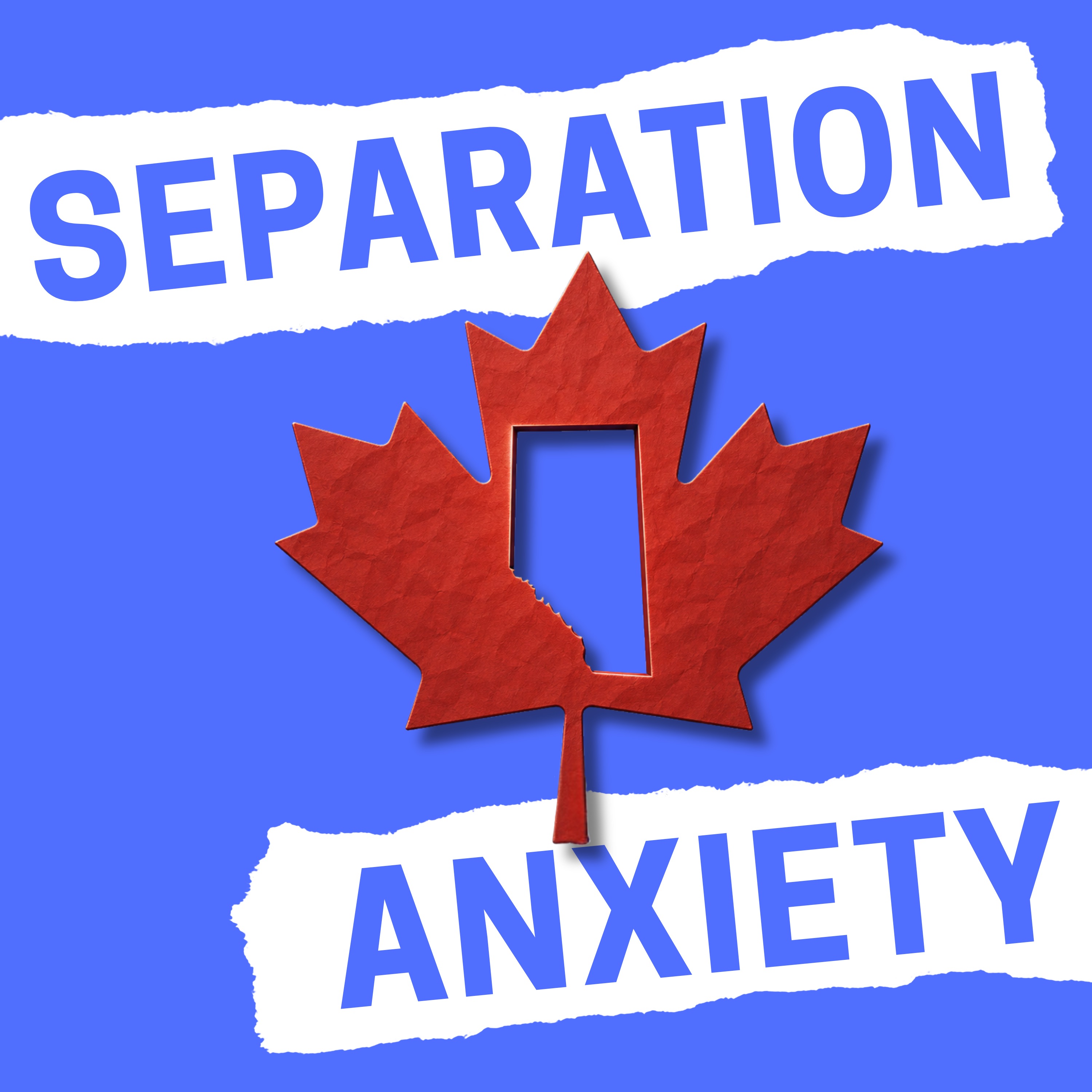
Hi there, I hope you're well. We're working on the next episode, but in the meantime, a bit of a treat for you. A couple of weeks ago, I told you about a new investigative podcast called Separation Anxiety, the Alberta Referendum, which Canadian True Crime has proudly helped to fund and support. Well, today I am so excited to share the entire first episode, completely ad-free, for Canadian True Crime listeners. It's important to me to boost this important grassroots journalism about an issue that has implications for all Canadians. And with only 10 days to go until the referendum, the story has only become bigger.
In the last week, Canadians learned that Alberta separatists had traveled to Washington, D.C., looking for U.S. support, floating possible deals involving Alberta's oil and fresh water, according to the Globe and Mail. We also learned that separatists have been getting advice from Republican strategists in the U.S. about how to find more supporters and get them to vote. We learned that First Nations leaders have been organizing voter registration drives and rallying support of their own, with a warning that if people don't make their voices heard by voting, others will make the decision for them. And sure, the polls say separatists are not the majority, but low voter turnout in the province I live in has resulted in a situation that is not at all optimal, so it's something worth understanding and paying attention to. And also this week, a separatist party won the Quebec provincial election.
So this whole separation thing is about much more than provincial politics, and what makes the investigation by award-winning journalists Danielle Paradis and Tim Queringasa for separation anxiety so interesting. They spent the summer traveling around Alberta, meeting the ordinary, everyday people who want to leave Canada, listening to their frustrations, their hopes, and their reasons for believing independence is the answer. But there's also a bigger picture. How did this movement gain so much influence? Who's helping to drive it? And what could all of this mean for the rest of the country?
Just want to clarify that this episode is not a replacement for our usual Canadian true crime episodes. We're sharing it ad-free because we are proud of the independent journalism behind it and we love for more people to hear what has been uncovered. So here is episode one of Separation Anxiety. It's called Among the Separatists. I hope you find it as interesting as I did because episodes two and three are available now. See the show notes for more information about how to listen and subscribe. Thanks again and I'll see you soon.
If you put it in terms of prosperity, Canberra is our adversary. What it would mean to be an Albertan is the opportunity to have a dream and go after it together. If we didn't have to give like 330 billion is the last closest numbers I've read. We have a path. And the path forward is a free and independent Alberta. I want to talk to those who are on the fence. Those who are still not decided. Longing for the nostalgia of the Canada that they wish was still alive. Canada they grew up in.
This is separation anxiety. On October 19th, Albertans will find 10 referendum ballots in voting booths. One will ask if the province should hold a binding referendum on whether to leave Canada. I'm Tim Queringesser. I'm an independent journalist who's written about Alberta politics for 15 years. I'm Dani Parody, an independent Métis journalist who covers Alberta politics and Indigenous issues. I'm also an assistant professor at McEwen University in Edmonton. Now, Tim, we've always collaborated as journalists. Our brand is to look at Alberta a little bit differently than others. We have, and Dani, you've gone on to create award-winning podcasts without me, like the place that thaws with APTN. But I always come back.
Tim, you write about Alberta for the Walrus, the Globe and Mail, and even international magazines and newspapers, but this is new for us. To get here, Separatists gathered more than 220,000 signatures supporting the question, do you agree that the province of Alberta should cease to be a part of Canada to become an independent state? A provincial judge quashed the petition because the province had a duty to consult with First Nations, but they didn't. Alberta Premier Daniel Smith then created a new referendum about whether to hold a referendum, but it isn't binding. Smith says a majority vote will trigger a full-fat referendum on separation. This is Episode 1, Among the Separatists. Part 1, On the Bridge.
There's a group of about 15 separatists standing on a bridge here, a small one overlooking an Edmonton freeway waving flags. Looks like it's just Alberta flags. Drivers on the freeway below are, most of them in big trucks are honking, giving them kind of support, and then a few people have driven by and yelled some critical thoughts. You can only kick a dog so many times before he's going to bite you back. And I've been kicked. That's Scott Russell. I found him on the bridge waving an Alberta flag. Scott's in his 40s and works as a natural gas pipe bidder in Edmonton. That kicking he talked about is people who called him a Nazi a few years ago. He said he spoke out against vaccines and COVID-19 lockdowns on Facebook. Scott told me he's unhappy about many other things too. Immigrants are a big one. He said they're drowning Canada's healthcare system. But what pushed him to become a separatist?
What's actually going on underneath is that the rug's being pulled out from under us. All the prosperity's being pulled out from under us. It's costing people like a lot of stress. I can't put a number on it, but every dollar you have to spend in taxes that you don't have or every time you have to like... not do something with your kids or make hard decisions like it takes a very massive toll on your health and your kids out and then what do they think about the future and like just plot this out 10 years down the road they talk about three four percent inflation i'm sorry but like you look at groceries five years ago you look now like a hundred dollars of groceries barely gets you like a day's food when you have three children like it's very difficult to afford that and still have their recreational activities and clothes and school supplies right and play that out 10 years and see what happens so then again what what about being independent and disconnected from canada as an independent state would make that better like well Alberta, if we didn't have to give, like $330 billion is the last closest numbers I've read about equalization payments. I'm sure a lot of that could go back to a tax cut for the middle class. So I checked some facts here. The closest number I could find was $321 billion. That number is from the Fraser Institute, and it calculated Alberta's net contributions to the federal government's treasury over the past decade.
So hold on. Did Alberta just give Canada $321 billion? The Canada Revenue Agency, everyone's best buddy, collects income taxes for the province and feds. From that pot of money, the feds redistribute money to provinces and territories, and they do it through something called transfer payments. Alberta receives transfer payments yearly, but what happens though is Alberta usually doesn't receive what's called equalization payments. Those payments see Canada redistribute taxes collected from provinces that have a lot to provinces that don't. Is that why you hear separatists almost universally say we're funding the rest of the country? Yeah, I think that's a fair assessment.
I also talked to Dennis Young on the bridge, and he also talked a lot about money. If you ask this one directly, I think I should ask more directly. So some have suggested you guys hate Canada, and then some have suggested you love Canada, but just the earlier version. So love or hate, which one? If you define Canada, you know, what part do you want to look at? If you put it in terms of prosperity, Canada is our adversary, and they are our adversary of every other province except Quebec. You know, Trudeau said Quebec is Canada. So according to him, we're sub-Quebeckers. And yeah, as far as prosperity, Canada is our adversary. We would be wealthier without being Canadian.
Is there a part of Canada you do like? Oh, I've lived across five, six provinces. And I was in Newfoundland when they shut down the fisheries and allowed the Spanish to come in and drag net. So, I mean, it's just more proof. They're doing the same to Alberta by basically scraping our oil out and telling us how much we can drill and all that as they did to Newfoundland. It's by design, it seems. You know, higher taxes, crappier jobs. And it is an attack on our prosperity. And they are our adversary. It's just relevant.
Another thing that often comes up at sovereignty protests is kind of ironic. It's a love for Canada. What? They love Canada? Yeah. Scott loves what you might call old stock Canada. He explained this by telling me about his recent stroke. He said he ended up in hospital and he said it felt like the nurses and doctors there had to meet cost quotas. Like the Canadian system was threadbare and didn't see his life as valuable anymore. I mean, I would ask you, what do you consider Canada? Like the country, the land, the people? I love it. But like the federal government and the system? You are darn right that I hate the guys who hate me and who literally want me dead and have said so in so much.
And have their health care system, the paid professionals have literally asked me, like the one time I've been in and needed medical care. Oh, do you want to be resuscitated? Or do you want to just die? Like, no, man, I'd rather live. The people who are coming after me, I'm coming after them. And I'm not afraid to let them know that. And I'm like, I'm sorry to say it, but I think we need God. I'm not sorry to say it, actually. But my brother-in-law asked me, are you a Christian nationalist? Yes. Like, this country is a nation. Like, where's our nation? Like, where's Alberta's nation? Everyone else gets to have a nation. Everyone else gets to have their heritage. Where's my heritage? Well, it's in Alberta.
Okay, so we heard a lot there about healthcare, the cost of living, and how Scott doesn't recognize Canada anymore. And how religion is mixing in this for him. Yeah, and I think it's interesting to note that the lead organizing group for the current separatist movement is called the Alberta Prosperity Project. And we also heard from Dennis what many might already know about Alberta separatists. That they feel Alberta gives more to Canada, and especially to Quebec, than it gets back. Yeah, Quebec is ever-present in Alberta separatism discussions. I thought we needed to hear more from separatists. So I went to the Whistle Stop Cafe in Mirror, Alberta, about an hour and a half drive from Edmonton.
Isn't that the cafe that was at the heart of the trucker convoys in 2022? Yes. Producer Amanda Erickson and I went there for Alberta Day, the province's birthday. So Whistle Stop Cafe, convenience store slash restaurant. And what are you seeing over there, Amanda? Big trucks with huge Alberta flags on them. There's a little tent where I'm assuming they're selling what looks like, I think, like merch tent almost. I haven't seen the sign before. It says Free Alberta from Overreach or F-A-F-O.
The event kicked off with Ben Crane, a singer-songwriter from rural Alberta. It was a small event. There were at most 20 people, including volunteers. I want to introduce to Ben Crane. He's going to do a little speech and play some music for all of you folks. Thanks for coming. I'm thinking today is a celebration day, not a complaining day.
So we all know what the issues are. I also talked to Patty Vold, who works with Chris Scott, the owner of the Whistle Stop. She goes on the bus tour. I'll let her explain it. So tell me about this bus. Well, he bought a motorhome and we got it wrapped and we're going all over the province. We leave tomorrow morning at 8 o'clock and we're starting out in Farentausch and I can't tell you where we're headed after that. And tell me what the bus looks like. Well, it's like the Alberta Crest. It's basically wrapped in the Alberta Crest. And it's absolutely beautiful.
The golden weed and the mountains and the hoodoos and the... Yeah, it's beautiful and it grabs people's attention. They know who we are. Just so everyone's clear, a wrap is a vinyl graphic decal that you wrap onto a vehicle. Yeah. And Tim, who is the most hated name in Alberta right now? The names Justin or maybe Pierre come to mind, but definitely Trudeau. Well, I met a distant relative of theirs in rural Alberta. His name is Benoit Trudeau. So firstly, though, is it true that you are like the third cousin of Justin Trudeau? No, no, no. We meet at the first Trudeau who immigrated in Canada in 1648.
So when I do my family tree, so that guy was named Etienne Trudeau, and he has six boys and five girls, and Justin's from the oldest boy. I'm from the second one. So Benoit has been making the independence barbecue circuit. And then what brought you up here? Politics. Benoit has written a book about why Alberta should be more like Quebec. Alberta needs to understand what it is to be sovereign, and politically, I believe that Alberta has a very apathic political atmosphere. I believe, sadly, that there are very few Albertans, including the political class.
know how to handle the Westminster system in their advantage. I believe that there's a lot of missed opportunity. I believe that they are way too subservient and way too eager to deliver a ship with Ottawa. So essentially, Alberta should behave like a sovereign country, take back control of the police, money, even insurance just like Quebec. I've heard that argument a lot from separatist organizers, and we'll hear from one of them when we come back.
I'm an Alberta girl. This is where I was born. It's all I know. It's everything that I love. Northern Alberta, by trade, is how I like to say it. That's Kathy Flett. She's the co-creator of the Alberta Women for Independence Network. What's that? She started this group to talk to women about Alberta separating from Canada. She came to our studio while the petition for a referendum to separate was still on. Kathy, why do you think that women weren't feeling connected? We have a very strong female premier. We've had a lot of women in politics. What was that gap, do you think? The gap that we discovered for women is that we like to fix things.
So yes, we've had strong women, but in all of those positions, they were trying to fix things. Even our current premier, right, with the MOU, trying to fix things, trying to bridge the gap. Our challenge, and challenge accepted, was to help women understand and see we can't fix it. Confederation isn't broken. It's working exactly like it's designed. And there's nothing we can do other than remove ourselves from that which isn't working for us. And that was when it clicked for us to get that message across. We can't fix it.
Kathy grew up in oil country, Peace River, which is four hours northwest of Edmonton. And growing up in an oil and farming family shaped how she sees the world. You heard things, right? You heard family or adult friends or whatever talking about things. And you always sort of had this curiosity of what was going on. And particularly in the 80s, even as a kid, you didn't know what, but you knew something. Something just didn't feel right. And then in my teen years, I ended up moving in with some family members and they had the Alberta Report. And oh my lanta, did I not get an education off of that? More so than I would have ever gotten in school. And that really began to formulate.
It sort of filled the gaps in for me. I wasn't necessarily a great student and I certainly didn't really care about politics. But what I was learning in school and what I was seeing in practical terms didn't match. And I had no wisdom. I had no nothing. I was just a kid. I didn't know how to put that together. But reading that Alberta report helped put that together. It helped sort of bridge that information gap that I had. And that's when I thought, oh, man, this is not working for us. I don't know why. I don't really know how to explain it. I just know that it's not working for us. And then I ended up in my later teens and early 20s and a mom and flying all over the place with kids and all of that and lost my way on anything. Politics, really paying attention and voting, but not organized in any way, shape or form.
Landed in McMurray. That's actually where both my boys were born. So again, surrounded by oil. Like that's what put shoes on our feet. That's what made sure my babies were fed. Like this is what we worked in. And feeling that tension that how dare you be proud of having so many amazing resources here. And how dare you be proud of how those resources are blessing you. And that didn't feel right to me at all.
So if people don't know the Alberta report, there's this mythos about the publication. It was this deeply conservative weekly that was almost like required reading for those who worked or cared about Alberta's resource economy. Yes, and it sounds like it was really formative for her identity as an Albertan. So we asked her to define what that meant. Oh, man.
Well, right now it means you're under the thumb of Ottawa, which isn't great. As our own republic, what it would mean to be an Albertan is the opportunity to be able to have a dream and go after it again without worrying about somebody in Ottawa deciding, no, you can't do that because we said. What it'll mean to be an Albertan is to have the freedom to have a choice of schools or have choice of health care without Ottawa saying, well, we're not giving you your money unless you do it our way for those programs. What it will mean is to be able to be on the world stage and proud again. Cathy told us that a new Alberta would use its oil wealth to build deals with other countries. It wouldn't be afraid to turn off the taps, so to speak, in order to get what it wants. But when you look at a map of Alberta, Tim, we're landlocked. Yeah, and you can imagine Canada having a whole lot less interest in having a pipeline from an independent Alberta running through its territory to get to an ocean. That doesn't faze Cathy. When I asked you about how you would negotiate or how you would get things done as an independent country, you talked in ways that sound familiar to, let's say, some of the petrostates. Well, we will be a petrostate. I mean, we've got...
the third largest oil reserves. So we will be that. But the rest of Canada needs to know that we now have the power to go there if we need to. And we will. We're not worried about it. We're not apologetic about what we have. And we're not apologetic about what we know we can supply the rest of the world with. And so we're not going to be stopped with being able to supply the rest of the world with what we have. Now, that doesn't mean we can't be great neighbours. It doesn't mean that, you know, suddenly EB has a change of heart and says, oh yeah, you know what, maybe a pipeline to the coast isn't a bad idea after all. So Cathy's premise is that without the rest of Canada dragging Alberta down, people would pay less tax. And instead of sending that money to Ottawa and Quebec, life would be affordable.
So where do First Nations fit in this new version of Alberta? Every inch of this province, as you know, is treaty land. Well, we talked about that too. Kathy, you mentioned First Nations. So what's your pitch to a First Nation person if, like, say they live on a reserve? What would you say to them for why they should join separation?
I can one-up you. What do I say? Because they do come out to some of these events or will connect with me in various other ways. As far as I can tell, it's not really working out for them well either. It's been a terrible experiment for what the First Nations have had to deal with. And what has been really interesting is they are coming out and they're signing this petition. So they recognize that as well. And it's an excellent opportunity for all of us to be able to have a do-over.
We conducted this interview during the middle of the petition, but I feel like many of the questions we raised in talking to separatists remain unanswered. But Kathy, she's not worried. No, everything's figureoutable. When you... That's my new word. I made that up some months ago. It's all figureoutable.
So Tim, something keeps coming up in conversations we're both having with people. Christian nationalism. I hear that phrase a lot when talking about Alberta, but I'm never quite sure what exactly it means. How does it keep coming up in your conversations? It's that people are wondering what role Christian nationalism plays in the Alberta independence movement. So did you figure it out? I spoke to two people to help me. First, I went to the Fairview Baptist Church in Calgary. A just society. A society that is marked or known by righteousness.
Can I just get you to say and sell your name for me? My name is Tim Stevens, S-T-E-P-H-E-N-S. Where did you study to become a pastor? A few different places. So I have my undergraduate degree at Queen's University in engineering. And then after becoming a Christian, I went to Detroit Baptist Theological Seminary, my Master's of Divinity, and then received my doctorate degree at the Master's Seminary in California. So Tim, the other Tim, the pastor, is from Ontario, just like you.
And like all Ontarians, he moved here for opportunity. I can see where you're leading with this. The why do so many Ontarians come to Alberta and then join the separatist movement question? Yes. Let's hear from Pastor Stevens. I was born in the Ottawa area. Okay. And when did you make it out to Alberta? I've been out in Alberta as soon as I finished university. Came out here working in the oil and gas sector. So 2004. For most of my adult life. Actually, you may have heard of him. He was arrested for defying COVID restrictions. In May 2021, that's kind of when you started making media appearances, let's say. And that was after COVID. Can you tell me about that time?
Yeah. Well, our church was just humming along and doing what normal churches do, gathering together to worship, I was preaching. But we became convinced very early on during the pandemic that meeting together was important. And that it wasn't going to be the health risk that everyone was warning about. And so we decided to meet without fanfare. And we were doing that for a long time until different people in the community realized that we started growing. And so complaints eventually led to tickets and court orders and enforcement. And eventually I was in jail for three weeks during that time. And I sought to use that as an opportunity just to explain to people why it is what we were doing. I think that was important. And he says that time really made things clear for him. What was it like being in prison for three weeks? Where were you?
Well, I was at the Remand Center in Calgary. And being in prison for three weeks is, the best way I can describe it to someone who doesn't have that experience, is like a major culture shock. You're in a very, very small and confined space. You have little privacy, you know, even using the toilet, something that you think you go get privacy. None of that is there. So all of that is shocking to the system. Then we got to the reason I was there.
Alberta independence. So you've had some posts on your website. One of them was like how Alberta independence matters to the church. That's right. No, I think it's important that as the church or people of faith, people who have the word of God, that we're conversant with the topics of today. There is a misconception that the church basically just deals with spiritual issues, matters of faith, the things that are between people's ears, and should stay out of the lane of politics or conversations that are in the public. So in our modern age, they would see the church or the pastor really is out of his lane if he's talking about issues in society today.
which I think is more of a radical view. So Tim, other Tim, is originally from Ontario but is now in Alberta and wants to separate? Yes, I pointed that out to him and he didn't flinch. But I wanted to know what he's actually asking for because he told me an independent Alberta would have to be built on Christianity. So your view of a new independent Alberta then would be based on...
Christian ideals or Christian? I think there could be no other way. There's many libertarians who are arguing for Alberta independence, but as far as I know, no libertarian ideology has ever formed a country. The values that people in Alberta are longing for are Christian values. And so if an independent Alberta is not rooted in the same Christian virtues as what Canada and the U.S. and other Western countries, formerly Christendom, if they're not rooted in those values, then it also won't survive. This is not just a matter of pipelines or economics. I think the root issue is what's the heart and soul of our province or our country.
I needed him to be more direct about his ideas for a Christian nation. Founding a nation on Christian ideals, these days, that's going to read to people like Christian nationalism. So do you identify as a Christian nationalist? Well, it depends. That term was coined as a pejorative term. And so I wouldn't take that label from someone who sees that as the boogeyman. But if you were to ask me, you know, are you a proponent of nationalism or globalism? And I would say nationalism. I want it on a local government rather than somebody, you know, in Belgium running my life. So I want a local government. And then for the Christian adjective, well, do I want a Christian nationalism? Do I want a pagan one? Do I want an atheistic one? Do I want a Marxist one? Yeah, I want a Christian one.
Danny, I feel like that's a response that's built out of reductions. We're not Marxists. We're not pagans. We're not atheists. We're not globalists. What we are are Christians who believe in a nation. Yeah, he was careful about it. He drew a line around the version of Christian nationalism that he doesn't want. I do want to live in a Christian nation. If that's what people mean by Christian nationalism, then I'm okay with that. But in many people's minds, Christian nationalism is almost like Iran, where you have these Muslim clerics running the government. Some people with Christian nationalism think, hey, we need a Christian prince who's going to come in and clean house, bring a top down. I don't believe in that.
I think any Christian nation will emerge through the success of the Great Commission, making disciples of the Lord Jesus Christ, teaching them to obey all that Christ has commanded. So Tim Stevens is one pastor leading one church with a congregation of 400 people in southeast Calgary. I wanted to understand what his version of nation-building might mean for everyone else. So I called someone who studies this. Can we just start with you saying and spelling your name, please? Sure. Michael DeMoore, M-I-C-H-A-E-L-D-E-M-O-O-R. My full proper position title is Associate Professor of Social Philosophy in Politics, History, and Economics. You really don't need to say all that. You can just say teaches politics at the King's University. King's is a small Christian university in Edmonton. DeMoore is a political theorist. I study Christian social thought, and I teach that regularly. And so over the past number of years, I've done some work on Christian nationalism, particularly attempts to make Christian nationalism intellectually respectable.
or by folks who try to articulate its theological foundations in a sort of rigorous way. They're never fully successful at it, but that's one of the things I study. I have a clip I'm going to play for you. Scripturally, we have these different spheres of authority. The family, we have the church, we have the government. There might be others, but those are the essential ones in society. So going through COVID and getting that solid in my mind helped me, and even understanding the history of both Alberta and our nation, helped me to understand that what we saw during COVID was really an example of where our country has already gone as it's moved more progressive, as it's moved more radically secular.
And what I found remarkable in what he said there is he went from talking about those spheres of authority to talking about where we're going collectively as a nation or as a country or something, right? The power of understanding these different spheres of authority is that you precisely sort of say, well, they have different callings, they have different natures, they have different tasks. And as a result of that, it may or may not matter that much to what extent the government of your country is openly proclaiming Christ as long as it's doing its job. However you conceive of its job, it's pursuing public justice, it's keeping the public safe, it's creating a safe business environment, whatever it is that you may. considered to be the fundamental task of the state. And so what's remarkable there is it still has a sort of vision that even if you have these different spheres of authority, the concern is about where we are going collectively and with who we are collectively and how secular we are getting in a broader sense or whether we collectively are drifting. And that's different from a lot of those more, if you will, pluralistic understandings of these different callings of different tasks and so on given to different social bodies. And that's what sort of crosses into, oh, a sociologist might say, that sounds like Christian nationalism to me.
So, Danny, I think we've established that some in the Alberta independence movement are Christian nationalists. I'm curious, though, why that matters. Like, does it change anything for the rest of us who are not Christian nationalists? I think the best way to answer that is to go back to what you asked earlier. What is Christian nationalism? Let's hear it from DeBoer. Christian nationalism, at its broadest, most sweeping use as becoming more and more common, is just the way in which people who aren't part of that tradition identify conservative Christians as they orient themselves towards politics. In the 80s, we called them the religious right. In the Bush II era, people called them theocons.
Now we call them Christian nationalists. Demore is careful with the term. He worries it's getting stretched to mean any conservative Christian who votes. And he points out that Christian nationalism is not new in Canada. Why did the Canadian government, when it decided it had to assimilate Indigenous people, turn residential schools over to churches, primarily to administer and run? Because the understanding was becoming Canadian had to mean becoming Christian. And that was part of becoming a Canadian and therefore building a Christian nation and keeping it on track.
So Demour is a Christian who teaches at a Christian university and goes to church. Does he then support a Christian state? No, he thinks a Christian state would be a mistake, and there's a theological reason for that. I don't mind saying I'm a Christian, but I'm not a Christian nationalist. I think it's a profound theological error to think that a state itself ought to be Christian and show any partiality for Christians. The state's task, as understood in my theological tradition, is to do public justice. In other words, to create the conditions under which all of its citizens can thrive, can exist freely, to create and maintain public services and infrastructure, and that...
crucially, are there to protect the vulnerable. So the Old Testament repeatedly has this framing, the widow, the orphan, and the stranger, right? And it's precisely that concern that is present throughout the Old Testament and therefore carried into the New Testament even more radically. So then I asked him the question that's on many people's minds. Is Alberta separatism a Christian movement? My inclination is to say that that's not what's driving the boat. There's a lot of Alberta separatists who are Christians. There's an important part of the separatist coalition. Any movement of any size is always a coalition between people doing it for different reasons and with different names.
some of that separatist coalition is doing it because they're Christians, right? Like that's their primary motivation. But overall, my diagnosis, and I've kind of alluded to this for a while now, is that separatism is fundamentally driven by frustrated partisanship. What does he mean by that? He means people who win politically in Alberta and lose in Ottawa over and over until leaving the country starts to sound reasonable. This is a little bit too simplistic, but I think it's generally true. If the conservatives had formed a government federally after the election of 2021, we would not have a separatist movement that has anything like, we wouldn't be making a podcast about separatism right now.
There's a lot to digest there about Christian nationalism, but also just straight-up nationalism. What do you mean? Well, I think the part I'm struggling to understand is the nationhood part here. How does feeling your prosperity is being restricted or values are changing or that there should be more Christianity in our day-to-day lives? Like, how has that coalesced to seeing a quarter of Albertans believe that we are a nation? I suppose I get that political means always seem to fail. Alberta votes conservative, the rest of Canada leans liberal. But still, can a nation be created from grievance? I mean, unity built on grievance hasn't worked for the political parties of Alberta, who fight and separate from themselves every 10 years or so.
Join us for the next episode, where we talk to someone who literally wrote the book on separation. Separation Anxiety is produced with the support of the Canadian True Crime Network. We release episodes weekly. Make sure to like, follow, and subscribe. And follow us on our sub stack, separationanxietypodcast.substack.com. If you have any feedback, send it our way at separationanxietypodcast.com. See you next week.