N-P-R. This is the indicator from Planet Money. I'm Adrian Ma. And I'm Ricky Mulvey. And Ricky, if I asked you what class you consider yourself, like are you upper class, working class or middle class, what would you say?
I'd say I'm a part of podcasting small but mighty middle class. How about you? Small but mighty, that is us. I also consider myself middle class and maybe that's not a very original answer because according to a Gallup survey, 54% of Americans consider themselves middle class. Let me ask you this, Ricky, how much money do you make?
It's a pretty personal question for a very public podcast is what I would say. Don't worry, it's just me, you and our listeners here. I make somewhere between $10 and $10 million is what I would say, just to give you a fair range estimation. Okay, well, thank you for narrowing that down for me. I think you might detect just a slight change in the air when I suddenly ask that question because frankly, in our culture, talking about income is taboo.
We worry about others, so think of us if they really knew how high or low on the income ladder we sit. But Pulitzer Prize winning data journalist Mona Chalabi thinks that we should all be more open about this. I think that money should figure much more prominently in intersectional identities. So someone like me might sit here and say, you know, as an immigrant and Arab cis hetero Muslim woman, but like, okay, well, how much money do you have? Because I would argue that actually my money has potentially shaped my outcomes in life far more than any of those other labels.
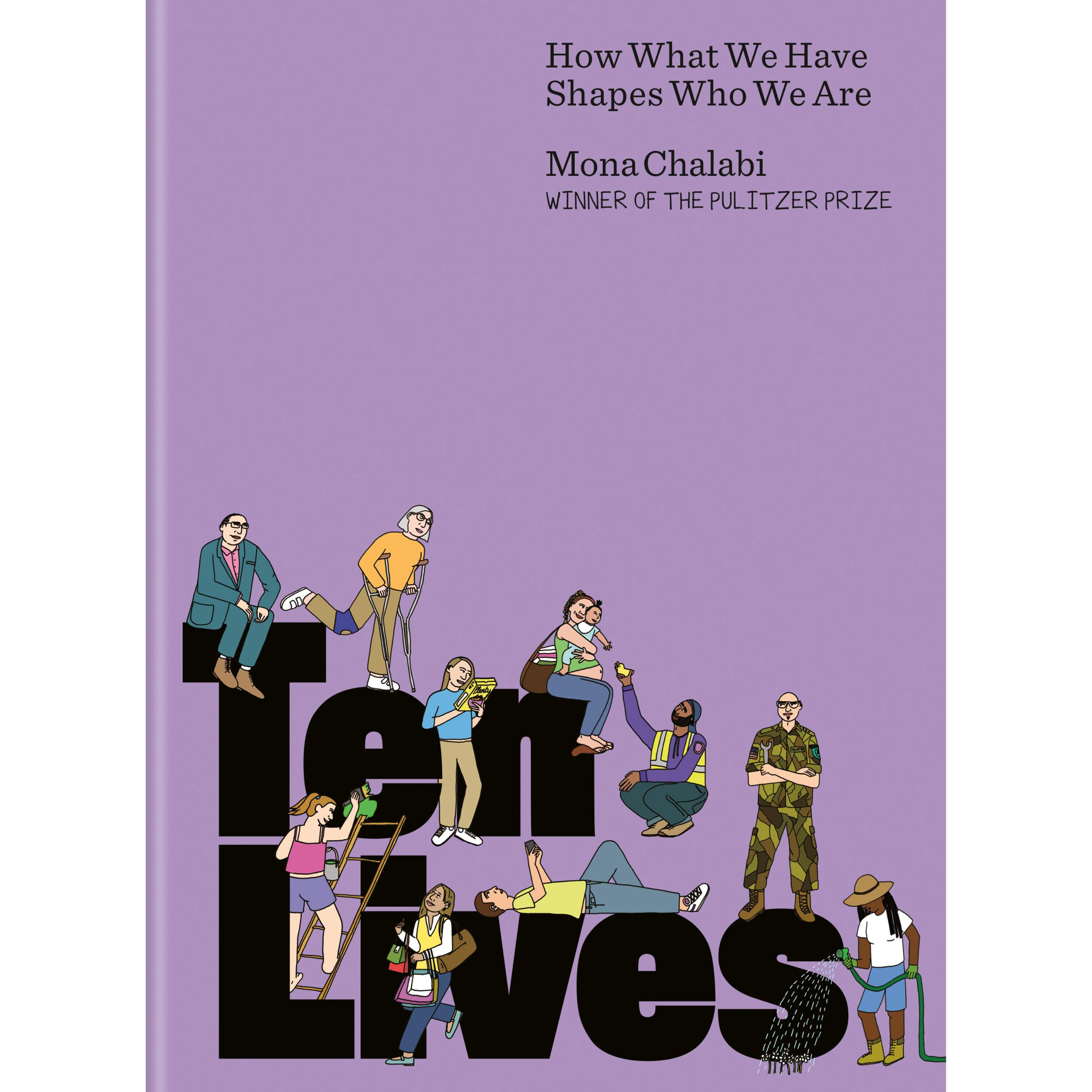
This is why our personal relationship with money is the subject of Mona's upcoming book. It's called 10 Lives, How, What We Have, Shapes, Who We Are. In her book, she uses interviews, statistics, and a ton of hand-drawn charts to paint a detailed portrait of class in America. After the break, my conversation with Mona. She tells us what she learned from asking 10 strangers all about their financial hopes and fears, and she argues why we can all talk a little more frankly about our own money situation.
Midlife brings a lot of changes. Your turn with Alice in Aubrey is a new podcast to help you navigate the twists and turns. From health and relationships to creativity and purpose, we can help steer your next chapter. With your turn with Alice in Aubrey, find it on the NPR app or wherever you get your podcast. Support comes from NPR sponsor AARP.
It's election season, which is an easy season to doom scroll, but it can be a hard season in which to find valuable information. NPR can be your source where a nonprofit that relies on your support, which means we can act and report in your interest. With NPR Plus, you can hear dozens of NPR podcasts, sponsor free, all while powering our independent newsroom. Sign up today at plus.npr.org. This election season, let the NPR Politics Podcast save your time and your sanity.
We'll help you understand key races, which polls you can safely ignore, and what might happen if power shifts in Congress. Our short daily episodes come out every afternoon so you can spend less time scrolling through each chaotic news cycle. Make NPR Politics your hub for midterm election coverage, follow our podcast on the NPR app or wherever you get your podcast. The idea for a book about class in America came to Mona during the early pandemic. Two things happened at the start of COVID.
One was that I started to anticipate that an economic crisis might happen and I thought it would be worth writing a book about that. And then the other thing was that something weird happened in publishing where people got very nice book deals. So I also wrote this book because I was paid a lot of money to write this book, which I know is quite uncomfortable for people to talk about. You want to believe that writers are motivated by higher ideals. But yeah, that definitely played a role.
Mona says she was motivated by getting paid $850,000 to write the book, which she considers to paraphrase her term, a buttload of money. And this sort of sets the tone for her reporting that she lays out in the book. Over the last few years, Mona followed 10 Americans with very different jobs. For instance, one is a man who makes over half a million dollars a year working in finance, another makes 30k a year working in an Amazon warehouse. And each of the 10, they come from a different income decile, which is to say, you know, you've got Tiffany, who's income puts her in the bottom 10% income-wise.
And then if you go up the ladder a little bit, you've got Christina, who's around the 50th percentile. And at the top, you've got somebody like Jacob, who's in the top 10%. What did you mean to accomplish by structuring the book this way? Some of it was a frustration with the existing conversations around income inequality. I felt like all of the conversations about the 1%, they were scratching our itch to feel angry.
But I don't know how much they were achieving in terms of policy or actual systematic change. And I think that those conversations around the 1% kind of enable sometimes the rest of us to hide and obscure our economic identities. Do you feel like Americans are, because you grew up in the UK, right? I did. And I've been here for a long time now.
I've been here for 12 years. How do Americans compare with the English when it comes to talking about class? It's a good question. I mean, when I moved over here, I feel like actually the conversations around class are very, very limited. There's much more sophisticated conversations around race.
But when it comes to class, most people are piling into this middle class label regardless of their bank balance or their annual income. And I think that's fundamentally a type of dishonesty. I think people aren't being frank with one another about their economic circumstances. But the subjects of Mona's book do get pretty frank, opening up about their incomes and their debts and the money they spend on everything from their house to their handbag to their gambling addiction. One of the interesting things I took away from reading the book was that wherever you fall in the income ladder, even if you're at the very top, it seems like everyone has fears and anxieties around money.
Yeah. I'm surprised. I think these pervasive feelings of insecurity are a direct consequence of this particular capitalistic system where you imagine a certain needs. Like, you imagine that you need to die even if you're in a healthy body. You imagine that you need to more close even though you're close.
It's for one. But we'll see if some of it is real. By real, partly what Mona means is that the essentials of life are expensive. Housing and healthcare are expensive. And life is unpredictable.
For example, in the first chapter, we meet Anna. Anna married a man who comes from an incredibly rich family. And someday her husband will inherit that wealth. And she says she feels like she'll never have to worry about money ever again. But then her and her husband divorced.
And now for the sudden she occupies a completely different place in terms of economic security. A divorce, an emergency medical bill, a job loss. Throughout the book, we see how these really common events can become life-changing setbacks. This commonality of insecurity, I think once we really, really harness that technology, it can be quite a powerful tool for change. So, for example, Mona says she wants to prompt people to think less negatively about their relationship with taxes and the government programs they pay for.
Although that raises another issue. So each of these ten individuals, if I were to ask them which government programme do you think needs to be funded differently? We'll have a different answer. There's someone who's going to really care about the Department of Veterans Affairs because he has a veteran. There's someone who's going to really care about health care because she has a surgery.
And all of those voices matter. Part of this book also tells the story of your relationship with money. And you get pretty transparent, like you present detailed charts about your income and talk about your own ups and downs. Tell me about the decision to weave yourself into this story. I just couldn't write the book without doing that.
It's completely intellectually dishonest to be saying, everyone, come and speak to me for hours and tell me all about your economic circumstances. But I'll just be this like kind of omniscient view from nowhere. So yeah, I had to share all of these details. I kind of hated it. It meant that the book is really, really part memoir because it's also not possible for me to just tell you my bank balance and how much I've earned last year full stop.
It's like, well, no, I actually have to tell you how many people in my family I'm supporting. And actually if I'm going to do that, then I want to tell you also about the economic circumstances I grew up in. So it just kind of becomes this unravelling that I'm sure I will regret because it feels very, very vulnerable. And it does kind of feel like I'm in a room full of strangers and I'm the only person who took my clothes off. But it's fine.
When people read the book, how do you hope people are changed by it? Honestly, best case scenario, people actually talk about class in much more honest ways with their friends, with their family members and with their co-workers. And they get much more granular rather than hiding behind these big convenient labels like middle class. Timona, conversations about income inequality today often focus a little too much on another label, the rich, the millionaires and billionaires. But she thinks that kind of lets the rest of us off the hook.
Again, I want to move away from this 99% versus 1%. I want us to have much more frank conversations about our relative economic power. And maybe that starts by all of us just talking a little more openly about money. Timona Chalaby's book is 10 Lives, How What We Have Shapes Who We Are, and it comes out in November. This episode was produced by Julia Ritchie and engineered by Quacy Lee.
It was fact-checked by Sierra Juarez, kick-canoes are editor and the indicators of production of NPR. Midlife brings a lot of changes. Your turn with Alice in Aubrey is a new podcast to help you navigate the twists and turns. From health and relationships to creativity and purpose, we can help steer your next chapter. With your turn with Alice in Aubrey.
Find it on the NPR app or wherever you get your podcasts. This fall, there are a lot of movies and TV shows on tap for you to see. And we're excited for all of it to arrive as you are. Talk culture happy hour, we've got a guide to what's worth keeping on your radar. Listen via the NPR app or wherever you get your podcasts.