
EPISODE · Jun 21, 2026 · 8 MIN
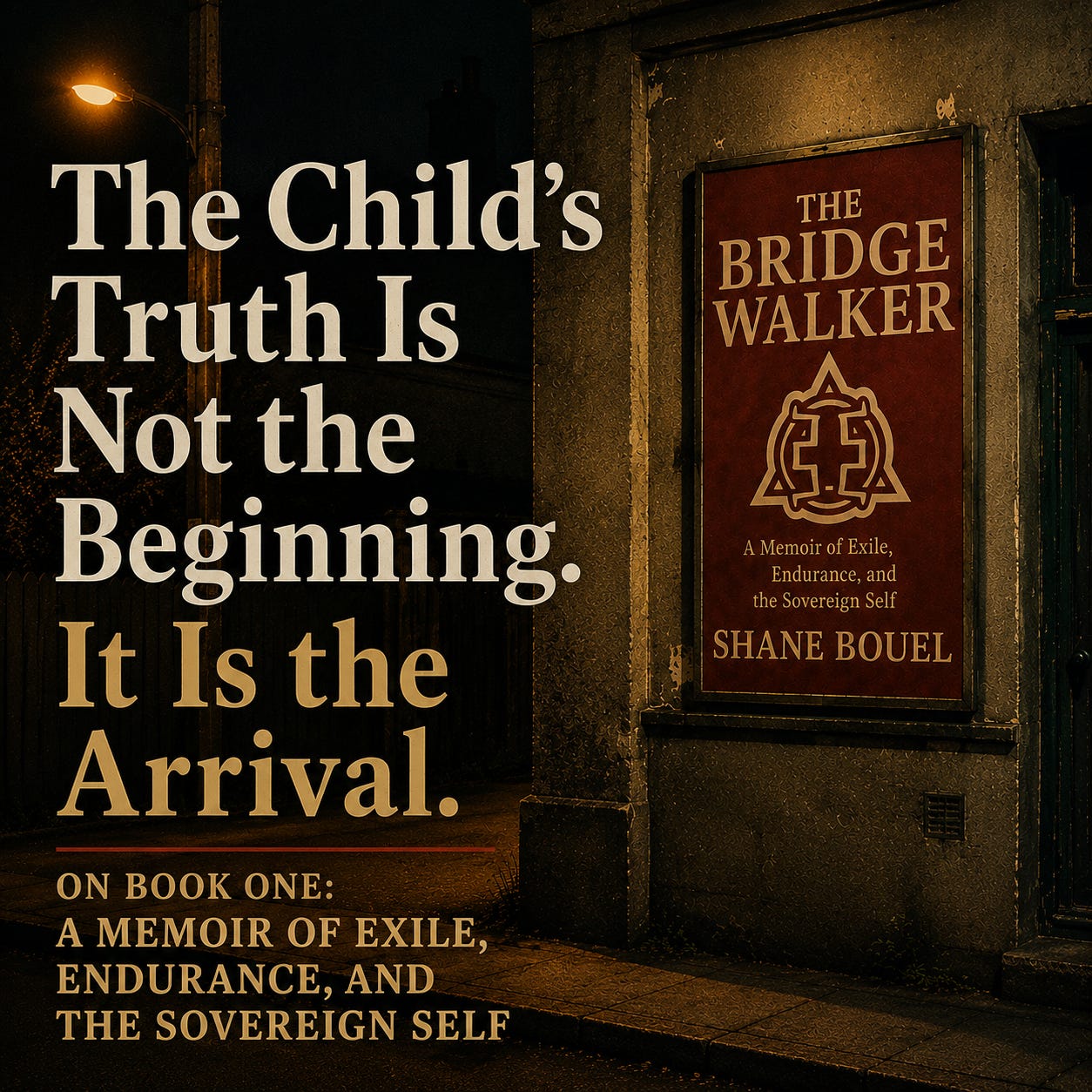
The Child’s Truth Is Not the Beginning. It Is the Arrival.
from The Experience of Adoption · host Thoughtless Delineation
By the time you arrive at Book One of The Bridge Walker Series, you have already encountered the architecture of sovereignty and descended into the theology of the wound. Shane Bouel has shown you what he built from the rubble and explained the nature of the fracture that produced it. Only then, stripped of the distortions of pity and the false comfort of chronology, does he take you to Brisbane, nineteen seventy-two, and show you where it began.This sequencing is everything. A memoir read first is vulnerable to a particular kind of reduction. The reader consigns the protagonist to their wound, reads the survival as heroic in a way that keeps the subject at a safe emotional distance. Victim. Survivor. Overcomer. These are categories that manage the discomfort of witness rather than sustaining it.Read third in the series, after the philosophy has been laid and the fracture has been named, the memoir cannot be safely reduced. What Bouel survived is not exotic. It is a system. One that operated with bureaucratic normalcy, with legal sanction, with the active cooperation of institutions that declared themselves benevolent while engineering a child’s epistemic displacement.The Colony and Its FictionsA Memoir of Exile, Endurance, and the Sovereign Self opens with what Bouel calls the Birth Fracture. The moment of original severance that precedes memory but not body. He entered the world, he writes, not as a child with inherent continuity but as a file number, an abstract marker replacing the living reality of his birthright. What followed was an adoption into a household already shadowed by its own unacknowledged loss. An adoptive mother who had herself surrendered a child to the same system, a grief never named, a wound that had no language and therefore no limits.He was present yet absent, rescued yet wounded. An undecidable being in a world that demanded clear, singular definitions.The memoir traces what Bouel calls the three half-lives. The pre-adoption void, in which the body carries knowledge of a severed connection before the mind has words for it. The fractured reality of the adoptive passage, in which an identity not his own is installed with the full authority of the state. And the search for wholeness, the long work of disentangling what was genuinely his from what was placed inside him by a system invested in his compliance.These are not presented as stages in a recovery narrative. They are presented as an ontology. An account of what it is to be constituted in a particular way by forces larger than the self, and of what it costs to refuse to be defined by that constitution.Epistemic Violence, NamedOne of the memoir’s most important contributions is its insistence on naming what happened with precision. The amended birth certificate is not called an administrative document. It is called an act of epistemic violence. A legal instrument that overwrote the child’s sovereign origin with a manufactured fiction and called the overwriting a gift. The system’s lies, Bouel writes, were not just about him. They were a collective agreement to worship hollow forms over living reality.This is where the memoir transcends the personal. Australian forced adoption is not a historical anomaly. It is an instance of a broader pattern. The colonial psychology that requires the displaced, children, Indigenous peoples, the un-homed of every category, to adopt the oppressor’s narrative of their own displacement and call it belonging. The adoptee who thanks the system for the wound is performing the system’s work for it.Bouel refuses this performance throughout. The memoir is not grateful. It is not bitter either. Bitterness is still a relationship with the wound, still defined by what was done. What the memoir achieves, with painful precision, is a witnessing of the wound that neither inflates it nor diminishes it. The child who entered Brisbane in nineteen seventy-two deserved better. The account is that simple, and that devastating.The Origin ScrollIn the internal logic of the series, Book One is called the Origin Scroll. The living record beneath the philosophy. It grounds the series’s metaphysics in blood and breath, in the specific texture of a particular childhood, in the exact weight of silence maintained by people who could not afford to know what they knew.Read in the publication order, it arrives after the reader has been prepared to receive it without reduction. Read in the series’s internal chronology, it is the root from which everything else grew. Either way, it is where the abstract becomes irreducibly human. Where the argument stops being an argument and starts being a life.A Memoir of Exile, Endurance, and the Sovereign Self is available now as part of The Bridge Walker Series.https://books2read.com/ap/nEJggv/Shane-Bouelhttps://books2read.com/b/mZyYqB This is a public episode. If you'd like to discuss this with other subscribers or get access to bonus episodes, visit thoughtlessdel.substack.com/subscribe
Embed this episode
NOW PLAYING
The Child’s Truth Is Not the Beginning. It Is the Arrival.
No transcript for this episode yet
Similar Episodes
No similar episodes found.
Similar Podcasts
No similar podcasts found.