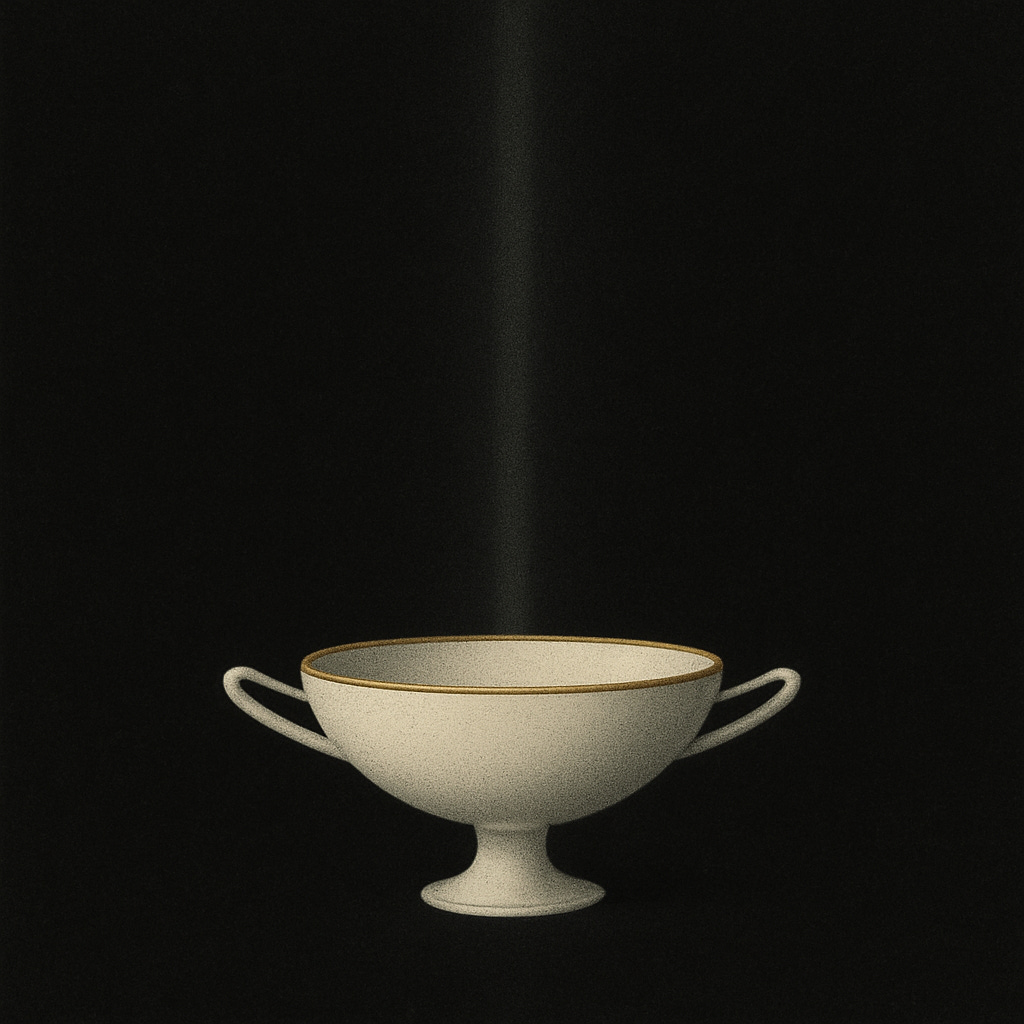
The City and the Question
from Language Matters by Elias Winter Hosted by Elias Winter
Opening — The City at War with Itself Athens had won and then lost the world. The plague ate its breath; the long war with Sparta drained its treasure and its patience; coups and restorations taught citizens how quickly neighbors could become tyrants, and how thin the line was between theater and law. In the agora—the place where the city pretended to be one mind—you could hear the fatigue behind the arguments. Offices still rotated, juries still filled their benches, the assembly still shouted itself into decisions, but the confidence that once animated the words had been spent. The city had learned how to speak louder than it could think. Into that noise walked a poor, stubborn man who refused to sell speech. He wore the same coarse cloak in winter and summer, went barefoot, and kept no school. Sophists set up shop and took fees; he took nothing. Politicians courted crowds; he courted one soul at a time, often the most important soul in the city—the one speaking in front of him. Where others performed wisdom, he insisted on something more humiliating and more merciful: the exposure of confusion. He was not Athens’ smartest man by his own account; he had simply discovered the one thing the city most needed and least wanted—to be shown where its certainty ended. The summons came, he said, from Delphi. A friend, Chaerephon, had asked if anyone was wiser than Socrates; the god replied that none was. He took this not as praise but as a riddle. To test it, he went to those who seemed wise: statesmen, poets, craftsmen. He found skill without definition, fluency without understanding, talent that mistook itself for truth. The politicians could move a crowd but could not say what justice was; the poets gave lines greater than themselves but could not explain their own excellence; the craftsmen knew their trade but carried that confidence too far. If he had any “wisdom,” it was negative: he knew the limits of what he knew. That limit, once named, became a method. Question by question, contradiction by contradiction, he made ignorance visible so that knowledge could begin. The city watched him learn to endure before it learned to listen. Years earlier, as a hoplite, he had held the line at Potidaea and Delium; he had stood fixed when others broke, and he had carried home wounded men with a calm that looked like stubbornness from the outside and discipline from within. He ate little, slept when he could, and feared less. Those habits—formed with spear and shield—migrated into speech. When men tried to drive him by threat or flattery, his composure did not move. That steadiness would matter when philosophy crossed from conversation to danger. Athens was not simply turbulent; it was split against itself. In 406 BCE, after a naval victory at Arginusae, the assembly—hornet-stung with grief over sailors lost in the storm—pressed to violate its own law by trying generals in a single mass vote. On that day Socrates, serving in rotation among the presiding prytaneis, refused to put an unlawful motion to the floor. He withstood the fury of a crowd that had already decided what justice should look like. Two years later the city fell; an oligarchic junta, the Thirty, took power. Among them was Critias, once in Socrates’ circle. When the Thirty ordered Socrates to help arrest an innocent man, Leon of Salamis, he would not move. Others complied; he went home. The gesture was small and absolute: lawless power would not borrow his hands. After the restoration of democracy, Athens swore an amnesty to stitch the city back together. It healed what it could and buried what it could not. Resentments dissolved in public and hardened in private. Socrates kept doing the only work he recognized as piety: caring for the soul of the city, one argument at a time. He asked the same unglamorous questions—What is virtue? What is piety? What is courage?—and kept discovering that confidence arrives long before clarity. He was a gadfly, he told them later, but not a nuisance by preference. The animal that stings a great, drowsy horse is unpopular for a reason: it wakes what would rather keep sleeping. He did not dress his challenge in poetry. He did not soothe it with fees. He did not protect it with a faction. He simply insisted that Athens be as good as it said it was by becoming as honest as it claimed to be. That insistence put him in collision with the city’s public face. If law is the formal conscience of a people, theater is its informal one, and by the end of the century the latter had swallowed the former. Aristophanes had made of him a comic mask in Clouds, confusing him with fashionable talkers and sky-bound speculation. The distance between a joke and a charge is shorter than a city imagines when it is ashamed and tired. In 399 BCE the city finally reached for the tools it understood—indictment, jury, sentence. The charge was simple and elastic: impiety and corruption of the young. But trials do not begin with filings; they begin with a mood. The mood was that Athens wanted harmony without examination, order without inward repair. Socrates’ life had become a standing refusal of that wish. He would not flatter, would not bargain, would not stop. The city was at war with itself, and he was the instrument that made the civil conflict audible. This is where his story must start: not with a doctrine, because he left none, and not with a school, because he founded none, but with a stance. A single citizen, stripped of titles, turning the city back toward first questions. Behind the public failure and the cup that waits at the end, there is a practice that does not change: expose confusion, honor the law, obey the inner restraint, refuse the unlawful order, tell the truth without selling it. What follows will trace that practice across the six faces by which it can be learned—against power, through method, under misrecognition, by interior discipline, in the courtroom, and in the wake he left behind—so that the reader does not merely know the life of Socrates but inherits his posture. The city will always be tempted to speak more than it can think. Someone must keep asking. Chapter 1. Against the Theater of Power Power in Athens wore a costume. It spoke in the Assembly with practiced thunder, turned wit into law on the comic stage, and hired teachers of speech to make victory sound like virtue. Socrates did not compete for that costume. He treated public power as a test of private integrity and answered it with three instruments: knowledge of the law, obedience to conscience, and a refusal to trade truth for applause. He showed the first instrument in 406 BCE, after the naval battle at Arginusae. A storm had swallowed survivors; grief and fury swept the city. The Assembly wanted speed, not procedure, and moved to try the victorious generals together in a single, illegal mass vote. On that day, by the lot that governed Athenian democracy, Socrates served among the presiding officers of the Council—the daily president whose duty was to put motions to a lawful vote. He would not. No rhetoric, no threat of the crowd’s anger, not even the city’s demand to honor the dead by breaking its own rules could make him table an unlawful motion. Later he recalled the moment without adornment: it was simply not legal, and he would not do it. The vote went forward another day without him and the generals were condemned, but the point had been made in the only currency a citizen truly controls—his own hands. He showed the second instrument under the opposite regime. In 404 BCE, after Sparta’s victory, the Thirty took power, led in part by Critias, who had once moved in Socrates’ circle. They sent for Socrates with four others and ordered them to arrest Leon of Salamis so he could be executed—an innocent man chosen to test obedience. The others went; Socrates turned and walked home. There is no heroic flourish in the surviving accounts, only the quiet refusal to be a tool. It is important that the two episodes mirro… This is a public episode. If you would like to discuss this with other subscribers or get access to bonus episodes, visit eliaswinter.substack.com
Embed this episode
No transcript yet.