
EPISODE · Jun 22, 2026 · 37 MIN
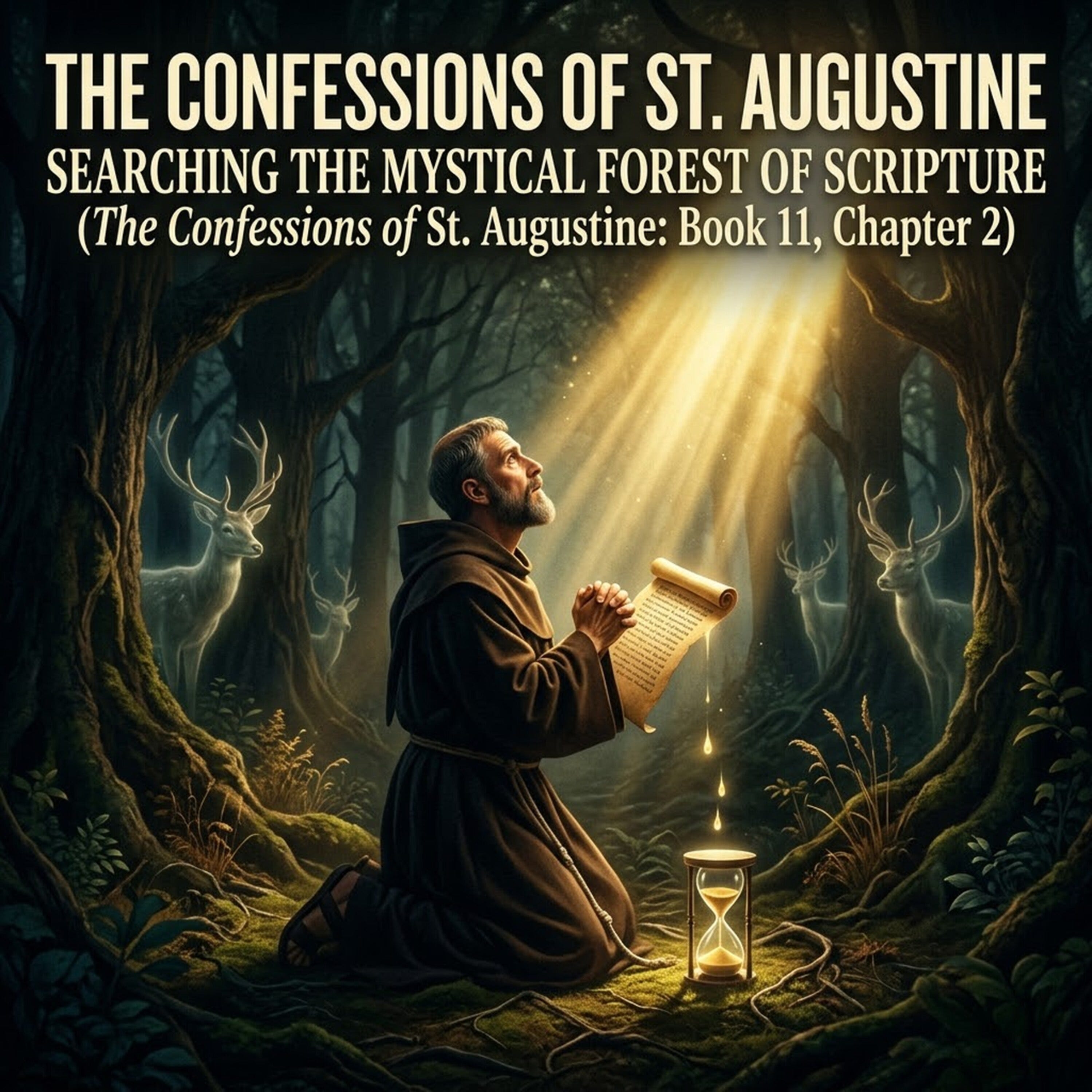
The Confessions of St. Augustine - 5 - Book Eleven - Book Thirteen
from Discipleship for the Present Podcast · host Kanu Emeruwa
We expect absolute precision from a doctor diagnosing a physical injury. As the hosts point out, if you have a broken arm, the x-ray provides a “clean... visible... completely definitive binary answer.” We are comforted by empirical measurements. But imagine asking that exact same doctor for an x-ray of time itself, or an MRI of the human soul’s gravity. Suddenly, the machinery of our physical world becomes completely useless.This episode opens by stripping away the familiar biographical touchstones of St. Augustine’s Confessions. We leave behind the rebellious teenager stealing pears for the thrill of it, and we bypass the weeping intellectual in the garden of Milan. Instead, we sit down with the mature Bishop of Hippo in Books 11 through 13. He is no longer looking backward at his own sins; he is looking outward at the cosmos and upward at the Creator, staring directly into the abyss of creation ex nihilo.To understand the spiritual burden of these final chapters, we must first understand the intellectual street fight Augustine was waging against the Manichaeans. These dualists believed that physical matter was inherently evil—a chaotic sludge that God merely organized. Augustine recognized this as a spiritually lethal worldview. If matter is an eternal mistake, then God is not the sovereign Creator of all things. Augustine pushes the Latin language to its absolute limit to describe a God who speaks the very concept of matter and time into existence out of the void.From there, the episode turns to the physics of eternity. When critics mocked Augustine by asking what God was doing before He created the universe, Augustine dismantled the question itself. God does not exist on an endless timeline waiting to lay down the tracks of the universe. Time is a creature, a manufactured feature of the universe. Asking what God was doing “before” time is, as the hosts observe, “literally like asking what’s north of the North Pole.”The episode then draws this ancient philosophy into the raw mechanics of modern discipleship. Augustine whittles the physical present down to a “razor’s edge moving at the speed of light.” Because the past is gone and the future is not yet, time is fundamentally a psychological reality residing entirely in our memory and expectation. The hosts connect this directly to the modern epidemics of anxiety (a frantic obsession with a non-existent future) and depression (an inability to escape a non-existent past). If we anchor our deepest devotions to things governed by time—status, wealth, approval—we are demanding permanence from a system fundamentally designed for decay.At the center of this theological exploration is one of the episode’s most powerful images: the gravity of the human soul. Augustine coined the phrase pondus meum amor meus—my weight is my love. In ancient physics, objects moved based on their inherent weight; fire reached upward, stones plunged downward. Augustine maps this directly onto the human heart. Your loves are active gravitational forces. Left to our own devices, the heavy weight of our selfish desires drags us down into the bitter waters of the world. The episode brilliantly applies this to the modern attention economy, describing it as an ecosystem engineered to attach synthetic weights to our souls.Finally, the episode shifts to the external life of the believer and the danger of unchecked allegory. While Augustine’s mind was unparalleled, his tendency to spiritualize every physical detail of Genesis threatens to obscure the simple, “dirt under the fingernails” obedience required by Christ. The wisdom here is not to imitate Augustine’s academic overreach, but to adopt his unyielding guardrail: all biblical interpretation must be governed by the law of love. If our towering theology makes us arrogant or causes us to weaponize truth against a neighbor, our methodology is fundamentally broken. The dry land must yield tangible fruit.In This EpisodeWhy Books 11-13 of Confessions present a radically different Augustine than the famous early chaptersThe intellectual street fight against Manichaean dualism and the defense of physical matterWhy asking what God was doing “before” creation is a philosophically flawed questionTime as a psychological reality: the razor’s edge of the present, the faculty of memory, and the burden of expectationHow anchoring our devotion to a temporal world creates perpetual anxiety and spiritual deathThe interpretation of Genesis: unformed matter, multiple valid meanings, and the non-negotiable guardrail of loveWhy weaponizing theology against other believers violates the fundamental purpose of ScriptureSpiritual gravity: how our soul’s “weight” is determined by what we love mostThe modern attention economy as a machine engineered to attach synthetic weights to our daily livesThe dangers of unchecked allegory and why complex theology must ultimately fuel simple, boots-on-the-ground obedienceThe Sabbath not merely as a day of the week, but as an eschatological destination of internal restPractical ReflectionIf you completely ceased all religious effort right now and simply let go, in what direction would your spiritual gravity naturally drift?Where are you demanding permanence from a system designed for decay, anchoring your ultimate devotion to things that are ceasing to exist with every passing millisecond?In your study of Scripture, does your reaction to differing interpretations mirror the grace of Christ, or the defensive posture of a threatened ego?Suggested Substack ExcerptWhen we imagine St. Augustine’s Confessions, we often picture a tortured youth in Milan or a teenager stealing pears. But in Books 11-13, we meet a mature bishop engaging in an intellectual street fight over the physics of time, the gravity of the human soul, and the danger of weaponized theology. In this episode, we explore how ancient philosophical insights into eternity fiercely intersect with the modern attention economy and the daily demands of discipleship.AI DisclosureThis episode was created using Google NotebookLM Audio Overview, based on human-curated source material, structured guidance, and editorial review. AI is used as a tool for clarity and delivery, not as a replacement for thoughtful study or engagement with the original texts.Copyright© 2026 Discipleship for the Present / Kamashcu Production Studios. All rights reserved. This is a public episode. If you would like to discuss this with other subscribers or get access to bonus episodes, visit discipleshipforthepresent.substack.com
Embed this episode
Ready to play
The Confessions of St. Augustine - 5 - Book Eleven - Book Thirteen
No transcript for this episode yet
Similar Episodes
No similar episodes found.
Similar Podcasts
No similar podcasts found.