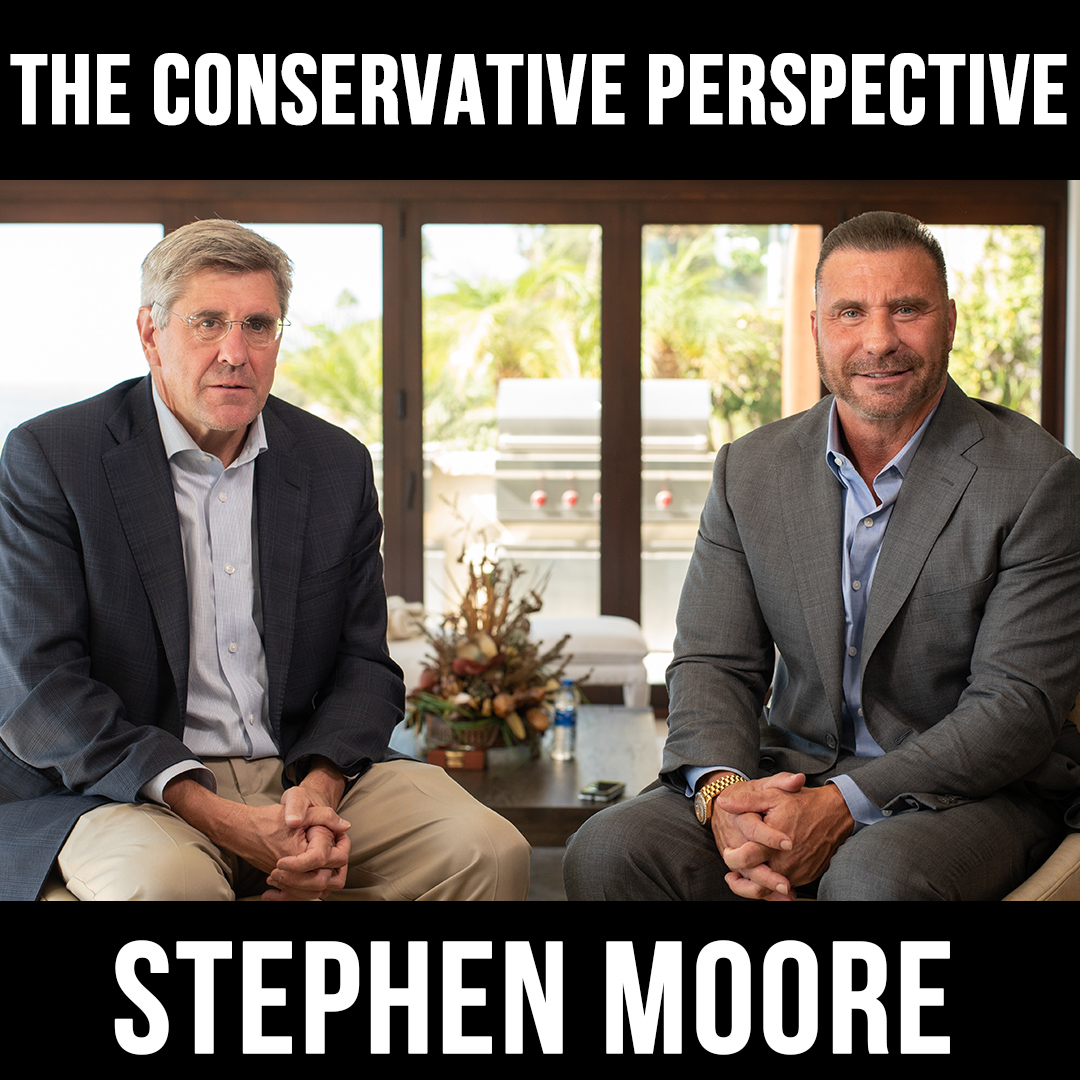
This is the environment show. Welcome back to Max out everybody. Today we are going to talk to the economy. And we're going to take a look at what I call the conservative perspective on it.
And then next week we're going to talk to the economy and have a more liberal or Democrat perspective. And I think the best person on Earth to discuss the economy from this perspective. The gentleman to my right is Steven Moore. Steven was an economic advisor to President Trump's 2016 campaign.
He was just nominated by President Trump recently to be a member of the Federal Reserve. And I was also the chief economic writer for the Wall Street Journal for ten years for ten years. So this is a perfect time and really great for you to expect. Thank you for having me.
Great house for me. Thank you. I'm going to tell you anytime you want to be here. Okay, so why do you think...
Let's get right into it. Why do you think there's a perception that the economy isn't working for everybody? That most people think this economy, capitalism in general, right now isn't working for the vast majority of people. Is that a false belief?
And why do you think people think that? I actually would challenge the question. I think people feel pretty good about the economy right now. I mean the statistics show about 60 to 65 percent of Americans feel like the economy is either good or great.
That's a pretty good number. But do they think that economy is good or great for them now? Yeah, they do. I mean we're seeing nice income gains right now.
I think things are pretty good. I mean think about this one. We've got the lowest inflation rate in the United States in 50 years. We've got the lowest inflation rate in 50 years.
We've got the lowest interest rates in 50 years. We've got the biggest wage gains in 20 years. We have one of the statistics I love to use is 7.1 million. You know what that number is?
That is the number of unfilled jobs in the United States. 7.1 million? That's larger than the entire population of the state of Indiana. That's how many surplus jobs there are.
So if you're a worker looking for a job and you have a skill that actually employers want, you can find a job. This is probably the best job market in 50 years. Now, whether we can sustain this, you know, who knows what the future will bring. But right now, this is a pretty damn good economy.
It really is. Now, a growth rate isn't quite where we'd like it to be. It's falling down. We want to get the 3% to 4%.
But we're now growing a 2-2.5%, which is decent. I think the China situation has been a problem for Trump in terms of trying to get that situation to result. But no, I'm going to say it's a pretty darn healthy economy. I think that, well, I can tell you, by the way, I'm going to tip my own hand on what I believe that I'm going to challenge things from both you and Austin.
I can tell you that when I see this recent advent, this drive for socialism, or what I call a real modification to capitalism, I think that's driven out of a sentiment. I think most people think, hey, the economy is going well. Obviously unemployment is lower, African American unemployment is lower, unemployment is lower. Latino unemployment.
You know, wages are higher than I've ever been. Asian wages are higher than they've ever been. And so I think people see that. But I don't think most people feel like they're benefiting that they're growing from it.
So we disagree about that. And my proof of that is this advent of a massive shift to some extent, in some circles, particularly Democrat circles, for a more socialist type economy, a more redistribution type economy. I'm going to challenge you again on that one. Because I think my view is because we do have prosperity now.
Look, this is the recession in June of 2009. This is October of 2019. So this has been a long, it hasn't been the most powerful expansion, but it's been a long one. And my feeling about this is people are kind of taking prosperity for granted right now.
They think, oh, this is just the natural course of things for things to grow. And when people get better off, then they're willing to say, oh, well, let's give stuff away for free and move toward more socialist model. I think it's almost a symptom of the fact that things are going well, that people are starting to say, oh, let's have free health care. Let's have free college tuition.
Let's have free, you know, my patron saint economist, I don't know who yours is, was Milton Friedman. And I, did you know Milton Friedman? I know who he is, the fourth of red. I was fortunate enough to know Milton pretty well, especially at the end of his life.
And I consider him the greatest economist of the last two years since, you know, Milton used to say to me, Steve, he said, you know, what was the most important enduring lesson of the 20th century? And, you know, he would answer his own question and say, it's that free market capitalism is a success. And communism, socialism, Stalinism, Nazism, all these massive government control models are failures. And then he would, for Lornley, say to me, you know, yet the lesson we seem to have learned from all this is we need more socialism.
And I don't get it. You know, socialism is a failure, almost everywhere it has been tried. And so I shudder to think we're going to move in that direction because I think it's so long. And the other thing that I'm really concerned about is the war against wealth and the war against success and the war against anyone.
You know, you've made it, you know, you've built a business, you're successful, you've experienced the American dream. What's wrong with that? I mean, people think that people like you are villains because you're successful. I mean, listen to the rhetoric out of Elizabeth Warren.
And I think that's pernicious, frankly. I mean, John F. Kennedy, who was a Democrat, used to say, a rising tide lifts all boats. You know, and that's what we want.
We want to be an aspirational country. I don't hear a lot of aspiration from the politicians these days. I don't, on either side by it. And I get to agree with that.
The reason I wanted you on, and the reason I want people listening to this is I think politics has become this debate of who's good and who's bad. President Clinton actually had a great quote when he really believed it or not. But he said, politics shouldn't be about about who's good and bad, but who's right and wrong. And we demonize each other, which I think creates these extremes in both sides of the party.
And I want people listening to this today because there's half my audience agrees with everything you say. The other half, how about today? And I'm going to do this with Austin too for the conservatives. Just listen to what they have to say.
Let's hear their perspective. So I want to ask- The biggest thing, I think the troubling thing I see in America today is people are hanging out with only people who agree with them. And I may disagree with you, but I don't think you're evil. I mean, I don't disagree with you.
The idea that somehow because you disagree with someone, you find them offensive. That's a new thing in America. And it means we're not listening to each other. We're not coming to any kind of bipartisan consensus.
And this is leading to a polarization in the country, which I don't know about you, but I've never seen it this bad. I've never seen this bad. I think there's a lot of factors contributing to this. I just watched what Ellen said a few weeks ago, which was a very reasonable thing she said about, sitting with President Bush, and she's got destroyed for saying a very reasonable thing.
And I think one of the reasons that that is is that technology has begun to feed us only what we believe in as well. So not only do we associate personally with people who agree with us, but because of what we click on, we're getting more of what we click on. This is self-preanforced. Right, all the time.
But to be specific, I'm going to challenge you on something. Be specific. If someone said to you, hey, look, I do agree. I do feel like Ed said, I don't feel like the economy's working for me.
Or I'm a young person. I've come out of a pretty liberal university. I look at this, I look at wage growth prior to recent, you know, prior to last year. So wage growth was terrible in that country.
Statistically, anyway, since the 70s and even the 50s recently- No, no, no, no. I wrote a book not long ago that I wish people would, you know, it's a picture book actually. It's called, it's called, it's getting better all the time. And it's really a history of the last hundred years.
Everything from what's happened with health, to the environment, to incomes, to the things we can afford, you know, every, you know, every records that are reached. And the conclusion is undeniable. The average poor person today has a higher living standard than the average middle class person 50 years ago. The average poor person actually in some ways has a higher living standard than even wealthy people.
What's that living standard measured by? Life expectancy, by health, by the things that you can buy. I mean, my goodness, you know, you have a self, everyone has a self, everyone has a self, everyone's listening. That's, that's, that's, that's more computing power than every computer that was used during World War II.
Why don't think most people would argue, Steve, that technology has advanced quality of life for people? Right. But I challenge you on that, because I think the statistics will show now that for example, new home buyers. So I look at someone like my sister, who's 30 years older, husband's in his mid 30s, they make a great living, they live in California.
They can't afford to buy a home. Whereas many, many years ago, a single income family could own a home in this country. Well, it's a fair enough. Let me give you a good point.
Let me give you a statistic. Top 1% in 1979 are in 12% of all market income. In 2016, they are in 20% of all market income. Do that one again?
Okay. Top 1% in 1979, the top earners are in 12% of all market income that was earned in 2016 is 20%. So it's almost all the what? Market income, income in the country.
Okay. Okay. Okay. But so what, you know, look, I think that's a bogus statistic.
Because, you know, what, we have Mark Zuckerberg, we have, you know, Bill Gates, we have, you know, all of these billionaires like Warren Buffett. But the fact that they, this is my whole point. The fact that Warren Buffett and Bill Gates and, you know, Zuckerberg have billions and billions of dollars, doesn't make you or me poor. And I think about the people who benefited from everything.
People say, oh my God, the founder of Facebook has, you know, let's say Zuckerberg's wealth is $30, $40 billion. Well, first of all, think of all the people that he's made in a million hours because of Facebook. Number two, you know, billion people on the globe use Facebook. Nobody puts a gun to your head and says you have to use Facebook.
Right. And, you know, I just hate this idea. Just because one person gets wealthy doesn't, it's not a zero sum game. It's not like because you have more, I get less.
No, it's an additive game. You're wealthy because you've added to the economy. You've helped other people. Google is a good example.
I mean, when I first came to Washington, I wrote a column recently on this. My first job was literally warehousing myself in the Library of Congress to find statistics for the, you know, and I'd literally spend hours and hours now. Now, literally, I go to Google and three seconds I can find out the answer to things that took me, you know, three days to find. Sure.
And you know what, you know what, Google charges me for that? Zero. Right. No, I do think it's amazing.
I think there's two. And help, by the way. Look at the, what if I got for a bit of the UI where I were diagnosed with cancer? The survival rates from cancer today are, you know, almost 70 percent versus even 30 or 40 years ago, you know, if you've got a cancer diagnosis, it was like a death sentence.
So a lot of the things we just take for granted that are so much better now. Now, my promise is, and you may disagree with this, this is the single greatest time to ever be alive. Yes. And I would add to that, we are living in the greatest place to be alive.
Of course we are living in this country, you know, where we have freedom and liberty. And you got me going here. I want to make one of the point. I do hear the browsing, you know, you know, well, it's hard to get home and we have homeless people.
I'm not saying there aren't problems in this country. But, and people want to move for social. Whenever I give speeches, and I know you give a lot of speeches yourself, I talk about freedom and free market capitalism. And the dangers of social.
And what is so interesting to me is that people who always come up to me after my speeches, you know what they are? There are people who actually came from socialist countries. People live behind East, you know, Berlin Wall and East Germany and pay people who didn't have freedom. And they'll come up to me and say, I came here because we have freedom.
And now Americans are trying to give away those free, they said, we had government health care, you know, in Romania. It wasn't very good. It's not happening in the United States. No, you're right.
A lot of friends in Canada travel, they're often like, be careful what you wish for. So I'm not trying to tip my hand on where I agree. I'm trying to get the devil's advocate position. I'm saying, when I say you, I mean, kind of an attitude in America.
I think what people would argue, and I would also argue is that I don't think there's any question that the world's better than it was 50 years ago. There's no question that medical science has improved, technology's improved. I think what most people are saying is if I'm in the middle, my financial life, the way we live, the fact that both of us need to produce an income now that it is harder to own a home in this country, that savings rates are, the average American is 4,000 bucks safe. Right?
That's the problem. The average individual income is $31,000 a year. The top 1%, individual, not household. Yeah, yeah.
Okay, individual income is $31, and the average 1% is at $1.5 million. There's an income gap. It's expanded. I don't think most people, well, maybe you may be right.
Most people may think, well, when one person's getting richer, I'm getting poorer. I certainly don't believe that's true. I want to take another angle on capitalism for you from the outside of the economy, and that is, I've been reading a lot about this lately. Maybe you agree with this.
I don't even think that the real thing is not a good term, because people are against capitalism. So I like to use the free enterprise system or free market capitalism because, you know, capitalism people think of Marxism, and you know, that just capitalism means you're holding down people to get ahead. Correct. Good point.
I think one thing that the conservative side of most arguments, they're terrible at phraseology. And they're left is very good at it. And I also think that, and we need even in this dialogue, I think sometimes the conservative perspective sounds disconnected, sounds like it doesn't care. I think you know that.
And it's something that really needs to be guarded. Incidentally, one of my heroes, another hero was Jack Kemp, remember the great congressman who played a big role. And Jack used to say, nobody cares what you know, until they know what you care. And there's so much truth to that.
If you don't think I give a damn about you, you're not going to listen to what I have to say. That's exactly right. And I think the Republicans have lost that debate many years ago. They've lost that narrative.
And we give you one. That's right. I liked what Trump, one thing Trump did that I kind of liked was he went into the inner cities. And he'd say, look, give us a try.
You know, the people who run Chicago or Newark or Cleveland or Detroit, you know, they haven't done so well. Why don't you try a different approach? Right. I thought it was wonderful that he made that effort as well.
I'm going to do one other argument about capitalism. I don't even know that we are a capitalist society. We're a modified capitalism. We have a progressive tax system, which is essentially almost socialist tax rates.
And I know you helped Trump with his tax plan, which I'm going to talk about in a minute. But having said that, one of the other things I've been reading about capitalism or the lack of regulation in capitalism, okay, is this idea that there becomes much more control, almost monopoly type control. You referenced Google earlier. People would argue that there's some danger that Google controls 80% of all the searches in the country, that Facebook has somewhere between 78% of all social media.
A couple of stats. Two corporations own 90% of all the beer we drink. Five banks control half of the nation's assets. A lot of data says once banks go over 50 billion, they become a little bit less efficient.
Many states health insurance markets, 80 or 90% are one or two companies. Alabama is one company, almost 90% high speed internet, all local monopolies. Four players control the beef market. After a couple of mergers, three companies will control 70% of the world's pesticide market.
How do you feel about that? There seems to be this contraction of control in the economy that we have now over some really important things like a Google or an Amazon. Amazon makes it very difficult. They control who gets on their shelf.
They make it very difficult for retailers to make a breakthrough as well. Is that just part of the big eating the small one? That's what you get in capitalism? Because people see that as well.
My view is that once you get to be the king of the hill, like a Google or like an Amazon. By the way, it ain't easy. It weren't easy. I hear all these people say, oh, we should break up these companies.
I'm not a favor of that. As long as you compete. As long as a competitive environment, one of my favorite books of all time is called, and I want you to get it. I'm going to send it to you.
It's called the myth of the Robert Bierons. Because remember, the whole antitrust stuff, that came in the progressive era in the first part of the 20th century. There was this view that JP Morgan and John Rockefeller and all these people, Henry Ford, were monopolists and that they were hurting for people. In fact, the truth is there's a few people who have done more to build the United States than Johnnie Rockefeller and Henry Ford.
I don't like the assault against success. It gets back to the theme we've been talking about. I think my view about Google and Facebook, by the way, I hate Facebook's politics. I'm a conservative liberal.
But I still defend, my response to Facebook's politics is I just don't have a Facebook account. I don't want to use their product. Nobody forces me to use it. Let's do the show 10 years from now.
In October of 2009, 29, and I guarantee you Google will not be one of the biggest companies. Facebook will not be one of the biggest companies. Who knows? Amazon could go bankrupt.
These companies, I remember, by the way, in the financial distress of 2008, when you had these big banks within a matter of weeks, remember that they failed. So I don't want the government to- I think you can point it out. I got a blockbuster video. They didn't evolve.
Next-class dominates that market. One other thing, I'm on the board of two startup companies that are in the technology industry. And we, both of the companies, we hope there's startups, there's high risk when you start up a new company, you've done that yourself. But one of the things we hope is, look, we've started with maybe $5 million of capital that we raised.
We hope to get the maybe $50 million valuation. Then you know what we want? We want Google to buy us. I mean, so the fact that you have the Googles and the apples and the Amazon's out there actually inspires new businesses to start, because you got somebody out there who can value out.
Okay. Let's start to agree with that. I'm not going to say if I agree with that. I did.
I did. I did. But I will say, I'm going to ask you about a couple of things that I do think that are out there and I'll talk about the tax plan that you helped produce for President Trump, the 2016 tax plans, the 2016 I guess. We passed it to December 22nd, 2017.
Okay, 2017. And I read often, most people say, well, the majority of those cuts went to corporations. And although wage growth has spiked, data shows a lot of those corporations took that actually bought back their own stock, that it didn't necessarily trickle down necessarily to the employees. That's something that you're going to hear.
Facts do support that that's true to some extent. How do you feel about that? First of all, the tax got itself. When we talked to Donald Trump about it back four years ago, Larry Kellewe and I, we recommended a reduction in the business tax rate, because we believe that was the biggest problem with the economy.
Now, look, you just got this from a competitive standpoint. The United States had a 40% tax rate on our businesses. Small businesses had large corporations. The rest of the world was down at about 20%.
And by the way, they kept going down, down, down, down, down. And we had seen, you know, we had seen major American companies that were involved in what were called inversions, where they were actually giving up their US citizenship and moving to Canada or Mexico or China or Ireland, Ireland as the lowest. So we told Trump, look, this is hurting. This is not putting America first.
And a lot of Democrats believe that as well. They did actually. We got, unfortunately, not a but the point is we wanted to make America, the whole idea was, how do we make American companies competitive in a global economy? You know, this is a global world.
There's no putting the genie back in that battle, right? And so the idea was, let's get the rates down. So we're in the game. And Trump loved that idea.
By the way, he was the one who insisted not just for big corporations, but also for there's 26 million small businesses. It's going to be tough. Let's make sure every man and woman who runs a business gets this lower rate. Now, I'm not going to apologize for that because I actually think it's been a big success.
One of the things that's happened is we're sucking capital now from the rest of the world in the United States. We're the country right now. Japan isn't growing. Germany has been in a recession.
Europe is flatline. China's economy is falling. You know, we're doing really well relative to the rest of the world. And I would argue as a competitive point of view, by cutting those rates, we made America a more attractive place to invest in.
Some people would argue though that that has been true. We've seen that happen. But having said that, that this was going to be paid for with GDP growth and that the deficit is growing as well and that's not a very conservative. It's a statistic.
You're ready for this one. So in 2019, this today, when we talk, it's about over 20 seconds, so we now, the fiscal year for 2019 ended on September 30th. So we now know what were the numbers for this? Federal tax receipts, the collections into the federal treasury in 2019, adjusted for inflation were the highest they've ever been in American history.
Now, what that tells me, then you're saying, well, why do we have a trillion dollar budget that tells me is we do not have a revenue problem. Our revenues are just fine. We have an overspending problem. And I will blame both the Republicans and the Democrats for that.
You know, the Republicans want to spend more money in the military. The Democrats want to spend more money on social programs. So what do we do? We spent more money on both.
And that's why we have a deficit. Okay. And are you good with this? Are we good with keeping going on a few of these things?
Is this okay? Okay. I love it. I love it.
I have friends in the know, I won't say who they are, but think they're in the know, that say, this is not, you know, Democrats are telling you this is an Obama economy. And Trump then immediately took credit for the economy when it was going well after his plan was instituted prior to that plan being put in place he was too, because let's be honest, most of this stuff is just happening now, as you said. I have a lot of friends that say it's neither. It's a Fed economy.
A Fed economy. This has been a quantitative easing. This has been a printing money economy. And that, A, that neither one of these two should be taking credit for anything that's happening in the economy.
And secondly, that if a recession does come, and I'd like your opinion about this, do you see one coming the next two to four years as most people in your position seem to be predicting that perhaps it could be a much as a long question, a much more extended recession, maybe not as deep, but could be longer because there's not a whole lot to do to help this time because it's all been done. So, you know, I've been in the policy game now for 35 years. You know, this is what I do, economic policy. So I clearly don't agree with this idea that, oh, it doesn't really matter for the president of this.
And when you make policy shifts, it makes a big difference. I mean, I live through what I call the three stooges of the American presidency, Richard Nixon, Jerry Ford, and Jimmy Carter. I mean, it just didn't get much worse than that, right? And you know, by the way, these are pretty amazing statistics.
I think you know them, but people are surprised when I say that. From 1968 through 1982, which was a 14, 15-year period, adjusted for inflation. The stock market lost 62% of its value. 62% of its value.
Why? We had high inflation, we had high tax rates, we just were doing everything wrong. A big welfare state we built up. And the way I like to put it, I have a little bias folks, but I'll just say it.
The clouds dispersed, the sun came out and God gave America around Reagan. And when Reagan came in, cut taxes, cut regulation, restored sound money, expanded trade, and we had one of the biggest booms in the history of the country. And by the way, just so people don't think I'm some kind of partisan economy, boomed under Reagan, if we were even faster under Bill Clinton, Bill Clinton was a genuine new Democrat. I mean, can you think of any of these Democrats on the stage today who would say the era of big government is over?
Would any of them cut the capital gains tax? Would any of them promote free trade? And I think we had the biggest retraction of government spending under Bill Clinton since the return was present. So my point is that when you get things right, things go well.
And then I believe that the Obama recovery, I don't believe this is the fact, it was the weakest recovery we had from recession since the end of World War II. And Trump capitalized that. People, a lot of people would say, gee, why are people voting for Donald Trump everything is so good in America? Well, you know what?
Yeah, if you lived here in Laguna Beach, California, lived in Hollywood, if you lived in Silicon Valley, if you lived in where I lived in the swamp of Washington DC or Wall Street, things were going great. But when I was on that presidential campaign, we went to, we'd go places like Ure Pensovania, we'd go to Charleston, West Virginia, we'd go to Frankfurt, Kentucky, and we'd go to Oshkosh, Wisconsin. And I'd talk to the folks and I'd say, how's that Obama recovery going for you? You know what they say?
What recovery are you talking about? There's no recovery here in the Repensovania or, you know, Flint, Michigan. So there were whole areas left behind. I feel kind of proud.
I think the country is doing better now. You know what? We're going to know the answer this in one year, because people are going to decide. So you think that our recession could be pending, but you think it has something with who gets elected into it?
Well, look, at any point in time, as you know, there's always a 15 or 20% chance in the next year or two. So when you ask me, is there going to be a recession next three years? It's probably a 50-50 chance, you know what I mean, because economies do go through cycles. There's all sorts of things that could happen.
But I'm pretty confident. I think this is a good economy. If we can get this trade deal done with China, it's a mini deal. It's not a great deal.
But I think that'll take a lot of the pressure off, because one of the things I'm worried about right now is that there's not enough capital spending in my businesses. Now in terms of the Fed, and this is amazing, I can't quite, I can't quite figure this out. I mean, do you ever think we have a negative interest rate? I mean, it's insane.
It's crazy. I mean, you guys, even like you're in the US, who buys a 30-year treasury bill, a 2% interest rate? You think the next 30 years we have less than 2% inflation? And by the way, when you buy a negative interest rate, what you're saying is that you're paying the government hold on your money, you mean better off taking your money, putting in a suitcase and bearing it in your back.
100%. What's going on here? So I have to say, I'm mystified by this, but one of the things I've advised the Trump administration to do, I had a Wall Street Journal article about this a few weeks ago. My God, as long as we got 2% interest rates, we should be issuing 50-100-year bonds and locking in these low interest rates forever.
And I don't always admit when I'm wrong, but every speech I've given to last 10 years, I say, interest rates can't go any lower. And they keep on wrong. Right, incredible. I mean, when you and I were, I don't know exactly how old you I am, almost 60.
When I was in high school, the mortgage interest rate was almost 20%. I live 3.5% mortgage rate. Unbelievable. Unbelievable.
Unbelievable. So, okay, so I want to give you a couple of things. I wonder why there's this perception in the country. One of the things that does tweak me is just when facts aren't told accurately.
So there's this notion, and as you know, that the rich aren't paying their fairs share, that somehow the top 1% somehow avoids taxation, which we both know isn't true. The top 1%, you know the stats better than I do. Yeah, they pay 40% of the income. I mean, that's incredible.
They pay almost 40% of the income, and they earn about 21% of that income. So they earn 21% of it. They pay 40% of the facts. It's just an absolute untruth that the top don't pay their fair share.
Yeah, and I want to add another statistic. The bottom 50% paying no federal income tax. Yeah, they pay maybe 2% or something like that. They pay almost nothing.
So it's a highly progressive system. Now, I hear all this talk. Let's go back to the Golden Age when we had 70 and 80 90% tax rates. Well, you know what?
This will surprise a lot of your viewers and listeners. Back then, the rich actually paid a smaller share of the income tax than they do now. You know why? Because rich people have tax accounts, and they didn't pay those rates.
What I'm for is the plot tax. No deductions, no loopholes, no special interest provision, you can't hide your money from the IRS. You know, if you're 17 or 18%, if you're a family for your first $30,000 of income is tax-free, you fill out your tax or a form on a tax. I mean, I'm not a rich guy.
I'm not rich. I'm doing pretty well, but I'm not rich. I had the 200-page tax return. It's ridiculous.
Why is that never getting tracked? Is that because there would be a reduction for the top rate? I'll tell you why. Because do you think anybody in Washington wants a plot tax?
All the power, we talk about the swamp. The tax code is the swamp. It's all tax attorneys and tax lawyers. I mean, why would you come to be lobbyists?
Do you think a lobbyist wants a plot tax? So if you feel strongly about that, you have Trump's ear. Why is that not something he'd go run on in the last time? We tried to sell them on it.
That's why we wanted to bring the rates down. Lower. Look, at least now, if you were introduced 50, 60, 70, 80% tax rates, I guarantee you, within three years, you're going to have so many loopholes in that tax code. I mean, it's just the natural course of events.
Right. And that's the worst tax system of all. I want a low rate with a broad base. It seems like a lot of people want a high rate.
And by the way, some of people just say, we want to be punitive. We don't even care if it raises revenue. We just want to stop the rich. I have a problem with that.
Who does that help? I'm going to leave that alone. Yeah. People have come from Mr.
Yang. People are looking at them. They like it. How do you feel about that?
You know, my big, I'm not totally against it. Wow. But what worries me is that it becomes a disincentive work. What we need Americans to do is work.
One of the problems we have in the bottom of yours is we still have in the Trump years. We've got a lot of Americans on the sidelines who could be working and should be, and look, people who work longer have longer life. Work is a good thing, actually. Work gives you a self-worth.
It expands your, people retire actually die of younger age than people who continue to work. So, work gives you a purpose in life I think. Don't you agree with that. And so, I don't want people on the sideline.
people on the sideline. I don't want the government giving people, you know, I do think, look, we're rich country. People should be able to have help there. We want housing for everyone.
So on. But I don't want to disincentivize people to work. That's why I don't want high tax rates. That's why I don't want big welfare giveaways.
I do think, look, if you work 40 hours a week, you know, you should have a guaranteed income, you know, and not necessarily the employer providing it that will provide you a subsidy. If you're working, you got to work, though. If you're sitting on the sidelines, no, we're not going to stop. Then how's that different than just raising the minimum wage?
Because I'll tell you why. Because if you raise the minimum wage, then all of the cost is borne by the employer. What's the employer going to do? You're high-ropereable.
If you're, you know, I always say, you know, $15, $16 minimum wage, I have two teenage boys. I love them to death. I don't always like them, but I love them. And I always say, you know, but you'd be insane to pay these kids $15, $16.
Now, I don't want to price people out of the work market. Can you remember the first job you have when you're a kid? I do too. I was working a little faster.
I was working a little factory filling orders, you know, and you learn a lot from your first job. Don't you? How to show up? How to be nice?
How to just be an employee. I don't want to price those jobs out of the market because the first job oftentimes is the most important job. Well, the consumer pays a price for that, too. You're going to have $7.00.
So what I'm talking about is you let the market set the wages. And if some people fall below what we would consider, you might be free, universal, basically. You have to work. It has to be tied to work.
That is shocking and reasonable. By the way, that would, here's the thing. We already spend over $1 trillion in all these welfare programs. So we could easily do that with the money we're already spending.
But you're assuming that's not how it works. You're assuming that somehow they'd be a give and take. That's not a problem. Government programs aren't taken away.
That's what they're saying is, let's get rid of all the welfare programs. Okay, a couple more things. Because there is this good news, and I think you've made some really great points, of which is mainly drowned out by the chaos and noise that we hear out of the executive brands and the media that covers the executive branch. And so I've heard you say that you're obviously a huge supporter of President Trump.
Do you agree that to some extent that if we could quiet some of this noise that perhaps it would be healthier for the country, whether that be tweeting or some of the comments, can you make a comment about that if you have a criticism, if you want to offer one up of the thousands of things you love about the president, the economy where it's going, what is one thing you'd say I kind of wish this didn't exist? I think I've told the president at this and he doesn't like to hear it. But I want this president to be the president of all the people. It's one thing to be running a campaign and you're going out and trying to get your voters stirred up and I went to the rallies.
They were a lot of fun. I mean they were amazing political events, cultural events. But then you're elected and you don't represent just the people voted for you. You represent all Americans.
And I think if I have one criticism from Trump, it's that. Reach out to the people who didn't vote for you. Don't just always appeal to your base. And I would like to see more of that from Trump because I think he would be more effective that way.
And I think the tweeting, one worry I have is there is chaos and there's always, Trump is almost being done chaos. And I do worry the American people are just getting tired of it. You know, petite, Trump petite. And I worry about it.
I told the president, you know, stop tweeting so much. You don't have to comment on everything that happens every moment of the day unless you're going to tweet on me. Then you can do that. And he's done that a few times in my book.
So I agree with that. I think he's he is sometimes his own worst enemy. It seems an awful lot of the time. A couple more questions regarding that.
Tell us something about him. So there are people watching us that are fans of his and people here that you know aren't his fans. Well, a couple things. I mean, we know what you know about him.
We know that is a great question. So I have a book called Trump on Alex that I wrote with my friend out Lapper a couple years ago. And you know, in the first couple chapters, maybe I think the most interesting is just about how we met Trump and how we got to work for him and what he's like to work for. And you know, I say in the book that when I first met Trump, which was, remember, the world like 15 Republicans running the president, I think I knew 14 of them.
I knew that Bush and I knew Jack Hasek and I know Marco Rubio and I knew New Dr. Pentecarsen. The only one I had never met was Donald J. Trump.
And so you know, we got a call that would you like to meet with Trump? And you know, I was I was curious about him because there was something going on in this country. And you know, it surprised me as much as it did anybody. So we went in and about January of 2016 and sat down with Trump and you know, we went up the escalator up, Trump power went up the in and first of all, I was impressed by the fact that all the people around him, you know, his secretaries and his assistants and the people, they love the guy, you know, and you can tell something about, you know, a person by how they treat the people that work for them.
And I was impressed by that. And then we spent about an hour in the room with him and had a great conversation and we he likes to argue, you know, which I like to do too. So we, you know, I don't know, great. But we was, and I got to tell you, I walked out of that room and I had stars in my eyes.
I was like, wow, this guy is going to be the next president of the United States. And I don't know what I'd say. You know, I think, you know, I've always said there were three presidents in my lifetime who had the kind of that expat that just connects with people. Ronald Reagan, Bill Clinton, Barack Obama, the three of them, you know, I've been in politics and they walked in the room, they lit up the room, you know, the amount of that.
But Trump sort of has that himself to that expat. And the other thing I'd say about him is that, you know, I say this is a joke, you know, and sometimes he gets him, you know, 95% of politicians are going to meet our wonderful people in public in jerks and private. Trump is a jerk in public and I want to go first and private. And really, I mean, when you meet him personally, he could not be a more charming, more, and he's always come to my personal, I consider him a personal front because he's always been really good to me.
You know, he's a good man. He's the other thing I'll say about him. We were talking about this off the camera. The guy's the energizer, funny.
I mean, I've never seen anybody with more energy than Donald Trump. And he's, he's like 70 something, 70. Yeah. And you know, he was running circles around me, you know, and we do three or four events a day and days just always going, you know, we call me up at one 30.
Hey, Steve, what are you doing? Sir, I'm sleeping. So I'm going to say four or five hours of sleep. One of the things that I've seen that he's a host, he works hard.
One of the things that I've observed about you and most people that I consider to be people like trust with decision making, they don't seem all that concerned with what people perceive them as. In other words, they're more concerned with what they stand for, what they believe in than they are necessarily, even today, you know, that I agree with everything he's there, the audience does. I think it's an odd thing in him. It appears that he cares so deeply about these perceptions.
It feels like, candidly, like an emotional weakness of his that he cares so deeply about the people's opinions all the time. I know. So, you know, look, every, every great leader throughout history with a few exceptions would have some fatal flaws. And that's his fatal.
I mean, a Shakespearean no flaw. And you know, Trump has that Shakespearean flaw. And I think he's in a lot of ways he's a great business leader. I think he's a good president.
But you're right. I think he cares way too much about what people think about him. And he's very thin skinned. You know, when I'm on TV, you know, eight out of 10 things I'll say about him are positive.
But when I go see him, what do you think he remembers? Right. The two out of 10 things I say that. But ironically, that's what makes you believable, in my opinion.
What makes you believable and relatable is that not everything is perfect all the time when you're describing it, which is my last question. And I want to make sure by the way everyone knows about the crypto market that you're involved with because you're involved with the company. And they just told you're overall feeling about this cryptocurrency economy that started that 99.9% of people in the world have no understanding of. So I'm glad we spent some time talking about this.
So I'm a big believer. I think it's the next big thing. You know, I really do. I think because of the blockchain, it's almost all transactions in the future will be done via electronic transfers of funding and so on.
And I think there are two big advantages to crypto or what I call kind of digital currencies. And we think we've got a great product that tracks. Number one is privacy. You know, why should the government have a monopoly on money?
You know, why not have private money? This, by the way, this freaks out people watching. People at the Federal Reserve Board are freaked out about it. The SEC is freaked out about the Commodities Future Trading Corporation.
You know, the Treasury Department. They don't want it. They want to maintain their monopoly over money. I like the idea of having private competitors to government money because for one thing, I think it keeps them honest.
And so there's that. You'll have privacy. You can make transactions with a cryptocurrency like a frax without the government knowing what you're doing. And people say, oh, well, that just means drug runners and criminals are going to use it.
No, 99.95% of the people are going to use this or law-abiding people. Just, you know, I'm kind of libertarian. I don't want to think rather than knowing what I'm doing. So that's one advantage.
The second advantage is that because we have a what we think is a very effective digital currency, by the way our currency called frax, FRAX, will be tied in value to the dollar. So one frax will be one dollar. And there are other, you know, there's this one big one called Libra. I don't know about this one.
This is Facebook. It hasn't gone so well last few months. Business companies have been dropping out of it. But they're linking their currency, their Libra to a basket of other, you know, currencies.
We think that's, we think the dollar is more stable. So the advantage of this is that the transaction costs of using a cryptocurrency like a frax are much smaller than they are if you use a credit card or use PayPal or, you know, whatever. And you can't use a dollar bill in an electronic. So we think the transaction costs.
Now, somebody making $100 a purchase is that's not going to be a big deal. But you're talking about millions of dollars of purchases that saving of one or two or three percent is significant. Okay, and a global economy too. Speaking of that, two more questions.
China, you mentioned China earlier. If I don't ask about it, people will be frustrated. Clearly, it looks like this mini deals being struck that is probably to our benefit. I think even a lot of Democrats are, are excited about the fact that he's taken this on.
What about the criticism that as we've made a few of these deals, although they've been wins, that we are a partner in a global economy, which seems to be in a recession global economy, that there's this ancillary damage that's been done to our relationship with many of these countries where we have struck deals that are in our favor. But maybe the long term relationship with even countries that are allies of ours isn't so favorable. How do you feel? Well, there's two couple points.
No, number one, China is an nemesis. They are a menace right now. I mean, and I don't say that with any joy. I mean, for 30 years after Mao died, Mao was one of the greatest villains, whoever stepped on the planet, he killed tens of millions of his own people.
But once they moved from communism, and they moved towards, you know, they back in the late 70s, they moved towards a more free enterprise free market, not entirely, but they moved in that direction. And then you have one of the great, you know, things that ever happened in history with literally half a billion people moved out of poverty. They became a middle class country in a very short period of time. So it was a great success.
But in the last seven or eight years, they've moved in the office direction. Look what's happening with in Hong Kong, you know, whether it's trying to, you know, I think the people's quote, liberation argument, liberators are not liberators, you know, is going to move in on. Look what they're doing in terms of, you know, they're building up their military in a very aggressive way. circa Japan 1939.
So I think Trump deserves a lot of credit for calling them out saying, wait a minute, these are no longer friends or allies. This is it. This country is an adversarial power. I also think that Trump did the right thing and basically saying, look, we can't go out.
We were in an abusive relationship with China. I mean, we've opened up for 30 years, we opened up our markets to them. They have never opened up their markets to us. Now, I'm a free trader.
I believe in free trade. But you know, I remember that meeting we had that I was talking about with Trump. He said, you know, look, I believe in free trade, but it's got to be a level playing field. And it's not a level playing field.
And it was one thing when China was a four or $5 billion trillion. I mean, now they're what 14, you know, they're a big boy now. They've got to play by the rules and they won't unless Trump uses the leverage that he has to get them to do it. Has he been successful so far?
You know, it's tough. I mean, I think he's fighting the right fight with China. And Trump is saying me left. We can't trade with China.
We sneeze if they can't trade with us. They catch pneumonia. And there's a lot of truth to that. They need our consumer market.
So now you pointed to him. I think a strategic mistake that he has made. One of the great lessons of history is you don't fight a multi-front war. That's the problem.
The Germans made many times. So you don't take a fight with everybody at the same time. And I think, you know, going after, you know, Canada and Mexico and the Europeans, by the way, you know, he has some legitimate grief, you know, gripes with Europeans. They don't always play by the rules either.
But I think it would have been a much better situation of what we need to do, in my opinion, is isolate China, right? You agree? Yeah. And I wish he would do that.
We've got to pass Nancy Pelosi for watching this pass the US Mexico Canada trade agreement. That would be a big plus for the world economy. But this is unknown. This is the one big unknown whether Trump can pull this off.
The Chinese, they're patient people. They're talking about these terrorists, but they may just say, we're going to wait out Trump. I hope I'm wrong about that. I hope you're wrong too.
Last question. There's an election coming. And what? Yeah.
I think I know who you think is going to win and who you want to win. But I want you to talk about this finally. Because you're involved in the media. I watched you on Fox, the other night.
I've seen you on CNN. So these are colleagues of yours, to some extent. One of the things that frustrates me the most, and this is not political left or right, is the bias in the media. Obviously, Trump's got this unbelievable contentious relationship.
He calls the liberal media a partner of the Democrats. And some would argue that some of Fox News are partners of the Republicans. I have no problem with someone like Sean Hannity being an advocate and a biased person for a more conservative viewpoint. I think he's transparent about that.
I don't think he pretends to be down the middle. And I don't think he pretends to be in the news business. I think he pretends to be in the editorial business. My frustration is when I see people on certain channels that pretend to be in the middle, pretend to be news people that we know are biased.
And then I see these same people hosting debates. So they're they're narrators of debates. And we know going in the morning, morning, I'm hearing the phraseology of even the questions in these debates. They're skewed with the bias towards them.
Just talk to the audience from your perspective as they start watching this coverage. Because for most people, they're watching it a little bit. But over the next five, six, seven months, the vast majority of Americans are going to start getting their news through these cameras and through their phone. What would you tell them about what they're seeing being reported?