
EPISODE · Aug 11, 2026 · 49 MIN
The Copilot Assumption That's Holding You Back — Agentic RAG
from M365.FM - Modern work, security, and productivity with Microsoft 365 · host Mirko Peters - Founder of m365.fm, m365.show and m365con.net
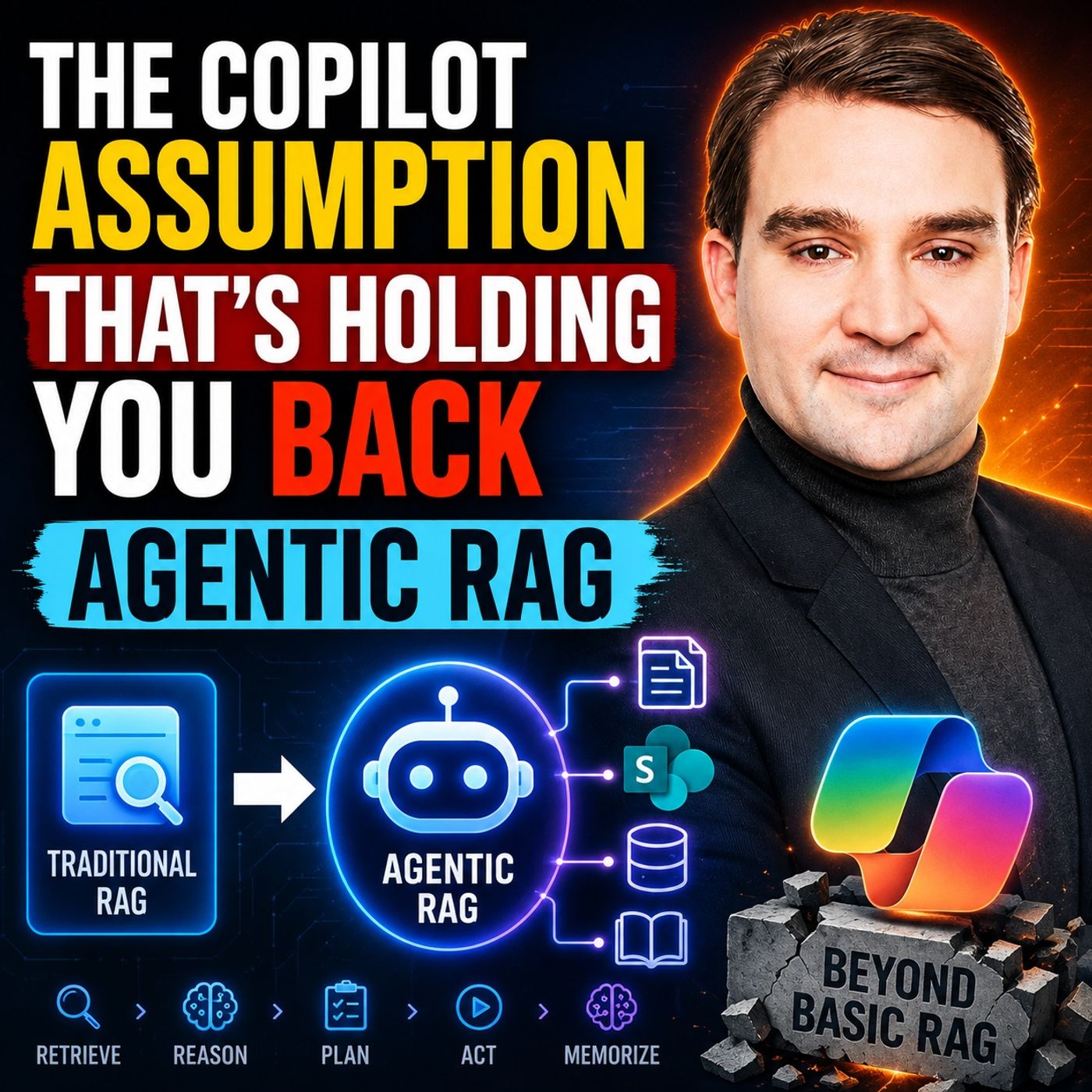
Most people still think Microsoft Copilot is fundamentally a question-and-answer system: you ask something, it searches for information, and an LLM generates an answer. But that mental model is becoming outdated. Copilot is evolving toward an orchestration system that can determine where to search, evaluate what it finds, decide whether additional information is required, and increasingly take action based on the result. In this deep dive, we break down Agentic RAG, how it differs from traditional Retrieval-Augmented Generation, why multi-source enterprise questions expose the limits of single-shot retrieval, and what this architectural shift means for Microsoft 365, Copilot Studio, Microsoft Graph, Entra, Purview, MCP, governance, and enterprise AI strategy.WHY TRADITIONAL RAG WORKS — UNTIL IT DOESN'TTraditional Retrieval-Augmented Generation follows a relatively straightforward pipeline. A user's question is converted into an embedding, relevant chunks are retrieved from a vector database, those chunks are placed into the model's context, and the LLM generates an answer. For straightforward questions such as finding a policy or locating a specific piece of information, this architecture can be fast, inexpensive, and highly effective. The limitation appears when the answer is distributed across multiple systems. Understanding why an invoice increased, for example, might require the current invoice, the previous invoice, usage information, and contractual pricing conditions. A single retrieval against one source cannot necessarily assemble that complete picture.WHAT AGENTIC RAG ACTUALLY CHANGESAgentic RAG changes the role of the language model. Instead of using the LLM only at the end of the retrieval pipeline to generate an answer, the model participates in deciding what information is required and how to obtain it. The episode explores the ReAct pattern — Reason, Act, Reason, Act. The system analyzes a problem, performs a retrieval or tool call, evaluates the result, and decides whether another action is necessary. This creates an iterative, potentially self-correcting retrieval process instead of a single search-and-answer operation.THE AGENTIC ORCHESTRATION LOOPA complex Copilot request can involve significantly more than retrieval. The episode walks through six major stages: query understanding, planning, multi-source retrieval, tool execution, summarization, and safety checks. Instead of blindly accepting the first search result, an agentic architecture can evaluate whether the retrieved information sufficiently answers the original request. If not, it can refine the query, search another source, retrieve additional information, and continue until it has enough evidence to complete the task.MICROSOFT 365 IS A MULTI-SOURCE KNOWLEDGE ENVIRONMENTEnterprise knowledge does not live in one vector database. Documents and policies may exist in SharePoint, conversations in Teams, communications in Outlook, structured business information in Dataverse, and additional customer or operational information in external systems. Agentic retrieval becomes especially valuable because these sources require different retrieval strategies. Instead of deciding in advance that every question should search the same repository, an agent can determine which systems are relevant to the particular problem. FROM ANSWERING QUESTIONS TO COMPLETING TASKSThis architectural shift changes what Copilot can potentially do. Traditional RAG primarily helps users obtain information. The human receives the answer and determines the next action. Agentic architectures can connect retrieval, reasoning, and execution so that Copilot can increasingly complete multi-step tasks rather than simply explain how a user might complete them. That moves Copilot closer to a delegation model: define the objective, allow the system to determine the required steps, and verify the result.AGENTIC RAG IS NOT AUTOMATICALLY BETTERMore reasoning comes with a price. Every additional planning step, model evaluation, retrieval attempt, and tool call consumes resources and adds latency. For straightforward questions such as finding an office Wi-Fi password or opening hours, an agentic pipeline can introduce unnecessary complexity. Traditional retrieval may produce the same answer faster and at lower cost. The important architectural question is therefore not whether Agentic RAG is universally better. It is which problems actually justify agentic reasoning.HYBRID RAG AS THE ENTERPRISE ARCHITECTUREA practical architecture combines both approaches. Simple, predictable questions can follow a traditional retrieval path. Complex or ambiguous requests requiring multiple sources can be routed into an agentic workflow with planning, evaluation, and iterative retrieval. This makes classification and routing an important architectural component. The system needs to determine whether a request is a simple single-hop lookup or a multi-step reasoning problem before selecting the appropriate retrieval strategy.COPILOT IS BECOMING AN ORCHESTRATORThe episode examines the broader movement from ask and receive toward delegate and verify. Instead of users manually directing every step, increasingly capable Copilot agents can interpret goals, construct plans, interact with applications and information sources, and execute parts of a workflow autonomously. That changes the relationship between employees and AI. The important interaction may increasingly become the goal provided at the beginning and the result verified at the end, while an orchestration layer handles the steps between them. AGENTS NEED IDENTITY AND GOVERNANCEAutonomy creates an immediate governance question: who or what is acting inside the environment? The episode examines agent identity, access controls, auditability, and the importance of applying governance to autonomous systems. Agents capable of retrieving enterprise information and executing actions cannot simply inherit unrestricted access without accountability. Identity, permissions, auditing, and Microsoft Purview therefore become part of the agent architecture rather than administrative tasks added after deployment.REAL-WORLD AGENTIC WORKFLOWSAgentic patterns become easier to understand when applied to actual business processes. The episode explores email triage that researches answers before drafting responses, productivity digests spanning multiple Microsoft 365 services, calendar workflows that interpret tasks and create time blocks, and approval processes that gather information from several systems before deciding how a request should be routed. These workflows combine interpretation, retrieval, reasoning, and action rather than performing a single search.MCP CHANGES HOW AGENTS CONNECT TO ENTERPRISE SYSTEMSThe Model Context Protocol represents another important part of this architectural transition. Traditional RAG focuses heavily on documents, embeddings, chunking, and vector search. Agents increasingly need something different: access to callable enterprise systems. MCP provides a standardized pattern for connecting AI agents to tools and systems rather than requiring a completely custom integration for every interaction. This moves the architectural conversation beyond simply making documents searchable toward making enterprise capabilities accessible to agents.GROUNDING BECOMES MORE IMPORTANT WITH AUTONOMYGiving an AI system additional autonomy does not reduce the need for grounding. It increases it. An agentic system makes decisions throughout a multi-step workflow: which source to query, whether retrieved information is sufficient, whether another search is required, when to stop, and potentially which action should follow. Each decision introduces another opportunity for error. Enterprise responses therefore need to remain traceable to authorized documents, records, and business information.WHY AGENTIC AI PROJECTS STRUGGLE IN PRODUCTIONA compelling demonstration is very different from a reliable production system. Latency, cost, reliability, integration complexity, monitoring, edge cases, and ongoing operational overhead become increasingly important as autonomous systems move into real workflows. Production systems must handle unexpected document formats, unavailable sources, ambiguous questions, changing upstream systems, and scenarios that were never included in a controlled demonstration. Building the agent is therefore only part of the problem. Organizations also need to design how that agent will be monitored, reviewed, maintained, and governed.ROI DEPENDS ON CHOOSING THE RIGHT PROCESSAgentic architectures introduce additional implementation and operating costs. That makes workload selection critical. High-volume processes provide more opportunities to amortize the fixed cost of designing integrations, orchestration logic, testing, governance, and monitoring. A sophisticated agent that runs only a handful of times per day may solve an interesting problem without generating enough value to justify its complexity. The business case therefore depends on both complexity and volume. Become a supporter of this podcast: https://www.spreaker.com/podcast/m365-fm-modern-work-security-and-productivity-with-microsoft-365--6704921/support.
Embed this episode
What this episode covers
Most people still think Microsoft Copilot is fundamentally a question-and-answer system: you ask something, it searches for information, and an LLM generates an answer. But that mental model is becoming outdated. Copilot is evolving toward an orchestration system that can determine where to search, evaluate what it finds, decide whether additional information is required, and increasingly take action based on the result. In this deep dive, we break down Agentic RAG, how it differs from traditional Retrieval-Augmented Generation, why multi-source enterprise questions expose the limits of single-shot retrieval, and what this architectural shift means for Microsoft 365, Copilot Studio, Microsoft Graph, Entra, Purview, MCP, governance, and enterprise AI strategy. WHY TRADITIONAL RAG WORKS — UNTIL IT DOESN'T Traditional Retrieval-Augmented Generation follows a relatively straightforward pipeline. A user's question is converted into an embedding, relevant chunks are retrieved from a vector database, those chunks are placed into the model's context, and the LLM generates an answer. For straightforward questions such as finding a policy or locating a specific piece of information, this architecture can be fast, inexpensive, and highly effective. The limitation appears when the answer is distributed across multiple systems. Understanding why an invoice increased, for example, might require the current invoice, the previous invoice, usage information, and contractual pricing conditions. A single retrieval against one source cannot necessarily assemble that complete picture. WHAT AGENTIC RAG ACTUALLY CHANGES Agentic RAG changes the role of the language model. Instead of using the LLM only at the end of the retrieval pipeline to generate an answer, the model participates in deciding what information is required and how to obtain it. The episode explores the ReAct pattern — Reason, Act, Reason, Act. The system analyzes a problem, performs a retrieval or tool call, evaluates the result, and decides whether another action is necessary. This creates an iterative, potentially self-correcting retrieval process instead of a single search-and-answer operation. THE AGENTIC ORCHESTRATION LOOP A complex Copilot request can involve significantly more than retrieval. The episode walks through six major stages: query understanding, planning, multi-source retrieval, tool execution, summarization, and safety checks. Instead of blindly accepting the first search result, an agentic architecture can evaluate whether the retrieved information sufficiently answers the original request. If not, it can refine the query, search another source, retrieve additional information, and continue until it has enough evidence to complete the task. MICROSOFT 365 IS A MULTI-SOURCE KNOWLEDGE ENVIRONMENT Enterprise knowledge does not live in one vector database. Documents and policies may exist in SharePoint, conversations in Teams, communications in Outlook, structured business information in Dataverse, and additional customer or operational information in external systems. Agentic retrieval becomes especially valuable because these sources require different retrieval strategies. Instead of deciding in advance that every question should search the same repository, an agent can determine which systems are relevant to the particular problem. FROM ANSWERING QUESTIONS TO COMPLETING TASKS This architectural shift changes what Copilot can potentially do. Traditional RAG primarily helps users obtain information. The human receives the answer and determines the next action. Agentic architectures can connect retrieval, reasoning, and execution so that Copilot can increasingly complete multi-step tasks rather than simply explain how a user might complete them. That moves Copilot closer to a delegation model: define the objective, allow the system to determine the...
NOW PLAYING
The Copilot Assumption That's Holding You Back — Agentic RAG
No transcript for this episode yet
Similar Episodes
No similar episodes found.
Similar Podcasts
No similar podcasts found.