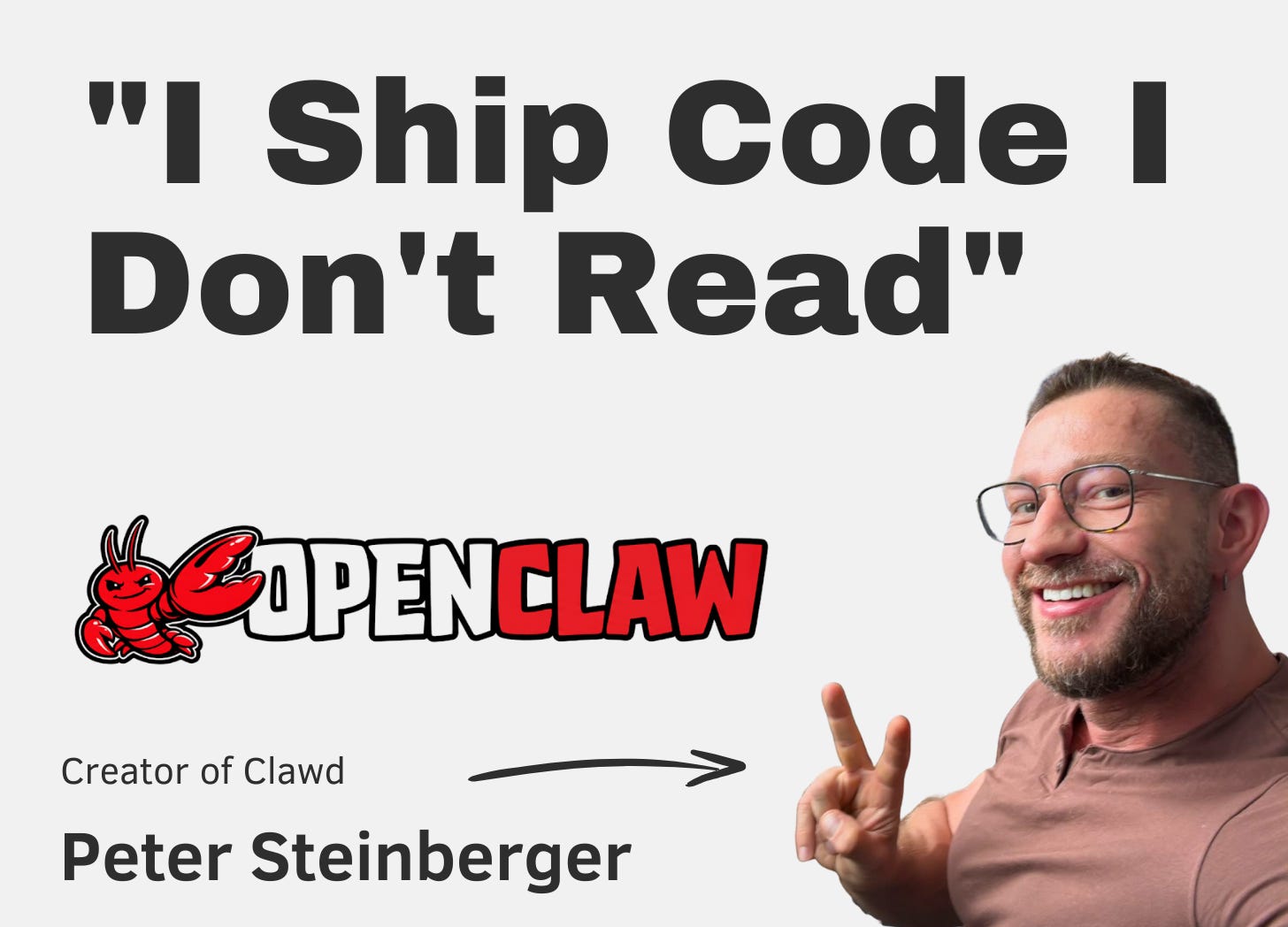
What if you could merge 600 commits on a single day and none of it was slop? This is what today's guest Peter Strainberger, the creator of Claudebot, claims he's doing. Peter is a standout developer who built PSPDF kit, the PDF framework used on more than one billion devices. Then he burned out, sold his shares, and disappeared from tech for three years. This year he came back and how he builds and what he's doing now looks nothing like traditional software development.
In today's episode we cover why he no longer reads most of the code he ships and why that's not as crazy as it sounds. How he's building Claudebot, his wildly popular personal assistant project, which feels like the future of Siri. The closing-of-the-loop principle that separates effective AI system coding from frustrating vibe coding. Why he says code reviews are dead and PR should be called prompt requests and many more. If you're interested in how the software in your workflow could change in the coming years thanks to AI, this episode is for you.
This episode is presented by Statsig, the unified platform for flags, analysts, experiments and more. Check out the show notes to learn more about them, the pragmatic summit on the 11th February in San Francisco, that I'm hosting with them and our other senior sponsors. Right, Pete, welcome to the podcast. Thanks for having me, Gage. It is awesome to meet you in person.
Yeah, I'm almost messed up. Yeah, what happened? You lost track of time. Does that happen often? And how so?
Not usually, not usually. This is an interesting time for me because my latest project is blowing up. Cloud, right? Cloudbot, yeah. Cloudbot.
I'm starting a bit to get in the sleep, but it's interesting. I never had a community blowing up so fast and it's just incredibly fun to work with. Before we get into Cloudbot and all the fun stuff you're doing, I want to remind all the way back. You create a PSPDF kit which is, I think, more than one billion devices, users, if you see a PDF render, you probably see that. But even before that, how did you get into tech?
Oh my God, how are you getting into tech? So I'm from you, rule Austria. Always more being introvert. So eventually, we always had some guests and one of them was a computer nerd. And then I got hooked with the machine he had.
And back my mum to buy me one. And then I was in high school or so. I guess I was 14. And then I started tinkering. I can remember everything was like I stole an old DOS game from my school and then wrote a copy protection.
But if I could sell it, it took like two minutes to load. I was just always tinkering. I was also playing old computer games, of course. But building stuff almost feels like playing a computer game. Like definitely right now, it feels better than Victoria.
I went and studied out. I went like a lot of best scripts for Windows. And then I did websites. So I guess a little bit of JavaScript. I even had to know what I was doing.
And then the actual first language where I had to learn how to build things is when I started university. And I never met my dad and I come from a poor family. So I was at work. I had to finance my own studies. So when other people were having holiday, I just worked full time at a company.
So the first real job I had was in Vienna. It was supposed to be one month. And then they kept me for six months. It was just a bridge between military and my university. And I kept working there for like five years.
And I remember the first day they gave me this huge book. I mean, that huge. And so it's Microsoft NFC. I still have nightmares. And I got like, I was like, this is terrible.
Like for the next one, I just silently used .NET. I just didn't tell them. And like a few months ago, I was like, yeah, I did a few organizations. But when it was too late, I did this a few times in this company. I don't know why they kept me.
No, because my shit worked. So I did .NET. And I actually actually take a .NET 2.0, like, generics. It took insanely long for the application to launch because everything was compiled at first start. And like, your heart is like, if you remember.
So how did you sample into both iOS and where did the idea from PSPDF come from? Not even the first one, first one was in the way in Austria. A little time goes on and I was at university and a French from the iPhone. And I think I touched it for a minute. And then I made a big board one like this.
Like it clicked when I felt it. And then to me, this was like a holy F moment. Because it was just like so different and so much better. So I got one. I was still not thinking about building for it.
You know, I was there was one was this 2009 time. So I was like, yeah, and then I used a browser. I can see the story. I was literally driving in the subway. And by the time I was using a gate dating app and this was iPhone OS 2.
Yeah. So so I want time ago, I typed this long message, I pressed send and we were just going into the tunnel. And the JavaScript is able to send button and then an error message game. But there was no copy paste. There was no screenshot.
So I was just like, and I couldn't scroll anymore. Because like scrolling was disabled. Like this long message was like a little bit emotional was gone. And I was so mad. I was so mad.
I'm like, what the hell? I'm in home and I downloaded it. It's called that's where the window came and it was like very steady. So I was like, like, I was like, this is unacceptable. I basically hacked the website.
I used regular expressions to like download to parse the HTML, which is like totally not something you should do. And I built an app and I used I used iPhone, I was like core data in beta, reg. I used a hacked version of GCC that backported the blocks compiler. So I could use blocks in iPhone, I was three, it took me quite a while to anything work. It was like, I had no idea what I was doing.
And I was like using all kinds of like beta tech, but eventually I got to work. And I wrote that company was like, I'm making an app. What do you think about it? No response, of course. So I was like, that's just putting the app store.
And this was for the dating app, right? Yeah. So you just like, you know, you look at the API, you could just like easily like build a client. API was HTML. Oh, I was just literally parsing HTML.
Oh, so you kind of parse HTML kind of turned it into your own, you know, like each user as an API. Clever. I mean, this is back in the day where no one thought this would happen. But I made, I put it in the app store. I charged five bucks for it.
And I made like, NK in the first month. And I had no clue what I was doing. So and it was like so many complex tech stuff. This was very early on that there was a lot of weird forms on Apple. So I just put in the bank account for my grandpa.
And then one day my grandpa called me, yeah, something is weird. Like I got this huge payment from Apple. I'm like, get his mind. This is mine. Don't touch it.
But the funny thing was when I this blew off and I remember I was in the club one day and like I saw someone using my app and I was so proud. And I want to go back to everyone, the show and say, I feel this and I was like, really weird. So I didn't. And then I went to the company. I worked for five years and told them like, I'm going to pursue this.
This is really exciting. And my boss was like mocking me. I really like, oh, you're making a mistake. This is a fat. This will not go blah, blah, blah, blah.
Anyway, that got me. That's what you call me. It's a chip on your shoulder. I'm like, you know, one day I'm going to have a company that that's was more money than yours. It took me eight years.
So I got hooked up like I worked. I'm a little bit of personality. So which you see again right now, but I worked a lot on this. I learned. I learned in high speed.
And this was the time I started Twitter. And that was usually hugely influential for my career. I made this actually quite good. And then one day I was at a party at 3am. Slightly intoxicated.
And I got a call from a US number. The guy on the phone was like, yeah, hello. This is John from Apple. Yeah, there's a problem with your application. Like some people reported pictures.
And that was it. That was the end of my app. It was going to go faster. And I was just I just quit my job and was like, well, a few Apple. I did freelance work.
I was at that job. I was introduced to that. So being the PC. Yes. Sorry for the term.
I was introduced to someone as one of the best iOS developers in Austria at a bar at 2am in Francisco. And I basically got a job in the US and then I moved to the US for a while. And then I went to the Nokia development days. And this is all like Stone Age. Why not?
Oh my god. And then someone came up to me and said, yeah, they built this app. Something is in Europe. And it works, but it crashes sometimes. And it was like a magazine viewer.
Right. It was back when the IP address came out and Steve Jobs said that like, this is a CDM. So everybody was building magazine apps. And I was like, that sounds like an interesting short term gig. And I was like, OK, I'll, I'll, I'll have you out.
And I opened it up and it was like, oh, the worst code of all the iOS that I've ever seen in my life. It was literally one file with like thousands of lines of Objective C. Yes, where they used Windows as tabs. I didn't even know that it worked. That was the price is worth it all.
And I felt like a house of cards and I tried to, I tried to search it, you fixings, but I guess somebody would touch something, something else would break. So I got it. I got it. I got it. I was able.
I told my book. This is like madness. I'm going to rely this for you. Nobody took a year. I'm going to do it in the months.
Wait two, two months. I wasn't that far off. And then he was working on a PDF. You know, I have a technical problem. The domain is is, I wouldn't say like completely unimportant, but you can always find interesting problems in every domain.
And that was a lot of interesting problems because you had a C call that would run the repeat F that would maybe take 30 megabytes, but also 60 for megabytes. So if you're not very smart and like, I'm very careful of what you do in the background and when the words which is kill you, I got really fixated. They're like making it good, like the rotation is like the page with like any mate. And so, so, you know, I like, I like those details. I spent way too much time on that.
That's why I took two months instead of one. But the end result was good. Um, and then I worked with them for a while and then a friend texted me up. It's like, yeah, I'm working on this next thing that's really hard. And like, no, wait, it's hard.
I know. Like I did that. You just built one. And I was like, can you, can you, can you get me the code? I'm like, sure.
That's sort of him. Like I expected the part that was PDF from, from this next now. And I'm, I'm sure, I'm sure like the other person was okay. And then I sold him that. I was like, well, if he's interested in that, why let's not try to tell it to other people.
And I used a WordPress template and mutilated it to run on GitHub pages. And then, and then when you did the fast and flow at the end, you got a drop box, link to my personal drop box with a source code, zip. And for this, not one afternoon, I tweeted it. And, and then in that week, three people bought it. It was like, I guess 200 bucks.
But back then, and for me, this was like amazing. And not only I got like three people who just bought it and like 10 emails, 10 people complained about it because they wanted it, but it didn't, didn't have the features they wanted, you know, it's like, I got nerd sniped. I was like, Oh, I didn't have text selection. Oh, how can it be? Three months later.
Oh, yeah, it's really hard. Text selection in a PDF specifically. Yeah. Yeah. Yeah.
You know the saying, the saying like the companies about young people because they don't know how it is. Yeah. Yeah, I had no idea when insane madness. This file from it is. Peter was talking about how some problems look deceptively simple.
PDF rendering is a good example. You look at it and think how hard could it be? And then you spend months on edge cases that you didn't even know existed. This looks easy until you build up patterns, shows up in other places too. Internal tooling for feature flags and experimentation is a classic example.
Teams often underestimate how much work it is to build the infrastructure around these tools. There's a reason big tech companies like Uber invested years into building internal experimentation and feature flagging systems, which brings to static are presenting partner for the season. Static gives you the complete toolkit without building it yourself. You could feature flags, experimentation and product analytics, all in one platform tied to the same underlying user assignments and data. In practice, it looks like this.
You roll out a change to 1% of users first. You see how it moves the top pipeline metrics you care about, conversion, retention, whatever is relevant for the release. If something goes wrong, instant rollback, if it's working, you can confidently scale it up. Companies like Notion went from single digit experiments per quarter to over 300 experiments with static. They shipped over 600 features behind feature flags, moving fast, while projecting against metrics regression.
Microsoft's Atlassian and Brexit used that for the same reason. It's the infrastructure that enables both speed and reliability at scale. Static has a generous fee to get started and pro pricing for teams starts at $150 per month. So learn more and get a 30 day enterprise trial, go to static.com slash pragmatic. And now let's get back to Peter and why rendering PDFs was a surprisingly hard problem.
But now I remember it was a few weeks ago, someone emailed me, they did something PDF from the one at my help and I just wrote them like, I did my deeds. I know more about PDF than any, any senior person ever should know, I mean to therapy. Good luck. But that's too well for now. And I just, I was waiting for my visa.
I worked on this project and I just kept on. More people kept on buying it. And you know, it was like, it was like summer, I was like lying at the lake and got another email that someone bought it for 600 bucks, 800 bucks for just up to prices as it had more features. And by the time I went to San Francisco to work at this company, it already made more than what I made there. But my whole life was, I still, I still saw like, I have to be there, you know?
So I did it. And also interestingly, at this company, I had to... So wait, wait, wait, wait, wait, wait, you moved to San Francisco? And of course, also it ended up being something where I had to build something with my framework at the company too. But you know, startups are not like eight hours, a little more.
And my personal project was also a little more. So my sleep was a little less. And then eventually after three months, Sabine, my manager came over and said this, I'll get me a choice to either keep working at this company and drop my project or vice versa. And I had one week to decide. The counter was one week to stay there or leave the country because I was on a complicated visa.
And when the decision was quite easy, it was like, yeah, I'm gonna do my own thing. And then at this point, it was already taking off. You already saw that this is there's a big business here. It will probably pay you as much as your US job would have paid. That's never my new driven.
It was more about what were you driven by? I want to make stuff that other people kind of amazing. Like I I love tweaking the details. I love those little delights. It wasn't even that the space that we're comparing in the space.
But my anger was always like, I built something as if Apple would have built it like with like all the love and care and polish and those little delights that a lot of people in the industry don't get. So even though we had compared those to Hilimah features and were around very long and my company was more successful. My product was more successful because developers tried the different ones and mine just felt the best. I think stuff is all about how it feels much more than the feature set. Like what we buy Apple stuff has more features than the windows, but it feels better.
So how did you go from like you you left this company and you were building this PPDF component that started to sell at what point did you hire the first person realizing, okay, there's something more to this. When I went back to, you know, I know it's like, okay, I have to go all in. And that's where I started working this freelancers a little bit and I'm way too late to be honest. I could have heard of hire much earlier, but you know, you know, it's a big step and that's kind of where it started having a life of its own and I spent pretty much certain years of my career, building this product with this weird name that I never changed because I took me like five minutes about it. And then it's stuck.
Yes, we have it. Yes, we have it. Finally, we did a rename, but I wouldn't have renamed it. But now it's a mouthful, but it's very unique. Well, you get it if you do object, you see because it's a name space.
Yes. And by the time it made perfect sense. My marketing, my strategy for marketing was always, I only care about the developer. Like, I know like upper management decisions, but if I can convince the people inside the company, they all do the marketing and lobbying for me. That worked really well.
We never did like cold, cold emails or aggressive. It was all inbound. All we did was like make good stuff and write in set full technical blog posts that and I went to a lot of conferences. Like the main part of it was, okay, if people understand that the people who built this product are like, know what they do and love what they do. That reflects on the product and that that worked really well.
And what was the tech style behind PSP? Did it was it objective C? Was it later Swift? Were there other technologies like C or anything else? We eventually expanded to all the platforms.
Big Shift was the switch out Apple's renderer, which was an years still quite buggy to like a big Z plus one that one then we used across all the frameworks. We were really early this web. We were one of the first PE frameworks that ran in that assembly. And I did the most clever thing that it was the very early days when I was taking off and we built a benchmark and that benchmark was eventually used by Google and Microsoft and Apple. And I basically had all these companies like working really hard and making my renderer faster because they used their benchmarks as one of their benchmarks and the benchmarks was like rendering our stuff with our shit.
Nice. And then as a company grew one thing that I remember about PSPDF kit, you did write a lot of blogs and one blog in 2019. So this was about like, I think, you know, your nine or 10 in the company. It was about how the team worked. And you mentioned things there, like every feature starts with a proposal.
You mentioned that you are conservative because it's a big API that people use. You want to be careful. Things like the Boy Scout rules, it's a very factor. How would you kind of put together the culture of this now? This team, which was now closer to 30 or 60 people?
You've actually 70 and I sold my shares and now it's almost 200. And I knew right from the get-go is like, I'm not going to find the people that I need in Vienna. So it was always just like remote first. And eventually we ended up with some kind of hybrid model, which made things a bit more complicated. I learned a whole lot on the go.
Like I never had the urge to be CEO. I always was coding. I even I brought people in to people that helped me a lot with other parts and on the business side. I can do it. And I think I'm quite good at it.
I just don't enjoy it. Like, you know, sales calls, where you like have to like think about a magic number, how much it would be worse because that's how enterprise works. Or. Peter just said, ah, the worst about enterprise sales because selling to large companies, enterprises is as tricky as it gets, not just because you need to get pricing, right? But because of all the enterprise features that you need to build.
And this leads us nicely to our season sponsor, WorkOS. If you're building with AI agents or automation tools, here's a problem most teams don't think about it first. Once an agent can take actions on your behalf, you need to control what it's allowed to do and traditional auth just wasn't designed for that. That's why WorkOS introduced MCP auth, which gives teams a way to authenticate AI agents with explicit permissions, all visibility and enterprise based security. Instead of sharing overscoped API keys, you can define clear boundaries for the data that agents can access and the agents they can perform.
If you're building AI powered features and want to fast without compromising security, check out workOS.com slash MCP. And with this, let's get back to Peter and enterprise pricing. But there's also the only thing that really works on more like this. Yeah, you mean enterprise sales specific, meaning custom pricing. So can you sell us for for dev listening who go to a vendor's website and they're frustrated that there's no prices that's called us or you're sure meeting why that is?
That's because we go and look at your company and I just take the dice and think about the number that you're probably willing to pay. And that sounds horrible. But also when you have a product where you can't really tear it down to a specific number, like it makes a difference if a freelancer contacts us or one of the big fortune for hundreds. That's not saying names. Because they use it to be different, the value they get out of it will be different and charging the same.
You would either exclude one or the other. If I go to low, they're going to see this fishy. It's like a procurement for like half in the box, we're not going to even start the process. And if we target to high, we're going to lose those people. So it's horrible and unfair to process scenes for some kind of products.
It is the most fair way after all, you know, on software. There is, I would say there's like four access that's like easy and hard and interesting and not interesting. We were very much in the not interesting and hard part. If you build something that every developer wants to build, it's going to be a hard sell. It's a hard sell.
Any hard sell, any other selling, anything to developers is a hard sell. Yeah. But if it's too easy or too interesting, good luck. But if it's, oh, God, I don't want to do this. And oh my God, this is hard.
That's a good spot to be in. So I found a really interesting niche and there was just an infinite number of complex problems. You need to tell me one or two hard things about parsing. How hard could it be? Yeah.
There's a specification. I'm an engineer. I know specifications. What's so hard? I mean, it was just one example where, you know, like PDF is links.
So like a table of contents and click on it and it goes to like page 37. So I built this whole model with assumption. Oh, yeah, maybe there's like a hundred or a 400 links in there. And then we got this one customer and we like paid really good money. And then it's like, oh, it takes four minutes to load the PDF.
What the heck guys? And I looked at it and it was like 50,000 page text Bible from Canada. And it's like 1000 pages. It had like more than 100 links per page, 500,000 links. My data model completely exploded because my assumption was off by a number of 1000.
But by then you have like a mutual product with an API. So like, how do you, how do you completely redesign the internal part without breaking things for everyone? Like suddenly everything has to be lazy, but before parting 101 was easy. But now they were like, this was like so difficult to keep it working for people. I think I spent like two months just on that, completely redesigning like the internals and like making sure it's still easy for people.
They don't have to know what we what we are, what we are, what we load lazy. Or if you copy the thing, it still has to like have to keep some connection. And it's a good reference and some of those things. So I'm sorry. And I love to support.
And I think that that was a confining factor why the company worked. Because if you send a ticket and then the CEO replies and helps you out, that has impact and my strategy was always like, I always used to listen to reverse. Because if you send a ticket and you get a reply, it's in five minutes, that's magical. If you wait one or two days, not much difference. Yeah.
So yeah, this was one of the problems I worked two months and I finally got it done to almost like this. And it was very satisfying. And you were writing a lot of the code or you were involved in a bunch of the code. I was a big, big team was now here, but you were still kind of overseeing. Right.
I mean, the details, I mean, of course I had a really great team and some parts I was more involved. I was always more involved in mobile because that's when my heart was, but it was always very deep in the tech and the marketing side of this inside, I had like, John Essen's house, I had my inside. Those I found good people. And the thing is, if you like the blogging and writing about how you sort of interesting, how problems will help you hire interesting people at one of those interesting problems. This is what I remember at PSPDF that your blog was every now and that it made it to Hack and use well, but it was just interesting to read.
And I couldn't name again, I'm not one into PDFs, but if I had to say something PDF, I would have said PSPDF because they're the only ones where I read interesting, interesting, and dream blogs about how you optimize your ship. It's still there, by the way. I myself also sometimes ask myself, like, interesting, do more companies not see this? Or is the question that you need to be a developer who's either to see or up there who just likes doing this? And by the way, did you ever write this thinking this will be helpful or you just wrote because you got something out of it, like putting out that you solved this hard problem?
I like sharing and inspiring people. Um, there was sometimes even conflicts where we were actually right about this because it's like a little bit of secret sauce, but I just never listened to the voices too much. Um, I just, you know, there's also like when you, when you write something down, this is just principle of like, you understand it, but then if you want to teach it, you really have to understand it. So to me, it was also a little bit like, oh, yeah, I worked in this really hard problem. And now I want to like preserve it and like help others.
So I got, I got a gig of it. Of course, I liked the attention. Um, but really it was this sometimes I just referenced a year later to my own pulses. I get this, this is a, this is both company documentation. This is like my own look, but it's helpful in so many ways.
And a lot of those bigger companies. Oh, they put on too much red tape. There's a lot of developers that don't really like to write. So I, I, I forced everyone once a month, a full day just to write about post about you getting a time here, like that day, you don't need to do any of your work, but write something. Yeah, you have a day to come up with a post.
Days is quite much actually. I mean, when I'm now, I just want to write posts and still takes me a few hours. I don't want to dwell too much on like the, I think that the starting time of the company is the most interesting, the, the, the, the growth phase. You get more of a tape, you get more people, it's much more gardening your product instead of like doing, doing white hacks and more iterative. So, so you got a little bit less interesting over the years and there was like more people drama is the more, the more people you have, the more issues there are.
And I didn't enjoy it that much. And I was really, really burned out. What burned you out, you think? I was just burning too hard. I was working most weekends.
I, I tried to shuffle all my material needs. And you know, as a CEO, you're basically the racepin because everything, everything that other people don't manage or can do or mess up, you have to fix. And it was quite lonely because you can't openly talk about a lot of things. I mean, I, I, I started the company to be quite open, but still, like you cannot, you cannot be negative. You have to, even if, even if like, even if like really bad stuff happens, I know that was like, one weekend when my co-founder called me at 5 a.m.
And told me like, yeah, this big airplane company and their planes are down because I was off just crashing. That was a very interesting weekend until I could like disassembled their, their app and did proof that they messed around with our source code to triggering, triggering a licensed key fallback that eventually like cost you should have. But that was like a, if the source company's gone and more moment. Um, and that's just on top to all additional stress. And there were quite a few of those things.
You can do it for a while. And I also believe like burnout doesn't necessarily come from working too much. It comes more from, or at least for me, when you, when you work on something, but you don't believe it anymore or you have like too many conflicts. And we also had a, we did fight a lot in the team, like management team. And by the time I, I made this mistake and I thought you have to like lead the company more democratically.
Um, so that was something that brought me out. I wouldn't want to miss it for a while though. Yeah. So, you know, from the outside, it seems you sold your shares, you made enough money to not have to work again. Should you not choose them for a lot of people?
Like, you know, people were starting out their business or one day, one, the sort of business. This sounds like the absolute dream. Like this is, I guess what we know realistically that most people will not make it. But if you make it, I mean, you kind of like, I guess, you know, checkbox done, you're kind of it's a little bit, if you're like climbing on a wall and you're in the bell, you're done. And then what I noticed is from the outside again on your blog, the blog post completely stopped for several years.
What did you do in this time? Uh, and what, what did you learn in this time? You'll be forward. You came back to where we are now. I needed a lot of time to decompress.
I, I catch up a lot on things I saw that I missed. I, I played a lot. Um, there were months where I didn't even turn on my computer. And for a while I was, I just didn't have this feeling of like, what should I do now? Like, like, it was definitely was like, white border, you know, you're not, you're not supposed to retire so early or like have so much, have such a good exit that you never have to work again.
That messes my mind quite a bit. But that was some, that was some hard years. And then in, in April, I was like, I, that was this idea that I had years ago. And even as I projected, I started and was like, yeah, I want to, I want to continue on that. And then after, after, after the morning, three years, I just sat back in my computer and started taking again.
But the thing was, this was like a Twitter analytics thing and it was written in, in Swift and Swift UI. And back then I already knew I would be so much better if I would build this website. So, so was this an existing idea that you kind of had at the back of your mind, something, something Twitter and all of that. Yeah. It was like something I wanted to build for myself.
Yeah. Cause, cause it didn't exist. And then even three years later didn't exist. It still don't exist. It kind of does, but I got a bit sidetracked.
So I went back and I wanted to build it in, in this web tech, but that was really, was always even a company. The one thing that I looked into the least because I had, I had some really smart to care of, of, of that side of the company that I brought in Martin. So never had to worry about it. That was one of the, you're not hands on what we are, any other stuff. I mean, I came back, I was like, what's the prop?
You know, that, that level where you, and you know, this is like, this is a trap. I see this many developers. The better you get at one technology, the harder it is to jump somewhere else. It's not that you can do it, but it hurts so much. You're like, like I can program in, in, in, in Apple stack.
I can program blind, but then in that stack, I have to Google the most mundane stuff. And it just like, it just hurts. You, you feel like an idiot again. Yeah. And I guess it's more experience to have it kind of sucks feeling.
I mean, I'm sure you say embrace and all that, but it's not great. You're not as efficient. You know that you could be faster, etc. And so I came back and I was like, gosh, it has to be, it has to be. What is this AI?
What is this AI stuff that the people are listening to? That's looking to this. And in April, a lot of us were this listening. I probably for rightfully so, but. And I, and I, like, in, I, to a degree, I credit those three years where I basically didn't turn on my computer because in those years, you guys checked out AI and learned that it's crap.
Yeah. The, the people who like, as about to say, so you missed out on, you didn't do the beta of get of co-pilot, you know, glorified auto-compleach, which is GPC three or maybe not even. There was, of course, 3.5, which is a big jump and it got increasingly better than GPT four. And so by the time you came back, what tool did you first use when you, because you missed out on like two years of like, like, Devs, us devs using this missing, finding some. You use cases for it.
Oh, so you started with clock code. That I think I just came out it came out of May, but there was a beta beforehand. Yeah. I think they had something, they had something in February already. They had a beta from February, correct?
Yeah. So, so, so, what was your first, you, you come back after like a, you know, hiatus and you made a turn on clock code and you missed everything else. And, you know, it was like, I remember I took this big, messy site project that I built. And I have this browser extension where that converted security repository into one big markdown. It was like a 1.3 megabyte markdown file and I dragged it into, in the Google's studio, but it's turned me to 2.5 or two to something.
And I typed write me a spec and it generated those four hundred lines of spec and I dragged the spec into clock code. And I was like, build and then I continue, continue, continue, continue. And that was like working on other stuff, you know, and eventually told me like, it's 100 percent production ready. And I started it and it crashed. I'm sure we can all relate to the story of the AI saying the code is production ready and crashing.
This is a very funny and innocent story, but I personally don't trust code that AI generates without verifying it. And this leads us to our season sponsor, Sonar. So let's look at some data. A newer part from Sonar, the state of code developer server report, found that 82 percent of developers believe they can code faster with AI. But here's what's interesting.
In the same survey, 96 percent of developers said they do not highly trust the accuracy of AI code. This checks out for me as well. While I write the code faster with AI agents, I don't exactly trust the code it produces. This really becomes a problem at the code review stage where all this AI generated code must be regularly verified for security, reliability and maintainability. Sonar queue is precisely built to solve this code verification issue.
Sonar has been the leader in the automated code analysis business for over 17 years, analyzing 750 billion lines of code daily. That's over 8 million lines of code per second. I actually first came across Sonar 13 years ago in 2013 when I was working at Microsoft's Ice Skype and a bunch of teams already used Sonar queue to improve the quality of their code. I've been a fan since. Sonar provides an essential and independent verification layer.
It's the automated guardrail that analyzes all code, whether it's developer or AI agent generated, ensuring it meets your quality and security standards before it ever reaches production. To get started for free, head to SonarSource.com slash pragmatic. With this, let's get back to Peter and how AI agents cannot exactly be trusted. Then I had an edit at an MCP, so could use the browser. I think I played with MCP was already there.
I gave the few miles. And then I had a 3-hour login page and it did something. It was not great, but it did something. And to me, this was my holy fuck mind blowing moment. And this was like an April or May.
This was just good enough that I could see the potential. And I understood it was like, yeah, this is where it's going. And from that moment on, I had a few months where I had really trouble sleeping. And I remember, because once on Twitter I sent you a direct message. I was up early for valid reasons.
My kids or something like that. But it was 5am and I sent you a message on Twitter and you replied immediately. And I was like, why are you up? And I was like, oh, this is usual. Like I usually I'm still usually awake.
And I asked like, why? And you said like, oh, I'm just like using cloth and it's really, really addictive. And I was like, really? And you're like, yeah, I'm not joking. Like it's really good.
And I think that was the thing. You said something or wrote something like just one more prompt. Like you told me how like what made it so addictive or what still makes it so addictive. I was the same economics as you go to casino. That's, it's my little slot machines.
You know, you press the trigger and it's like, nope, you're doing the prompt. And it will go to the, the crap or it does something that actually builds your mind. And it's this. And you're saying it does, it builds your mind as like you're with experience developer. Like it's not easy to blow your mind, right?
Like you've seen good code, you can differentiate like crap code, decent code, good enough code. Like you have a bar, right? It's so funny, you know, in my company, I used to obsess over every detail, every spacing, every new line, the naming, I spent so much time backshading. And in retrospect, I'm like, what the heck, why did I do that? Like, what's the point that the customer doesn't see the inside?
Of course, like it has to meet some standards. It has to work. It has to be fast. It should be secure. But like how much did that bike shed there?
It's like, it's to be though. You say that, but then you also just said that people loved PSPDF because it was the most polished, it worked the best. Do you not think that that amount of carrying bike shedding, as you call it being obsessed? It sounded like you were keeping tech bed at bay, you know, like being obsessed with the Y spaces is not going to be messy. And we know it's not just the Y spaces.
We know you're going to care about testing and all that. Like, it sounds to me that PSPDF kit, like, you know, like what I see is you were not just building a product that was great UX, but you built something that had a really good hygiene and that's how it could be high performance and all that is. How do you think about it? Yeah, yeah, yeah, yeah. To degree, yes.
And even now, like, I mean, like my last blog post was confession that I should quote it under it. And yeah, we have to talk about that. And at the same time, I spent so much time to like restructuring. I mean, even today, like, I really wanted to get this PRN where there were like 15,000 line chains, right? In my list, I moved everything to plug-in architecture with I was so excited about.
And I care a lot about the structure. Did I read all the code? No. It's really just boring plumbing. Well, what are most apps?
Like, data comes in from an API in one form. You like, you parse it, you package into a different form, you store it into a database, and it's a different form. It comes out again into a different form than it's HTML or whatever, and you're typing something. It's a different form again. And all you do is like, you're massaging data in different forms throughout your app.
This is what most apps are. You're pretty chasing printers. And the really, the hard part is of my postgres 30 years ago for some networks. That's really what a lot of software is. Like, there's always some interesting parts, but I don't have to care how this button is aligned, which tailing class is used or, or like, many details are boring and many other details are interesting.
But I think it's much more about system architecture than having to read every single line. Right. Now jumping forward, what is your workflow like? Like when you're working on cloud bot, are using a terminal, multiple terminals, which tools, and how are you, you know, like you said you're not, you're kind of like not reviewing the code, but you're still thinking about architecture. Like, what does your average data look like in terms of tooling?
You know, you have to explain to a developer who might join the team, you know, at one point, you think like, what is it look like? It's interesting. Let's go a little bit where we were in April, this cloud code. And then I got really hooked. And then I did some, I had a face where I did cursor.
And then I did, I used Gemini 2.5 a bit. And we have this face with opens four. I hooked up a lot of my friends, like I know, I know both Armin and Mario from Vina, they got, they got a IPL because I was addictive. And then my end-user was like, confusing them and then they tried it out. And then eventually we're up at 5am.
And I called it like the back iCloud. I mean, I was the reason like I started the meetup in London and I called cloud code anonymous because it's a little bit like a drug because it's so, it's so much fun. To me, what blew my mind so much was this realization that I can build everything now. Before you had to really pick which side project you build because software is hard. Yeah, it's still hard.
But now like I am this friction that I talked about where I'm so good at this technology and I'm like, I'm like, I'm like, oh, let's make the ceiling go. I have no clue about go. But I have a good system understanding. And once you have that, it's like you develop a feeling what's right, what's wrong. Like it's a skill in itself.
I remember there was a tweet where someone said, oh, when you write a code, you feel the friction and that's why that's how you make good architecture. I feel the same friction when I prompt because I see the code flying by. I see how long it takes. I see if like the agent pushes back. I see if what it creates looks like messy or like makes sense.
When I prompt, I have a hinge already how long it's going to take if it takes much longer. I understand that I'm mess. You kind of feel the model. You know, you know, usually it's like this or if it runs. I feel it's very much something else.
It's like I learned to talk, maybe I'm going to say dare or dead language more. So like my knowledge how to use those things improved and also the models improved. And then like over the time between April and now I would say that inflection point was summer where it just got so good that you could you create software without actually writing code by hand. But the real that changed that like solid from us was again, GPT 5.2. That was again, I think it's underrated.
I don't know why all these people still use cloud code. I kind of get it. It's a different way of working. But whatever open here I cook there is insanely good. Pretty much every prompt I type gives me the result I want, which is insane.
Like on on on cloud part, the my latest product, I use between five and ten agents in parallel. If you're very much cloud code build, you have to forget quite a lot of the silliness that the things that you have to do to create good output with cloud code. I mean, I also met that team and they created the whole category. Like cloud code is is a category-defining product and it is amazing for general purpose computer work and it is really good for coding. I still use it almost every day.
But for writing code in complex applications, code is just so much better because it takes ten times longer. Cloud would read three files and be confident enough to just like create code. And then you really have to steer it and push it so it reads more code so it gets a bigger picture of your code base. So it weaves in new features better. And code is just like be silent and just read files for ten minutes.
And if you only work on one term, then that completely understands how you find this unbearable. But I rather have something where it's also you don't tell it what to do. It's also something that people don't get. I have a conversation with the model. It's like, oh, let's look at this.
What options do we have for this structure? Did you consider this feature? It's like, because every session is like the model starts from having no understanding about your product and sometimes you have to just give it a little bit of pointers. What about this? And this explores different directions.
And you don't need plan mode. Like, I'm just having a conversation. Until I say build this, it will not build this. There's some trigger words because it is, they're all idle trigger hungry. But as soon as I say, let's discuss or give me options, they will not build things until I say build.
So a lot of what you say, a lot of your prompting or a good part of it is this conversation where you are pretty much planning together with the agent. Yeah. Like I said, you remind them, it's like, okay, we need documentation. What would be good spot? It would give us recommendations.
No, it should be a bit of a bit of a page. We need a configuration. How does this fit into this other feature? It's like, I am designing the system because I have this system understanding about how this is my product, how is the shape looking. I don't have a line by line code understanding this.
That's what could extend us from you. But I'm the architect, you know, it sounds a little bit like you're almost, you know, for years back, this, this totally game got out of style, but there was this idea that you would have the architect with a capital A who used to be a software developer, but they're not hands on anymore because they spent a lot of time understanding the business and they have these developers working underneath them. And some companies still kind of work a little bit like this, but most modern companies don't, but some banks, et cetera, I met people there who are capital architects. They do the system plan. They've felt talked with fellow architects.
They have the blueprint and then they literally pass it down to the team and everyone hates this model obviously because, you know, again, like, I think as people, you kind of want more, the architect is never on call for the stuff. And so it just kind of breaks down and practice and a lot of large companies just move to the staff and your model where you're kind of all working together. Of course, there's people who make who might have more input, but sounds like it's almost like this world where you are the architect who kind of, you know, you have your little agents who do the code, except in this case, you are, of course, full responsible because you're still individual contributor. You're not like, okay, you might see your manager of agents or whatnot, but the code is yours. It's your responsibility.
You're going to be on call if you push out code that takes down Clobbot, which they just recently, you're on the hook for it, right? Like, and I think the difference in this system when it was in companies, it was the architect was kind of shielded from the output of their work because there's so much people and so much process, et cetera. Well, I wouldn't say I like the word builder builder. Yeah. And as it goes, that's there's a few categories that I see for people that are highly successful using using AI and people who struggle, I came more about the outcome, the product.
I very much care about how it feels and everything, but how the plumbing works underneath, I care structurally, but you know, not to the, not the biggest detail. And then there are people who really love to code on hard problems, like think about algorithms, don't really like the, I'm building a product with like all the marketing, they more like, they like to solve hard problems. And those are people who really struggle and often reject the AI or get really sad because that's exactly the job where the AI does. Like, it solves the hard problems. Sometimes I give you some pointers, but many times I learned more this year than the last five years around software architecture and designing.
There's so much insight, those monsters on knowledge. And everything is just a question away, but you have to know what questions to ask. Of course, I also put this Twitter thing and it's still not done and I really hope I architect it at one time. Everything worked, but if I used it more at some point, it seems really laggy and weird and then it worked again. I just couldn't figure it out.
And it was like really difficult to debug because it was not easy to reproduce. It was just like, you use it more and things were really slow. I basically had like software in, in, in, in PS well, like in postgres that would be triggered when certain incidents were doing and then the database would, would get really busy. And the model couldn't see it because it was, it was, it was so far abstracted from all the, you know, like those, those models are really good at tracing through, but this was a side effect that was so hard to see because it was only in this one file, a function that had no connection to anything else, misnamed was not easy, grabable. I just never asked the right question until I was like, do we have any side effects for listeners?
And I found it, and I fixed it. And it's like, but everything is just the right question away. Yeah, but you need to have like knowledge expertise, experience. I mean, so, so these are people who are rejected and then the people who care a bit less about how it's been cloned internally, but they're just excited to build things, they're really successful. And one thing that also helped me is, you know, when you run a company and then you hire people, you can't breed on everyone's neck and like make them have the line of code exactly that way.
And there's a lot of people who didn't mention team that they had this experience, how to, how to relax a little bit and understand that, yes, this maybe is not exactly that code that I want, but it will get me closer to my goal. And for anything that is like, not perfect, we can always make it better and like put more time into it. I very much believe in this iterative improvement. I had to learn to let go a little bit of my company. So, so then when I, when I had to look code, you can feel like I have like, I have like imperfect sometimes silly, but sometimes very brilliant engineers that I have to steer and where we work together on a common goal.
It's what I look like being the boss again. And interesting. You built kind of software, I guess the traditional way, you know, pre AI for 15 years or even more than 15 years. And you got really good at being also leading a team and how to have high standards. You really cared about the craft there as well.
You've now kind of been like a survive coding or working with agents for a year. You're comparing it to what do you think, what do you think really, really changed and what do you think are things that kind of stay the same despite all of the time? I don't like, I don't like to turn by a quote. I have to call it. I think I think I think by coding is by now almost a star.
I call it, I do what I do with agent engineering with a little star by putting starts at 3am. Now, because all the mundane stuff of writing code is automated away, I can move so much faster. But also means I have to sing so much more. I'm still very much in the flow. It is completely the same feeling as, for me, I very much in this flow state.
But it is mentally even more taxing because I have, I don't have one employee that I manage. I have like five or 10 that all work on things and I switch from this one part to this other part to this other part mostly because of I'm this and subsystem or like this feature. And then I know that it will probably take like 40 minutes or one hour to build. So like I want to have the plan right and then I build it and then I move on to something else. But then this is cooking and then I work on this and then this is cooking and then this is cooking and then at some point this is cooking and then I go back to this one.
So like I switch around a lot in my head and wish I wouldn't have to do that. Like I'm sure this is a transition problem. And at some point we have we have models and systems that are so fast that that I can parallel to the less. But to stay in the flow state, I need to massively parallelize. So that's how I go back to there.
And maybe tweak it a little bit more but usually just like try it out. Maybe then this is ready because this will only took like 20 minutes. So like I can't say jump around. Maybe there's one main project that has my focus and I have some set of projects that also need attention. But maybe it's been five minutes.
It doesn't seem like half an hour and then I tried and it doesn't need so much capacity up there. This almost sounds like two things come to mind. One is there is these games where you have to manage a kitchen with the employee and you see like recipes or something come out and you need to jump in and do it. And when I start craft, you know you have to go main days and you have like your site basis to give you resources. That as well.
And also one thing that just came to mind is you said like I go there and I watch this and I make a decision is when I see the chess grandmasters play multiple boards at once you see something they always all go there. They kind of you can see that they just like see what's on that board. They make a decision and for some boards they suffer longer. I guess better players or better opponents. It feels you know both they're occupying 100% of their brain.
You're occupying your brain. You're kind of scaling yourself as long as you can contact switch. The difference the difference was up until this was cloud code. You have to work a little different because it is much faster. But then the output often doesn't work on the first try.
Like it makes something but then if I got to update three other things it crashes or you give it. The good thing about how to be effective with coding agent is always like you have to close the loop. It needs to be able to debug and test itself. That's the big secret. That's something I think that's part of I got so much more effective.
But the obvious was cloud code. I often had to go back and like fix up the stuff or it just takes a lot of iterations. So in the end it's not that much faster. It's just more interactive. And these days was quite like it just almost always gets it right.
My general strategy is always I build a feature. Of course you always let it write tests and you make sure that it runs. It runs. So even when I write a Mac app. I know I just yesterday debug this feature.
The Mac app couldn't find a remote gateway. But like the same code in TypeScript could. But Mac app is kind of annoying to debug because it builds it. You have to start it. You have to look at it.
You have to like notice it's not working. So now I just tell you like you're going to build a CLI just for debugging that invokes all the same code paths that you can call yourself and then you just iterate and fix it yourself. And then it will just cook. When I took cook for an hour and it was done and I told me that I was in a race condition here and like a misconfiguration blah blah blah blah blah blah. It's not sensible.
I don't need to see it. But you don't only see it because you set up the validation loops and you trust that because it ran it. I mean, this is I guess it's not too dissimilar to like sometimes we work on a large project, a large company. When all the tests pass, I mean, it doesn't mean that 100% is there. But it's it's a pretty good and all the new new code has test as well.
You know, someone thought about it and tested and all that. So even on the very list project, we always had bugs for like anti gravity has like a certain weakness with how it takes to calls in the loop in the format. So you have to look some filtering. Yeah. And I broke a bunch and it actually took me way too long to realize like, what am I doing here?
I just need to automate this. So I was just going to call this like design life test that spin up a bit or continue on. Install the whole thing, spin up a loop, use my API keys from this and this file. And then you tell the model to read an image, create an image before and then look into the image and see what it sees. So I don't not just tell the loop.
I'll still tell tool calling, make it work. And then it's off to forever, but it tested all my API keys like from anthropic, I'll say that I will, like everything and it fixed all those little indices where sometimes the tool calling didn't work. I was ordering was wrong because I closed the loop. And that's that's it's in closing the loop. You mean just have a way to have the agent be able to validate its work.
That's why that's the whole reason why those models to be currently have are so good at coding, but like sometimes mediocre good at writing creative because there's no easy way to validate it, right? But code, I can compile, I can link, I can execute, I can verify the output. If you design it the right way, you have a perfect loop, like even not for websites. I built the core in a way that can be run via CLI. So it's like, I have this perfect execution loop because the browser loop is insanely slow.
You want something that that loops fast. So sounds like one thing that is not really changing from like before is we had this before like backend or business logic, we have a heavy thing could easily be or more easily be verified that it's correct. I'm surprised actually using a tent decoding makes you a better code because you have to have to think harder about your architecture. So it's easier, very final because verifying is the way how to make things good. Well, then remember back back even before AI for complex systems, like once you got someone who built these things before, what they started with, how do we make it testable, right?
Like you need to design interfaces, classes, testable, you need to think about like, am I going to fake things? Will I use mocks? Will I use end to end testing? Which will be long, et cetera. But these are like really hard artificial decisions.
And once you make them, they're like, it's harder to change. And in your world, you know, like the model would cook a lot longer if you ask it to make a massive refactor. And if you have tested, it'll get it right. But you know, it's not these trade offs. It's still software.
It's I would say I write better code now that I don't write code myself anymore. And I wrote really good code. But like even back in the company, sometimes testing was so tedious. And you come up with all those edge cases and the branching. I mean, outside of Kent Becca, I deeply respect that he was on the podcast.
And we talk like he still writes tests first and he tells me that I'm doing it. He's not mad at me for not writing it. But if you want to write like, you know, poor quality code, it's on you. But I don't know many developers, myself included. I never liked writing tests.
And even when I pretended that I did, I just never did this a little bit like writing documentation and writing tests. To me, it was never a creative expression. It is so good. Now, like I would say from a last project, I have really good documentation. And I didn't write a single line myself.
Like, no, I don't write a test at a little documentation. I explained the model, the trade offs. Like why we did something like this and then tell it like, like write that, right? The intersection beginner friendly and the more technical detail at the end. And it is so good.
I never had a project with that good documentation just by every time I decided to feature this as a part of this part of the process. And I was like testing. I was like, OK, we built this. How are we going to test this? Yeah, we could do this and this.
What if we build it this way? And then we can test it better. And it's like, this is not part of my thinking because I always think like, how do I close the loop? How do I, the model always needs to be able to verify the work itself, which automatically steers me to better architecture. So why do you think there's a bunch of like experienced devs who are still pushing quite a bit back on just like the idea that AI can do a lot of this?
Never said we could go. I stumbled over a blog post by my galahaga, Kogogos love that I deeply respect and learn a lot from. And this blog post was just was a dissing of the current way, how models work. And what he did was he tested like five or six models, including some that make no sense, like the the open AI 120 billion open source one. And it's not good enough to write good code.
You know, it's like, and he just he wrote the prompt as far as I understand it. There was not a lot of information left. But to me, it sounded like he would have prompt. He put it on cloud web and he pressed send. And then he took the output and ran it and it didn't compile.
And it was disappointed. But he's like, of course, it did not work. Do you think I can write bug free code on the first attempt? And those little those those models are ghosts of our collective human knowledge. They work very similar in many ways.
Of course, you don't get it right the first time. Like there will be mistakes. That's why you have to build a feedback loop. And also you don't just send a prompt to the model. You start a conversation.
Hey, this is what I want to build. He complained that he used old API. Hey, you didn't specify the macOS version. So it made an assumption to default to like old API, because that information was missing. And it is it is trained on a lot of data, not just the last two years.
And there's just more old data than new data. So this is like the more you understand how those little beasts think, the better you get it prompting. And then he spent maybe, I don't know, a day or something on planes it. And then just decided that this technology is still not really good. But to be effective, you have to spend significantly more time.
You know, it's like, it's like, you know how to play guitar and I put you on piano and you try to be like, oh, this sucks. I'll go back to my guitar. No, no, it's like, it's a different way of building. It's a different way of thinking. You have no idea how often I screamed at like 3 AM to cloud code, because it did something silly.
I slowly started to understand why those things do, what they do with like exactly the way I tell it to do things. And sometimes you can literally ask, you can even even ask to like, for this project, the last project like, I feel like a human merch button, because the community is like blowing off and all I do is like reviewing guitars. I have very little times actually like code myself anymore. And in the beginning, it would often like just cherry pick things and look close to PR and I was like, so I know it. So I was like, why are you doing this?
You have any you say this and this and this and this and this. I was like, I learned the language of the machine a little bit more. I tweaked my prompting and now I get exactly what I want. Because it's a skill like any other skill. Yeah. And this is like, I was saying the same thing,
even though I've been using it for years and I think everyone, I think once I start to realize like, I'm not okay, I could do better. What if we put this to a real test? Because I think it's fair to say that right now you're building Clobbot, which is a, you know, it's not something that generates revenue. There's a lot of users and it's blowing up and it's a really cool tool. But it's not PSPDF kit, which is a business that is a lot of revenue as a hinging over it.
If today, you know, which is white PSP that is not as is, you need to rebuild PSPDF kit, you now have these agents. How differently would it look? How much would you trust it? What would you delegate? What would you value?
And when, you know, you built up a team around it because now it's a profitable business at the very least, you need to hire sales people, whatnot, how do you think the team would look different today with that same product? Because you know exactly what it took to build it. And you also know what these tools can do today. I could easily run a company with 30% of the people. It would probably be quite difficult to find people on the level.
But you want, you want to have really senior engineers that really understand what they build, but also comfortable in delegating. And know which parts are actually important to work on and which parts I can vibe. That's still something I don't see a lot. Like, especially in the EI world, there is so much crap on Twitter. There's so many people that are loud, but clearly have no clue what they're doing.
Oh, yeah. There's so many dumb concepts around, like, I'm sorry, but the Ralph Wiggum one. Like, this is again another silliness people use to work around model limitations of opus. You don't even need to use corrects. There's maybe a few cases where you have a really long list of individual tasks.
That can be automated, but that's usually not how soft the building works. So there's these people who I see so many people building up this and elaborated orchestration layers, and then you have like, please, that all many creates tickets and then your agent does tickets and then your agent emails the other agent and then you build up this elaborate mess. What for? Oh, yeah, they did design the spec for like a few hours. And then it just like the machine builds it in the whole day.
I don't believe this works. Like, like this is this is you. This is the waterfall model of software building. This we learned long ago that this doesn't work. Like, I mean, yes, people work differently and maybe it does work for some.
I just I just I don't see how this how this could work for me. Like I have to start with an idea and often I purposefully under prompt the agent. So it would do something that would give me new ideas. Like maybe like 80% of the things are soon, but like crap. But like, they're like, I don't think they're like, oh, I didn't think about that way.
And then I iterate and shake the project and I have to I have to click it. I have to like I have to feel it. I feel I feel to make good software. I you know that one single those those things often like leg is taste. I have to feel like how does this feature feel?
And then the beauty now is that features are so easy. I can just like throw it away or like replant it. My building model is usually very much what would it's very rarely that I actually revert and have to go back. It's just like, okay, no, let's change this. No, let's do this.
And it's like it's like shaping a lot of this like you start with a rock and then you like sit away at it and like pick different areas and then slowly like this statue emerges out of marble. That's how I see that's how I see building something. I guess reflecting on how software engineering is changing. This seems like a change because before before we had AI or any of these agents upfront planning did make a difference, you know, writing at PSB of you and this that I think to have a proposal where people put a lot of thought up front to specify and do because it was expensive to I guess to build to do you think this is changing because of the cost of just writing code is going down or I mean, it's still a plan.
But you still do yes, but I don't put as much into it because it's not so much easier to just like try and look at the results and then see if oh yeah, this shape could work or no, we have to like the tweaking and even like oh no, we have to like do it a completely different way isn't so much cheaper that it's to me it became much more playful. Yeah, I guess because like, you know, when you're working, even if you have like a new grad on the team or an intern, you know, you give them something they were working for day or two now, it's not a day or two and we're not talking days here, we're talking minutes or like if it's a long running task like 10, 20 minutes at worst plus you're not just waiting on that thing, you have parallel things running. So it's not that much of a waste if you will in the beginning I had this assumption of like one agent and then it changed to multiple agents and there was an assumption of like one provider, like what's up and not some multiple ones and changing that was like such a pain would have been such a pain if I would have written it myself because you have to weave in literally everything through the whole logic of the application and yeah, it took quite like three hours, it would have taken me like two weeks, you know, so that upfront planning I could have realized that in the beginning but now
I know that like I can just change things and it's much easier to work on your technical depth or your you know, you evolve, are you think about a project as you build a project? That's why I don't believe in I don't know things like gas town where like you write it back and then you build it self and then it's done how can you even know what you want to build before you build it? You learn so much in the process of building it that will go back into your thinking of how the system actually will end up being to me it is very much it is very much a circle until I don't you don't walk up the mountain like this you go you go around and sometimes you like you straight off a little bit of pause but eventually you reach the top that's that's how I feel it's Australia's then you know you've been building cloud buffer but like two months three months non-stop yeah sure let me let's switch a little bit here so one of the ideas that got me back was even in April May was I wanted to have this hyper personal assistant and not like not like one that says I'm good morning email all these are your three tasks no one that has a really deep understanding
of me and doesn't just I don't know I meet a friend and then when I go home to think hey how was how was that meeting or one that would wake me up one day and say hey you haven't texted Thomas in three weeks and I noticed he's he's in town right now because I checked his Instagram account you want to say hi or something that says hey I noticed every time you meet that other person you said why is that like something something that is deeply personal like almost the anti-warm it's kind of like the movie her but but that's where technology is going those models are really good at understanding text they they're the bigger the context is the more patterns they see and even though they're like matrix concolations without a soul it very often feels different so this was like one of these ideas and I even created a company I called a mantasmash machine like the loving machine but in summer when I exploded the models went quite there yet I got some results so that was like okay this is like I'm a little too much on the edge of what I need right now which was very exciting because I know that the state of the eye goes so fast that I can just revisit that in like a little later
and and one of the ideas also was is that I assume that all of the big corporations right now are very much working on personal systems in the future no everyone will have you will have your best friend who is a freaking machine that will understand you that will know everything from you that will can do tasks for you that will be proactive that will require a lot of tokens but everyone who can afford it will have one and of course this will democratize and trickle down to like more and more people as as we learn how to build more efficient systems and and hook up on chips no question this is where the things are going you see like the first things like opening eye who would launch a pulse with some pro activity but we just don't have enough compute yet to offer this as a feature and also it's quite difficult my idea was it's like I kind of want something that runs on my computer and where the data is yours is actually mine and not and it's also quite scary that like you you give up your entropy access to your email your calendar your dating apps I don't know if you talk to to your normie friends but a lot of my friends in the ring they use that a lot
to basically have a therapist and it does work incredibly well like it's a really great listener it understands your problems and unless like some of versions of four older like sure this is a great idea I want to put french fries into salads it works really well and I did that too like to like I mean part of it just is like the deactive reflecting already is helping you so it would even work if the machine would only repeat exactly what you wrote to a degree but it actually gives insightful question it's actually it got really good so I had this idea of this like assistant but it took wasn't there so I did out of part and I built a whole bunch of fun stuff with like of course like a bit of vibrato in your career to become like a energetic engineer you have this phase it's a trap phase where you you're looping and building your own tools to like optimizing your own workflow but this idea of like this hyper personal agent stuck a little bit and then over the last few months I really started I built it but finally initially I didn't even had the scope that it has now like I called it what's really I just I just I just wanted to do
to trigger stuff for my computer with WhatsApp so I built like a WhatsApp relay where I had an agent that could do stuff with my computer and then I I was traveling to a miracle for a friend's birthday and was out most of the day and just used WhatsApp to to talk to my agent and I was kind of hooked it it was guiding me to the city it was making jokes it could text other friends via WhatsApp from me it and I remember I was blown away because I the beginning the tech was very scrappy but I built in something where I could send an image didn't even use the proper sync to send an image I just gave the string and it could do the retool to like with the string and then I was in my rock line was just like just like not seeking it's any device a voice message but I didn't build that and then like 30 seconds later it replied to my voice message and I'm like how did you do that oh yeah you sent me a file and and then I looked at the header and I found that it's ogge so I used ffmb to convert it and then I looked for a vista on your computer but it's not installed but I found the opening I key so I did a curl to open your server let it translate and I'm like
holy cow like this was opus 4.5 and it's so incredibly resourceful like you just did this you know other people say oh you just gave it to the system no just like it just figured it out I slowly got hooked on the same I I used it I used it to wake me up and it was running I it was running on my Mac studio in London and was connecting OSSH to my Macbook in America and was turning on the music and making it louder and louder is because I didn't reply and to make that work I added a heartbeat so which which in a way is insane from a security perspective you have a model that you prompt this do something cool it surprised me that you send every few minutes to make it proactive and like go through your task list I like probably the most expensive alarm clock ever but it was just hilarious and as a text it sounds like because I was I had a balloon fart and it knew that I had to wake up very early and I didn't reply and it was like you could see the reasoning Peter's not responding Peter has to wake up no no no no sleep I was bitching to me and then I showed it to the the
friends I was with and everybody was like hooked it was something magical and I was hooked too um and then I I went on Twitter and I got the most muted responses because nobody would get it I feel it's somewhat of a of a new category of products um that a little bit like your story with like you know when you think of the iPhone yeah from the marketing campaigns and tv and anywhere and then you have to use it yeah so I worked on it but only the last two months and the name changed from what I related to at some point a cloud uh see like what is this name like it doesn't fit the features anymore because like I had like telegram in there and other features so I renamed it to to cloud is because it's an inside job because I like to who I felt about this is a better name had a better domain and explained the product better so I did it on the domains and then I I also quietly build up my army because to make this work you want you want everything to be a CLI so I was building CLI so everything like for Google for my bed for lambs for music okay why CLI is one and why not mcp isn't what do you think about mcp
anyway as a crutch it's it's I think that the best thing that came out of mcp is that it made companies re-sync to open up more APIs but the whole concept is easily you you have to pre-export all the functions of all the tools and all the explanations when your session loads and then the model has to send a precise blob of chasing there and gets chasing back but surprise models are really good at using bash and like imagine imagine you have a better service so the model could ask for a list of available cities and they get like five entities like and then it has to pick one city out of the pharmacy but it cannot filter that list because that's not part of how mcp works and then it's okay give me the better for london and you would get like the weather temperature wind rain and like 50 other things that I'm not interested in because I just want to know is it raining or not probably raining because london but the model needs to digest everything and then you have like so much crap in your context whereas if it's a CLI I could use just it could use chikyu and cuz filter for exactly what it needs but doesn't there's not seem like a limitation that everything
is loaded around their mcp in the context that seems a problem like it sounds like it could work if mcp were not in the context and there was a way to discover a decide which one to use that's what that's what that's what companies are building now but this is the problem of that I cannot change them I cannot I cannot easily read the script that says hey get me get me like all the all the cities that are over 25 and then and then filter out only that part of information and like pack it in one command that's it's all in the mcp because I cannot script it yeah but I guess it's just a matter of time because if we think about like you know when you're when I'm building a weather app right now I know that you know even without AI I know I need to build up this thing I need to any special data so I will search what kind of API's are available which one do I like which what kind of trade-offs for pricing for covering etc and then I choose that API I could chain APIs because I could get that result and look up etc etc so I guess this is you know like it sounds pretty much we've solved this so as yeah we're gonna solve it'll just take some time and who knows what the format for it will be I mean I mean I built McPoid which is a which is a small type script thing that converts MCP to a CLI so so you can you can just package it up basically you're saying CLI is right now
a lot more efficient yeah yeah so some I in in in in in trouble don't have MCP support but you can we make a border you can use any MCP you can you can literally be on your phone and say hey use the use the versatile MCP to do this and this and it will go on the website it'll find the MCP it will load it and it will use it all all all on demand even right now if you use MCP you have to restart cloud code which is like very user unfriendly so quite a bit of my army to like automate everything which was a lot of work I think together the video a few days ago I took like this guys insane because the list is really long by now but like I was playing with my my agent I just I wanted to do more and more stuff you know I felt it really hard to convey what it does it's still hard to me in January very first just a week now I did okay let's try something that's really insane thing of like making a discord and then adding my agent to discord there was somebody who contributed discord support to it and even though I wasn't sure if I should merge it then I shouldn't trick it so I put on my agent who has full read videxes to my computer in a public discord
work possibly go wrong yeah I just like this is absolutely insane and then of course like some people try to discord and then they saw me they saw me using the full power of this thing like checking my cameras doing home automation it playing dg from me like I was in the kitchen and I told him like look at my screen and I'm my agent's done because it has full access of my clean and you can kick so you can actually kick into the terminal and type from me and like you can tell me your cortex stay distant this because it just sees the screen I mean I'm working on optimizing that yeah like I actually want to stream out it because it would be much better if it's text but it works already like it's in the background it's on the screen that like makes some rans if I do some shit and everybody who experienced it for a few minutes got hooked like this was this was the craziest blow up from 100 stars to like what's 3,300 stars in a week and I think I merged 500 pull requests already that's why I feel like a human merge button so that's why that's why I'm a little I'm little all over the place these days because this project is blowing off and and you know the beauty of it is the technology disappears you just you just talk to
a friend on your phone that is infinitely resourceful has access to your email your calendar your files can build websites for you can like do administrative work and scrape websites can call your friends or can call a business I'm just about to to merge the call feature it literally can call a business and like make a reservation for you and you don't have to think about computation or or in all of that context blends away I have like a have memory systems that will remember not perfect nothing's perfect yet but it's already feels magical because all because because now I I walk around I see like this event I sent a lot of picture it will it will not only tell me the reviews of this event if there's a conflict in my calendar if like friends talked about it or you know it has so much context that it their responses that it can give me are like so much better than like what any of the current tools that live in the own little box can give me well sounds like it builds whatever apple was hoping seriously but I honestly I built the best marketing tool for entropic to sell them what's description I don't know how many people signed up for the 200 subscription because
and like many people already had one and use a second subscription because it's so token hungry it's not it's not that it's token hungry it's just that people love it so much that they use it all the time and because the technology blends away they don't see that it spawns sub-agents and does like a whole bunch of things in the background to just make it feel easy but like there's some actual engineering like there's a lot of work in the bag to make it feel easy you know this is like the hard part like you hide complexity to agree that it feels magical well but yeah but this is interesting because like I can send from we're talking you know you put so much thought into architecting this thing and right now like you've been building this for a few months and yes it blew up but in your head like do you have a structure of how clubbot is structured like what parts you need to modify you know like like you kind of you can get your your mindset into it you know where modification needs to do you know what you want to refactor because it's not gonna be efficient are you thinking about like things like memory consumption token consumption efficiency those kind of things I mean token consumption is more like how to do how to structure the prompt and memory it's it's TypeScript that shows chasing around in the end let's be honest
yeah like like like I get text from from LLM I save text to to disk isent text to WhatsApp or to now we have like MS teams like discord signal iMessage WhatsApp and there's there's two more that are landing like metrics that will will expand this thing even further it's like it's it's really poorly by now but but mostly I again I move around text in different shape and maybe maybe it goes to different providers or there's like now it's different agents and there's like the agenting loop and there's like a lot of configuration and there's it's a lot of plumbing but nothing's there's nothing in there that is really difficult yeah well but it's it's a lot of small things right like I feel in software right like we know first software even before AI there was not much difficult of course you need to learn and understand the language and all that but the difficulty is how do I how do I make it so that it feels magical so so what I worked on a lot is now you have you have this one line that you type in it that you place in your command I will I will check if you have no installed one brew installed I'll install the npn package I do some check if you have any existing stuff just
do like yeah just to make it work simple even if you've already used an older version and everything and then I'll guide you through setting up a model but again I will I will pre-find if you have codecs or cloud installed so you can just press enter so you don't have to think about it mostly just press enter and then you want to what's the bit happening your number it will just work again and then and then I'll ask you do you want do you want to hatch your bot and you can press yes and then and then like a two-year a two-year comes up because it's in the terminal right you want to go experience yeah so just a two-year basically for that and where you to see wake up my friend and then the I program the model I edit a bootstra file and to explain the model that is now being born to like create an identity and a in a in a in a in a soul where like the values of the user in and then what will be like hello like stretches why you um why why I'm what's my name you know this this is this like I've watched people do it and that's where the magic starts that's where that's where they're like they know what I'm gonna think about I'm talking to to gpd 4.2 no I'm not talking to
my friend created Vahuan like a unicorn with part of his name or like I'm talking to cloud and then it's like what's important to you what do you do is like here I'll program it to be like curious and then go through this bootstrapping phase and then it will actually delete the bootstra file and create a user dot indeed with like information about you a soul dot indeed it's like all the core values and an identity with the like what's his name what's his core emoji what are the things that are like inside jokes and but it's like evolving documents that it will maintain and like tweak as you interact with it and then you just like send you a message on WhatsApp and you just like sending you talking about like making this flow easy that's hard yeah also like even even coming up with the idea of you know you're not you're not editing the configuration because the agent can edit its own configuration you don't have to update anything because the agent can update itself you can literally ask about update yourself and it will fetch itself and update itself and come back and you'll be like yeah new features blending the table will be away so far that's the magic that's why that's why I was like but it feels it's very similar to what you would be a speed of cut right you can blend it away the complexity of a PDF so that which is there you could rotate
you could do yeah even a DPI level back then but it's a bit bizarre like what you described reminds me of this black mirror episode I just watched which is called plaything where it's a digital little creature that creates of course the black mirror so it has a black bit of a dark ending but but it had it was also a game it also kind of feels you know we talked about how you you don't play as much games because you like but this also feels a little bit like a game right but it's kind of like more connected with reality just fascinating how we're here but pulling back into the realm of software engineering so you build this this product and it's now it's a production software you're merging poor because people are using it now thinking back to pspdf get and companies that are like that which which have you know like tens or hundreds of developers working on our production software knowing what you know with how you're building clob bottom the tools that you're using how do you think software engineering at those larger companies could change one thing I see is for individual people like you it's like AI is really really hitting a fit like you're making your way more productive you're in control at teams or at companies that are you know have existing code it's just a lot kind of slower it's it's not really okay people use for
this or that but but it seems a huge divide between the two worlds and you've kind of been the you'll see you over this company what might that be or is it just more a timing thing where every user technology often comes with how this you know pick it up earlier I mean companies will have a really high time adopting AI efficiently because this also requires to completely redefine how you know you know like you know like at google they tell you you can either be an engineer or like a manager but or you want to also like define how do you why looks that pro doesn't exist because either you like you build it or you you design it but this new world needs people that that have a product mission that that can be able to do everything and you need like far a few of them but ultimately just very high agency and high-company people but you can you can like probably like from the company down to like 30 percent which is very scary because they give I mean economically this will all lead into a fiasco and a lot of people will like have trouble finding a place in this new world but I'm not the least the price that current companies cannot very successfully use the i mean
they do to a degree but you have to do big refactor first you know like not just on your codebase but also on your company I designed even on code bases I designed a codebase not so it's useful it's easy for me it has to be easy for the agent I optimize for different things not always the things that I prefer but the things I know work the best and and have the least friction for those models because I just want to move faster and ultimately they have to deal with the code not me I had I deal with the overstructure and I can still do that in the way that like everything has to be resolved you know pull requests I see them always prompt requests now like I don't I somebody opens a pull request I don't I lot of these say thanks I think about the feature and then with my agent we start off with the PR and then I'll design the feature as I see fit the agent really reuses like maybe I use some code but it's more like it gives the agent a good understanding of what the goal is and sometimes it's very useful because it's tricky bucks right but I basically rewrite every pull request and and weave it in also a lot of people let's say the overall code quality of of PR is went down a lot because people vibe code and building
a system features still needs a lot of a lot of understanding of your overalls design and if you if you cannot do that you will have a harder time steering agent and the output will be bad yeah and if you don't have a be back to close it etc yeah so so I found it highly effective like I know it at my at PS3F kit sometimes a pull request was like a week in the work yeah and comment on it and I have to contest context switch and you wait for the eye for 40 minutes no I have the discussion as you can how would this affect something like I let them on review they will bring something up I have some ideas as well we're going to reshape it into a form that fits my vision and then we weave in the code it's literally there's so many new words I use for like writing code now it's just model it's just so funny like weaving in code in an existing structure and sometimes you have to like change the structure so it would fit now imagine that you would hire one or two people to make it a small team how do you think in this world and you keep want to keep doing what you're doing how do you think things like code review CI CD would change I don't care much about CI why why not you use the care a lot I can't use the use the care a lot right and I still do this there's value but I I have local CI I'm a little bit I'm a little bit of the age field now that maybe because
because the agent runs the test right yeah and it's just very fast though I don't I'm gonna push on the on the back on the plane and wait for 10 minutes to wait for for CI because you wait until the agent already if the test pass locally we merge and then yes sometimes main slips a little bit but it's it's usually very close because maybe sometimes I forget the and the agents call it gate I don't know where that's coming from should I run full gate so now I call it gate this gate full gate is like linting and building and checking and they're running all the tests and I almost think it like it's a wall you know like it's like you call cilinda and like the to build a test it's almost like a gate before my code goes out so I know it's like okay once you're done like a commit is run full gate like I'm slowly adopting their language but but and if you hire like one more person to work on this you probably wouldn't do code reviews either but that's what I'm sensing you would you'll probably trust this person to run like pick up your working style right even in discord if you don't you don't talk about architecture like big decisions like you still need to have style like there was like this one full request that adds voice calling so now like literally I cannot cloud hey can you call this restaurant and and and and reserve you see and and it can do that but it it's a big it's quite
a big new module that like touches a lot of places I'm like you have to have this feeling is like it's like like I'm a little bit like I want to merge this but oh this is becoming bloatware so I so I I had this idea of like oh let's my typical way let's make a c-lire of it and I really had a project where I tried to solve something like this but unfinished so I opened up Codex and said hey look at this PR look at this project could we weave this feature in again say we from like so let's just give it could we weave this feature into the c-lire what are the up and downsides and then we're like oh yeah I could do this and this they give me honest opinion with this to me it sounds like it actually it would fit into the project and it's like yeah you would get this and this benefits that we cannot do if you're next I'll see you like okay but I don't like this is getting bloatware could we build a plugin architecture and then I will and you know like one of the secret hacks on on on using iFactively is you reference other products like I constantly tell you to look into this folder because I solved it there and I solved it there and all the previous thinking I did to like solve a problem well the i so good at this still to like read the code understand my ideas I don't have to like explain it again well if I explained again I might like make mistakes that like wouldn't
get across exactly the idea that I have in my head so in this case I know that Mario was a shitty coding agent which is like a actually very much not shitty coding agent that's so high I know that he had this plugin architecture that would load code via vat GT and because of the TypeScript so it was like can you look into this folder and this folder and then it just came up this is really insanely good plugin architecture again but like being inspired by the people and then that's why you don't have to feeling and then I came up with yeah that's what I built last night basically I mean sounds like this is gonna be completely different like you know PRs are like in your workflow you're not using PRs that much as CI is just different it's tester still doing there's an important word of feedback loop using things more like weaving instead of code you're talking more about architecture and taste it sounds like a pretty big shift to me in this world let's assume you get to the point where you're gonna hire the next one and two and three developers on this team let's imagine that this thing gets a life of its own and you know maybe it's a business as well what skills would you look for and what would you advise an experience engineer right now would you be excited to work with what kind of either expertise projects would you look for someone who sounds like who can work in this way or can pick up this
way of working someone who's from github and that's open source and and someone where I have the feeling that they they love the game the way you learn in this new world is by like trying stuff and it very much feels like a game where you improve your skills as you get better like like a music instrument you have to like keep trying and I that I'm now this efficient and this fast and I don't know like I think I had like 600 commits in a single day this is like completely nuts and it works like it's not like there was a somebody did a quote even said like oh this is actually not slop and like yeah yeah a lot of skill I wanted to yeah it's it's a lot of hard work but you need to play with the technology and learn and then you will get in the beginning it might be frustrating I don't know kind of like you know you start going to the gym it's gonna suck it's gonna be painful but very quickly you like you get better and you feel that that your workflows get faster and then you feel improvement and then you get hooked but yeah play and and yeah also work hard yeah I mean you're putting more hours into this thing I've never I've never I've never worked
more even even when I had my company I've never worked so hard as I do now not because I have to but because it's so addictive and so much fun but also because right now I'm like using the moment where it says traction and there's a lot of people who like pushing me um I feel good because I think you have got pretty good business sense not not not necessarily in the business business but seeing when there's an opportunity there is an opening for to get traction right like what you said for people to work in the open right now it seems novel you're telling me you don't think you could even if you want to hire you don't think you could hire people because there's not many people working in the open clearly using these things fast forward two or three years from now once a bunch of people start to do it and everyone does it it's kind of like moot a little bit so there's also that a group that a lot of people are worried about is the new grads the people with no experience or either in school or about to graduate because of course you've been an experienced engineer by the time this came around you know you have a lot of things to build on putting back yourself into shoes of someone like that and knowing what you know what would you recommend of activities that they do things that they build or try and you know like do what would you recommend on focusing
on the fundamentals of software engineering on this on the agents can mixing the two I would recommend them to be infinitely curious yes it's going to be harder to enter this market it's it's absolutely going to be harder and you need to build things to the gain experience I don't think you need to write a lot of code but you need to I don't know you know there's a lot of open source that is complex that you can like check out and learn and you have an infinite patient machine that is able to explain all the things so you can ask you can ask all questions why why was it built this way to like gain system understanding but it requires real curiosity and I don't think universities right now set up to teach you that in a really good way this is usually something you discover through pain it's not going to be easy for new people but they have they have to benefit that they are not tainted by all the experience like they use agents in ways that we don't even think about again because they don't know that it doesn't work and by then it probably does and also their friends use it all the time like like the other day I have this little menu bar app for cost tracking on on on cursor and and cloud code and everything and it was a bit slow so I was like okay let's do let's do performance measurement and my old ways like I
open instruments and click around and we just call the extension to everything but it turns out they blew me away it was like I didn't have to open instruments anymore it was just like made it faster and then did I make some like all of that sounds good do it yeah I think we might be underestimating both like how resourceful people entering tech have been also how young people if I think about some of the great companies started they were very young and obviously very inexperienced but had a lot of passion so so that's there as well yeah it's a big opportunity I'm especially taking like it's I have to take it and like but all the things you mentioned about just your way you know weaving code in not carrying up PR not carrying out code reviews it's a big change because these things have been been been us with like again for like 15 plus years of your life that they have been in fact you know a lot of it has been kind of you know solid building blocks of PSB of it right yeah we need we need a lot of new things even you know even when I get a PR I'm actually more interested in the prompts than the code I ask people to please add the prompts and some do and I I read the prompts more than I read the code because to me this is this is a very high signal of like how did you get to the solution what did you actually ask how much steering was involved then the
extra lot to me this gives me more idea about the output I don't have to read the code or like if someone wants a feature I asked for a prompt request like write it up really well because then I can just point my agent to the issue and rebuild it so because because the work is the thinking about how it should work and what the details are and if someone else does it for me I can literally say build and it will work and I and then yeah of course I think about it but it will really or if someone sends me a PR that just a few fixes I told people please don't do that it takes me 10 times more time to review that and just dive in fix in in in in in in in in in in in wait a few minutes so there's a there's a saying things that are like we're completely different even even in the beginning now we have a one liner but for the last two weeks like when you got really traction I told people to just just point an agent at the repository to configure it so I didn't had I didn't have onboarding but we had clock hold based onboarding like Claude would like check out the good repository read the things and write the configuration for those people and set everything up so it works like set up a launch agent that didn't have the manual set up because it was not a priority anymore because because agents cannot do it for you and and since the product was built by agents they
structured it exactly the way agents expect things to be named and think there's certain ways that are encoded in in the in the weights how do you expect things to be named and everything exactly like how do you expect to be a really good navigating the product so it was not a priority to work on boarding as much I mean eventually I want this magic experience but it was more important to like make sure your message arrives and that things don't explode so onboarding with it like type this prompt into your agent which is within mind blowing even a year ago right so to wrap up we'll do some rapid questions so I'll just ask any Tommy what's on your mind what's the tool that is not a CLI not an ID it can be physical that you you use you like you would recommend I buy a lot of gadgets and many of them dust away but there's this one kind of crappy thing that was not expensive that gives me almost unlimited amount of joy and it's like this android powered photostend where I can upload pictures and where like it has an even address and friends can send pictures and it will just show pictures and I and I put a few a few in in my house again and I mean even animations a little
crappy because it runs anywhere that is terrible from technology but but it gives me infinite number of joy because it is low tech that just shows pictures and reminds me of happy moments in my life and it was like 200 bucks and I don't know to be honest I guess I'm watching the latest iPhone I bought the iPhone 17 I still haven't unpacked it because I just in my head I wanted it but then I couldn't get around to it because it's just a hassle to like move the sims around and I said I basically know no no feel of a benefit but like this little this little device gives me infinite joy what's something that helps you recharge outside of tech like just or just moving away from from tech and screens but keeps me sane even if I work crazy hours is going to the gym even better working with a coach and leaving my phone in the locker and then I really have like a good hour where I just feel me and I and I'm like in the moment and I'm not distracted by notifications or tempted to like touch my phone like we need more time for this or even sometimes I go for a walk and I leave my
phone at home and it feels very scary it's almost like it's almost like an organ by now you know it's like your body knows where it is and if you don't know where your phone is you freak out I'm having a blast I love it this is great P thanks very much well this was a super interesting conversation and it feels to me that how one person teams build software AI is already completely different so what we've been used to one thing that really caught my ascension is how Peter thinks in prompts and not pull requests and how he weaves in the code and no longer merges the code he doesn't find pull requests all that useful and would rather get prompt suggestions even on github I do think we might have to rethink the importance of prompts or at the very least sharing of prompts and software development the more we use AI and AI agents another thing that struck with me was Peter's emphasizing how important is to close the loop as Peter explained the reason AI is so good at coding but often media card writing is because you can validate code you can compile it run test check the output so the secret to making AI system development work well is to design your system to close the loop and have the air run the test finally I was wondering if Peter is in the flow as much even when he's not writing code turns out he is he's in the flow more than ever and he told me that it's mentally more exhausting to juggle several AI units in parallel than it was just the right code my feeling is
that someone who was a great developer without AI can be an excellent kind of code architecture or card or ordering person with AI this is just a gut feeling I've had so far but Peter seems to prove it finally we should know that clawbot is more of a yellow project than most production apps so take the approaches that we discussed with a grain of salt at the same time I do think that a lot of what Peter does because well spread to build a production code except review and validation will become a much more important step in those projects if you enjoyed this podcast please subscribe on your favorite podcast platform and on youtube a special thank you if you also leave a rating on the show thanks and see you in the next one