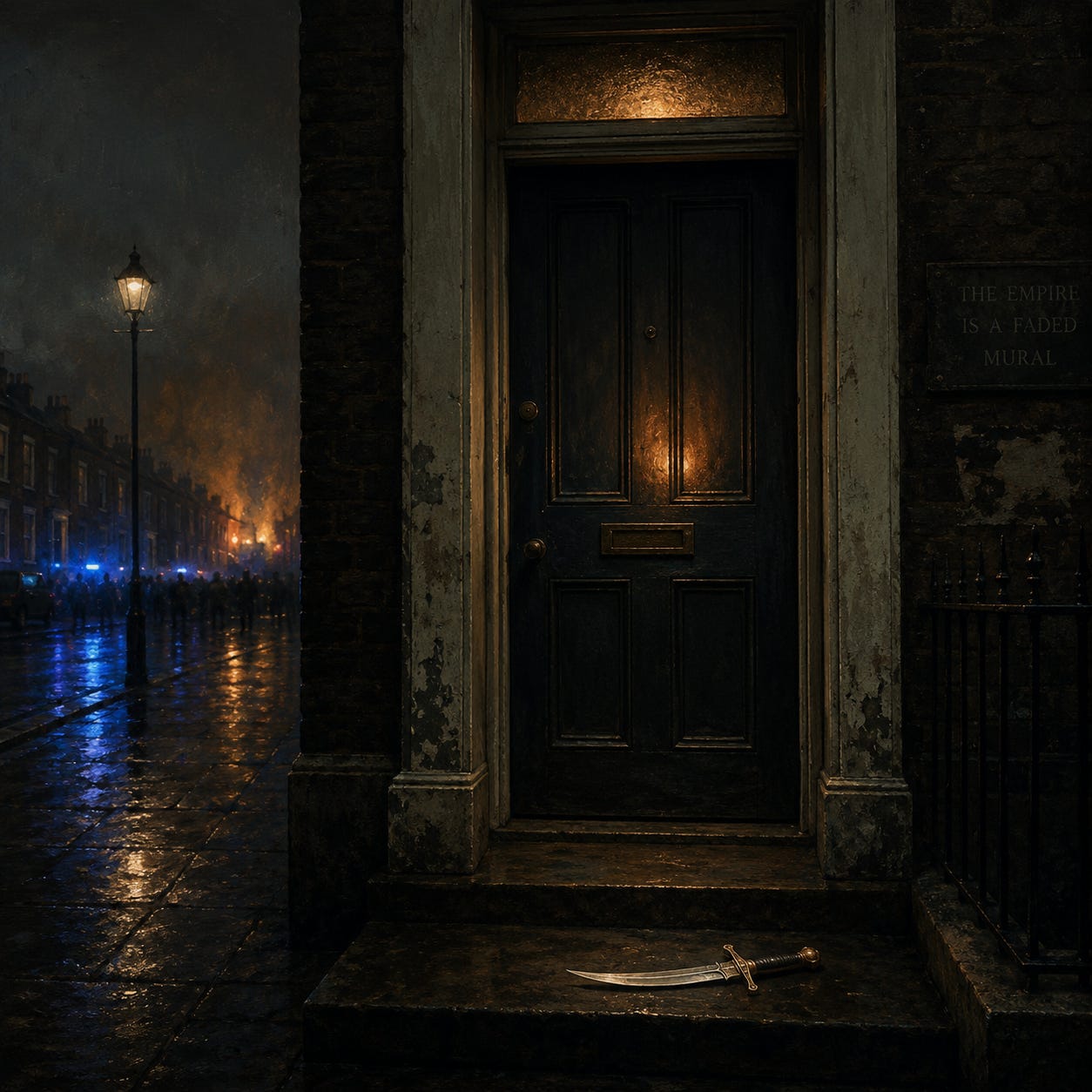
The Dagger and the Door
from Language Matters by Elias Winter Hosted by Elias Winter
I. The Boy and the Dagger Henry Nowak was eighteen years old. That is the first fact, before the politics, before the footage, before the slogans, before the men with flags discovered his name and turned it into one more object in the national bonfire. He was eighteen. A boy at the beginning of that brief and foolish age when life still appears to be expanding, when a city is not yet a battlefield but a map of possible nights, possible friends, possible mistakes, possible futures. Southampton was not a sacred place. It was not a battlefield of civilizations. It was a university town, a port city, one more British place where the young walk home under weak streetlights with their coats open and their guard down. Then came the dagger. Not a metaphorical dagger. Not a hidden dagger in the language of politics. A literal blade, carried in modern Britain by a man who lived under the protection of a religious exception the state had decided it was too refined, too plural, too careful, too historically sensitive to question. In a country where boys are lectured about knives, where schools perform safeguarding rituals, where airports confiscate nail scissors, where police forces issue solemn public-safety campaigns about the horror of blades, a man was permitted to move through the public world with a ceremonial weapon. This is the absurdity before the tragedy. Or rather, it is part of the tragedy. The liberal state, in its late imperial confusion, had built a cathedral of exceptions. Everyone else was told that the blade was the symbol of disorder, masculinity, delinquency, street violence, social collapse. But here the blade passed through another doorway. Here the blade acquired vocabulary. It became heritage, identity, accommodation, respect. It became the sort of object that no official wanted to describe plainly because plain description would reveal the stupidity of the arrangement. A dagger is a dagger. The fact that it has been given a sacred biography does not make it less able to enter a body. This does not indict a people. It indicts an exemption. A civilization has the right to honor another man’s faith without granting his knife a passport. Vickrum Digwa did not merely carry a religious object. He turned it into the oldest thing a blade can become. He used it on a boy. There is a particular grotesqueness in that transformation. The sacred object, the marker of discipline and devotion, becomes an instrument of cowardice. The symbolic weapon becomes the actual wound. The man who carries the blade under the language of honor enters the record not as a guardian of conscience but as one more small man with a story to tell after another person is bleeding. And he did have a story. That is what killers often reach for when the blood appears. Not silence. Not confession. Story. He claimed, according to the reporting, that he had been attacked, racially abused, forced to defend himself. In other words, the blade did not only enter Henry Nowak’s body. A narrative followed it. The narrative arrived quickly, maybe more quickly than reality itself could be seen. The victim became suspect. The dying boy became a problem to be controlled. The man with the dagger became the man with a grievance. This is what happens in exhausted societies: facts arrive limping, but scripts arrive armed. The police came into the scene with the dull urgency of men trained to administer danger rather than perceive truth. They saw what they had been taught to see. Or perhaps they saw nothing at all. Henry Nowak, stabbed and dying, was handcuffed. He said he could not breathe. He said he had been stabbed. There is no literary invention capable of improving that horror. The sentence is sufficient. A boy told the state the truth, and the state restrained him. This is not a left-wing scandal or a right-wing scandal. It is not a story about one tribe’s hypocrisy redeeming the other tribe’s madness. The same police culture that can march elderly pro-Palestine protesters into vans for holding signs, the same procedural machine that can confuse dissent with danger, can also look at a dying boy on the pavement and treat him as the disorder to be managed. This is the point the factions cannot bear. The far right sees Henry Nowak and says the police have been captured by liberal guilt. The liberal establishment sees the far right using Henry Nowak and says the police must be defended against racist agitation. Both are half-blind. The police are not innocent because the far right hates them. The police are not fascist only when they arrest old women protesting for Palestine. The police are not suddenly sacred when they fail a white boy. The problem is deeper: a state that has lost moral sight and compensates with procedure. A state that no longer knows how to look directly at reality without first consulting the approved script. A state that can be brutal toward the harmless and stupid before the bleeding. A state that confuses order with justice because order is easier to document. Henry Nowak’s death became a symbol because everything around it was already symbolic. The dagger was symbolic. The exception was symbolic. The accusation of racism was symbolic. The police body camera was symbolic. The handcuffs were symbolic. The street after his death became symbolic. The men who later shouted his name made him symbolic. The tragedy is that before he was a symbol, he was a boy. A boy on a pavement. A boy whose life had not yet hardened into biography. A boy whose parents did not need a theory of empire or migration or policing or religious accommodation. They needed him alive. The absurdity of the dagger should not be softened. It belongs in the center of the story. It is absurd that a modern state terrified of knives could not bring itself to say that religious meaning does not entitle anyone to carry a functional blade in public. It is absurd that a civilization so bureaucratically alive to every category of harm could fail at the simplest one. It is absurd that the sacred vocabulary of pluralism could end with a dead student and a dying boy in handcuffs. But absurdity is not comedy here. It is the sound tragedy makes when the institutions become too stupid to recognize themselves. Henry Nowak did not die in the wilderness. He died inside the paperwork of a civilization that had forgotten how to look at a bleeding boy and know who needed saving. II. The Woman Behind the Door Then came the mob. Not justice. Not grief. Not public anger purified by moral clarity. The mob. There is always a point in these stories when the dead are betrayed by the living who claim to avenge them. The victim’s name becomes a torch. The wound becomes permission. The specific crime becomes general accusation. A man does something terrible, and then the crowd decides that an entire category of people must answer for him. That is the hour when protest becomes pogrom. In Belfast, and in the surrounding eruptions of anti-migrant violence in Northern Ireland, the scene changed from the pavement to the house. The first story had a boy outside, exposed to the state. The second has a woman inside, exposed to the crowd. This is the necessary reversal. Because if Henry Nowak reveals the cruelty of a state that cannot see the victim, the woman behind the door reveals the cruelty of men who no longer care who the victim is. Imagine her not as a demographic but as a body in a room. She has furniture. She has a phone. She has a door whose meaning has suddenly changed. A door is supposed to separate the private from the public, the home from the street, the sleeping from the shouting. It is one of civilization’s smallest promises. On one side, the person. On the other, the world. A society can be measured by whether that door still means anything when men gather outside. For the women trapped in Belfast, the door became a question. Outside were masked men, young men, local men, men drunk on the heat of belonging to a crowd. Cars burned. Windows broke. Flames spoke … This is a public episode. If you would like to discuss this with other subscribers or get access to bonus episodes, visit eliaswinter.substack.com
Embed this episode
No transcript yet.