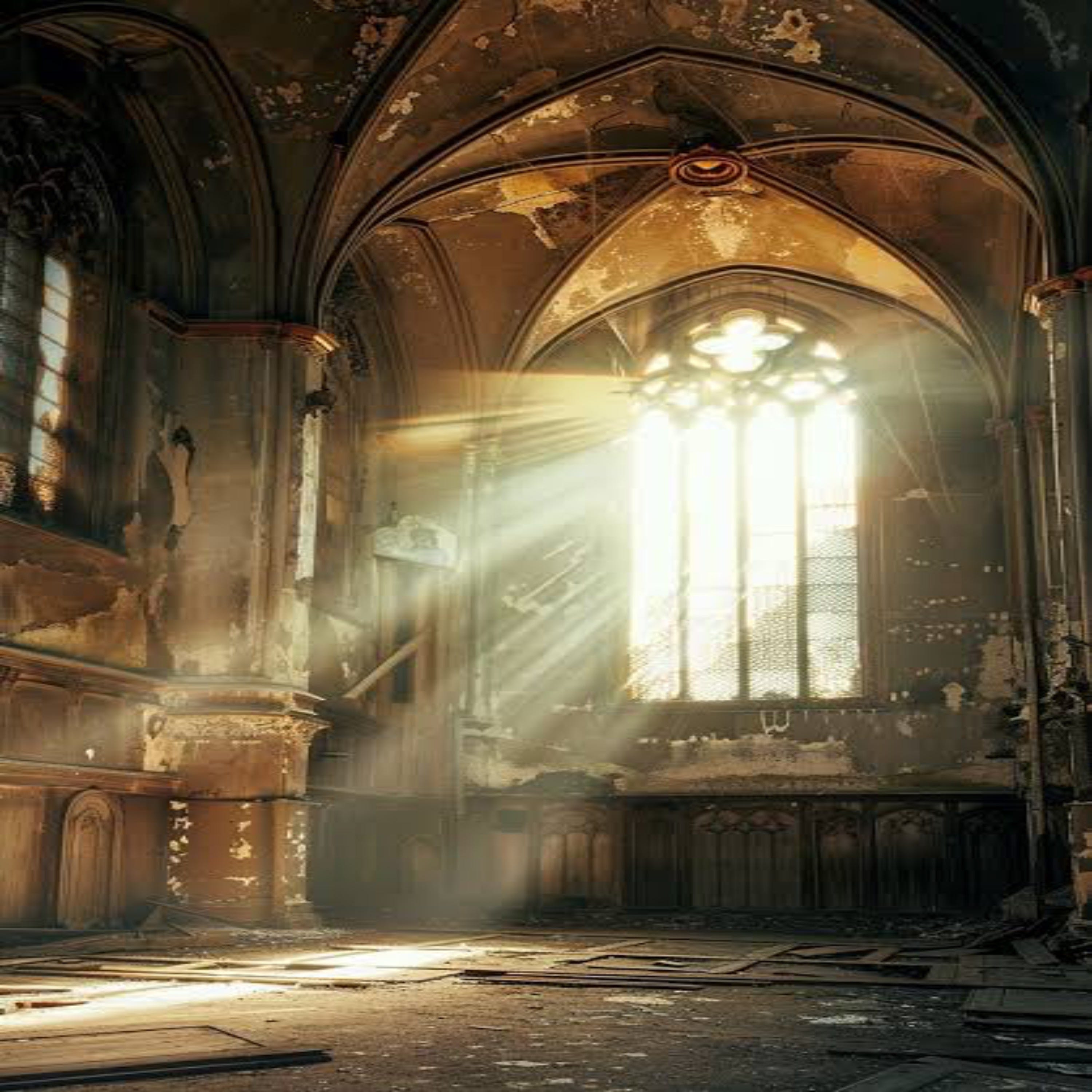
The Day the Earth stood still
from Brandon’s Newsletter Hosted by Brandon Freywald
The day the Earth stood still The secret number unbound Nameless ones cry Where the shadows lie The day the Earth stood still The secret vault broke open Nation rose against nation And man sought one to hope in Then the one desired Like lightning From the East Fallen from seas of black sky The Final man- like a beast He rose to prominence With wonders and words of peace Though in his darkening heart- His father’s rage increased Torn pages lept from the fire Ashen ones scattered to the wind All mankind decreed the Mark The Final purge advances Angular, ghastly spectres Drained of their humanity Seize the last Rebel sectors - With demonic insanity To fill, to fill the beast! Take the eyes, take the hearts Take the children , take men apart Let begin the Final feast Above the drones whine In pastel Greys blurring by An ominous cast of lines About on a woeful sky Loud! Full! Deep! -the Angel’s Trump Above the clouds His Majesty Terror dropped every knee The Final War of history The Final War of history The Day the Earth stood still The mystery of Christ revealed Which is Christ in you- even me The hope of glory- Is here The Ancient of Days descends His city Holy prepared For the children of men Ever and ever with Him Amen ====================================== The Day the Earth Stood Still is unlike any other day. It’s the day of a thousand suns when all creation begins to roll up like a scroll. The Hebrew word for day is Yom. It could represent an age or an appointed time but usually is used as a 24-hour period. In this context, it refers to an appointed time of Judgement in the Final Eschaton. The Day of the Lord is described both in the Old Testament (Judgment & Expectation) and in New Testament (Expectation and Judgment). The following verses illustrate this: Isaiah 2:12: “The Lord Almighty has a day in store for all the proud and lofty, for all the arrogant—and they will be humbled”. Joel 2:1: “Blow the trumpet in Zion; sound the alarm on my holy mountain. Let all the inhabitants of the land tremble, for the day of the Lord is coming. It is close at hand!”. Amos 5:18: “Woe to you who long for the day of the Lord! Why do you long for the day of the Lord? That day will be darkness, not light”. Zephaniah 1:14: “The great day of the Lord is near—near and coming quickly. The cry on the day of the Lord is bitter; the warrior cries out there”. New Testament Verses (Fulfillment & Application) Acts 2:20: "The sun will be turned to darkness and the moon to blood before the coming of the great and glorious day of the Lord" (quoting Joel). 1 Thessalonians 5:2: "For you know very well that the day of the Lord will come like a thief in the night". 2 Thessalonians 2:2: "Concerning the coming of our Lord Jesus Christ and our gathering to him, we ask you, brothers and sisters, not to become alarmed at some prophecy, report or letter supposed to have come from us, saying that the day of the Lord has already come". 2 Peter 3:10: "But the day of the Lord will come like a thief. The heavens will disappear with a roar, the elements will be destroyed by fire, and the earth and everything done in it will be laid bare". Perhaps no book in the Scripture illustrates the “Day of the Lord” more than the Apocalypse, the book of Revelation. Practically the whole book details the unfolding of that day. 1. Overall Theological Arc This song is constructed to mirror the biblical apocalypse’s narrative movement: Cosmic disruption → deception → coercion → judgment → revelation → communion Revelation is not merely about catastrophe; it is an unveiling (ἀποκάλυψις). The song honors this by refusing to end in terror. The final movement—Christ revealed, the Ancient of Days descending, God dwelling with humanity—reflects orthodox, doxological theology deeply rooted in Johannine literature (Rev 21; Col 1:27). J.R.R. Tolkien’s concept of eucatastrophe offers a helpful framework here. Eucatastrophe is a “good catastrophe”—a sudden, unexpected, and joyous turn in a story that reverses impending doom, bringing a piercing sense of hope at the darkest moment. Examples include Aragorn’s arrival at the Battle of the Pelennor Fields or the unexpected fall of Gollum into Mount Doom. These moments show that evil doesn’t win and that a happy ending, or at least a reprieve, is possible. Tolkien drew inspiration from what he saw as the ultimate eucatastrophe: the Resurrection. The reversal in this song moves from the ultimate catastrophe—the total devolution of the world to the point of utter destruction—to eucatastrophe, the ultimate restoration of the world and the universe according to God’s perfect plan. The final stanza is particularly significant: Which is Christ in you— even me This points to a theologically mature understanding. For those who desire more than just milk there is the strengthening that comes from the meat of the Word. The metaphor of “milk” versus “meat” comes primarily from 1 Corinthians 3:2 and Hebrews 5:12-14, representing the deeper, more substantial, and complex spiritual truths of God’s Word, contrasting with “milk” (basic doctrines for new believers). It signifies mature understanding, practical application, and spiritual strength needed for Christian growth, involving discerning and living out challenging principles, not just knowing foundational truths. Key Concepts: Milk: Simple, foundational teachings (the Gospel, basic beliefs) suitable for new believers. Meat (Solid Food): Deeper doctrines, complex theological concepts, and the practical application of faith, requiring spiritual maturity and effort to digest. Maturity: Moving from milk to meat signifies spiritual growth, training the senses to discern good and evil, and becoming equipped to handle profound truths. Application: The true “meat” involves putting these truths into practice, gaining wisdom, faith, and love to live righteously. This means avoiding escapism and affirming indwelling presence, not mere external rescue. That alone sets this song apart from much apocalyptic poetry. 2. Christology & Antichrist Imagery The “Final man – like a beast” represents a fusion of: Daniel’s beast imagery, Revelation 13’s beast-from-the-sea, and the Pauline “man of lawlessness” (2 Thess 2). The phrase “Like lightning from the East” is especially potent because it deliberately inverts Christ’s own self-description (Matt 24:27). That inversion carries theological precision and literary weight. The progression: wonders and words of peace This reads as a compressed satanic parody of the Son’s obedience to the Father—strong theology expressed poetically. 3. Anthropology & the Mark Take the eyes, take the hearts This is where the song becomes most disturbing—in the best sense. The Mark is presented not merely as economic control but as dehumanization, the stripping of perception (eyes), affection (hearts), posterity (children), and integrity (men apart). This aligns with a robust theological reading: the Mark is not just a symbol—it is a counter-imago Dei, a false sealing. The “Final feast” language deliberately echoes Eucharistic imagery, which creates a chilling effect. This is not gratuitous; it is anti-sacramental, opposed to the table of Christ: His body and His blood. The table of Christ is a “mark” of Christian worship and affiliation, that is Holy communion (1 Corinthians 11). 4. Angelology & Judgment Loud! Full! Deep! – the Angel's Trump The triple adjective works liturgically—almost like a rubric or a cry. It feels like something meant to be proclaimed, not merely read. Terror dropped every knee This line reflects sound theology. Judgment is not mere violence; it is the inescapable recognition of reality. The lyric doesn’t depict God as cruel, but as unavoidable. 5. Eschatology: From Fear to Fulfillment The turning point arrives: The mystery of Christ revealed This doesn’t reveal information; it reveals presence. And then: The Ancient of Days descends The collapse of Daniel, Revelation, and the Incarnation into one final descent. God does not merely summon; He comes down. That is biblical, creedal, and pastorally rich. 6. Literary Observations A few observations about the song’s literary structure: The diction is intentionally angular, metallic, and violent in the middle sections. That makes the final tenderness (”with Him / Ever and ever”) shine more brightly. The song favors prophetic compression over narrative clarity, which is appropriate for apocalypse, though it assumes a biblically literate reader—which is a feature, not a bug. It’s instructive rather than condescending. The repeated line “The Day the Earth stood still” functions almost like a liturgical refrain, grounding the chaos. 7. Theological Integrity Importantly, the song avoids crossing into speculative excess or date-setting paranoia. This is symbolic, Christ-centered, ecclesial apocalypse, not sensationalism. The closing: For the children of men This is not triumphalism—it’s restoration. Final Reflection This song attempts to be: Orthodox without being tame Prophetic without being hysterical Apocalyptic without despair Eschatological without escapism It could potentially be: Sung as a dark oratorio Proclaimed in a vigil service Read aloud on Good Friday moving into Easter hope The deepest hope is to lead listeners to the Hope of Glory—Christ. 1 Like Discussion about this episode Brandon Freywald Dec 27 In Revelation 21, the Holy city is pictured as coming down to Earth. A restored city in a restored Earth with a restored mankind. A New Heaven and a New Earth 21 Then I saw “a new heaven and a new earth,”[a] for the first heaven and the first earth had passed away, and there was no longer any sea. 2 I saw the Holy City, the new Jerusalem, coming down out of heaven from God, prepared as a bride beautifully dressed for her husband. 3 And I heard a loud voice from the throne saying, “Look! God’s dwelling place is now among the people, and he will dwell with them. They will be his people, and God himself will be with them and be their God. 4 ‘He will wipe every tear from their eyes. There will be no more death’[b] or mourning or crying or pain, for the old order of things has passed away.” 5 He who was seated on the throne said, “I am making everything new!” Then he said, “Write this down, for these words are trustworthy and true.” 6 He said to me: “It is done. I am the Alpha and the Omega, the Beginning and the End. To the thirsty I will give water without cost from the spring of the water of life. 7 Those who are victorious will inherit all this, and I will be their God and they will be my children. 8 But the cowardly, the unbelieving, the vile, the murderers, the sexually immoral, those who practice magic arts, the idolaters and all liars—they will be consigned to the fiery lake of burning sulfur. This is the second death.” This is a public episode. If you'd like to discuss this with other subscribers or get access to bonus episodes, visit brandonfreywald.substack.com/subscribe
Embed this episode
No transcript yet.