
EPISODE · May 12, 2026 · 17 MIN
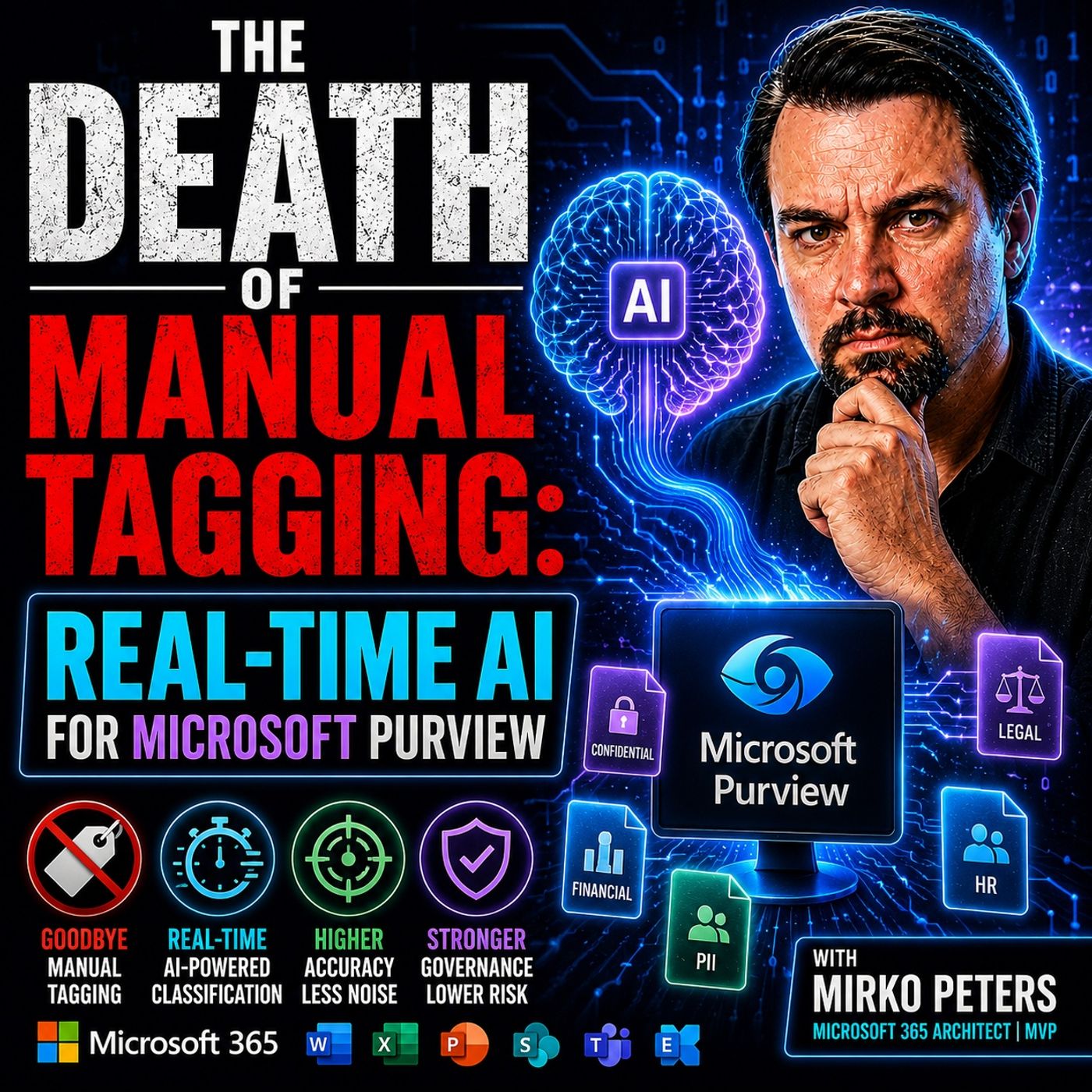
The Death of Manual Tagging: Real-Time AI for Microsoft Purview
from M365.FM - Modern work, security, and productivity with Microsoft 365 · host Mirko Peters - Founder of m365.fm, m365.show and m365con.net
Manual tagging is dead. The modern enterprise simply produces too much data, too quickly, for humans to classify it accurately. In this episode of the M365FM Podcast, we expose the structural failure behind traditional Microsoft Purview labeling strategies and explain why relying on employees to manually classify sensitive information has become one of the biggest security blind spots in modern organizations. For years, enterprise governance frameworks have depended on a dangerous assumption: that users will consistently stop what they are doing, evaluate the sensitivity of a document, and apply the correct label every single time they save a file. But real-world adoption rates tell a different story. Most organizations see manual labeling adoption hover around thirty percent, leaving the majority of intellectual property effectively invisible to security controls, Data Loss Prevention policies, and compliance enforcement mechanisms. This episode breaks down why the entire model of user-driven classification is collapsing under the weight of AI, high-velocity collaboration, and massive unstructured data growth across Microsoft 365, Teams, SharePoint, OneDrive, Slack, and Copilot environments. We are moving away from human-driven governance and into an era of autonomous classification where AI understands the meaning, context, and intent of data in real time.THE STRUCTURAL FAILURE OF MANUAL GOVERNANCE Traditional labeling systems were designed for a slower world. A world where users created fewer files, collaboration moved at human speed, and security teams believed awareness training could compensate for operational friction. That world no longer exists. Today’s employees are overwhelmed by notifications, meetings, chat streams, AI-generated content, and constant collaboration requests. Expecting them to behave like full-time data librarians while trying to perform their actual jobs is structurally unrealistic. We explore why:Manual tagging creates productivity frictionUsers consistently choose speed over governanceSensitivity labels are often misunderstood or ignoredSecurity models built on human choice inevitably fail at scaleUnlabeled files become invisible to downstream security controlsThis episode also examines how modern compliance failures increasingly originate from governance gaps rather than firewall breaches or encryption failures.WHY REGEX AND KEYWORD MATCHING ARE NO LONGER ENOUGHFor years, organizations relied on regex patterns and keyword matching to identify sensitive content. These tools are incredibly fast—but fundamentally context blind. A regex engine can detect a pattern that looks like a credit card number or social security identifier, but it cannot understand the meaning of a document. It cannot distinguish between a public training manual and a confidential merger strategy. This creates dangerous false positives and even more dangerous false negatives. We explain:Why regex fails against modern unstructured dataThe difference between pattern recognition and semantic understandingHow intellectual property bypasses traditional detection enginesWhy context is now the most important security signalHow AI-driven content changes the economics of governanceAs organizations deploy Microsoft Copilot and AI-powered search experiences, unlabeled data becomes dramatically more dangerous because AI systems amplify every governance mistake hidden inside the environment.BUILDING THE AI INTELLIGENCE LAYER FOR MICROSOFT PURVIEW The future of Microsoft Purview is not user-driven labeling. It is autonomous AI-driven governance operating directly inside the data stream. This episode explores how organizations are deploying Large Language Models as real-time classification engines that understand the intent, relationships, and sensitivity of data without requiring any user interaction. We break down:How AI inference engines integrate with Microsoft PurviewWhy LLMs outperform traditional pattern-matching systemsThe role of semantic understanding in modern governanceHow fine-tuned models recognize proprietary business contextWhy autonomous classification reduces human error dramaticallyInstead of asking users to select labels manually, AI systems now analyze documents automatically at creation time, mapping content directly to Purview sensitivity labels behind the scenes. Governance becomes invisible infrastructure rather than an interruption to productivity.REAL-TIME CLASSIFICATION AND THE LATENCY PROBLEM One of the biggest architectural failures in modern Purview deployments is the mismatch between AI speed and traditional compliance systems. AI operates in milliseconds. Most Microsoft Graph labeling workflows operate asynchronously and can take minutes—or even hours—to fully propagate across Microsoft 365 workloads. This creates a dangerous vulnerability window where sensitive content exists without protection while AI systems like Copilot can already access and index it. We explore:Why asynchronous labeling creates exposure gapsThe hidden risks of delayed Purview propagationHow Copilot can expose unlabeled sensitive informationThe importance of Time to First Token (TTFT)Why governance must operate at the speed of the promptThis episode introduces the concept of the Guardian Agent—a real-time governance proxy that validates and applies policy decisions instantly at the edge before backend synchronization completes.Become a supporter of this podcast: https://www.spreaker.com/podcast/m365-fm-modern-work-security-and-productivity-with-microsoft-365--6704921/support.
Embed this episode
NOW PLAYING
The Death of Manual Tagging: Real-Time AI for Microsoft Purview
No transcript for this episode yet
Similar Episodes
No similar episodes found.
Similar Podcasts
No similar podcasts found.