
EPISODE · Jan 5, 2026 · 8 MIN
The Dictator’s Day in Court: Maduro Enters 'Not Guilty' Plea
from Atlantic Lens, a Podcast by Marta Dhanis · host Marta Dhanis
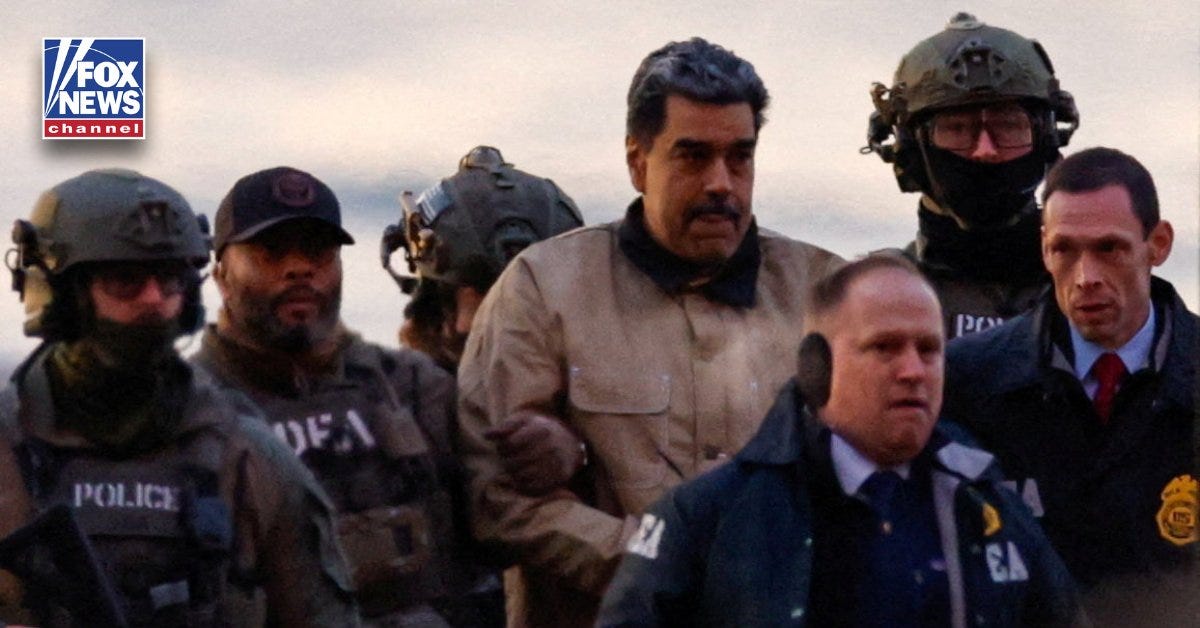
If you missed the preview of the hearing, read it here.The transition from a presidential palace in Caracas to a high-security cell at the Metropolitan Detention Center (MDC) in Brooklyn is a distance that cannot be measured in miles.Today, Nicolás Maduro Moros and his wife, Cilia Flores, appeared before Judge Alvin K. Hellerstein in the Daniel Patrick Moynihan U.S. Courthouse for their formal arraignment. Under the heavy gaze of U.S. Marshals and amidst a total security lockdown of Pearl Street, the couple, once the most powerful figures in Venezuela, stood to hear the charges that could see them spend the rest of their lives in American prison. The man who once commanded Venezuela entered shackled at the ankles (not that common at SDNY), though not at the wrists, wearing prison orange shoes, beige pants and a blue shirt.The “Not Guilty” PleaAs expected, Maduro and Flores entered pleas of “not guilty” to all counts, including narco-terrorism conspiracy, cocaine importation, and the newly unsealed weapons charges.“I am not guilty, I am a decent man, I am still the president of my country,” said Maduro in Spanish and through a court interpreter.At another instance, Maduro’s frustration boiled over. He declared: 'I am the President of the Republic of Venezuela (...) I am here kidnapped (...) I was captured at my home in Caracas.' Judge Hellerstein, maintaining the brisk pace of the court, immediately cut him off, informing the defendant that there would be an 'appropriate time' for such arguments, but that time was not today.The physical toll of the extraction was also laid bare for the court. Mark Donnelly, the Houston-based attorney representing Cilia Flores, informed the judge that his client sustained significant health issues during her capture, including bruising to her ribs that the defense believes may be a fracture requiring immediate X-ray and medical attention.While the proceedings were brief - roughly 20 minutes, the atmosphere was historic. This was a collision of international law and American executive power. Judge Hellerstein, a veteran of the bench known for his no-nonsense efficiency, moved through the procedural requirements with the same rigor that he’s known for. In this room, Maduro was not “El Presidente”, but rather a defendant facing a superseding indictment that carries a mandatory minimum of 50 years to life.To a non-American audience, a “not guilty” plea can sound defiant or strategic but in U.S. federal court, it is neither. At this stage, the plea functions as a procedural placeholder. It preserves the defendants’ rights, allows discovery to begin, and opens the door to pre-trial motions. Almost every federal defendant enters the same plea at arraignment, including those who later plead guilty.The Pollack Defense: A Tactical StartThe most significant development inside the courtroom today wasn’t the reading of the charges, but the presence of the man standing next to Nicolás Maduro. Barry Pollack, the veteran trial lawyer who famously secured Julian Assange’s freedom, has officially taken the lead for the defense.His appearance signals that the defense strategy will not be a simple denial of facts, but a sophisticated assault on the legal architecture of the prosecution. Pollack is a specialist in “extraterritoriality”, challenging the U.S. government’s right to arrest and try foreign citizens for actions taken on foreign soil. By retaining him, Maduro has moved from a political defense to a high-level constitutional one.If you value independent reporting on justice and power across the Atlantic, subscribe to Atlantic Lens newsletter&podcast: free or paid. The Immediate “Remand”Judge Hellerstein ordered that both Maduro and Flores remain in federal custody without bail.Pollack did not offer a formal argument for release today, a tactical choice. In a case of this magnitude, asking for bail at an arraignment is a losing battle. Instead, Pollack’s focus remained on the long game. By accepting detention for now, he preserves his ability to file more complex motions regarding Maduro’s status as a “Prisoner of War” or a “protected head of state” later this month.While awaiting trial, the couple will be held at the Metropolitan Detention Center (MDC) in Brooklyn. Since the 2021 closure of the MCC in Manhattan - following the fallout of Jeffrey Epstein’s death - the Brooklyn facility has become the primary destination for the SDNY’s highest-profile defendants. Maduro and Flores now join a roster of notorious current residents that includes Luigi Mangione, and former ones such as Sean “Diddy” Combs, Sam Bankman-Fried, and Ghislaine Maxwell.In cases involving terrorism-related charges, international narcotics trafficking, and mandatory minimum sentences measured in decades, detention is structural. Flight risk is absolute, the sentencing exposure here is significant, and bail is functionally irrelevant.The Noriega ShadowThe timing is actually ironic: 36 years ago to the day of Maduro’s capture, on January 3, 1990, Panamanian leader Manuel Noriega was brought to the United States following a military invasion.As I’ve reported previously, the “Noriega Precedent” is the roadmap for this case. In 1990, during George H. W. Bush administration, the courts established that the U.S. could try a foreign leader captured during military operations, even without prior Congressional authorization - as we have seen now under Trump’s tenure. And today, we saw the 21st-century version of that playbook.The Legal Battlefield AheadWhile the arraignment is over, the real legal war is just beginning and the next hearing has been scheduled for March 17. David Weinstein, a former federal prosecutor now in private practice with Hinshaw & Culbertson, has previously told Atlantic Lens that the coming months will test the boundaries of international law.“What we will see in the weeks ahead are arguments about the USA’s extraterritorial power to enforce our laws, the reach of conspiracy statutes, the Geneva Convention and prisoners of war, and head of state immunity,” Weinstein noted.The most contentious fight will likely center on ‘Head-of-State Immunity.’ Maduro’s defense is expected to argue that he is protected from prosecution as a sitting leader. However, the U.S. government’s explicit refusal to recognize the results of the July 2024 Venezuelan elections, and its recognition of opposition figures as the legitimate victors, strips Maduro of that legal shield in the eyes of the SDNY.The Math of “Full Wrath” = Death Penalty?Despite some headlines suggesting otherwise, the death penalty is not currently on the table for Nicolás Maduro or Cilia Flores. While reports have speculated about capital punishment, the legal reality at SDNY is far more grounded in existing statutes.The “full wrath of justice” promised by Attorney General Pam Bondi is mathematically staggering, but it is focused on ensuring the couple never leaves a U.S. prison alive, not on an execution.Legal expert David Weinstein explains why a death sentence is highly improbable.“It is unlikely that they would seek the death penalty and even unlikelier that it would be imposed. The current charges don’t carry that penalty. They would have to supersede and add a Continuing Criminal Enterprise (CCE) charge, and they would likely have to specifically allege a death in the indictment.”While some may speculate that under a Trump-appointed DOJ anything is possible, the legal reality is that the death penalty is not a unilateral executive decision. Even if prosecutors were to supersede the indictment to seek capital punishment, federal law requires a jury - not just a judge - to unanimously authorize a death sentence. Ultimately, the trial remains under the gavel of Judge Hellerstein, a Clinton appointee known for a strict, by-the-book adherence to sentencing guidelines.Under the current federal law:* Narco-Terrorism: Carries a 20-year floor.* Weapons Stacking: The unsealed 2026 indictment includes “stacked” counts for possession of machine guns and destructive devices. Because these 30-year mandatory sentences must run consecutively (one after the other), the couple is facing an effective 50-year mandatory minimum.For a couple in their 60s, this is a life sentence by another name. The DOJ’s strategy appears to be a “guaranteed exit” from society through mandatory minimums rather than the years of constitutional litigation that a capital case would trigger.The Global Financial LockdownWhile the SDNY handles the criminal prosecution, the international financial net is tightening. Just hours before the arraignment, the Swiss Federal Council announced it has frozen all assets held in Switzerland by Nicolás Maduro and his associates with immediate effect.This move, enacted under the Foreign Illicit Assets Act (FIAA), is designed to prevent an “outflow of assets” during the current volatility. In a statement from Bern, Swiss officials clarified that while they are monitoring the “legality” of the U.S. military action, their priority is ensuring that any illicitly acquired funds are preserved for the eventual benefit of the Venezuelan people. This adds a third front to Maduro’s legal battles: a criminal trial in New York, a transition in Caracas, and a total freeze of his European “nest egg.”The Political VacuumWhile the legal gears turn in Manhattan, a political vacuum looms over Caracas. Interestingly, President Trump has signaled a lack of support for María Corina Machado, the moral leader of the Venezuelan opposition and 2025 Nobel Peace Prize winner.“I think it’d be very tough for her to be the leader,” Trump said recently. “She doesn’t have the support or the respect within the country.”This suggests that while the SDNY handles the criminal prosecution of the old guard, the Trump administration may be looking toward a different, perhaps more pragmatic, transition of power in Venezuela, and one that may involve figures less aligned with the traditional opposition.What’s Next in Court?Maduro and Flores will return to court on March 17. Until then, the case now goes into discovery and pre-trial motions phase. Given his history with complex litigation, the judge is unlikely to tolerate delays. The defense will undoubtedly file motions for “Prisoner of War” status and a challenge to the legality of the military capture.But for today, the image remains: a former dictator standing in a Manhattan courtroom, answering to a judge appointed by the very system he spent decades trying to undermine. In the Southern District of New York, the law has a very long memory.Thanks for reading Atlantic Lens by Marta Dhanis! This post is public so feel free to share it. Get full access to Atlantic Lens by Marta Dhanis at atlanticlens.substack.com/subscribe
NOW PLAYING
The Dictator’s Day in Court: Maduro Enters 'Not Guilty' Plea
No transcript for this episode yet
Similar Episodes
No similar episodes found.
Similar Podcasts
No similar podcasts found.