We're not looking for trouble. We just want to have fun. We like the trip. The meaning of pretty girls appear from time to time.
Papol, Playboy's MC. When you saw a gang of long-haired moms with tattoos and motorcycles, you would have watched this. You know, nothing told us in the beginning that this was gonna be trouble to the extent that it did become. Joe's red and white empire, that's great.
That's Andrei Butch. Mushar at the opening there, former Montreal. A cop had a major crime, so Montreal Police Force for about 34 years. And of his many virtues, being truthful here, is one of them.
I can swallow a lot of things. But what I cannot swallow is the police making the statement that in the early 80s, they did not know, they did not know the extent of the biker crisis. The bikers certainly knew. They knew how to play the game.
We're gonna talk about the early bikers in the township Sherbrooke area. Talk a little bit about a gang called the Dirty Reich. Before they were Hells, even before the Jata, they were the Dirty Reich. That's not going back as far as the Irish Red Hand Gang in Montreal, but it's pretty far back.
It's about 50 years. The 60s. The de facto president of Jata's, who rose to prominence in the Hells Angels, was at first a member of the Dirty Reich. The Jata's or Gypsies first formed as the Dirty Reich in the early 1960s.
They changed their gang name to the Jata's in 1970. They were allowed to patch over to be the Sherbrooke Linuxville Hells Angels on December 5, 1984. Then on May 24, 1985, we have the massacre of the Vell chapter members at the Linuxville bunker. That's it.
You have a brief history of the evolution of the Dirty Reich. Going back even further, it feels very collectory. I'm sorry. But going back further, the Dirty Reich actually, they spun off from an early version of what would become the Jata's number one rivals, the Adams.
The Adams begat the Dirty Reich, begat the Jata's, then patched over to the Hells Angels. That's the history, that's the sequencing. Why is that important? It's important because you can't throw these names around because where we're going in this story, we're going to start saying so-and-so was an atom or so-and-so was a Jata.
You're going to be so freaking confused. If you don't have a little bit of the foundation, people, you're going to get very frustrating. So this is your foundation. The earliest written evidence of the Dirty Reich appeared in a 1968 Electrabian article documenting a meeting in Sherbrooke between the Dirty Reich and this motorcycle club out of Montreal, the Playboy's.
The Playboy's came to Sherbrooke for a Saturday meeting with the Dirty Reich, and a reporter was permitted to sit and take notes, I don't bring them beers or something, and for their leader, Popeye Sherbrooke was a bad memory. The last time they kind of cruised through the local police, hassled them and fellow members, papal, pepal, Ronnie, T-bob, Bonnie, Francisco, Jean, E, Nick. And after reading this article, I have to admit, I was even beginning to doubt myself and think that maybe this whole biker thing that I misunderstood the situation. And these are just some excerpts from this 1968 article.
They travel together on weekends. They laugh all the time. They live in Montreal, but never spend time there. They have been as far away as per se in the gas busy.
They promise to return to Boston every week. They're only passionate their bike, that it is in order and in good condition. They only live according to this motorized machine, which represents freedom and escape for them. For them, its friends, and the motorbike.
They affirm indeed that their main motto is all for one, one for all. And they are ready to come to each other's aid. Bikers do not try to cause trouble. They want to ride a motorbike and sail in the open air.
That's all. Besides, when they leave like this for a weekend or even a few days, they admit wanting to take the fresh air to sleep under the stars, under a bridge, in a barn, or an abandoned house. That's that 1968, the Tribune article, and I have to admit the council at Rivendell didn't see such fellowship. Nevertheless, this article documents what was, I think, an early well-crafted myth about bikers that they were, they were misunderstood and they were unfairly villainized.
According to Popo, your average biker was this harmless liver team like Arthur Rimbault. If he had enough to quench his appetite, a bike to ride, an abandoned barn in which to rest his weary head after a long day's ride, then he was content. Or maybe the bikers were more like wild animals if you didn't mess with them. The bikers wouldn't mess with you and society.
Don't look him in the eyes, man. Except that most bikers weren't average, as we know, they didn't mind preying on society, stealing property, cashing pensioners welfare checks, as documented in the second report. To put it bluntly, a jug of wine, a line of coke, and the vowel. So despite apologies years later, like we hear from Butch Bouchard in that Hell's Angels documentary, it's one of those, the excerpt is one of those really bad history channel documentaries on the Quebec Hills Angels.
It's one of those deals. You have to sit through 45 minutes of nonsense to extract 10 minutes of content. But despite these apologies, we didn't know and it was a few bad apples. This litrebion article documents very clearly that the press, that the police, that society was being fleeced from the very beginning.
I'll go one further. Here's an article from the following year, the spring of 1969. This must have gotten lost in all the giddy excitement around the moon shot that year, because this is a whopper. A young priest from Sherbrooke will wear a leather jacket and the crest of the Dirty Reich Motorcycle Club.
A trebion May 21, 1969. Father Jia Selveig vicker at St. Thamy Parish in Sherbrooke and Chaplin for the Dirty Reich Motorcycle Club has no intention of imposing himself. Like all movements of young people, we must not be accepted.
We must be desired. It is the same thing with the bikers. Father Selve said it is important that he be able to take part in the club's outings and that he is present at their meetings. You have to be close to these young people and know them well, continue Father Selveig to realize that the outward appearance is very deceptive and that they are far from being as too many people imagine them.
A group of Dirty Reich club members asked what they expect from the chaplain. First insisted that Father Selveig is first and foremost a friend, that they did not know he was a priest during their first meeting. The bikers added that he is an advisor, a guy who knows them well and who thinks more than them. Thus the members of the Dirty Reich Club specified that Father Selveig had acted as an intermediary with the parents of their friend Andre Colomb who lost his life in a motorcycle accident during the weekend.
Explains Marcel Frank Thibault, Vice President of the Dirty Reich Club, we were squeamish and we didn't have enough psychology to talk to Andre's parents and convince them to let us participate in the funeral. The few Dirty Reich members present all agreed on one point. Father Selveig knows them well. They are more at ease with him which makes him better able to advise them with the problems that arise.
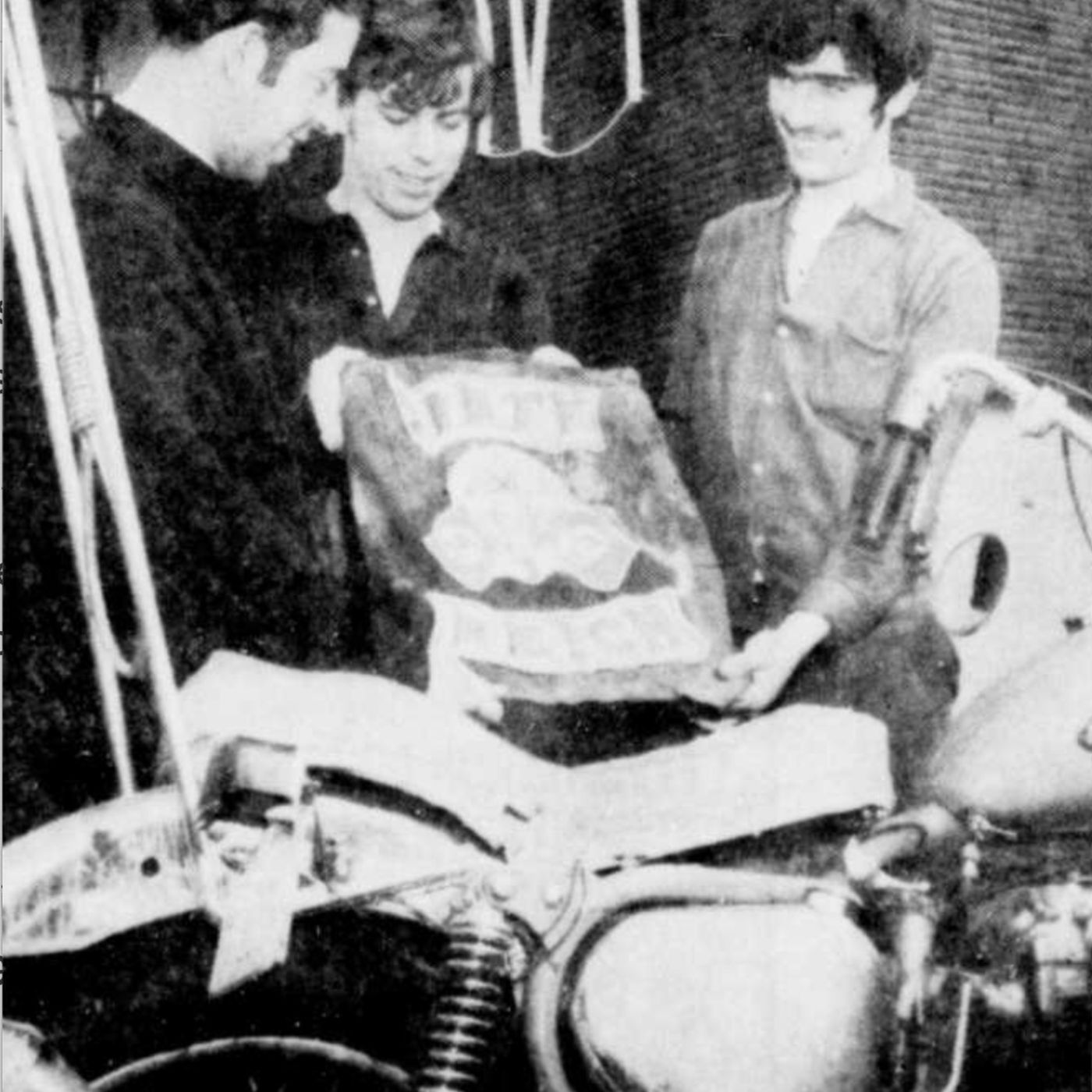
I'll direct you to the website, tresuller.com, T-H-E-R-E-S-A-A-L-L-R-E point com. There are photos of Popol from the playboys, photos from the funeral of Andre Colomb was quite a big deal. This big weekend affair, lots of bikers from the surrounding area showed up to pay tribute. There's a picture of a flower arrangement here that the Dirty Reich presented at the funeral.
It's something to see. So go to the website continuing. In the club, during an interview, Father Selveig specified that the decision to become chaplain to the bikers was not taken immediately. Ordained a priest less than a year ago, Father Selveig met the bikers on several occasions.
Then he was asked, are you game to board with us? Since then, he has attended a few biker meetings and meetings have even taken place in the basement of the church. Make no mistake about it, explains Father Selveig, the members of the Dirty Reich club want to be at peace and they don't want to trouble anyone. All of that so far I don't have a problem with.
I don't have a problem with a ministry's outreach to try to reach these gangs. I don't have a problem with meetings taking place in the church. All of that sounds like a fair gambit. Let's where we go from here.
A project. Father Selveig explained that bikers realize that when several of them meet at one place, everyone is uncomfortable and many are afraid. It is for this reason, he said, that steps will be taken with the municipal authorities of Sherbrooke in order to obtain financial assistance that could allow the acquisition of a house outside the city, where all the members of the Dirty Reich club might get together. The members of the club know that the municipal authorities of Granby have contributed a grant to set up Le Qubecois, a biker club of the city, and a building outside the city.
They would like the same thing in Sherbrooke as a contribution to the organization for leisure activities for young people. Yes, it sounds very similar to what was going on at the same time in Montreal with Le Muk, and we'll get there continuing his motorcycle. Yesterday, Jengra, Iffi, L'Mite lent a motorcycle to Father Selveig, and it will be available to the young priest as long as he acts as chaplain to the bikers. The firm will also take care of the maintenance of Father Selveig's motorcycle.
The latter welcomed the news with joy, but the joy was even greater among the members of the Dirty Reich club, the crest. Father Selveig said he wants to dress like the members of the Dirty Reich club. I want to wear the jeans like them, a jacket, and most importantly, a club vest. The name of their club, he said, is very important to them, and they see to it that they conduct themselves well so as not to sullie that name.
Father Selveig's jacket will have, you know, just ignore the illusions, the Nazi Germany, but it's okay. We're all being brotherly here. Father Selveig's jacket will have a small chaplain crest at the very request of the members. The chaplain added that his presence in the club had the effect of overcoming the objections of several relatives who did not value their son being part of the club.
Finally, he said, I could allow myself to be more present with them when I get to know them better. So that's this May 1969 Electrabune article and there's more pictures. So there's a picture of Selveig and B'Boy and the vice president Marcel Frank Thibault presenting Selveig with his motorcycle and his colors, his vest. It's the same photo from the last time's episode.
The last time I didn't capture it, caption it. However, somebody guessed what it was correctly, well done, and that that was Father Selveig in the photo. I don't know everything about these affairs. That's kind of the point you're a player, you're a participant in this.
So somebody did say, oh, you know, that I don't know this is true or not a different documentation of this. They said, well, they want to become president. I don't know that that's true. Maybe when they were the Jatans, possibly, but they transitioned from the Jatans in 70, so relatively rapidly.
But mentioned, we'll go on, but he later married, he had a child, and I don't know what happened to him, but his wife is still living in the Sherbrooke area. And I posted the full article as well in French, but it's a showstopper. You can see it at treeceller.com. And you know, there's so much, obviously, to digest here about Father Selveig.
You know, as the article says, he's a young priest with this Saint Fermi parish in Sherbrooke who not unlike many priests in that era wanted to do outreach, fill the ministry and the community. And as I say, in this way, he's not that different from working the work with early biker gangs by John Dalzel, the Montreal cop who in April 1969, just one month before the publication of this article launched Lemuc or the Association of United Motorcyclists of Quebec. And there's a link to that whole thing, if you want to know more about the history of Lemuc. It was one of the earliest attempts at community policing programs where again, they were doling out government money to early biker gangs.
Dalzel very much like, Salve, Salve, like, Dalzel wanted to wear the appearance of a biker, the jeans, the leather jacket ride the bike, all of that stuff. So we see this cross-pollination and the symmetry between like programs in the era and not only in Montreal, but being replicated in Sherbrooke. For me, efforts by people like Dalzel and Salve would have had the effect of instantly legitimizing biker culture at a time when gangs were eager to establish a foothold in Quebec communities. As this article suggests, if you were a parent and you were having doubts about the people your son was associating with, but then the police, not only the police, but your priest, your parish priest, told you that there was nothing to worry about, you wouldn't question such authority figures.
And then as well, you had the media backing it up. You had the Montreal Gazette and the Sherbrooke Electribune promoting these olive branch initiatives as something to be desired by communities. Personally, it is not unlike say a parent believing there was foul play involved in the disappearance of their gutter, but then the police sent town college coming out and suggesting that she was a drug addict, a lesbian, a runaway. So you should just go home and forget all about it.
Everything is fine here. That's the power of institutional influence. I have no doubt that in those early biker days, there were members who genuinely only wanted to ride their bikes on weekends and be left alone, but they were easily manipulated by figures and duped by figures like a bawai, a bullion who knew they were taking advantage of the good graces of stooges like Father Selway, whether he was a willing stooge, whether he was a full patched, converted drink, the Kool-Aid member is something left unanswered. But you know, I'm not approved, but if you're a priest, there's a moral gray area here, right?
Accepting bribes, like leather jackets and a bike with free maintenance is the surest road to becoming co-opted and corrupt. That alone is just, you know, if you sit down with the mafia and you share a cup of coffee and he buys, you know, figure buys you a cup of coffee, you've already been compromised. Remember, Josh, a bullion, he's not a choir boy here, although in the photo online, every, every, there's every indication that that was the case, but he was not, he was involved in the murders of the Hells, five Hells Angels members of the Lennoxville bunker in 85, the Lennoxville massacre sometimes called the Sleeping Bag murders. In 1988, he was arrested in Amsterdam in extradited to Canada, where he played guilty for his involvement in those five murders.
So this sets the stage for where, you know, that trajectory eventually led. As I said, we don't, we don't hear about Father Selve again. He's involved in community work until about 1972, and then he drops off the radar. And he can only speculate to the reason, you know, I wonder if you eventually saw the light and he was being used as a tool.
Less than five years later in 1974, you had open war in the streets of Sherbrooke, Adams and Jitans literally shooting it out in the downtown streets. And I can't imagine any resident of Sherbrooke having the tolerance for, at that point, for Selve's biker sermons that they just wanted to be at peace and that they don't want to trouble anyone. But Father Selve wasn't quite finished with his do-good ministry for the Dirty Reich. He would re-emerge in the fall of 1969 with what I consider to be a showstopper.
It's kind of like the PT Barnum men of the cloth and Eastern townships. I'm presenting to everyone the greatest shitshow on earth. And what happened next is some kind of church-foody fuckery, to be sure. But that is his story I'll share next time.
This is Who Killed Theresa. Some, you know, some brief announcements here. I don't normally like to talk about current events, but we should mention that the Sartidou Quebec has hired a new director, Directoris Madame-Daktisa General Jean-Bosade. She is the first civilian to be appointed head of the Sartidou Quebec.
She's sent in three decades with the Ministry of Public Security, which oversees the Sartidou Quebec, but I would say only. But, you know, how much control you can reign over, raging tigers, uncertain. So she's a civil, she's a career civil servant. That might work.
That may not work. It was almost a unanimous decision. I think Assembly National in Quebec City, she was proposed and voted on by Premier Francois Lago. Interesting that Guillot was a dissenting vote.
He's an independent member of Parliament in Quebec. Guillot was, we mentioned him before, because he's a police, he was a former police officer of the Sartidou Quebec, who fought the Biker Wars. And he voted against the appointment of Jean-Bosade. The other thing I wanted to mention, as a curio, this came up this week in the nose that two senior citizens, two men in the age of 67 and were arrested in the the Meghog-Rock Forest area for possession of drugs, possession of cannabis.
What did they have here? Hash cocaine, narcotics, magic mushrooms, $25,000 in cash, stash of arms, 13 weapons, pistols, carbines, 550 cartridges, 250 bullets of various calibers, discovered in the residence. One lived near Lake Meghog. The other one lived at an address.
I thought it was in Austin, but it's actually in Sherbrook. Hey, listen, there's sex at generians all the time. Traffic, that's not shocking. Where's it shocking to somebody to have an arsenal of weaponry?
What I do find surprising is that two guys in 67 and 68, I don't find it surprising. I find it interesting. So two guys, 67 and 68, okay, they're the right age for people who came up in this era that we were just talking about. And yet in the article, the police refused to disclose their names.
Now, normally you don't give that privilege to people. If somebody does something wrong, you add them and you say who they are. You've never less in this case. In this case, these guys are given the benefit of not being ID.
So I put this to the question to the writer, Viatka Sonburg, who writes for her elect review now today. So she's very good. She's a very good investigative writer. I'm sure it's very hard to cover these stories.
She covered the story of the Sherbrook-Mannican case for which we're still waiting patiently for the coroner's report, right? To which Viatka has been very diligent to, you know, she's writing that. She's not letting that bone go, which is more than I can say for some reporters nowadays. Anyway, I put this quite a why.
Why don't we know their names? And so she was going to reach out and report out. I want to know who these two guys are. Maybe there's somebody we've already talked about in the last month.
That's the obvious question. All right, you know, we had a laundry list of names in the second report. So are they on that list? If you have any information that would help solve a crime, what crimes today, but certainly a lot of Tom Fuhrry.
Contact the Sarti to go back at 1-800-659-4264, or you can send them an email at cic at Sarti, S-U-R-E-T-E, point-a-C-A, point-a-C-A, and state your claim for all roads. Go to the website. You can go to tressallour.com and research the cases we talked about today. And previously, and there's also links there to all kinds of things.
You can buy the book. Wish you were here. You can sign up for the newsletter. That case is not here on Substack.
And you can follow us on social media. All those links are at tressallour.com. That's enough for today. This has been Who Killed Teresa and your host John Allure.
Have yourselves a great, great day.