
EPISODE · Feb 24, 2026 · 1H 14M
The Disquiet of Quiet Quitting (Magrizos et al 2026) | FT50 HRM
from Revise and Resubmit - The Mayukh Show · host Mayukh Mukhopadhyay
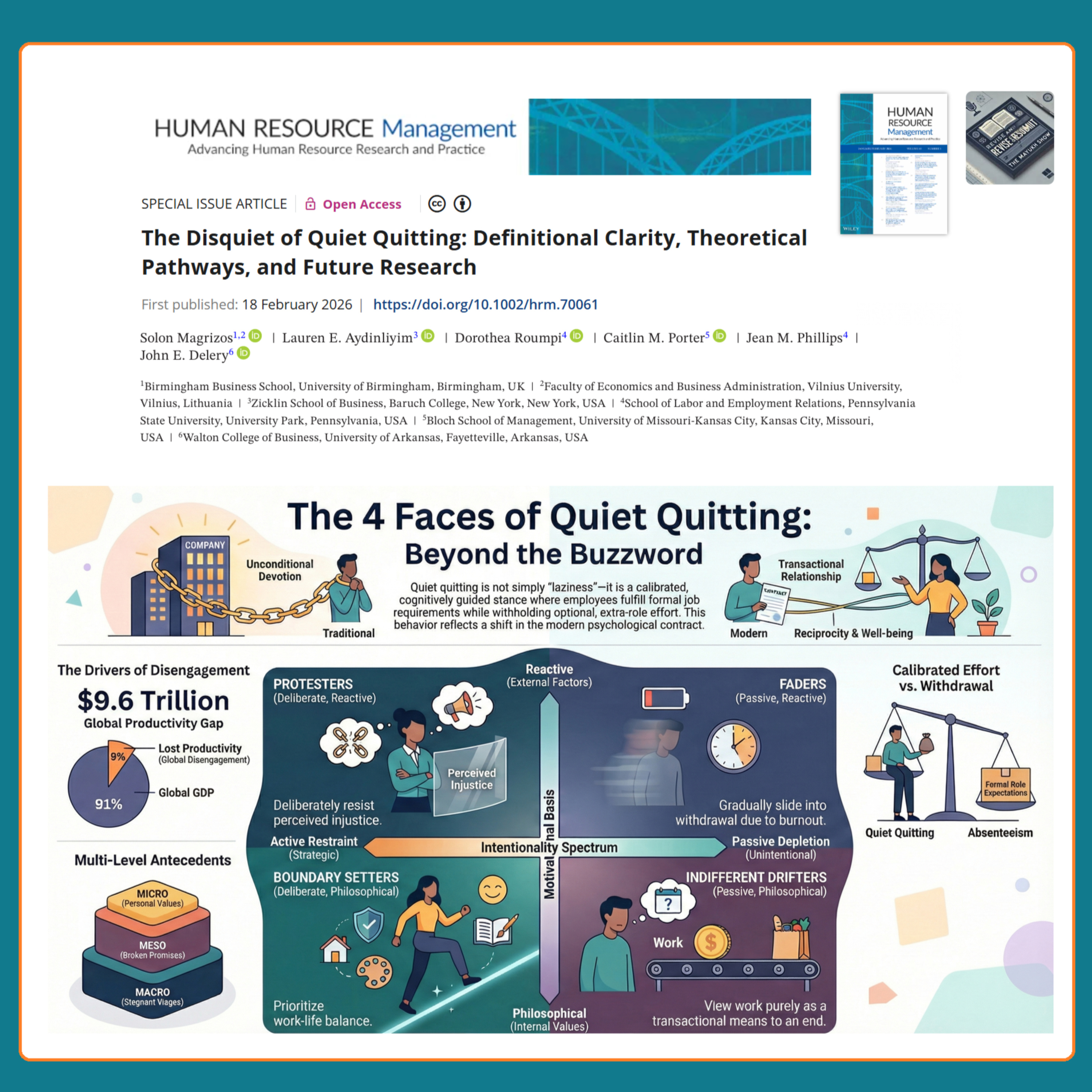
English Podcast Starts at 00:00:00Bengali Podcast Starts at 00:16:02Hindi Podcast Starts at 00:35:38French Podcast Starts at 00:55:00ReferenceMagrizos, S., L. E. Aydinliyim, D. Roumpi, C. M. Porter, J. M. Phillips, and J. E. Delery. 2026. “ The Disquiet of Quiet Quitting: Definitional Clarity, Theoretical Pathways, and Future Research.” Human Resource Management 1–18. https://doi.org/10.1002/hrm.70061Youtube Channelhttps://www.youtube.com/@weekendresearcherConnect over linkedinhttps://www.linkedin.com/in/mayukhpsm/Welcome to Revise and Resubmit 🎙️📚 where we take big, prestigious research and make it feel like something you can hold in your hands, turn over, and actually use.Quiet quitting. Two words that sound like a whisper, yet somehow land like a headline. It is the office chair that stops rolling forward. It is the extra mile quietly reclaimed. It is not a tantrum, not a vanishing act, not necessarily burnout. It is something more precise and more unsettling: a calibrated decision to do the job, but stop donating the self.Today, we are stepping into a truly prestigious venue: Human Resource Management, an FT50 journal. 🏛️✨ And we are doing it through a timely review published online on 18 February 2026: “The Disquiet of Quiet Quitting: Definitional Clarity, Theoretical Pathways, and Future Research,” by Solon Magrizos, Lauren E. Aydinliyim, Dorothea Roumpi, Caitlin M. Porter, Jean M. Phillips, and John E. Delery.What I love about this piece is that it refuses to let quiet quitting stay as a social-media mood. It asks for definitional clarity, then earns it. Drawing from 11 papers in a special issue, the authors map what quiet quitting is and what it is not, and they insist we take its many faces seriously. 🧩🔍 Deliberate versus passive. Reactive versus value-driven. Narrow versus broad in scope. Not one story, but a set of stories we have been lumping together because it felt easier.Then comes the part that lingers: the 2 × 22 typology of quiet quitters. Four characters walking around modern work life like they have always been here, only now they have names. Protesters ✊, Faders 🌫️, Boundary Setters 🧘, and Indifferent Drifters 🧊. Different motives, different levels of intentionality, different signals about fairness, well-being, and what “sustainable engagement” even means when everyone is tired of pretending.If this is not just a trend but a message, then the real question becomes: what exactly is your workplace hearing when someone stops doing the “extra,” and what are you hearing about yourself when you feel relieved to stop? 🎧🤔Before we dive in, subscribe to Revise and Resubmit on Spotify and follow the YouTube channel Weekend Researcher 📌🎥. You can also listen on Amazon Prime and Apple Podcast 🍎🎙️.And with sincere thanks to the authors and to the publisher, Wiley Periodicals LLC, for bringing this important review to Human Resource Management 🙏📄: when you hear “quiet quitting,” who do you picture first, a Protester, a Fader, a Boundary Setter, or an Indifferent Drifter, and why?
Embed this episode
Ready to play
The Disquiet of Quiet Quitting (Magrizos et al 2026) | FT50 HRM
No transcript for this episode yet
Similar Episodes
No similar episodes found.
Similar Podcasts
No similar podcasts found.