
EPISODE · Jul 26, 2026 · 55 MIN
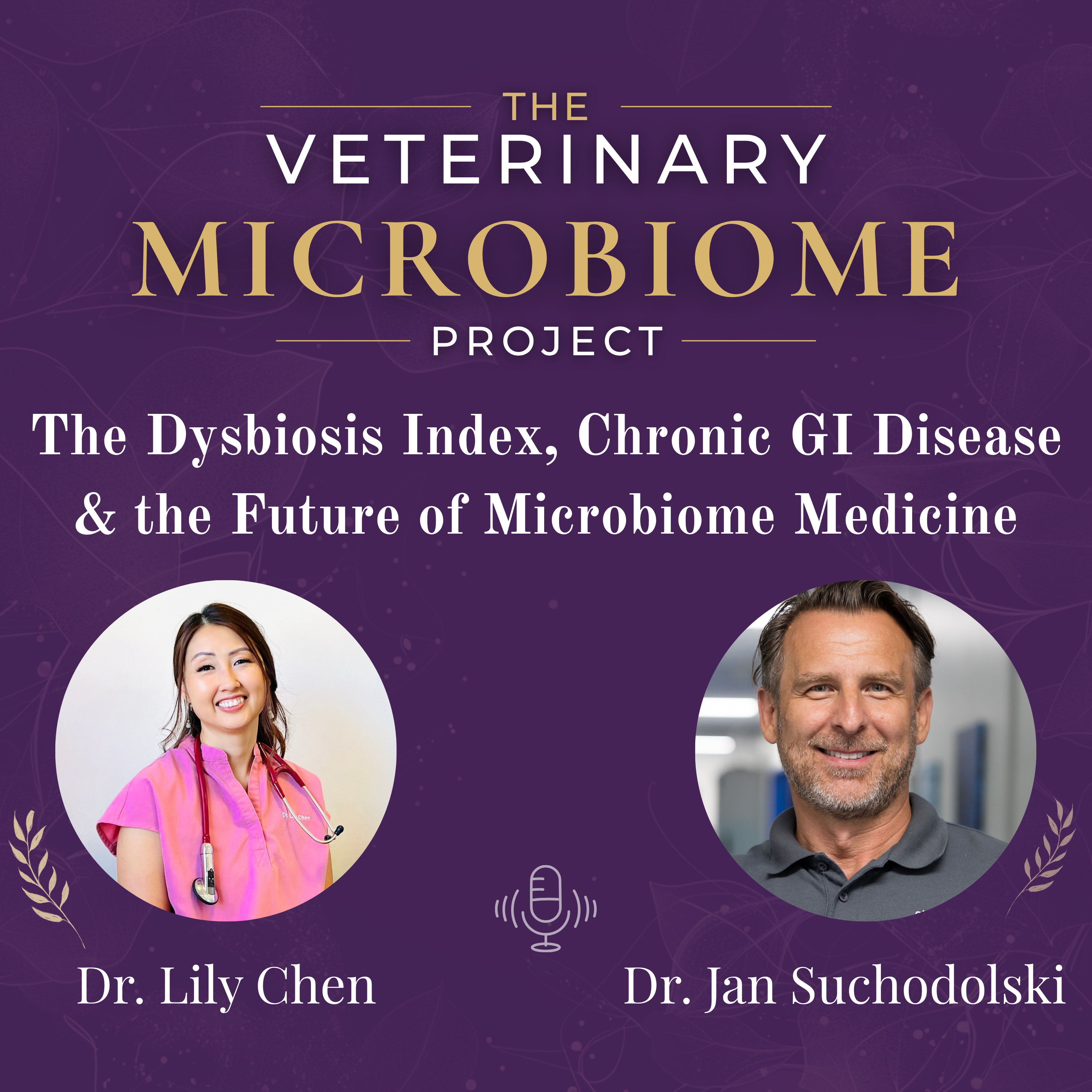
The Dysbiosis Index, Chronic GI Disease & the Future of Microbiome Medicine with Dr. Jan Suchodolski
from The Veterinary Microbiome Project · host Dr. Lily Chen
How the science behind the Dysbiosis Index is reshaping how we diagnose, treat, and think about chronic GI disease in companion animals.If you have spent any time in the veterinary microbiome space, you already know the name. Dr. Jan Suchodolski is a professor and head of Microbiome Sciences at the Gastrointestinal Laboratory at Texas A&M University, one of the most influential veterinary microbiome research centers in the world. A lot of the foundational science clinicians reference every day came out of his lab.In this episode, Dr. Lily Chen sits down with Dr. Suchodolski to talk about how the Dysbiosis Index was built, what it is actually measuring, and why a single number can tell you more about a patient than a long list of bacterial species. They dig into chronic GI disease as a spectrum, the two major drivers of severe dysbiosis, and why some patients can be restored while others cannot. They also get into where microbiome medicine is headed next, including emerging mucosal damage markers, early diagnostic testing in puppies, the role of steroids alongside FMT, and what a truly multimodal approach to GI disease looks like in practice.Real science, real cases, and a little magic.KEY INSIGHTS:✨ The Dysbiosis Index is a machine learning tool built from hundreds of validated qPCR studies across thousands of animals. It measures total microbiome shift, not just individual bacterial changes, and a score above zero indicates dysbiosis, with higher numbers reflecting increasingly severe disruption.✨ There are two major drivers of severe dysbiosis: broad-spectrum antibiotic use and chronic GI disease with mucosal remodeling. Antibiotic-induced dysbiosis often recovers on its own or with FMT. Chronic mucosal damage is a different challenge entirely.✨ Not every animal with chronic GI disease has dysbiosis, and not every dysbiotic animal has the same underlying disease. Treating them as the same population is a clinical mistake.✨ Twenty years ago, the treatment recommendation for dysbiosis was antibiotics. Understanding why that was both clinically effective and fundamentally wrong is one of the most important paradigm shifts in veterinary GI medicine.✨ FMT is not a one-session fix for chronic GI disease. If there is partial improvement followed by relapse, that is a reason to keep going, not to stop. The severity of the dysbiosis should set the expectation for how long and how often treatment is needed.✨ Steroids do not significantly disrupt the microbiome at anti-inflammatory doses and can actually support mucosal recovery through bile acid transporter pathways. A multimodal approach combining FMT, diet, and targeted anti-inflammatory therapy is increasingly where the evidence is pointing.✨ The Dysbiosis Index normalizes around eight weeks of age in puppies. Testing after that window gives clinicians a genuine early intervention opportunity before subclinical dysfunction progresses.✨ Emerging fecal markers of mucosal cell shedding, including arachidonic acid, nervonic acid, and ceramides, may open a new diagnostic layer for understanding epithelial damage independently of microbiome shifts. This is where Dr. Suchodolski's lab is focused next.RESOURCES:Texas A&M Gastrointestinal Laboratory: https://vetmed.tamu.edu/gilabFOLLOW:Integrative Pet Wellness Center: https://integrativepet.comUnicorn Academy: https://theunicorn.academyDr. Lily Chen: Instagram: @dr.lilychen @the.unicorn.vetThreads: @the.unicorn.vetLinkedIn: Lily Chen, DVM, CVA & The Unicorn VetJoin our newsletter to get more clinical microbiome insights
Embed this episode
Ready to play
The Dysbiosis Index, Chronic GI Disease & the Future of Microbiome Medicine with Dr. Jan Suchodolski
No transcript for this episode yet
Similar Episodes
No similar episodes found.
Similar Podcasts
No similar podcasts found.