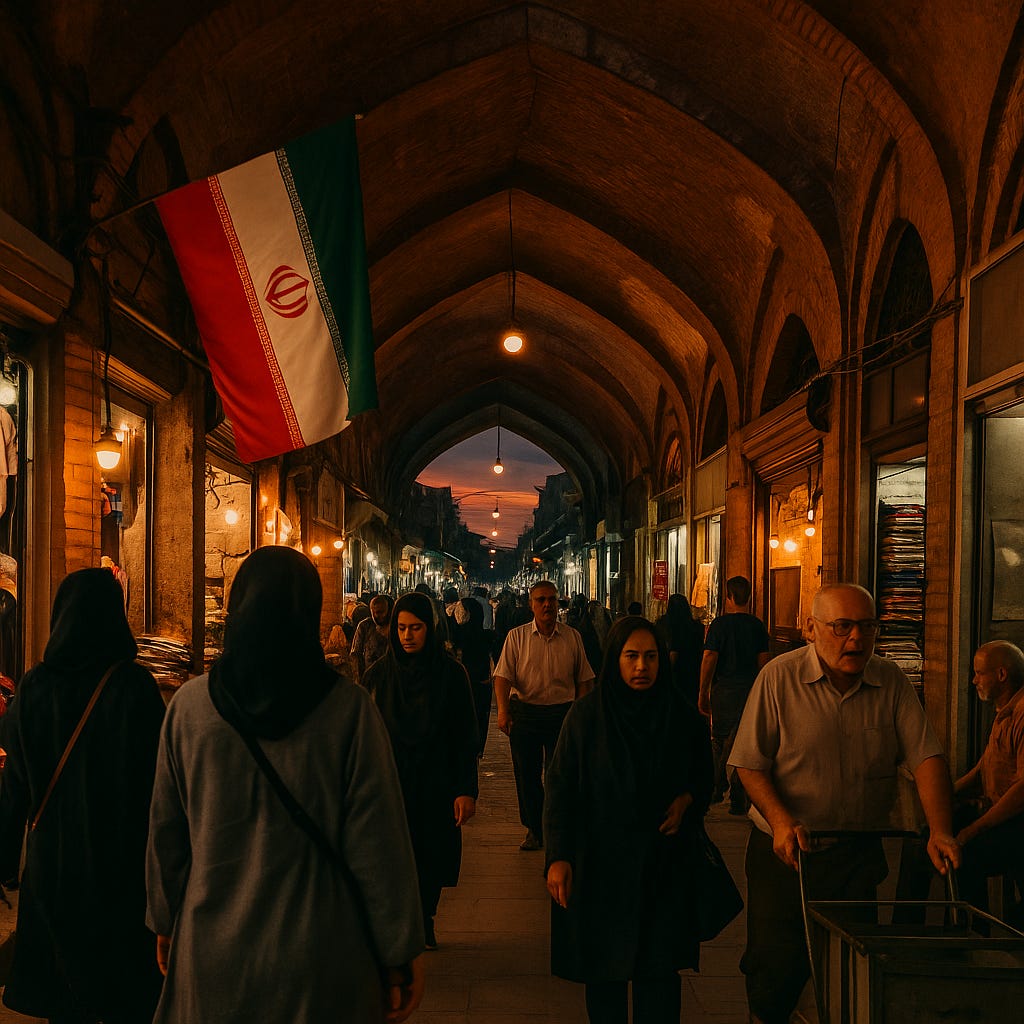
The Empire That Needs Our Silence
from Language Matters by Elias Winter Hosted by Elias Winter
This essay was written in direct response to Roger Cohen’s After War With Israel and U.S., Iran Rests on a Knife Edge, published by The New York Times on June 29, 2025. That article, cloaked in the authority of foreign correspondence, embodies the subtle violence of Western narratives that reduce Iran to a theater of pity, paranoia, and paternalism. What follows is not a rebuttal of facts, but a moral counter-narrative—an attempt to unmask the architecture of empire that makes such stories both possible and persuasive. I do not write this as a journalist. I write this as one who has seen both the tremor in the voice of an exile remembering home, and the flicker in the eyes of those who would turn that pain into policy. I write as one who knows the machinery of empire does not merely run on steel and oil, but on stories—stories that teach us who deserves pity, who deserves bombs, and who deserves to vanish quietly. The article that provoked these words is not exceptional. It is exemplary. Roger Cohen’s After War With Israel and U.S., Iran Rests on a Knife Edge is the perfect specimen of a genre that soothes Western consciences while sharpening Western knives. It floats above the blood it describes, narrating the tragedies of Tehran with a tone that invites the reader not to act, but to nod along. It is imperial scripture masquerading as foreign correspondence. But this moment, in the wake of a catastrophic 12-day war that nearly ended a nation, demands more than nodding. It demands that we see the scaffolding of our narratives—the comforting myths that let us claim compassion while preparing the next blow. It demands we break the silence that is both the empire’s armor and our own cage. In the chapters that follow, I will name the six patterns in Cohen’s piece that reveal how these narratives are built: Paternalistic Framing, Selective Empathy, Performative Balance, Erasure of Imperial Responsibility, Condescending Moralization, and Cynical Reduction of Complexity. I will show how each serves the same end: manufacturing our consent for endless war. Because Iran is not a parable. Iran is a nation. And until we learn to see it as such, we remain prisoners of the empire’s mirror. Chapter 1: Paternalistic Framing The first mask the empire wears is benevolence. It does not say, We wish to dominate. It says, We wish to save. And so it teaches us to see Iran not as a complex nation of eighty million souls, but as a child in need of Western guidance—a place of perpetual crisis, a patient we must diagnose, a pupil we must instruct. Roger Cohen’s article drips with this paternalistic framing. He opens with Roxana Saberi’s trauma—a trauma real and harrowing—but he uses it as an emotional anchor to make Iran’s suffering legible only through Western eyes. The Iranian state becomes a menacing father figure; the Iranian people, wayward children who must be freed from his grasp. Every observation is filtered through outside authority: Cohen’s expert sources, European think tank analysts, and diasporic voices who speak from the safety of Paris, London, or Washington. Even when Iranian officials or citizens are quoted, their words appear as curiosities—evidence to be examined, not testimony to be heard. This framing is not a small sin. It is the keystone of imperial propaganda. Because if Iran is a child, then we are justified in disciplining it. If Iran cannot govern itself, we must intervene. If Iran’s choices look different from ours, it is because it is irrational, backward, or broken—never because it has a history, a logic, or a right to sovereignty. The tragedy of this paternalism is that it kills compassion while pretending to offer it. It teaches readers to pity Iran while denying it the dignity of adulthood. And so the bombs we drop are rebranded as lessons; the sanctions we impose, as tough love; the military bases we surround it with, as guardianship. Cohen’s piece is not unique in this. It stands in a lineage of Western writing on the Global South—from the “white man’s burden” of Kipling to the liberal interventionism of the modern editorial page—where distant lands are described not as equals but as wards of our superior civilization. It is easy to read such prose and imagine ourselves humane. It is much harder to admit that seeing others as children is the oldest lie of empire. Chapter 2: Selective Empathy Empathy, when wielded selectively, becomes a scalpel of control. It slices the world into those whose suffering we choose to feel and those whose deaths we ignore. It teaches us to cry on cue for the chosen few while never asking who set the stage. Cohen’s article invites the reader into a carefully curated gallery of grief: Roxana Saberi’s memories of Evin prison; the diaspora’s conflicted longings; the anguish of a family watching war from Dubai. But there are absences that shout louder than any included voice. Where are the poor of Khuzestan, bombed alongside refineries built on their land? Where are the mothers of soldiers who died in Israel’s airstrikes, men who never dreamed of politics but were conscripted by a state that sees them as disposable? Where are the farmers whose lives wither under the yoke of sanctions that Western papers so rarely examine? This is not accidental. Selective empathy is how empire maintains its moral self-image. It directs our tears to stories that humanize the people we might want to “save,” while erasing those whose deaths we tolerate—or cause. By placing the diaspora’s fears at the center, Cohen makes Western readers’ identification with Iran dependent on proximity to Western lives, passports, and respectability. There is no space in this framework for Iranians who resist both the regime and foreign domination, who believe their nation deserves dignity free from mullahs and Marines alike. There is no empathy for the millions who reject both Ayatollahs and the violence of American exceptionalism. Their complexity would muddy the clear lines of pity and blame Cohen’s narrative requires. Selective empathy is worse than indifference. It is an active training of our hearts to beat only for those who fit the story of enlightened intervention. It makes us feel moral while preparing us to support wars that kill the very people we claim to grieve. Until our empathy includes all lives—enemy and ally, secular and devout, rich exile and poor villager—it is not compassion. It is a weapon. Chapter 3: Performative Balance The empire is too clever to speak only with one voice. It knows that monologues are easy to dismiss, but a dialogue—real or staged—can project the illusion of fairness. And so it constructs a theater of “balance,” where conflicting opinions are presented not to deepen understanding, but to consecrate authority. Cohen’s article performs this dance masterfully. It pairs hints of hope—President Pezeshkian’s vague calls for reform—with ominous warnings of Iran’s supposed instability. It sprinkles criticisms of the regime alongside reminders of its “paranoia,” offering readers a controlled opposition of perspectives that ultimately funnel back to the same conclusion: Iran is dangerous, irrational, and in need of external correction. This kind of balance is not journalism. It is a ritual. It tells us we have considered every side, while carefully excluding any side that might indict our own role. It makes us feel worldly, informed, and above the fray—without ever challenging the central narrative that Iran’s fate must be decided by the wise custodians of Western power. Performative balance also obscures root causes. It weighs the Iranian state’s repression against Iranian resistance, but never against the decades of external sabotage and isolation that shaped both. It presents “hardliners” and “moderates” as two poles in a vacuum, as if the Ayatollah’s paranoia were born from thin air, rather than from coups, sanctions, assassinations, and a world that has taught Iran again and again that sovereignty is a sin. True balance would require grappl… This is a public episode. If you would like to discuss this with other subscribers or get access to bonus episodes, visit eliaswinter.substack.com
Embed this episode
No transcript yet.