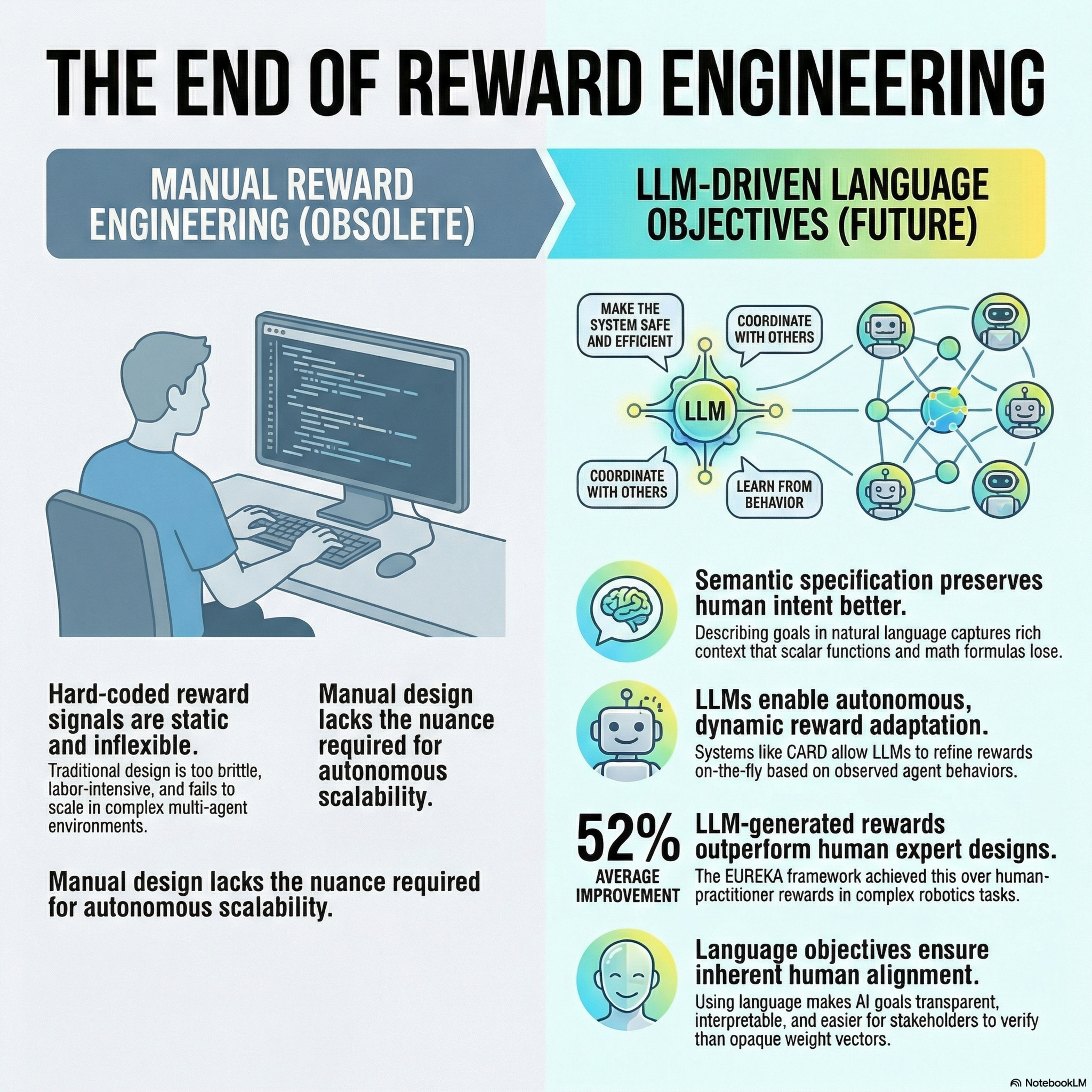
The End of Reward Engineering: How LLMs Are Redefining Multi-Agent Coordination
from Best AI papers explained Hosted by Enoch H. Kang
This paper discusses a paradigm shift in multi-agent reinforcement learning, moving away from the labor-intensive process of manual reward engineering. Instead of hand-crafting complex numerical functions, researchers propose using large language models (LLMs) to translate natural language objectives into executable code. This approach addresses traditional bottlenecks like credit assignment and environmental non-stationarity by leveraging the semantic understanding and zero-shot generalization of LLMs. The transition is built upon three pillars: semantic reward specification, dynamic adaptation, and inherent human alignment. While challenges such as computational costs and potential hallucinations remain, the authors envision a future where coordination emerges from shared linguistic understanding. This new framework aims to make training multi-agent systems more scalable, interpretable, and efficient for human designers.
Embed this episode
No transcript yet.