
EPISODE · Jul 10, 2026 · 49 MIN
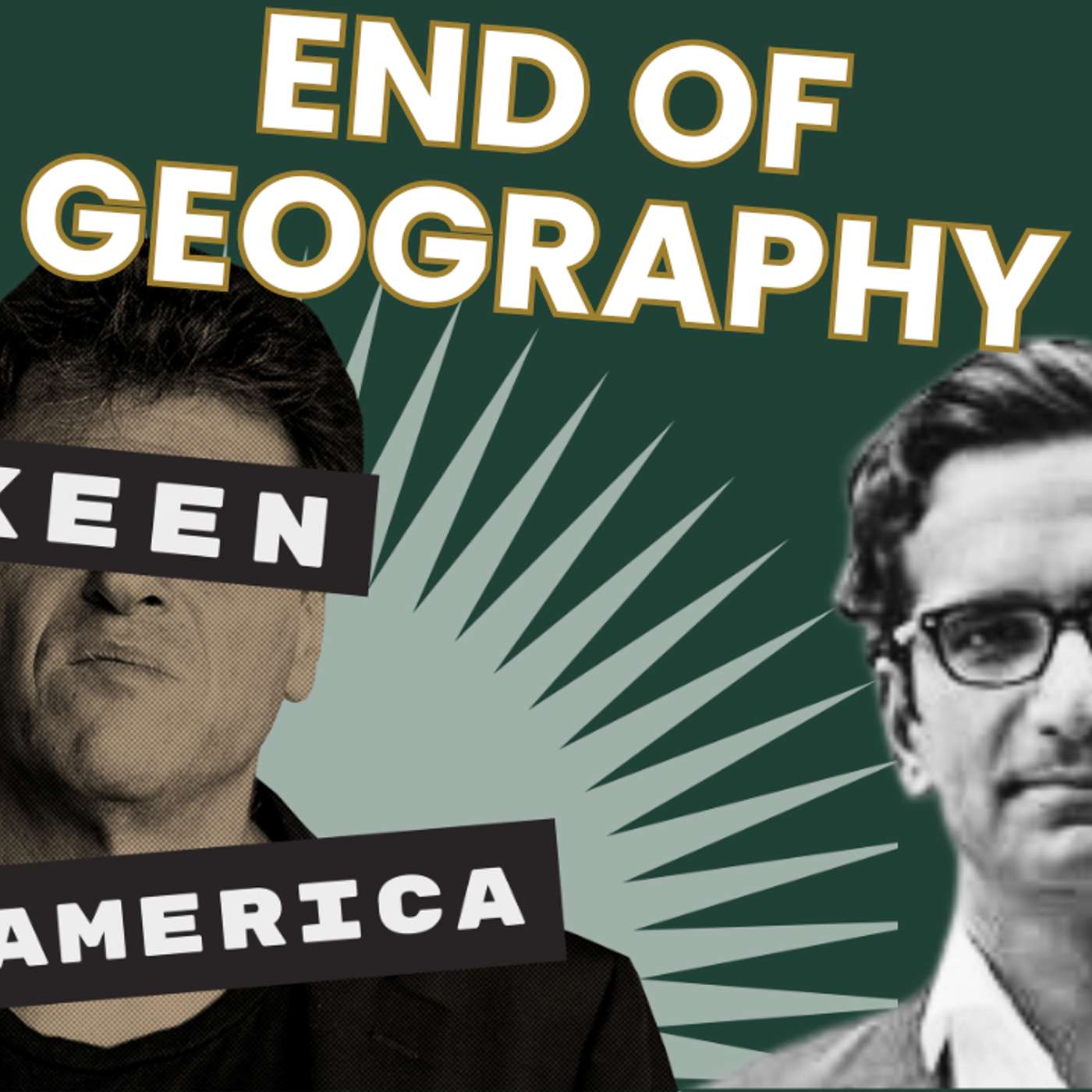
The End of the End of Geography: Mehran Gul on Why Innovation is Happening in America & China — but Nowhere Else
from Keen On America · host Andrew Keen
“A place that doesn’t have great philosophers will not have great technologists either.” — Mehran Gul on Europe’s inexplicable underperformance The digital revolution, we were promised, would mean the end of geography. From Beijing to Birmingham to Berlin to Barcelona, anyone could invent anything anywhere, and so the geography of innovation would no longer matter. But that’s not the way it has worked out. At least according to the Geneva-based innovation geographer Mehran Gul. Gul’s acclaimed The New Geography of Innovation is a travelogue of innovation. But what he finds on his journey around the world in search of innovation is the end of the end of geography. Yes, Gul reports, there’s innovation in Beijing and in Birmingham (USA) — but not in Birmingham (England), Berlin or Barcelona. All the important invention is in China and the US. There simply isn’t much radical stuff going on anywhere else. Gul began his journey expecting to find ten or twelve countries able to innovate competitively with the United States and China. But what he discovered is either niche players or, in the case of South Korea, Israel, and India, just an extension of the US-centric system. Europe — as renters rather than owners of American technology — comes off worst. When PayPal went public, it minted 160 millionaires who went on to help build SpaceX, Tesla, LinkedIn and Palantir; when Skype exited at about the same value, it minted 11. And if you put London aside, the rest of the UK is now poorer per capita than Mississippi. And the AI boom has only compounded all this, with half of last year’s key research papers coming from China, 40% from America, and just 4% from Europe. So really the new geography of innovation is the old geography. Only with China replacing Europe as the only serious competitor to American innovation. Oh lord, oh lord. As a Mississippi bluesman might summarize Europe’s predicament. Five Takeaways • Golden Shares: The Two Systems Are Converging. OpenAI offering Washington a 5% stake, the US government owning Intel — these are Chinese moves, and Gul argues the two models are becoming more alike than either admits. But he pushes back on the lazy version of the China story: its tech sector rose despite the state, not because of it. Jack Ma exiled to Japan, Didi hit with a billion in fines, entire sectors decapitated overnight in 2021 under the banner of common prosperity. In a country with no independent media and no opposition parties, the only rival to centralized power is the tech sector — and the party knows it. • Two Countries — and Everyone Else. Gul started writing expecting to find ten or twelve countries punching at America’s level; the honest answer turned out to be two. Only China has broad-based competence across technologies and a genuinely competitive relationship with the US. The middle powers — South Korea, Israel, India — are extensions of the American system, not rivals to it. That finding surprised the author as much as anyone: it’s not the book he set out to write. • Europe: Renters, Not Owners. After the Fable 5 and Mythos bans, Europe woke up to being a renter of American technology — foundation models, NVIDIA GPUs, all of it. Its best companies keep leaving: DeepMind to Google, Arm to a New York listing, Hugging Face from Paris to Manhattan — while Volvo, Supercell, and KUKA sold to China. Gul’s diagnosis is institutional, not cultural: European employees own half as much of their startups as American ones, so there is no European PayPal mafia. His fixes: a European Nasdaq to replace 41 competing capital markets, and pension funds unleashed into venture capital. • The Question Nobody Is Asking. Since 1990, America’s share of global GDP has held at 25% while China’s multiplied tenfold — the loser is Europe. The top ten American tech companies are worth $27 trillion, more than the GDP of every country on earth except America itself. Tech is not one industry among many; it is the foundation of all of them — the new cars came from Tesla, not GM. Gul’s message to the skeptical Spaniard enjoying long lunches: the last sixty years of American platform dominance skewed power across the Atlantic, and the next sixty will add China to the bill. • The Rest of the Map: Anti Case Studies. Japan tops the freedom indexes, has the technical schools, and still never escaped the keiretsu — disproving Matt Ridley’s claim that innovation is simply the child of freedom. Taiwan’s relevance comes down to one company and Morris Chang’s missed promotion at Texas Instruments. Singapore is an inspiration, not a model — a one-party city-state that invoices NVIDIA’s chips and banks ASEAN’s venture capital. India underperforms while Indians excel — 56 notable American foundation models last year, 35 Chinese, barely one Indian. And Switzerland reminds us innovation isn’t only venture-backed: a train network running on renewables since the 1960s. About the Guest Mehran Gul writes about technology and business. He is the winner of the Financial Times/McKinsey Bracken Bower Prize, from which The New Geography of Innovation grew. He attended Yale as a Fulbright Scholar, Fox International Fellow, and Teaching Fellow, has been a Lead for the Digital Transformation of Industries at the World Economic Forum in Geneva, and served as an expert on entrepreneurship and industrial policy at the United Nations Industrial Development Organization in Vienna. Born in Pakistan, he lives in Switzerland. The New Geography of Innovation: The Global Contest for Breakthrough Technologies (Avid Reader Press/Simon & Schuster), a Financial Times Book of the Year, is his first book, out in paperback this month in the US and UK. References: • The New Geography of Innovation: The Global Contest for Breakthrough Technologies by Mehran Gul (Avid Reader Press/Simon & Schuster). The Wall Street Journal: “An ambitious tour of technological innovation.” • Sebastian Mallaby — author of The Power Law, which argues China’s tech rise owes more to American-style risk capital arriving in Shanghai and Shenzhen than to the state; recently on the show discussing his biography of Demis Hassabis. • Kai-Fu Lee — author of AI Superpowers, cited by Gul as the classic account of tech written through a Chinese lens. • Matt Ridley — author of How Innovation Works, whose thesis that innovation is “the child of freedom and the parent of prosperity” Gul tests against the anti case study of Japan. • Andrew Keen — author of How t...
Embed this episode
Ready to play
The End of the End of Geography: Mehran Gul on Why Innovation is Happening in America & China — but Nowhere Else
No transcript for this episode yet
Similar Episodes
No similar episodes found.
Similar Podcasts
No similar podcasts found.