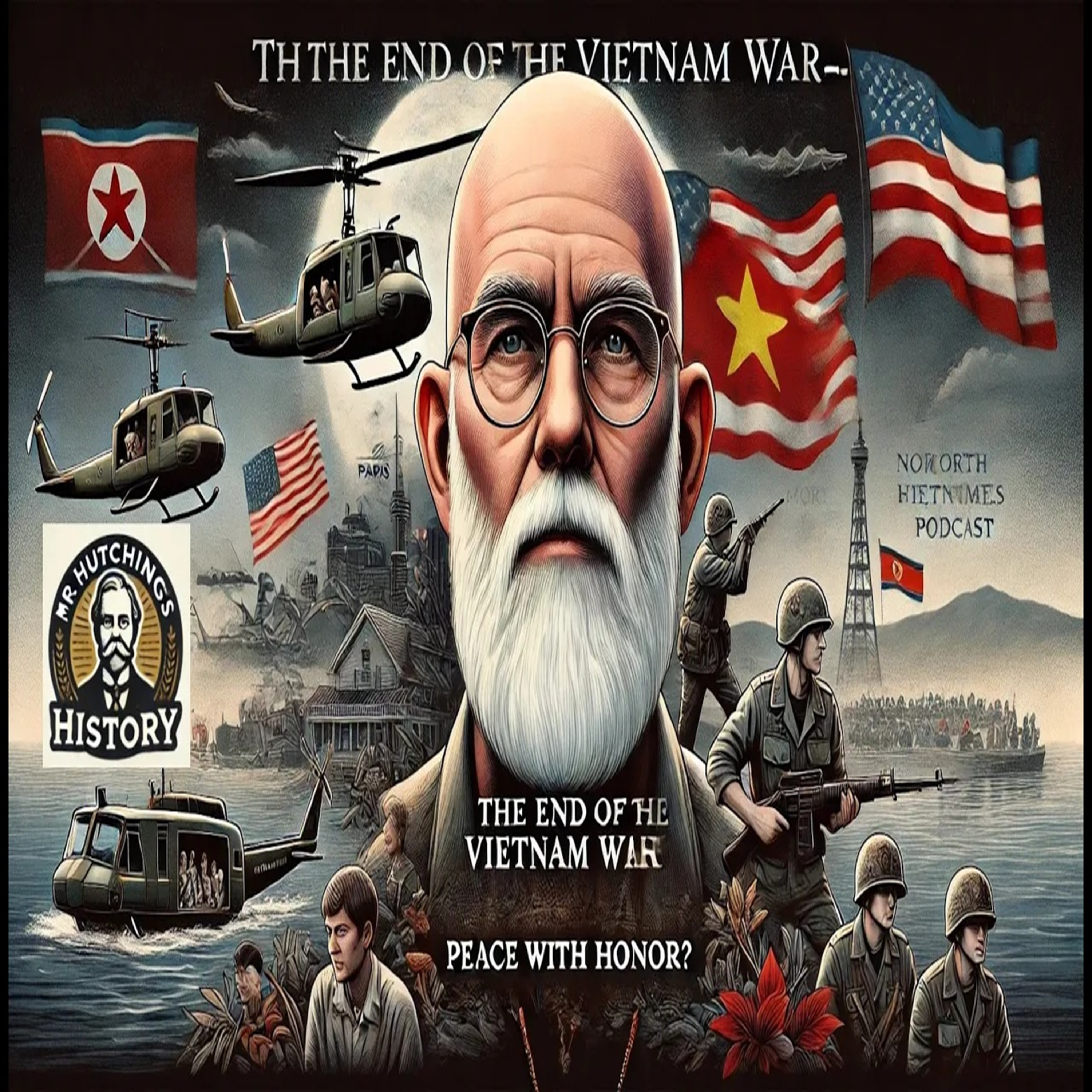
The End of the Vietnam War—Peace with Honor? episode artwork

EPISODE · Nov 21, 2024 · 13 MIN

The End of the Vietnam War—Peace with Honor?

from Mr. Hutchings History · host Produced, created, and written by Harold M. Hutchings

Welcome back to Mr. Hutchings History! In today’s episode, we explore the end of the Vietnam War and its profound implications for US foreign policy during the Cold War. From Nixon’s "Peace with Honor" strategy to the Paris Peace Accords of 1973, we examine how the US sought to exit the conflict while maintaining credibility and containing communism. We also discuss the role of Henry Kissinger in shaping US diplomacy, the expansion of the war into Cambodia, and the ultimate fall of Saigon in 1975.Key topics include:Nixon’s Vietnamization and "Peace with Honor"Kissinger’s diplomacy and the Paris Peace AccordsThe impact of the war on US domestic politics and the anti-war movementHistorical interpretations of US involvement in VietnamThe fall of Saigon and the end of containment in Southeast Asia#Paper2WorldHistory #VietnamWar #Nixon #PeaceWithHonor #ColdWar #Containment #ParisPeaceAccords #Kissinger #SaigonFall #SoutheastAsia #USForeignPolicy #Vietnamization #ColdWarDiplomacy #AntiWarMovement #HistoriographyWorks CitedGaddis, John Lewis. The Cold War: A New History. Penguin, 2006.Herring, George C. America's Longest War: The United States and Vietnam, 1950-1975. McGraw-Hill, 2002.Karnow, Stanley. Vietnam: A History. Viking, 1983.Schlesinger, Arthur M. Jr. The Bitter Heritage: Vietnam and American Democracy, 1941-1966. Houghton Mifflin, 1967.Chapters(0:00) Introduction – The End of the Vietnam WarWas "Peace with Honor" truly achievable?(1:00) Nixon’s Dilemma – Political Pressures and the Cold WarBalancing domestic anti-war protests with US global credibility.(1:32) Vietnamization – A Strategy with ContradictionsWhy handing the war to South Vietnam while escalating elsewhere backfired.(2:28) Expanding the War – Cambodia, Laos, and Kent StateHow US military actions fueled unrest at home and abroad.(3:10) Operation Linebacker II – The Christmas Bombings (1972)Why Nixon launched one of the most intense bombing campaigns of the war.(3:58) Henry Kissinger and Realpolitik – Diplomacy or Power Play?How Nixon's National Security Adviser reshaped Cold War strategy.(4:47) Nixon's Visit to China (1972) – A Diplomatic ShockwaveHow opening relations with China pressured North Vietnam.(5:41) The Paris Peace Accords (1973) – Ending the War or Pausing It?Why the agreement secured US withdrawal but failed to ensure lasting peace.(6:45) The Fall of Saigon (1975) – A Symbolic DefeatHow the North Vietnamese victory reshaped global perceptions of US power.(7:37) The Legacy of Vietnam – America’s Image and Foreign PolicyHow the war changed US intervention strategies and public trust.(8:15) Historians' Debate – Was Vietnam a Mistake or a Power Play?Examining Orthodox, Revisionist, and Post-Revisionist interpretations.(9:45) Post-Cold War Perspectives – Nationalism vs. CommunismDid the US misinterpret the true motivations of the Vietnamese?(10:30) Lessons from Vietnam – What Can We Learn Today?Understanding the war’s impact on history, diplomacy, and global conflict.

Welcome back to Mr. Hutchings History! In today’s episode, we explore the end of the Vietnam War and its profound implications for US foreign policy during the Cold War. From Nixon’s "Peace with Honor" strategy to the Paris Peace Accords of 1973, we examine how the US sought to exit the conflict while maintaining credibility and containing communism. We also discuss the role of Henry Kissinger in shaping US diplomacy, the expansion of the war into Cambodia, and the ultimate fall of Saigon in 1975.Key topics include:Nixon’s Vietnamization and "Peace with Honor"Kissinger’s diplomacy and the Paris Peace AccordsThe impact of the war on US domestic politics and the anti-war movementHistorical interpretations of US involvement in VietnamThe fall of Saigon and the end of containment in Southeast Asia#Paper2WorldHistory #VietnamWar #Nixon #PeaceWithHonor #ColdWar #Containment #ParisPeaceAccords #Kissinger #SaigonFall #SoutheastAsia #USForeignPolicy #Vietnamization #ColdWarDiplomacy #AntiWarMovement #HistoriographyWorks CitedGaddis, John Lewis. The Cold War: A New History. Penguin, 2006.Herring, George C. America's Longest War: The United States and Vietnam, 1950-1975. McGraw-Hill, 2002.Karnow, Stanley. Vietnam: A History. Viking, 1983.Schlesinger, Arthur M. Jr. The Bitter Heritage: Vietnam and American Democracy, 1941-1966. Houghton Mifflin, 1967.Chapters(0:00) Introduction – The End of the Vietnam WarWas "Peace with Honor" truly achievable?(1:00) Nixon’s Dilemma – Political Pressures and the Cold WarBalancing domestic anti-war protests with US global credibility.(1:32) Vietnamization – A Strategy with ContradictionsWhy handing the war to South Vietnam while escalating elsewhere backfired.(2:28) Expanding the War – Cambodia, Laos, and Kent StateHow US military actions fueled unrest at home and abroad.(3:10) Operation Linebacker II – The Christmas Bombings (1972)Why Nixon launched one of the most intense bombing campaigns of the war.(3:58) Henry Kissinger and Realpolitik – Diplomacy or Power Play?How Nixon's National Security Adviser reshaped Cold War strategy.(4:47) Nixon's Visit to China (1972) – A Diplomatic ShockwaveHow opening relations with China pressured North Vietnam.(5:41) The Paris Peace Accords (1973) – Ending the War or Pausing It?Why the agreement secured US withdrawal but failed to ensure lasting peace.(6:45) The Fall of Saigon (1975) – A Symbolic DefeatHow the North Vietnamese victory reshaped global perceptions of US power.(7:37) The Legacy of Vietnam – America’s Image and Foreign PolicyHow the war changed US intervention strategies and public trust.(8:15) Historians' Debate – Was Vietnam a Mistake or a Power Play?Examining Orthodox, Revisionist, and Post-Revisionist interpretations.(9:45) Post-Cold War Perspectives – Nationalism vs. CommunismDid the US misinterpret the true motivations of the Vietnamese?(10:30) Lessons from Vietnam – What Can We Learn Today?Understanding the war’s impact on history, diplomacy, and global conflict.

NOW PLAYING

The End of the Vietnam War—Peace with Honor?

0:00 13:04

No transcript for this episode yet

We transcribe on demand. Request one and we'll notify you when it's ready — usually under 10 minutes.

The 48 Laws of Power by Robert Greene (Full Audiobook) Robert Greene Amoral, cunning, ruthless, and instructive, this multi-million-copy New York Times bestseller is the definitive manual for anyone interested in gaining, observing, or defending against ultimate control – from the author of The Laws of Human Nature.In the book that People magazine proclaimed “beguiling” and “fascinating,” Robert Greene and Joost Elffers have distilled three thousand years of the history of power into 48 essential laws by drawing from the philosophies of Machiavelli, Sun Tzu, and Carl Von Clausewitz and also from the lives of figures ranging from Henry Kissinger to P.T. Barnum.Some laws teach the need for prudence (“Law 1: Never Outshine the Master”), others teach the value of confidence (“Law 28: Enter Action with Boldness”), and many recommend absolute self-preservation (“Law 15: Crush Your Enemy Totally”). Every law, though, has one thing in common: an interest in t The Laura Ingraham Show Laura Ingraham The most-watched woman in the history of cable news brings her no-holds-barred political and cultural commentary to podcasting with The Laura Ingraham Show. A bestselling author, breast cancer survivor, and mother of three internationally adopted children, Laura was the most listened-to woman in talk radio before launching her own podcast. A trailblazer across media platforms, she brings a unique perspective to this twice-weekly show, drawing on her experience as a white-collar criminal defense litigator and a Supreme Court law clerk.New episodes drop twice a week—delivering the clarity, courage, and common sense America needs. Vampires of the Paper Flower Consortium Elizabeth Guizzetti Come for the evening, stay for eternity! Paper Flower Consortium is a podcast from the largest vampire coven in Seattle. Their stories are told by Loretta Fabron Onfoy, coven historian and librarian, in the hope that the modern vampire's way of life is not lost during the next great language transformation. Some tales in this anthology are horrific, some are droll, some are filled with misadventure--just like any eternal existence. Episodes sponsored by the Paper Flower Consortium's Business Community. The history is followed by questions from curious initiates. Want to ask Lady Loretta a question about vampirism? Have a topic you want to see discussed? Email [email protected] WW2 - the Key Questions, answered by Laurence Rees. Laurence Rees A former Head of BBC TV History programmes, Laurence has specialized in writing books and making television documentaries about World War Two, the Nazis and Stalinism for thirty years. He won a BAFTA and a Peabody for his TV series 'The Nazis: A Warning from History' and a British Book Award for his book on Auschwitz, which is also the world's best selling book on this notorious camp. His book 'the Holocaust: A New History' was described by the Times as 'exemplary' and by the Daily Telegraph as 'the best single volume account of the atrocity ever written'. Educated at Oxford University, for several years he was a visiting senior fellow at the London School of Economics, London University. He holds honorary doctorates from the University of Sheffield and the Open University. Professor Robert Service, of Oxford University, described Rees as 'one of the world's experts on the Second World War'. Sir Max Hastings wrote in the Sunday Times, in a review of Laurence Rees' 'World War Two: Behi

Frequently Asked Questions

How long is this episode of Mr. Hutchings History?

This episode is 13 minutes long.

When was this Mr. Hutchings History episode published?

This episode was published on November 21, 2024.

What is this episode about?

Welcome back to Mr. Hutchings History! In today’s episode, we explore the end of the Vietnam War and its profound implications for US foreign policy during the Cold War. From Nixon’s "Peace with Honor" strategy to the Paris Peace Accords of 1973, we...

Can I download this Mr. Hutchings History episode?

Yes, you can download this episode by clicking the download button on the episode player, or subscribe to the podcast in your preferred podcast app for automatic downloads.
URL copied to clipboard!