
EPISODE · Jul 13, 2026 · 28 MIN
The Enemy Is the Last God
from Language Matters Podcast · host Elias Winter
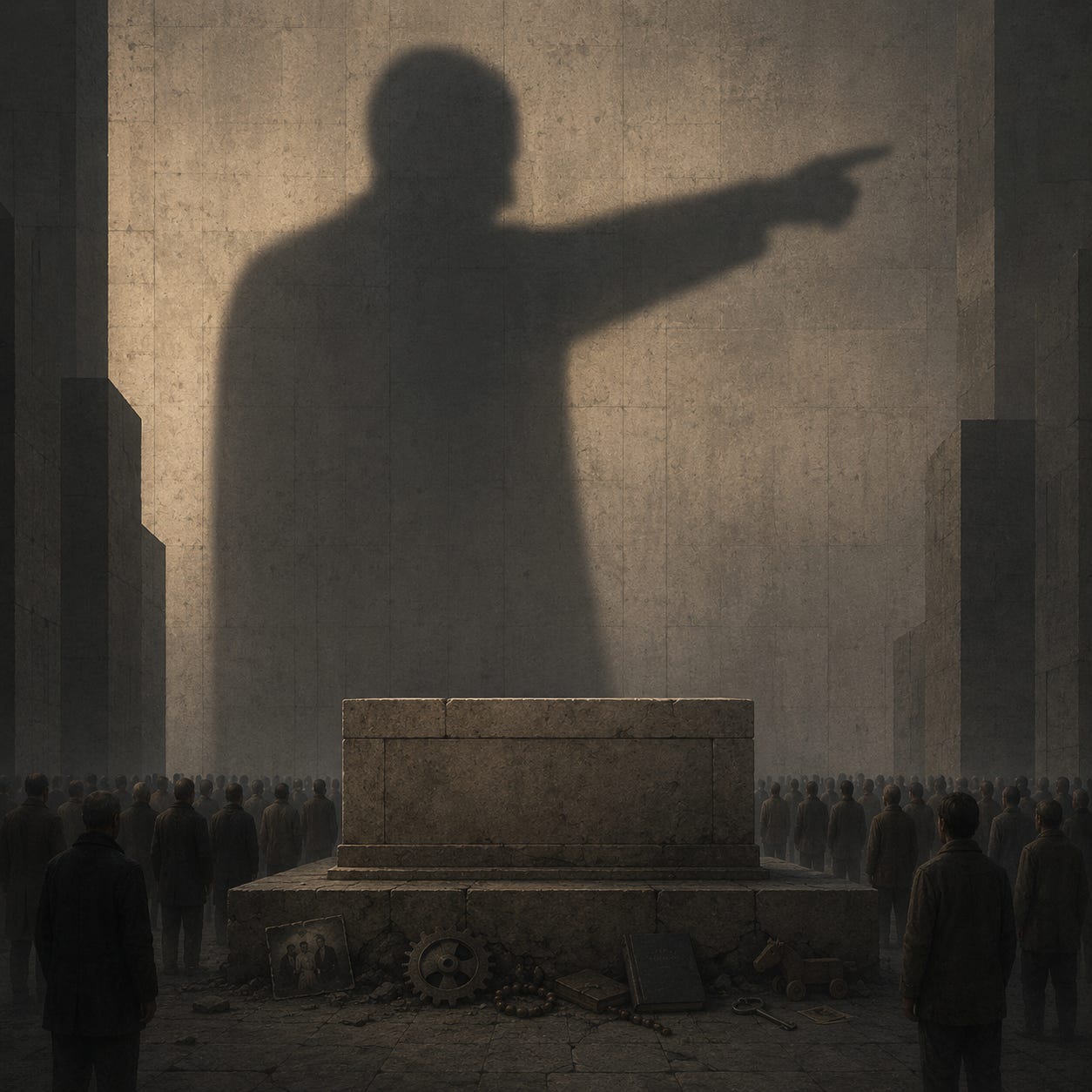
The Last GodA civilization may stop believing in God long before it stops needing gods.The temples can empty. Ritual can fade into private habit. Priests can become cultural relics. Yet the deeper human demands remain: the need to suffer for something, to belong to a people, to name evil, to distinguish innocence from corruption, to believe that history moves toward judgment.Modern societies often mistake the weakening of religion for the disappearance of the sacred. But the sacred rarely disappears. It migrates.It enters politics. It attaches itself to nation, blood, grievance, memory, sex, land, humiliation, and loss. It finds new altars in rallies, screens, funerals, uniforms, flags, and public acts of punishment. People who no longer agree on what is holy may still achieve unity through agreement on what is profane.The enemy then begins to perform the work once performed by God. It explains suffering. It reveals the hidden order beneath chaos. It divides the innocent from the corrupt and demands vigilance, sacrifice, confession, and loyalty.The enemy becomes godlike not because it is loved, but because it becomes the ultimate source of explanation, obligation, sacrifice, and collective purpose.It makes ordinary life feel historical.The movements examined here are reactionary in a specific sense: they convert perceived social loss into a project of restoring an imagined moral order through hierarchy, purification, and designated enemies.Such movements do not emerge from emptiness alone. A society can answer spiritual vacancy with distraction, withdrawal, therapeutic individualism, technocratic management, or private pleasure. Enemy-centered politics requires more: usable grievances, political entrepreneurs, weakened institutions, polarizing media, and opportunities to convert emotional intensity into state power.Where these conditions exist, the absence of a shared moral horizon becomes dangerous. A society uncertain of what it exists to protect becomes vulnerable to defining itself through what it opposes.The most spiritually barren movements often speak most loudly in the language of destiny. They have little to offer the soul except mobilization, little to offer the citizen except suspicion, and little to offer the future except purification.Yet they possess one great advantage.They know how to make fracture feel sacred.The Privatization of MeaningModernity did not merely weaken religion. Under certain conditions, it privatized meaning while centralizing power.Markets expanded into regions of life once governed by custom, family, guild, congregation, and locality. Work became more mobile and less rooted. Civic associations weakened. Public space was reorganized around consumption. Responsibility for failure moved steadily inward, from institution to individual.The citizen was told that belief belonged to private life. Truth became personal. Identity became a project. Morality became a choice among competing lifestyles.The public world, meanwhile, became extremely capable of calculation. It could classify populations, move capital, predict appetite, monitor behavior, and accelerate nearly every process except the formation of a common answer to the question of why any of it mattered.What is a good life?What do the living owe the dead?Which desires should be refused even when they can be satisfied?Why should strangers remain responsible for one another?What makes suffering bearable when it cannot be cured?The modern individual is rarely given answers. He is given options.Choose your values privately. Compete publicly. Manage the loneliness personally.This arrangement contains a genuine moral achievement. It frees people from compulsory doctrine and inherited authority. It permits lives that older communities would have punished or erased.But it also leaves each person responsible for constructing alone what previous societies inherited collectively: a language of duty, a relation to death, a reason to sacrifice, a place in time.Most people cannot manufacture a civilization alone.They can select a lifestyle, assemble a taste, join an audience, cultivate a brand, and build a career. But these are not the same as inhabiting a moral world.The problem is not that modern people have no values. They possess many private values and too little shared meaning. Their lives are dense with preference and thin with obligation.Modernity did not eliminate the sacred. It outsourced the sacred to the individual, then left the individual too isolated to sustain it.Reaction enters through this opening.It arrives not first as doctrine, but as relief. It offers the scattered person a world in which nothing is accidental, no loss is private, no humiliation is meaningless. It tells him that his loneliness is historical, his disorientation political, his suffering authored.The person who could not build a moral world alone is invited into one already complete.It has symbols, martyrs, prohibitions, enemies, and a promised return.The Alchemy of ReactionReaction begins with injury, but injury is never enough.Every society contains griefs that do not yet know one another. A town loses its industry. A worker sees his labor become invisible. A village empties. A parent watches a child abandon the family’s faith. A language once spoken with pride becomes a source of embarrassment.Other experiences are morally different. A man raised to expect unquestioned authority discovers that authority must now be negotiated. A dominant group encounters people it once excluded as equals. A woman gains freedom but enters a society that offers independence without security, reverence, or rest.These are not equivalent losses.The loss of livelihood, community, or political voice is not the same as the loss of inherited authority over women, minorities, children, or subordinates. One may represent abandonment. The other may represent emancipation.Reactionary politics gains power by compressing them into one vocabulary of dispossession.First comes disorientation. The world changes faster than inherited identities can explain.Then humiliation. People do not merely lose something; they feel that what they loved, expected, or embodied has been declared backward or disposable.Then compression. Distinct experiences are folded into a single story.The closed factory, the independent daughter, the new curriculum, the distant capital, the absent God, the unfamiliar neighbor: all become evidence of one deliberate betrayal.Then identification. Those who suffer are told that they are not isolated failures. They are the authentic people.Finally, the enemy is named.The genius of reaction is not that it invents pain. It is that it gives separate wounds a common author.Once the author is named, complexity becomes conspiracy. History becomes theft. Difference becomes attack. The future becomes restoration.The movement does not need its members to agree on economics, war, religion, class, technology, or the state. It needs them to agree that something rightful was taken, that someone took it, and that power must reverse the loss.If contradiction appears, the enemy is obstructing the plan.If corruption appears, the enemy has infiltrated the movement.If conditions worsen, the enemy is stronger than anyone understood.If leaders violate the movement’s morality, the enemy has made ordinary morality impossible.This is how resentment becomes cosmology.A grievance says: I was harmed.A reactionary faith says: We are the last innocent people in a world organized against us.That sentence offers more than anger.It offers absolution.The Village MachineThe reactionary dream is often described as a return to tradition. More precisely, it is a desire to restore the moral conditions of the village.In the village, everyone is legible. Roles are known. Deviation is visible. Reputation is shared. Authority has a face. The dead remain present through memory. The child enters a world already named.This world can be suffocating. It can imprison women, punish difference, erase privacy, and enforce inherited rank. But it also answers needs the anonymous city often neglects: recognition, continuity, mutual obligation, and the assurance that one’s life is witnessed.The metropolis offers freedom through distance. One can escape the family, the congregation, the neighbor, the role assigned at birth. One can become unknown enough to become oneself.But anonymity has a shadow. The person liberated from the village may discover that no one is watching because no one cares.Reactionary politics promises to restore village intimacy without surrendering the power of the modern state.This cannot be done.A nation of millions cannot become a small moral community. It cannot know each person personally or enforce one conception of virtue without coercion.So the state simulates the village.It uses surveillance to recreate visibility, ideological screening to recreate reputation, public denunciation to recreate gossip, standardized language to recreate custom, and databases to know what the neighbor once knew.Reactionary government is a village simulation operated by a modern machine.Such movements may praise simplicity, soil, family, faith, and ancestral order. Yet they depend on mass broadcasting, centralized bureaucracy, digital monitoring, administrative classification, and technologically amplified policing.They do not reject modern power.They reject modern pluralism.They want the archive, the ministry, the algorithm, the weapon, and the screen placed in service of a society where everyone can again be assigned a visible moral location.The machine grows larger because the village no longer exists.The Enemy as InfrastructureHatred is usually treated as an emotion. In mass politics, it often becomes an institution.The enemy performs tasks that a functioning social order would otherwise have to perform.It creates unity without requiring agreement.A movement may contain the poor and the rich, the pious and the cynical, provincial constituencies and metropolitan financiers. Their interests may conflict. Their futures may be incompatible.Yet they can remain together as long as they believe they face the same enemy.The enemy is the bridge across contradiction.It also explains failure.Ordinary governments are judged by outcomes. They must manage trade-offs, restrain corruption, preserve trust, and leave institutions capable of surviving them.Enemy-centered governments operate by another logic. They need not solve every problem if they can reinterpret each problem as evidence of sabotage.The economy does not fail; it is attacked.The policy does not collapse; it is betrayed.The bureaucracy is not incompetent; it is disloyal.The population is not unconvinced; it is deceived.The leader is not corrupt; he is surrounded.This is why the enemy must be continually renewed.A government based on performance can rest when a problem is solved. A government based on grievance cannot. It requires recurrence.Where ordinary governments require results, enemy-centered governments require return.The enemy must appear each morning because it is doing the work that governance, theology, and solidarity no longer perform.Without it, the coalition begins to see itself.The moralist notices the leader’s immorality. The worker notices that wealth remains concentrated. The anti-elite follower notices that a new elite has taken power. The believer notices that public piety has produced neither mercy nor peace.The enemy delays these recognitions by keeping the movement externally focused.This is why dissent from within is often more dangerous than opposition from outside. The outsider can be hated. The insider reveals the contradiction.The enemy is the institution that holds the movement together.Why the Majority LosesA militant minority does not require majority belief.It needs enough people to enforce, enough to benefit, enough to repeat, and enough of the rest to remain separate from one another.The reactionary coalition has the easier task. It needs agreement about the enemy.The pluralistic majority has the harder one. It must determine how people with different gods, histories, bodies, classes, and memories can live together without domination.The minority can chant.The majority must negotiate.The minority can repeat one story.The majority must protect the right to tell many.The minority can promise purification.The majority must administer coexistence.This makes pluralism appear weak even when its disorder is the consequence of representing genuine difference.Its strength is dispersed. Its members may privately reject the militant worldview while disagreeing about nearly everything else. They mistake disbelief for resistance, contempt for organization, numerical superiority for institutional power.But private disbelief does not prevent an institution from being captured.A population can mock official slogans while obeying official offices, working inside official agencies, depending on official contracts, and avoiding the risks of coordinated refusal.Authoritarian systems survive not because everyone believes.They survive because disbelief remains private while loyalty becomes institutional.The organized minority seeks the mechanisms that convert intensity into rule: appointments, budgets, schools, courts, media, police, patronage, records, and fear.Its opponents often organize around rejection. But a coalition united only by what it opposes inherits the same structural weakness it condemns. Once the immediate danger passes, its internal differences return.Democratic resistance therefore needs more than unity. It needs constitutional agreement, material competence, and a positive account of belonging strong enough to survive disagreement.The majority loses when it remains a population rather than becoming a public.Apocalypse as Administrative TechnologyApocalypse is often treated as a belief about the end of the world. Politically, it is a method of governing the present.Ordinary politics exists in long time. It must preserve what it inherits. It must imagine that opponents will remain after the election, that institutions will outlive leaders, that children will inhabit the consequences of present appetite.Apocalyptic politics tells people that history is approaching rupture. The final struggle has begun. Compromise becomes betrayal. Patience becomes cowardice. Institutional restraint becomes collaboration with evil.The future is no longer a shared space to be built.It is a verdict.This changes the moral meaning of destruction.A collapsing institution may be welcomed as purification. A worsening conflict may prove that the enemy is desperate. A failed policy may demonstrate that resistance is deeper than expected.Breakdown does not falsify the prophecy.It fulfills it.The darkness proves the warning. The violence proves the stakes. The isolation proves the chosenness of the faithful.Apocalypse thus becomes a shield against accountability. It transforms consequence into confirmation.The movement may speak obsessively about children, ancestors, civilization, and generations while behaving as though no ordinary future is worth preserving. It sacrifices institutions, trust, competence, and peace in the name of descendants who exist primarily as symbols.The long term becomes sacred in rhetoric and disposable in practice.Apocalypse is the political abolition of the long term.The world does not have to end. It is enough that people begin governing as though coexistence already has.The Costume of FaithEvery reactionary order needs a new elite that appears not to be an elite.Its members speak more roughly than their predecessors. They reject professional decorum. They perform plainness, piety, toughness, provinciality, or deliberate vulgarity.The old elite justified itself through education, refinement, technical expertise, or cultural fluency.The new elite justifies itself through authenticity.It says: we are not polished because polish is corruption. We are not restrained because restraint is weakness. We do not speak the old language because the old language concealed betrayal.Rejection by prestigious institutions becomes proof of moral worth.In reactionary politics, disqualification by the old elite becomes certification by the new one.The follower sees a leader considered crude, fanatical, or unqualified and concludes that the old order hates him because he represents those it once ignored.The supporter receives symbolic ownership of power.The new elite receives the state.Anti-elitism does not abolish hierarchy. It changes the costume of hierarchy.Religion can undergo a similar narrowing.Religion has never served only one function. It can discipline the self, cultivate mercy, place limits on appetite, and summon the believer toward ethical transformation. It can also classify insiders and outsiders, legitimize rulers, regulate bodies, and define collective boundaries.Political religion emerges when the classificatory function overwhelms the transformative one.The decisive questions change.Not: Have you become truthful?But: Are you one of us?Not: Have you mastered your appetite?But: Do you honor our symbols?Not: Have you served the weak?But: Do you recognize our enemies?Religion becomes less a discipline of conversion than a technology of political legibility.This is why public religiosity can increase while moral conduct decays. The religion may not be failing at its assigned political task. It may be succeeding.Its task is no longer primarily to make the believer good.Its task is to make the population classifiable.Faith can ask the ego to surrender.Political religion invites the ego to return disguised as a civilization.Personal vanity becomes collective chosenness. Personal fear becomes sacred injury. Personal aggression becomes defense of the faith.The individual receives the emotional rewards of transcendence without undergoing the humiliation of repentance.He does not have to become smaller.He only has to belong to something that declares itself greater.The Sacred That Was Never BuiltReactionary movements succeed because they offer corrupted versions of real human goods.They offer belonging to the lonely, continuity to the uprooted, sacrifice to the bored, moral seriousness to the trivialized, ritual to the isolated, and transcendence to the consumer.They do not invent these needs.They discover them abandoned.Their opponents often answer with procedures, expertise, rights, choice, and exposure of hypocrisy. These matter. A society without them becomes cruel quickly.But facts cannot replace communion. Choice cannot replace obligation. Procedure cannot tell a person what deserves reverence.A court can protect freedom of conscience. It cannot create a conscience.A market can satisfy appetite. It cannot teach appetite when to stop.An institution can recognize identity. It cannot guarantee belonging.This is the failure at the center of the modern settlement. It freed people from coercive meaning but did not reliably build a shared moral world capable of sustaining that freedom.The answer cannot be a return to compulsory belief, inherited hierarchy, or the moral surveillance of the village. The old sacred was not innocent. It often demanded obedience from women, silence from minorities, shame from the body, and submission from those outside its favored order.But neither can a pluralistic society survive by treating every sacred claim as private taste.It needs a language of reverence that does not require domination.Dignity without chosenness.Solidarity not founded on enemies.Obligation without inherited rank.Continuity without captivity.Ritual without compulsory belief.Freedom disciplined by responsibility.Such commitments do not emerge from declarations alone. People learn them through institutions that make cooperation habitual.They learn them in unions and civic associations where strangers become responsible for one another. In schools that teach disagreement without humiliation. In public service that places people from different backgrounds inside a common obligation. In libraries, parks, meeting halls, and neighborhoods not organized entirely around consumption. In public commemorations that remember victims as well as victories. In systems of material security that make pluralism livable rather than merely legal.A non-authoritarian sacred would not eliminate conflict. It would refuse to make dehumanization the price of solidarity.It would not tell everyone what to worship.It would establish what no faction may destroy for the pleasure of belonging.It would teach that truth is not a weapon owned by one side. That mercy is not weakness. That restraint is not surrender. That the stranger’s dignity does not depend on resemblance. That no movement becomes holy by identifying someone it is permitted to crush.Reactionary movements do not triumph because they possess too much faith.They triumph because the societies opposing them possess too little shared language—and too few shared institutions—for practicing what deserves reverence.The enemy becomes the last god only after a society has forgotten how to kneel before anything it does not wish to destroy.—Elias WinterAuthor of Language Matters, a space for reflection on language, power, and decline This is a public episode. If you would like to discuss this with other subscribers or get access to bonus episodes, visit eliaswinter.substack.com
Embed this episode
NOW PLAYING
The Enemy Is the Last God
No transcript for this episode yet
Similar Episodes
No similar episodes found.
Similar Podcasts
No similar podcasts found.