
EPISODE · Feb 25, 2026 · 15 MIN
The Executable Web. When Museums Become Actionable by AI Agents
from AI in the Museum: Connecting Futures · host MuseumWeek
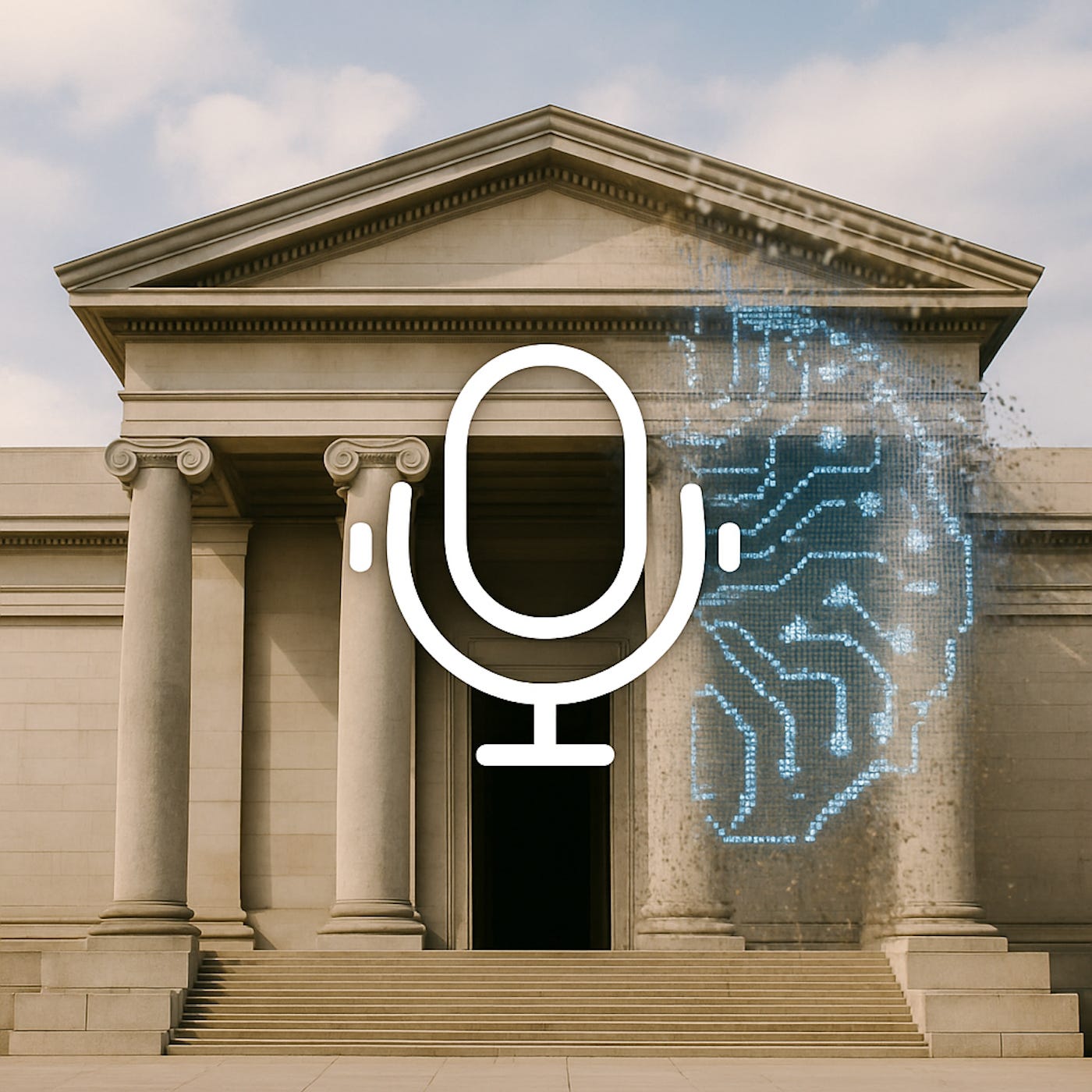
A Structural Shift in the Architecture of the WebA structural shift is unfolding beneath the surface of the web. For three decades, websites have been designed primarily for human navigation. Pages were structured visually. Interfaces were optimized for clarity and engagement. Search engines indexed content so that users could find it, read it and act upon it.Today, a new layer is emerging. It is not designed for human eyes, but for artificial agents.The idea is simple, yet transformative. Instead of forcing AI systems to imitate human behavior by clicking buttons and interpreting graphical interfaces, websites can expose structured functions directly. Search the archive. Register for an event. Book a ticket. Retrieve metadata. Access educational material. These actions can be declared as callable tools, accessible to machines through standardized protocols. The web would no longer be merely read by machines. It would be executed by them.From Interface Imitation to Structured ExecutionUntil now, AI agents have had to “pretend” to be human users. They scrape pages, simulate cursor movements, interpret layouts and attempt to infer meaning from visual structures. This approach is fragile and inefficient. It depends on interface stability and often breaks when websites change.Emerging standards such as the Model Context Protocol and related experimental initiatives aim to move beyond this paradigm. They propose a structured interaction model in which publishers define the functions that agents are authorized to call, under controlled conditions. Instead of navigating through layers of design intended for humans, an agent can directly invoke a declared function and receive a structured response.This evolution does not signal the disappearance of graphical interfaces. Museums will continue to design websites for visitors. But alongside the human-facing layer, a second layer may develop. This new layer would expose services in a structured, machine-readable way. In practical terms, the web becomes two-layered. One layer serves human experience. The other serves machine execution.From Visibility to Actionability. The Rise of AEOIn such an environment, the strategic question shifts. For years, institutions have focused on Search Engine Optimization. The objective was visibility. How do we rank. How do we appear in search results. How do we attract traffic.In an agent-mediated ecosystem, visibility alone may no longer be sufficient. The new challenge becomes actionability. Can an AI assistant directly query our collection database. Can it enroll a user in a workshop. Can it retrieve authoritative descriptions without distorting them.This shift is sometimes described as a move from SEO to Agent Engine Optimization, or AEO. The question is no longer only whether agents can find us, but whether they can act through us in a controlled and reliable manner.Why This Matters for MuseumsFor museums, the implications are substantial. If AI assistants increasingly mediate access to information, they may become dominant gateways to cultural content. A visitor might ask an assistant to suggest exhibitions on climate change, retrieve primary sources on a historical event, or book a science workshop for a school group.If the museum’s digital infrastructure exposes structured services, the assistant can perform these actions directly and accurately. If it does not, the assistant will rely on secondary sources, approximations or aggregated data from platforms that do not belong to the institution.The stakes extend beyond convenience. They concern the circulation of knowledge. Museums are custodians of validated, curated and contextualized information. When AI agents become intermediaries, the integrity of that information depends on how it is accessed and transmitted. Structured exposure of functions allows institutions to define the rules of interaction. They can specify what is accessible, under what conditions, with what attribution requirements. They can embed source references, usage constraints and traceability mechanisms into the interaction layer itself.Governance, Sovereignty and Editorial ControlThis introduces a governance dimension. Who defines the callable functions? Which datasets are exposed? How is premium or subscription-based content protected? How is editorial value preserved?Archives, digitized collections and scholarly resources represent significant investments. If agents can retrieve and redistribute content without clear attribution or control, institutional authority may erode. Conversely, if museums define interoperable standards and maintain oversight of their machine-facing layer, they can strengthen their position within AI ecosystems.The discussion is therefore not purely technical. It touches on sovereignty. If large AI platforms define proprietary interaction standards, cultural institutions risk dependency. Their content could circulate primarily through external ecosystems, shaped by opaque algorithms. Open and standardized approaches to an executable web offer an alternative path. They enable institutions to remain actors rather than passive data providers. By declaring structured tools themselves, museums can retain agency in how their knowledge is mobilized.Rethinking Digital Strategy in an Agent-Mediated WorldThis transformation also redefines metrics of digital success. Traffic and page views may no longer capture the full picture. A museum’s influence might increasingly be measured by how often its structured services are called by trusted agents, how frequently its authoritative descriptions are cited, and how effectively its systems integrate into educational or research workflows mediated by AI.Yet caution is necessary. An executable web amplifies both opportunity and risk. Poorly defined interfaces could expose sensitive data. Insufficient traceability mechanisms could weaken attribution. Over-automation could reduce the richness of human engagement. Museums must therefore approach this shift deliberately. The question is not whether to embrace or reject machine interaction, but how to design it in alignment with institutional values.At a practical level, cultural institutions may begin by identifying the services that could benefit from structured exposure. Collection search functions. Event registration systems. Educational resource access. Metadata retrieval. Each of these can be mapped and evaluated. Which actions should be callable. Which require authentication. Which must remain restricted. This mapping exercise is as much strategic as technical.Conclusion. Becoming Executable on Our Own TermsThe emergence of an executable web marks a profound reconfiguration of digital infrastructure. It suggests that websites are no longer static presentations of information, but programmable knowledge systems.Museums have long adapted to technological change. From print catalogues to websites, from audio guides to immersive installations, they have integrated new media into their mission of transmission. The agent-driven web represents another stage in this evolution. It challenges institutions to rethink their digital architecture, not as a mere communication channel, but as an interoperable system within a broader computational ecosystem.The critical question is therefore not whether machines will execute parts of the web. That trajectory is already visible. The real question is whether museums will shape this layer proactively, or allow it to be shaped around them. In an agent-mediated world, remaining visible is no longer enough. Institutions must also remain executable, on their own terms.Benjamin BENITA, Editor-in-Chief, MuseumWeek MagazineSources: Google previews WebMCP, a new protocol for AI agent interactionsAgents no longer need to “pretend” to be humanModel Context Protocol (MCP) Get full access to MuseumWeek Magazine at museumweek2h1r4.substack.com/subscribe
Embed this episode
Ready to play
The Executable Web. When Museums Become Actionable by AI Agents
No transcript for this episode yet
Similar Episodes
No similar episodes found.
Similar Podcasts
No similar podcasts found.