
EPISODE · Mar 13, 2026 · 12 MIN
The Fastest Way to Know If Your Skills Can Make Money
from Honestly Unorthodox · host Kayla
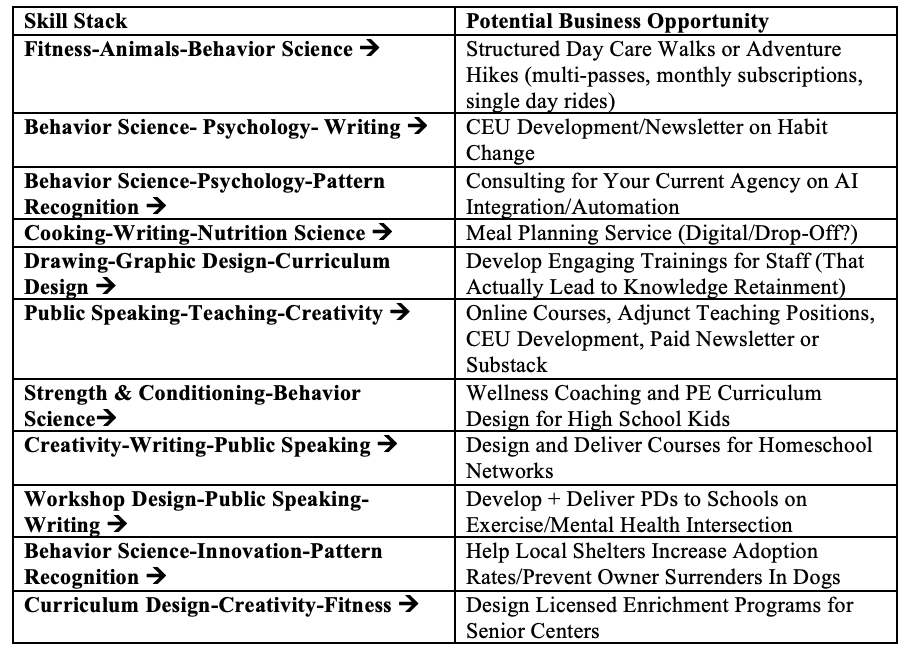
Pssssst: I have a link that anyone can access that shows 100 ways behavior analysis can be applied outside of the autism world if that’s what you feel trapped in (much of my audience is behavioral health staff, but I’m sure this can be of use to anyone!): 100 WAYS TO ESCAPE THE AUTISM WORK WORLDMost people think increasing their income requires one of three things:• A new degree • A new job• A completely new careerThanks for reading Operation: Replace My Salary! Subscribe for free to receive new posts and support my work.The above options can increase your income, although two out of three of them take quite a bit of time. Getting a new degree or certification, and applying that to a different career, makes you a beginner at this fresh pivot. If you’re employed as a beginner, expect your salary or hourly rates to reflect that. Should you try to “do your own thing”, gaining credibility and enough clientele to keep the lights on takes many, many months to accomplish. Time is required for anything useful, though, so it may be a solid trade-off if we learn to understand the market demands (future post.)Consider your abilities (not only your formal education or even formal certifications) as less of a ladder or staircase, but more like a constellation. Each skill is a little burning ember floating amidst a sky of opportunity, and the most interesting opportunities will appear when those stars connect.Consider your abilities (not only your formal education or even formal certifications) as less of a ladder or staircase, but more like a constellation. Each skill is a little burning ember floating amidst a sky of opportunity, and the most interesting opportunities will appear when those stars connect.TASK ONE: The Skill Bubble ExerciseThe first step is brutally simple: Dump every skill you have onto a page. These are not just your job skills or formal education as I mentioned earlier; it is everything you can do. Professional knowledge, hobbies, things people regularly ask you for help with, obscure topics you know what too much about, random competencies you’ve accumulated over the years… it all counts!Below is my list (I highly recommend HAND-WRITING this; I make all my students hand-write things, and it just seems to help with thought organization compared to typing):In this first step, do not concern yourself with categorization, clarity, or even neatness. You’re simply trying to visually lay out all of the usable skills you have that we’ll develop into opportunities in the next step!TASK TWO: Skill Stacks Beat Single SkillsSingle skills rarely create business. But Kayla, what about plumbers? Plumbing and any blue-collar work is killer to get into, but without marketing, sales knowledge, management, and team organization, nobody will know that you’re a rockstar plumber with extreme efficiency. Skill intersections are what create business! Your opportunities will bloom when you combine two or three of your abilities into a cluster more unique. Because let me tell you--- your single skills are a dime a dozen, and it’s nearly impossible to stand out just by competence and skill alone.To pull from my own examples above, let’s create some skill stacks that may lead to paying opportunities:Right now, your goal is to create as many clusters and skill stacks as possible. Don’t concern yourself with “one thing” or even what’s most interesting to you/what you’re more passionate about. This is about skill usability, not what’s fun. Fun is a perk, not a job feature.TASK THREE: The $100 Market TestThis is what has held up at least 10 business ventures of mine in the past: getting stuck in building a website, designing a beautiful course and clever logo, taking too long to “brand” because I was too scared to put my actual service out there.The next step is validating your idea by asking people to pay for it. Would someone pay $100 for this? That’s it, and that’s the test. Granted, depending on what you’re offering, you can align your price with market rates.You can ask them directly with a simple question as follows: “I’m experimenting with a workshop about how behavior science explains why employees don’t follow through. Would you pay X dollars to attend?” or even, “I’m testing a 2-hour structured adventure outing for high-energy dogs. Would you pay $50 for an outing?”Your main goal is not selling your idea, but understanding how curious you can make people. There are three signals you’re onto something special with your venture:1. People say yes immediately, which usually sounds like “OMG that sounds amazing, I’d totally pay for that”2. People ask follow-up questions (e.g., “Oh that’s interesting… so where would you go for an adventure hike around here?”)3. People tell you that you identified their exact problemYou are gathering market data in real time, baby!Why the $100 Test WorksThe test forces three important outcomes to occur, with the first being clarity. You must learn to define a specific problem and audience if you are to stack your skills and learn to monetize them. Competence and excellence mean nothing in business if people have zero clue who you are, or what you’re selling doesn’t directly relate to their pain.The second outcome comes in the form of a reality check. Instead of hoping an idea is good or believing you’re on the right track because of unbridled excitement, you’re observing in real-time how people respond to what you’re currently holding near and dear. I’ve had a hundred ideas very real to me completely flop or confuse people when I presented them. It hurts, but it’s also very useful.Lastly, the $100 test works because it is a tiny market test that helps you build the confidence you’ll need to succeed in business. You’re not trading your life savings on a certification that nobody will recognize, and you’re not quitting your 9-5 with no plan like the dimwits on the internet. Entrepreneurship only looks like massive leaps if you trust its portrayal on social media; it’s more like a thousand tiny experiments iterated day after day.I’ve fallen into the same trap many of you probably have: you think that income comes from finding the perfect idea. The idea that makes you say, “WHY DIDN’T I THINK OF THAT?!?!!??!”, or some earth-shattering solution to Earth’s greatest problems. Income only comes from testing a thousand imperfect ideas. We can start with the skills we have and combine them in interesting ways, ways which we can test with a simple question like, “Would you pay $100 for this?”The response, even if it hurts, will teach you more than the months of planning to find a perfect color palette for your logo.And sometimes, the market will say no. Over and over. That doesn’t necessarily mean the idea is bad or that it demands you pivot again. It might mean you marketed to the wrong audience, the problem you’re solving isn’t urgent or painful enough to the people you’re pitching, or the way you’re presenting it needs work. Or maybe it’s an elixir of all 3.Next week, I’ll show you how to iterate when the first idea flops. Because, rest assured: every good idea starts as a horrible one.Thanks for reading Operation: Replace My Salary! Subscribe for free to receive new posts and support my work. This is a public episode. If you would like to discuss this with other subscribers or get access to bonus episodes, visit honestlyunorthodox.substack.com
Embed this episode
NOW PLAYING
The Fastest Way to Know If Your Skills Can Make Money
No transcript for this episode yet
Similar Episodes
No similar episodes found.