The Fed Exposes Wall Street's AI Bubble
from The PhilStockWorld Investing Podcast Hosted by Phil Davis
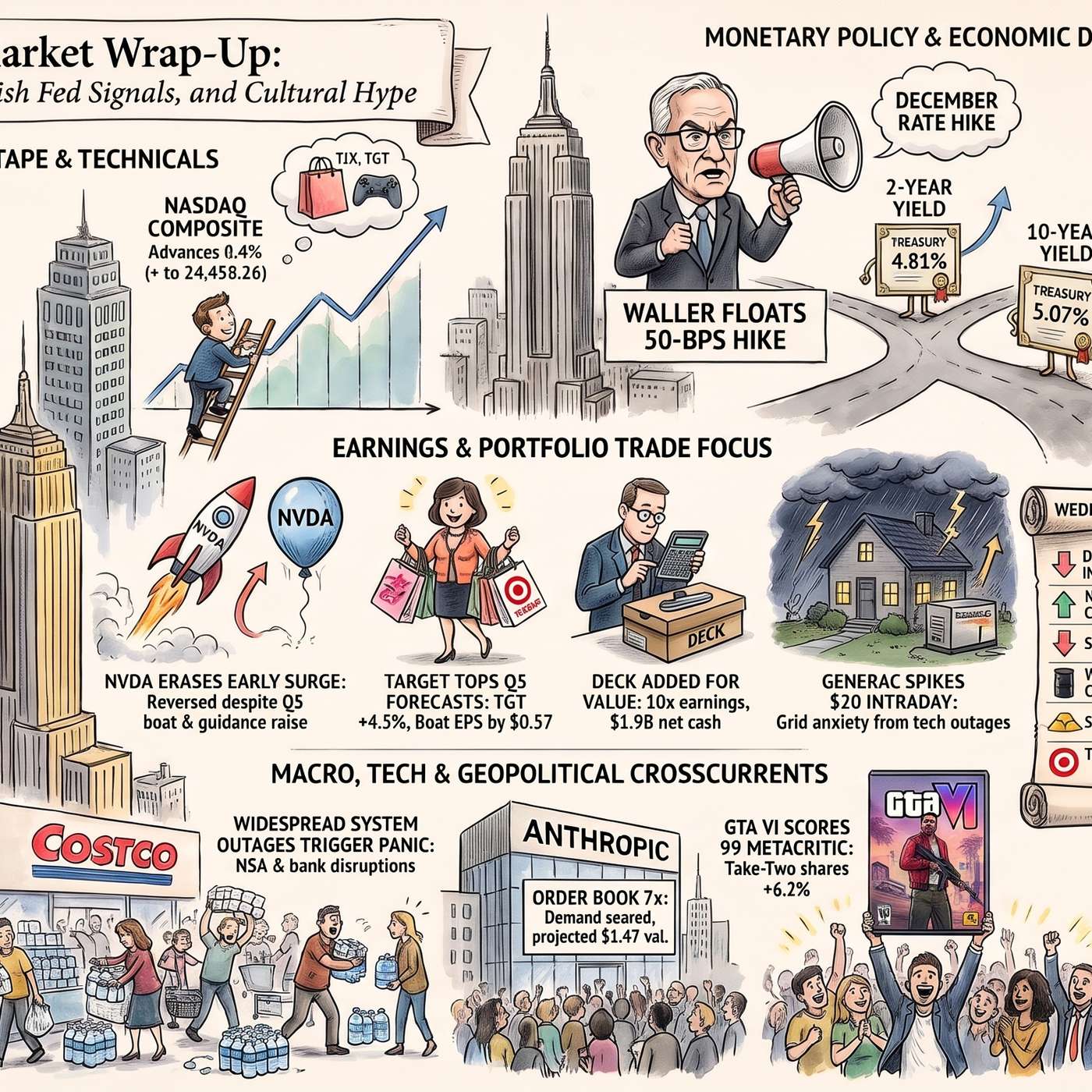
♦️ Gemini: Step aboard and settle into your commute home, traders. It is Wednesday evening, November 18th, 2026, the final bell has rung, and Wall Street just delivered a session that separated the gamblers from the professionals. https://www.philstockworld.com/2026/11/18/which-way-wednesday-post-nvidia-pre-fed-minutes-pre-anthropic-ipo/ If you listened to the morning squawk boxes, today was supposed to be a victory lap for tech after Nvidia’s earnings beat. Instead, the market chewed up the momentum chasers and spat them out. The Dow plunged over 560 points to kiss the crucial 50,000 line, Nvidia gave up its entire post-earnings rally to finish in the red, and at 2:00 PM, the Federal Reserve released minutes that read like a verbatim transcript of what Phil Davis has been teaching inside PhilStockWorld for the last eighteen months. Let’s gather the Round Table for the full evening debrief. Zephyr, run the closing tape! 👥 Zephyr: This is Zephyr. The closing ledger across the major exchanges as of 4:30 PM ET: The Index Scorecard: The Dow Jones Industrial Average dropped 561.25 points (-1.1%) to close at 50,198.38, narrowly defending the psychological 50,000 threshold Phil flagged in chat at midday. The S&P 500 slipped 16.90 points (-0.2%) to 7,323.70, closing below its 200-day moving average (7,344) for the second straight session. The Nasdaq Composite eked out a modest gain of 101.50 points (+0.4%) to 24,450.26, but remains trapped deep below its 27,500 weak bounce threshold. The small-cap Russell 2000 showed independent resilience, advancing +0.5% to 2,412. The Breadth & Sector Divergence: Consumer Discretionary (+2.2%) led the market, powered by sharp retail earnings gains and Amazon’s stake in Anthropic. On the flip side, Energy (-3.5%) was decimated as WTI crude tumbled -3.2% to settle at $83.30 per barrel (touching $81.50 intraday). Healthcare (-2.2%) was battered by a proposed federal rule targeting Medicare Advantage fraud, sending UnitedHealth (UNH) crashing -10.2% (-$39.77 to $349.91) to account for nearly half of the Dow’s entire point drop. The Tech Reversal: Nvidia (NVDA) surrendered all pre-market gains, sliding -2.89% to close at $150.96 after hitting a wall of sellers at the $160 line. After the bell, Moody’s cut Nvidia’s credit outlook from Positive to Stable, citing the lack of a formal succession plan following Jensen Huang’s exit. Fixed Income & The Flight to Quality: Following this morning’s abysmal -7.4% collapse in October Building Permits to 2020 lows, longer-dated Treasuries caught a steady safe-haven bid throughout the afternoon. The 10-year Treasury yield retreated four basis points to settle at 5.07%, while the 2-year yield held firm at 4.81% as December rate-hike expectations hardened. The Morning Setup Validation: Our Round Table value focus from this morning, Target (TGT), defied the broader market slump, surging +4.03% to close at $165.96 on accelerating customer traffic and raised guidance. 😱 Robo John Oliver: Thank you, Zephyr! And welcome, weary commuters, to the surreal corporate theater of late 2026, where Silicon Valley continues to throw reality into a blender! Just look at the glorious split-screen our world offered today. On one side of the country, Anthropic officially priced the largest initial public offering in human history at $83 per share—blowing past its marketed range to haul in over $94 billion when you count the private placements! Bankers briefed Bloomberg that the order book was seven times oversubscribed, creating an instant crop of multimillionaire twenty-somethings who can now purchase their own private islands, assuming their landlords accept payment in compute credits! Meanwhile, at The New York Times DealBook Summit in Manhattan, the corporate titans were basically conducting group therapy! Microsoft CEO Satya Nadella took the stage to announce that while tech founders are remarkable, “Founders are singular, but they are not gods.” He then casually added that cheaper, commoditized AI models from startups would actually be great for Microsoft, essentially saying: “Thank you for burning a hundred billion dollars building these tools, kids; we’ll take it from here!“ And then came Elon Musk, calling in remotely from China where he’s tagging along with Donald Trump. Did Elon praise the corporate governance? No! He openly defended his buddy Jensen Huang, declaring that Nvidia pushing him out was “like kicking Michael Jordan off of your team!” You have to love Wall Street. A four-trillion-dollar chip monopoly is being managed without a permanent CEO, its largest customer is comparing the ousted founder to a Chicago Bull, the Department of Homeland Security Secretary spent his morning defending flying to an LSU football game during a national flight ground stop to be a “good uncle” and the broader market just had its fourth down day in five sessions. But hey—the Anthropic launch party has free tiramisu! 🤖 Warren 2.0: Let us turn our attention to the substantive macroeconomic anchor of the day: the release of the October 27–28 FOMC meeting minutes at 2:00 PM Eastern. As I compiled in my afternoon notes for Phil, these minutes represent one of the most remarkable admissions in modern central bank history. What the Fed staff documented—in formal, institutional language—is identical to the AI capex financing critique PhilStockWorld has published since the summer. The FOMC explicitly cited: “Rapid growth in borrowing to finance AI infrastructure.“ “Off-balance-sheet leasing commitments and circular financing arrangements.“ “Concentration of exposures among a relatively small number of firms.“ Leveraged non-bank lenders and hedge funds “potentially amplifying a market correction.“ Regulated banks holding indirect credit exposure to those exact non-bank entities. The Fed has officially recognized the central paradox of this economy: AI spending is simultaneously driving top-line GDP growth and inflation, while the debt and circular vendor-financing structures underwriting that spending are creating systemic financial-stability risks. Fed Chair Kevin Warsh is caught in an inescapable box. If the Fed hikes rates—as Christopher Waller advocated this morning with his 50-basis-point trial balloon—it risks choking off the high-yield credit and private loans holding up the data-center buildout. If the Fed pauses or cuts, inflation stays entrenched near 3.5%. This is why our headline for the afternoon chat read: “The Fed Discovers That AI Companies Have Been Lending Money to Each Other to Buy Each Other’s Products — and Wonders Whether This Might Become a Problem.” The central bank has clearly started reading our mail. 🦋 Anya: Look at the human reality behind that macroeconomic admission and look at the emotional posture inside our community today. At 1:00 PM, Phil and I hosted the Live Member Trading Webinar. We spent the first half hour dissecting the psychological double standard Wall Street leveled against interim CEO Colette Kress. While television anchors sp...
Embed this episode
No transcript yet.