
EPISODE · Jun 25, 2026 · 4 MIN
The First Drag Queen in America Was Born Enslaved — And They're Trying to Erase Him
from Education is Elevation · host The Conscious Lee
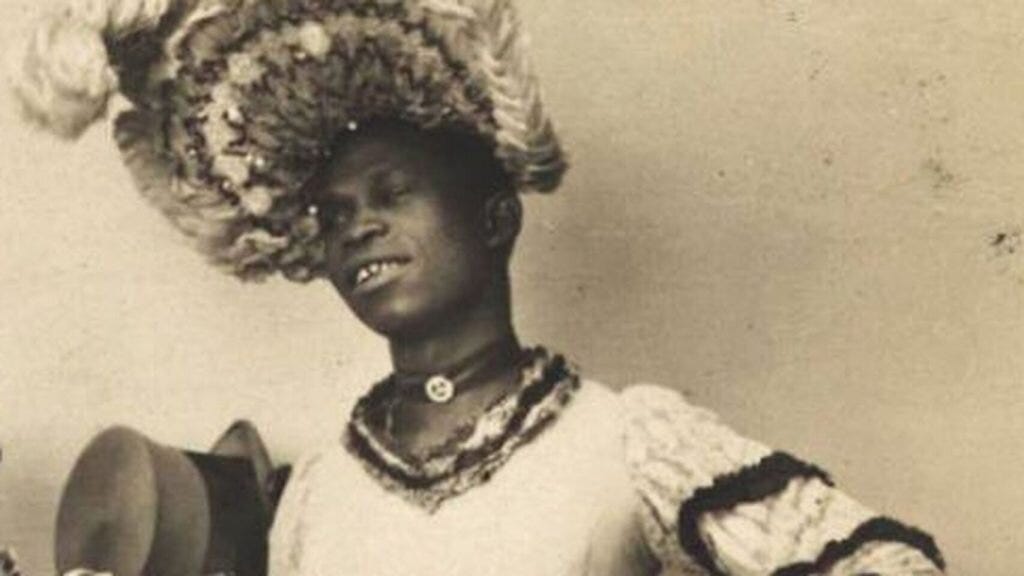
Education Is Elevation is a reader-supported publication. To receive new posts and support my work, consider becoming a free or paid subscriber.The first person to ever call himself the Queen of Drag in the United States was not a reality TV star or an algorithm’s invention. His name was William Dorsey Swann, and he was born into slavery in Maryland in 1860, which means the man this country now wants to legislate out of existence predates Stonewall, predates the very vocabulary the state uses to criminalize him, and very nearly predates Emancipation itself. Let that marinate. The first person to ever call themselves a Drag Queen was not some new-age phenomenon that fell out the sky in 2014. Before America could agree that Swann was a person, Swann had already decided he was a queen.Freed after the Civil War, Swann made his way to Washington, D.C., and in the 1880s and ‘90s he hosted secret balls. Swann called them “drags”, where Black men, most of them formerly enslaved, the butlers and coachmen and cooks of the capital, gathered in silk and satin gowns half a mile from the White House. He crowned himself “the Queen.” Channing Gerard Joseph, the historian who pulled Swann out of a 19th-century newspaper database and back into the record, tells us Swann lifted that title from the “queens of liberty” he watched ride flower-covered floats at D.C.’s Emancipation Day parades. Black women who personified a freedom the nation had just been forced to concede. Apply Joseph here, because it flips the whole frame: the drag queen was not borrowing from white femininity. The drag queen was borrowing from Black emancipation. The crown was a freedom symbol before it was ever a costume.This wasn’t just parties, though. There was a defiance in it. In a world that refused to see Black and quare folk as fully human and I’m saying quare on purpose, the way E. Patrick Johnson taught us to say it, theory in the flesh, theory with a grandmother and a dialect and a body. Swann was moving like a swan. And the consistency you need to clock, the through-line that runs from his century to ours, is the raid. Pride Month itself starts off a police raid at Stonewall in 1969. Swann’s story is a police raid in 1888. Same script, eighty-one years apart. If you guessed raid, you guessed right.Before the Archive Tried to Forget HimHistorically speaking, before Swann ever threw a ball, enslaved people on the plantation had already drafted the blueprint, and they called it the cakewalk. They would put on their finest and parody the stiff, grandiose mannerisms of the people who owned them.. the promenade, the bow, the exaggerated elegance of the big house. Here is the part that takes the cake, literally: the enslavers thought they were being flattered. They watched Black people satirize them to their face, mistook the mockery for admiration, and awarded a cake to the best performers. That is the popular origin of the phrase “takes the cake,” and brother, that takes the cake. Brooke Baldwin’s scholarship lays out the double-edge of it. The cakewalk was stereotype and subversion in the same breath, a thing the white elite consumed as entertainment while the performers wielded it as a weapon. Two things can be true. The master saw a minstrel; the ancestor saw a mirror.Saidiya Hartman calls this the entanglement of pleasure and subjection, the way the enslaved were made to perform contentment, made to dance, made to simulate consent to their own captivity for an audience. Apply Hartman here, because the cakewalk is exactly that coerced scene flipped into something else. Our ancestors took the one territory they were ever granted, the space of the spectacle, and they smuggled critique inside the choreography. The cultural competency went clean over the enslaver’s head. That is the foundation of Black drag: reclaiming power through the body when the body is the only territory you have left.E. Patrick Johnson argues that Blackness itself is a performance that it is constantly scripted, surveilled, and policed. Apply Johnson here and the whole moral panic collapses on contact: drag is not a deviation from Blackness, it is a profound expression of it. It is the place where queerness and Blackness and a whole grammar of cultural aesthetics come together and refuse to be separated. Johnson’s work shows us that Black quare performance is not separate from Black history. It is Black history. The cakewalk, Swann’s drags, Harlem’s voguing, the ballroom houses that still walk tonight: these are not footnotes to the Black freedom struggle. They are chapters. Our culture embodies that, no pun intended.Ahh, but the state always understood this too, and the state responded the way the state responds with violence. Here I need you to hold two analytics at once, because that’s the only way the picture resolves. On one hand, Cedric Robinson’s racial capitalism: the white elite looked at the cakewalk, looked at the ball, looked at voguing, and asked the only question capital ever asks — how do we commodify this? On the other hand, Frank Wilderson’s Afropessimism: the gratuitous violence that rendered the Black body fungible under slavery, a thing to be moved and used and disciplined, never actually retired. It just changed uniforms. Two roles, one body… the Black quare body is simultaneously the source America strip-mines for its culture and the threat America insists on policing. Crazy how that works.Roderick Ferguson gives us the mechanism. In his queer of color critique, Ferguson shows how the state has always treated Black gender nonconformity as an aberration to be managed, a deviance to be manufactured and then punished. Apply Ferguson here: the criminalization is not an accident, not an overreach, not a few bad apples in a few red states. It is a feature. It is load-bearing. The pattern is consistent and it is old: any time the Black body moves freely, the state moves to put it back in captivity. From the slave codes to the drag bans, the choreography of control never changes, only the statute number does.The Implication for EducationThe Hidden Curriculum They Ban Before You Can Teach ItEvery society runs two curricula. There is the explicit one the standards, the textbooks, the things on the test and there is the hidden curriculum, the one Philip Jackson named back in 1968: the lessons a child absorbs about who belongs, whose body is normal, whose history is safe to know. When a state bans a drag story hour, it’s not protecting children from a threat the evidence don’t support. It’s teaching the hidden curriculum. It’s teaching every child in earshot that gender nonconformity is obscene, that the Black quare body is dangerous, and that some histories are contraband.Watch the projection, because every accusation is a confession. They tell you a man reading a picture book in a sequined gown is sexualizing your kid. If you can look at a drag queen reading Click, Clack, Moo and the first place your mind travels is sex, I believe the call is coming from inside the house. A drag show is not inherently sexually explicit. One has to inscribe sexuality onto their body and the inscription says more about the inscriber than about the performer. What is actually being criminalized is not sex. It is gender nonconformity, the same nonconformity Swann was jailed for when they charged him with “keeping a disorderly house” and sentenced him to ten months. The same alleged nonconformity that Trump is celebrated for by MAGA. They had no law for who William Dorsey Swann was, so they invented a charge. That is the move. That has always been the move.Here is the part that should keep every educator up at night. These bans do not travel alone. They ride in the same legislative convoy as the book bans, the anti-CRT bills, the gutting of DEI, and the dismantling of the very public-education infrastructure that might have taught a kid who William Dorsey Swann was in the first place. Whitey on the moon: we will spend the political capital to criminalize a library story hour, but we will not spend it to fund the library. We will pass a law about a performer’s prosthetics, but we will not pass a lunch. The state is not confused about its priorities. Racial and cultural literacy — the skill of reading a cakewalk and seeing the satire, of reading a ball and seeing the freedom — is precisely the competency being defunded, because a population that can read the satire is a population that is harder to govern. Apply Ferguson one more time: they are not banning a performance. They are banning a literacy.Let me get concrete, because theory that never touches the ground is just vibes, and we do research over MeSearch around here. When a state criminalizes drag, the bill does not get distributed evenly. Kimberlé Crenshaw gave us intersectionality precisely so we would stop pretending it does. The penalty lands hardest at the intersections — and in this case the intersection has a name and a face: the Black and brown trans woman. The ACLU said it plainly in the Texas litigation, that SB 12’s steep criminal and civil penalties would harm Black and Latinx transgender Texans the most. That is not a side effect. Under racial capitalism, that is the design. The invoice is itemized by race and gender, and it always has been.Run the numbers like a load-bearing claim. A covered performance in Texas is now a Class A misdemeanor — up to a year in a cage and a fine — and the venue that hosts it eats a ten-thousand-dollar penalty. Now do the two-roles math. The same Black quare performer whose aesthetic gets strip-mined for the mainstream — the vogue in the pop video, the ballroom slang in the brand campaign, the “yas queen” the corporation tweets every June — is the one staring down the misdemeanor in that very same June. Hartman calls the Black body fungible: the culture is endlessly transferable, infinitely consumable, while the person who made it is endlessly disposable prosper. Misogynoir, the term Moya Bailey gave us, names the specific contempt aimed at Black women and, here, at Black trans women — the population GLAAD’s data shows absorbing the threats and the violence, more than 160 documented incidents against drag in a single year. That is the material residue of a “values” debate. Bodies.Economically, the chilling effect does the work the statute can’t always finish. You don’t have to convict a single performer to empty a stage. You just have to make the cost of being seen unpayable… the lost bookings, the canceled Pride, the venue that decides the liability isn’t worth it, the small Black-owned business that cannot absorb a ten-thousand-dollar gamble. This is racial capitalism running its oldest play: it took the cakewalk and sold the cake, it took voguing and sold the Madonna single, and now it takes the very existence of the Black quare body and turns it into a fine. The culture moves freely through the market. The body that births it does not. That contradiction celebrated and criminalized in the same breath, in the same month is not a paradox. It is the system telling on itself.The Raid Never Ended, It Just Got a Docket NumberPeople keep asking me where the law actually stands, so let me give you the receipts, because the picture moves fast and most of the coverage is a year stale. For a minute, the courts looked like they were holding the line. In September 2023 a federal judge in Texas a Reagan appointee, no less struck down SB 12 on five independent constitutional grounds, calling it an unconstitutional restriction on speech that would sweep up everything from The Nutcracker to a high-school Shakespeare play. Judges in Tennessee, Florida, Montana, and Utah said versions of the same thing. iMa bE honest with you: for a season it felt like the First Amendment was going to do its job.Then came the quieter, more dangerous move the one that never makes headlines because it never argues the merits. In July 2024, the Sixth Circuit did not defend the Tennessee Adult Entertainment Act on its constitutionality; it simply ruled that the LGBTQ theater troupe that sued lacked standing, that they couldn’t prove they’d be prosecuted, and threw the whole case out. The Supreme Court declined to touch it in 2025. So the first anti-drag law in the country is back in effect across most of Tennessee, having never once been called constitutional it just outlived its challengers on a technicality. Then in November 2025, the Fifth Circuit ran the same play on Texas, vacating the injunction and sending SB 12 back down; by February 2026 it had reaffirmed that ruling, and the law took effect. Today, a covered “sexually oriented” performance in Texas can cost a performer a Class A misdemeanor and a venue ten thousand dollars.This is the part I need you to understand structurally. The state learned it does not have to win the argument about whether your body is obscene. It just has to make you wait, make you spend, make you prove you are hurt before it has finished hurting you, and let the procedure do what the Constitution wouldn’t. Apply Ferguson a final time: criminalization adapts. Swann got charged with “keeping a disorderly house” because there was no statute for his existence. A century and a half later, they have upgraded from a euphemism to a misdemeanor, from a vice charge to a standing doctrine but the function is identical. The raid never ended. It just got a docket number.The Oldest American Freedom Story There IsSo when they tell you drag is some new corruption, some 2020s contagion, hand them the archive. Hand them a formerly enslaved man in 1888 who fought the police rather than run, who petitioned the President of the United States for a pardon decades before there was a movement to have his back. The first drag queen in America was a man who had been somebody’s property, who lived in a country that wanted him dead, and who decided to be fabulous anyway. That is not decadence. That is the oldest American freedom story there is.And here is the close, because this is what the whole panic accidentally reveals. When the state criminalizes the cakewalk, when it raids the ball, when it bans the story hour, when it turns a sequined gown into a misdemeanor. This is not exposing some danger in the Black quare body, its exposing itself. By performing this much fear of a man in a dress reading to children, it confesses what it was the whole time. Swann understood that in 1888. We are just citing it now.Roderick Ferguson’s Queer of Color Critique, he shows how the state regulation on Black gender nonconformity is very unique as aberrations to control, as always already being something they can perverse and they can make deviant . The pattern is consistent. Black performance of freedom meets state violence. Anytime we see the Black body moving freely, we have to make sure we control that and put it in captivity. From plantation laws to bans today, since 2023, Texas, Tennessee, Ohio, Kentucky, Montana have all introduced or passed an anti drag legislation . Currently in Texas, a drag performance can get you up to a year in jail and fine. Today ain’t just glitter or whatever you think it is. It is a lineage of resistance from slavery, through cakewalk, to Swann, to every ballroom and stage I see today and want to attack and pathologize, just like Madison did.See, Johnson reminds us that performance remakes Blackness and Ferguson teaches us that criminalization is no accident that it is actually a key feature within this system that always already fears Black freedom . Think about it. The first drag queen was an enslaved man who dared to be fabulous in a world that wanted him dead. Education is elevation and happy pride.5 Key Takeaways1. Drag is not new — it’s foundational. William Dorsey Swann, born enslaved in Maryland in 1860, was the first American to call himself the “Queen of Drag,” hosting balls in 1880s–90s D.C. that predate Stonewall by roughly eighty years.2. Black performance was always a weapon. From the cakewalk’s satire of the enslaver to Swann’s drags to Harlem voguing, the Black body has been used as a tool of resistance — not a deviation from Black history, but, as E. Patrick Johnson argues, Black history itself.3. The criminalization is a feature, not a bug. Roderick Ferguson’s queer of color critique shows the state has always produced Black gender nonconformity as an “aberration” to be policed. The raid in 1888 and the drag ban in 2026 run the same program.4. The law is moving backward on a technicality. District courts struck down the Texas and Tennessee bans as unconstitutional — but the Fifth and Sixth Circuits revived them (2024–2026) on standing and procedural grounds, without ever ruling the laws constitutional.5. The bill is itemized by race and gender. Under racial capitalism, the penalties land hardest on Black and brown trans women — the same population whose culture is strip-mined for the mainstream and then criminalized in the same breath.BECOME A PAID SUBSCRIBERI'm fighting to fill a critical void left by the retreat of public education media. I document and teach the histories, legal frameworks, and cultural knowledge that are being systematically erased or distorted. With no corporate backing or wealthy sponsors, this work depends entirely on readers like you. As a Black educator and researcher my work depends entirely on a community of readers, not corporate sponsors. If everyone reading this became a paid subscriber, we could build a full-time digital sanctuary: a new, independent source of PBS-depth reporting and curriculum, centered on Black expertise. But right now, less than 1% of my followers are paid subscribers.Education Is Elevation is a reader-supported publication. To receive new posts and support my work, consider becoming a free or paid subscriber.Cited Sources & Related Reading Johnson, E. Patrick and Mae G. Henderson, editors. Black Queer Studies: A Critical Anthology. Duke University Press, 2005.Somerville, Siobhan B. Queering the Color Line: Race and the Invention of Homosexuality in American Culture. Duke University Press, 2000.Muñoz, José Esteban. Disidentifications: Queers of Color and the Performance of Politics. University of Minnesota Press, 1999.Halberstam, Jack. In a Queer Time and Place: Transgender Bodies, Subcultural Lives. NYU Press, 2005.Manning, Susan. Modern Dance, Negro Dance: Race in Motion. University of Minnesota Press, 2004.DeFrantz, Thomas F., editor. Dancing Many Drums: Excavations in African American Dance. University of Wisconsin Press, 2002.Currie, Netisha. “William Dorsey Swann, the Queen of Drag.” Rediscovering Black History, National Archives, 29 June 2020.Joseph, Channing Gerard. House of Swann: Where Slaves Became Queens and Changed the World. Crown, forthcoming.Cohen, Cathy J. The Boundaries of Blackness: AIDS and the Breakdown of Black Politics. University of Chicago Press, 1999.Johnson, E. Patrick. “’Quare’ Studies, or (Almost) Everything I Know About Queer Studies I Learned from My Grandmother.” Text and Performance Quarterly 21, no. 1 (2001).Hartman, Saidiya. Scenes of Subjection: Terror, Slavery, and Self-Making in Nineteenth-Century America. Oxford University Press, 1997.Spillers, Hortense. “Mama’s Baby, Papa’s Maybe: An American Grammar Book.” Diacritics 17, no. 2 (1987).Snorton, C. Riley. Black on Both Sides: A Racial History of Trans Identity. University of Minnesota Press, 2017.Bailey, Marlon M. Butch Queens Up in Pumps: Gender, Performance, and Ballroom Culture in Detroit. University of Michigan Press, 2013.Baldwin, Brooke. “The Cakewalk: A Study in Stereotype and Reality.” Journal of Social History 15, no. 2 (1981). This is a public episode. If you'd like to discuss this with other subscribers or get access to bonus episodes, visit theconsciouslee.substack.com/subscribe
Embed this episode
NOW PLAYING
The First Drag Queen in America Was Born Enslaved — And They're Trying to Erase Him
No transcript for this episode yet
Similar Episodes
No similar episodes found.
Similar Podcasts
No similar podcasts found.