
EPISODE · Mar 10, 2026 · 22 MIN
The First Iran Domino: From Bahrain to Your Grocery Bill
from Tatsu’s Newsletter Podcast · host Tatsu Ikeda
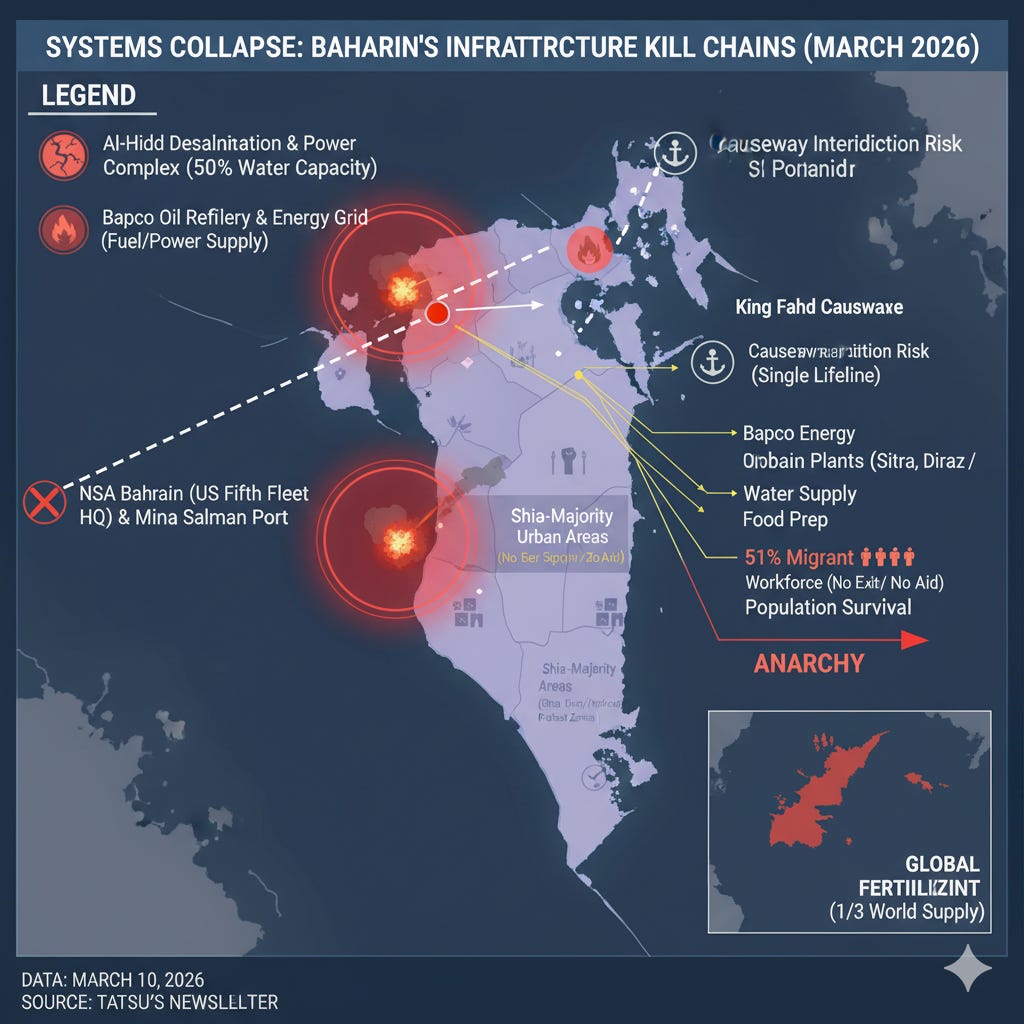
March 10, 2026"There are only nine meals between mankind and anarchy." Alfred Henry Lewis, Cosmopolitan Magazine (1906)[1]Bloomberg: $35/month. Financial Times: $42/month. The Economist: $17/month. Original analysis by Tatsu with 40+ footnotes: $8/month.This post is public. Share it with anyone who should see this.Ten days ago, I wrote that they killed Khamenei and it would not matter.[2] Two days ago, I wrote that the war had already metastasized beyond anyone's plan: a bifurcated Iran, a depleting missile shield, Russian intelligence feeding targeting data to Tehran.[3] Both assessments hold. But while the world fixates on the spectacle in Tehran, on interceptor arithmetic and nuclear materials, something quieter and more consequential is happening 600 miles to the south.Bahrain is dying.Not dramatically. Not in a single strike. The country is being taken apart piece by piece, system by system, with a precision that suggests planning rather than impulse. An Iranian drone hit a desalination plant on March 8.[4] A ballistic missile set the national oil refinery ablaze on March 5.[5] Protesters are in the streets for the first time since 2011.[6] The Saudi backstop that saved the monarchy fifteen years ago does not exist in 2026.[7] And the Fifth Fleet headquarters, the reason the United States cares about this island at all, is operating out of hotels because the base is no longer safe.[8]This article is about why Bahrain is the most vulnerable state in the Persian Gulf, how Iran is exploiting that vulnerability without firing a single invasion force, and why the fall of a country most Americans cannot find on a map would reshape the global order in ways that the fall of Tehran never could.$8/month for original, footnoted geopolitical analysis. Bloomberg charges $35.The Triple Kill Chain, Water, Food, and EnergyThe strategic concept is simple enough that you can draw it on a napkin. Bahrain imports 90% of its food.[9] It produces 100% of its drinking water through desalination.[10] Desalination requires energy. The energy comes from the Bapco refinery and the domestic gas grid.[11] Destroy any layer, and the layers above it collapse.Take out energy: desalination fails. Take out desalination: water disappears. Take out water: food preparation becomes impossible. Everything collapses simultaneously, and the reserves are measured not in months or weeks, but in days.This is what Alfred Henry Lewis meant. Nine meals. Three days. In a country that grows almost nothing and manufactures every drop of water its population drinks, the distance between normalcy and anarchy is shorter than almost anywhere else on earth.COUNTRY FOOD WATER RESERVES RISK IMPORT DESAL ──────────────────────────────────────────────────── Bahrain 90% ~100% Days EXTREME Kuwait 90%+ 90% Limited High Qatar 90%+ ~100% ~1 year Significant UAE 85% 90% 4-6 months Moderate Saudi 80% 70% 6+ months LowestQatar learned this lesson in 2017, when the Saudi blockade cut 40% of its food imports overnight.[12] Within weeks, Doha had established emergency airlift routes and redirected maritime shipments through Omani ports. By 2019, Qatar had built strategic reserves sufficient for approximately one year. Bahrain learned nothing from Qatar's experience. There was no reserve buildup, no alternative supply chain, no contingency for the scenario now unfolding. The kingdom is an island connected to the outside world by a single 25-kilometer bridge to Saudi Arabia, and that bridge was not designed to sustain a nation.Iran understands this arithmetic. The targeting sequence observed since February 28 follows a deliberate escalation ladder: first military nodes (the Fifth Fleet, Sheikh Isa Air Base), then economic nodes (the Bapco refinery, Salman Port), and now life-support nodes (desalination infrastructure in Muharraq).[13] This is not carpet bombing. This is systems engineering applied to state collapse.Two to Seven Days of Water SecurityBahrain's water security depends on six desalination facilities producing approximately 846,000 cubic meters per day.[14] In normal times, this is barely sufficient for a population of 1.6 million consuming 440 liters per person daily.[10] In a war, "barely sufficient" is a euphemism for catastrophic fragility.FACILITY TECH CAPACITY STATUS (MAR 10) (m3/day) ──────────────────────────────────────────────────────── Al-Hidd (HIDD) MSF 409,100 Partially compromised Al-Dur Phase 1 RO 218,200 Operational Al-Dur Phase 2 RO 230,000 Operational Sitra (SPWS) MSF 113,600 Decommissioning Ras Abu Jarjur RO 73,400 Operational Alba Desal MED 31,800 OperationalThe concentration risk is extreme. Al-Hidd and the two Al-Dur phases account for over 75% of total national output.[14] Al-Hidd alone produces nearly half. On March 8, the Bahraini Ministry of Interior confirmed an Iranian drone strike on a desalination plant in the Muharraq area, acknowledging "material damage" and three injuries.[15] Intelligence reporting suggests the strike targeted the intake systems or high-pressure pumping stations of the Al-Hidd facility, the country's single largest water source.[4]The ministry used the phrase "material damage" with the deliberate vagueness of a government that cannot afford to tell the truth. If the Al-Hidd facility suffers a sustained 40% reduction in output, national water production falls below survival thresholds within days. Regional analysts estimate Bahrain's strategic water reserve at two to seven days of normal consumption.[16] Not months. Not weeks. Days.And "normal consumption" is a fantasy during a shooting war. Panic buying and hoarding typically spike demand 25 to 30% within the first 48 hours of an infrastructure crisis.[17] Families fill bathtubs, buckets, anything that holds water. That spike, applied to reserves already measured in days, compresses the survival window to something closer to 48 hours at the extreme. Bahrain ranks among the five most water-stressed countries on earth. Without desalination, the island is uninhabitable.[18]"Desalination plants, essential to Gulf water security, bombed in Bahrain and Iran." Circle of Blue, March 10, 2026[4]The feedback loop is the part that makes recovery nearly impossible without external intervention. Desalination is energy-intensive. The thermal plants at Al-Hidd and Sitra consume natural gas in enormous quantities. The reverse osmosis plants at Al-Dur require high-voltage electricity from the national grid, which is powered by Bapco Energies and associated generation facilities.[11] On March 5, an Iranian ballistic missile struck the Bapco refinery in the Maameer industrial zone, igniting the facility and forcing a declaration of force majeure on oil shipments.[19] The government claims domestic energy demand can still be met. Whether this is true matters less than what happens if it stops being true: the refinery provides backup fuel oil for the desalination plants when natural gas supplies are interrupted. Lose the refinery and you lose the backup. Lose the backup during a war that has already hit the primary, and you are counting hours.Energy goes down, water follows. Water goes down, firefighting capability collapses. Without water pressure in the urban grid, Manama and Muharraq lose the ability to extinguish fires, a detail that matters when Iranian missiles are hitting residential towers and luxury hotels across the capital.[20]Saudi Backstop No Longer ExistsIn 2011, Bahrain's rulers faced the largest protest movement in the country's history. Two hundred thousand citizens, one in every three, marched for democracy in the streets of Manama.[21] The Al Khalifa monarchy survived for one reason: Saudi Arabia sent 1,000 troops with armored vehicles, the UAE contributed 500 police, and they crushed the uprising by force.[22] Five thousand security personnel stormed Pearl Roundabout at dawn. The monument was demolished. A three-month state of emergency was declared. One hundred and twenty-two people were killed in the broader crackdown. The opposition was decapitated: Al-Wefaq dissolved, its leaders sentenced to life, its spiritual authority forced into exile in Tehran.[23]The lesson the Al Khalifa drew from 2011 was straightforward: Saudi Arabia will always come.They were wrong.FACTOR 2011 2026 ────────────────────────────────────────────────────────── Saudi backstop 1,000 troops sent Defending itself Trigger Democratic hopes Shia leader killed External strikes None Active missile fire Infrastructure Intact Base, refinery, desal plant hit Water/food supply Normal Hormuz closed, desal attacked US credibility Intact Base evacuated Opposition Organized parties Crushed but enraged Intl attention Arab Spring media Buried under Iran warSaudi Arabia in March 2026 is not the Saudi Arabia of March 2011. Riyadh is managing its most significant security threat in decades. Iranian strikes have targeted the Saudi capital, the port of Dammam, and Prince Sultan Air Base.[24] The Saudi air defense network is performing at high efficiency but hemorrhaging Patriot interceptors at a rate that threatens regional stockpiles. Riyadh hosts 13.4 million foreign workers, the vast majority of whom lack access to bomb shelters or emergency medical protocols.[24] Any diversion of military resources to save Bahrain a second time risks triggering a collapse of Saudi Arabia's own home front.The Peninsula Shield Force, the GCC's collective security mechanism that was rebranded as the Unified Military Command in 2021, remains paralyzed by command fragmentation and interoperability failures.[24] It exists on paper. It does not exist as a deployable force.The King Fahd Causeway, a 25-kilometer series of bridges and embankments, is Bahrain's only physical lifeline to the outside world.[25] In peacetime, it handles approximately 27,000 vehicles daily. Since February 28, it has been overwhelmed by civilian traffic attempting to flee Bahrain and military convoys moving in the opposite direction.[26] The Causeway includes various utilities on Passport Island, but there is no documented large-scale water pipeline capable of transferring hundreds of thousands of cubic meters daily from Saudi Arabia's Eastern Province to Manama.[25] Even if such a pipeline existed, Saudi Arabia's own desalination plants in Dammam and Al-Khobar are under threat of Iranian drone strikes, limiting the surplus available for export.[24]Reports from early February 2026 suggested that Riyadh was already considering a partial military withdrawal from Bahrain due to a breakdown in coordination and trust.[7] Saudi Arabia has reportedly begun to view Bahrain's alignment with Emirati interests as a challenge to Saudi regional leadership. The Cradle reported that the "era of blank checks" for Al Khalifa security has ended.[27] Manama is being told to prove its alignment in exchange for protection, at a time when its internal stability is the lowest since independence in 1971.70% Shia Discrimination ProblemThe demographic composition of Bahrain is its most volatile internal variable, and it has been for 243 years. The island has been ruled by the Al Khalifa, a Sunni dynasty, since they conquered it from Persian forces in 1783.[28] The population is 60 to 70% Shia, depending on whose estimate you believe.[29] The government claims 45%. Independent and opposition sources place it closer to 70%. The discrepancy itself tells you something: a government that cannot acknowledge the size of its own majority has a problem that no amount of interceptors can solve.Military leadership, intelligence services, and key government ministries are overwhelmingly Sunni. Shia citizens face systemic discrimination in employment, military service, and housing. The government has pursued deliberate demographic engineering, naturalizing Sunni migrants from Pakistan, Syria, and other Arab states to dilute the Shia majority.[29] Iran's Interior Ministry designated Bahrain as "Iran's 14th province" in 1957.[30] The Shah formally relinquished the claim after a UN-supervised plebiscite in 1970, but hardliners in the Islamic Republic have periodically revived it. In 2007, the Kayhan editor (close to the Supreme Leader) called Bahrain an Iranian province. In 2009, an adviser to the Supreme Leader used the same language.The Proxy War Nobody Calls a Proxy WarThis is not an ancient theological quarrel that happens to play out on a small island. It is an active proxy competition between two regional powers, each stoking one side of the divide for strategic advantage, and both have been doing it for decades.The mechanics are straightforward. Iran provides the Bahraini Shia opposition with three things it cannot generate domestically: money, training, and religious authority. The IRGC Quds Force runs an operational pipeline into Bahrain through intermediaries in Iraq and Lebanon, funding opposition networks, smuggling small arms, and providing the ideological framework that transforms political grievance into sacred duty.[50] Bahrain has disrupted these networks repeatedly. In 2015 and 2016, the government announced the discovery of large weapons caches linked to Iran, including explosives, assault rifles, and bomb-making materials hidden in residential neighborhoods.[51] The arrests numbered in the hundreds. But disrupting a network is not the same as destroying it, and the infrastructure for external coordination has never been fully dismantled.Saudi Arabia's response has been equally deliberate and equally cynical. Riyadh does not simply defend the Al Khalifa. It helps engineer the conditions that keep the Sunni minority in power: funding the security apparatus, providing intelligence cooperation, and backing the naturalization campaigns that import Sunni citizens to dilute the Shia demographic advantage.[29] The 2011 intervention was the most visible expression of this policy, but the quieter dimension is the constant, decades-long effort to ensure that Bahrain's Shia majority never achieves political representation proportional to its size. Both sides are feeding the fire. Iran amplifies Shia grievance to destabilize a US ally. Saudi Arabia suppresses Shia political power to maintain a friendly buffer state. The Bahraini population is caught between two external powers that treat their island as a chessboard.The Khamenei Martyr CatalystThis is why Khamenei's assassination is not just another political crisis in Bahrain. It is a religious detonation.Khamenei was not merely a head of state. For millions of Shia worldwide, he held the status of marja al-taqlid, a "source of emulation," the highest rank of religious authority in Twelver Shia Islam.[52] His rulings on matters of faith, law, and political obligation carried the weight of divine guidance. When the United States and Israel killed him on February 28, they did not simply remove a political leader. They created a martyr of the highest religious order, and they handed the IRGC the most powerful recruitment tool imaginable: a murdered marja whose blood demands response as a matter of religious duty, not political choice.The IRGC does not need to smuggle more weapons into Bahrain. It needs only to broadcast Khamenei's image alongside footage of the Minab schoolgirls and let the theological logic do the work. For a devout Bahraini Shia, the question is no longer whether to resist the monarchy. It is whether failing to resist constitutes a betrayal of faith.That is the powderkeg. Not demographics alone. Not economics alone. The intersection of demographics, economics, and a religious catalyst that transforms passive resentment into active obligation.The assassination of Ayatollah Ali Khamenei on February 28 was not merely a political event in Bahrain. It was a religious one. Protests erupted within hours in traditional opposition strongholds: Sitra, Muqasha, Diraz.[6] Footage shared on social media showed crowds marching through narrow streets, chanting "for the sake of Hussein" and targeting the American role in the war. These were the first significant public demonstrations since the 2011 crackdown, and they materialized in a single day, driven not by democratic aspiration but by sectarian grief for a murdered spiritual leader.The 2026 protests differ from 2011 in their explicit anti-American character. Many Bahraini Shias now view the U.S. Fifth Fleet as a magnet for Iranian retaliation, turning their neighborhoods into a target zone for regional powers.[6] The death of a Bangladeshi worker in the Salman industrial area and the wounding of 32 civilians in Sitra by Iranian drone debris on March 8 and 9 have intensified this resentment.[31] The argument is simple and, from the perspective of people dodging missile fragments in their living rooms, difficult to refute: the Americans brought the base, the base brought the missiles, remove the Americans and you remove the missiles.On March 3, Grand Ayatollah Sheikh Isa Qassim, in exile in Tehran since the 2016 crackdown, issued a statement condemning the U.S.-Israeli strikes and calling on Muslims to "strengthen resistance and jihad."[32] This directive, from the most authoritative Shia cleric associated with Bahrain, has provided religious legitimacy to street-level resistance. Molotov cocktails and barricades have appeared in multiple neighborhoods.[6]"The war on Iran has ignited rare civil unrest in Bahrain." Middle East Eye, March 2026[6]The government response has been severe and predictable. Since March 6, the Ministry of Interior has banned all street gatherings and open-air assemblies.[33] At least 65 people have been arrested in the first week of March.[6] Eleven were detained for posting footage of Iranian attacks online, charged with "misleading public opinion" and "spreading fear."[34] The government has deployed AI-based social media monitoring to identify and detain individuals sharing strike footage. The detention of influencer Sayed Baqer al-Kamel for posting a video of a burning building in the Seef district was designed as a warning to the broader population.[6]But 65 arrests are containment, not resolution. The security apparatus is holding. The question is whether it can continue to hold if water runs short, food prices spike, and the population concludes that the monarchy has lost both its external protector and its ability to provide basic services. That is the calculation that brought down the Shah in 1979, and the inputs are converging.Iran on March 6 also targeted the Financial Harbour Towers in Manama, the location of the Israeli Embassy, sending a drone that was intercepted near the complex.[35] Bahrain signed the Abraham Accords on September 15, 2020, the fourth Arab state to recognize Israel and a decision deeply unpopular among the Shia majority. For Iran, Bahrain's normalization with Israel makes it a symbolic target: proof that the Accords bring consequences, not security.Iranian state media and IRGC-affiliated channels have shifted from reporting military strikes to celebrating "popular resistance" in Bahrain.[13] The coordination of pro-Iran demonstrations in Bahrain alongside gatherings in Istanbul and Yemen reflects a broader strategy to mobilize the "Axis of Resistance" against Gulf monarchies that host American bases.[13] Iran does not need to land a single soldier on Bahraini soil. It needs 70% of the population to conclude that the monarchy is incapable of keeping them alive.U.S. Fifth Fleet: Shield or Magnet?Naval Support Activity Bahrain, headquarters of the U.S. Fifth Fleet, is the only permanent American naval base in the Persian Gulf.[36] Its area of operations covers 2.5 million square miles, from the Arabian Gulf through the Red Sea. The deal that created it in 1995 was symbiotic: the United States gets power projection across Hormuz, and the Al Khalifa get an American security guarantee that keeps a Sunni minority in power over a Shia majority.[37] The weaker the regime, the more dependent on the United States, the better the basing arrangement. The same model as Diego Garcia, Djibouti, Guantanamo: bases in countries that cannot say no.Both sides of the deal are now failing simultaneously.TARGET DAMAGE IMPLICATION ────────────────────────────────────────────────────────── SATCOM radomes 2 destroyed Fleet comms degraded Warehouse complex 50% destroyed Logistics shortages AN/TPS-59 radar Damaged Missile warning reduced Personnel housing Relocated Lost secure quarters Mina Salman Port Missile strike Port ops compromisedInitial strikes on February 28 and subsequent drone attacks left visible scars across the Juffair facility. Satellite imagery confirmed the destruction of two satellite communications radomes, 50% destruction of the main warehouse complex, and damage to the AN/TPS-59 early warning radar.[38] The radomes provided high-bandwidth fleet communications. The radar fed targeting data to the regional missile defense network. Their degradation increases the "leakage" rate of Iranian missiles across the entire Gulf, because early warning data can no longer be shared with the same speed or accuracy.[39]The Bahrain Defense Force's own intercept statistics, published March 7, reveal the scale of the barrage: 86 ballistic missiles intercepted and 148 drones engaged. Of the drones, 88 were downed. Thirty-six landed or struck inside the country.[35] Those 36 successful drone hits are the number that matters. In a country the size of Bahrain (roughly four times the area of Washington, D.C.), 36 penetrations saturate the defensive perimeter.On March 2, the Department of State ordered the evacuation of all non-emergency U.S. government personnel and family members from Bahrain.[40] The remaining "mission critical" staff relocated from Juffair to hotels outside the neighborhood.[38] The embassy issued shelter-in-place orders for all American citizens remaining in the country.[41] The base is described as operating under "restricted" status: command functions continue, but the ability to support sustained naval operations from Mina Salman port is compromised by debris and the ongoing threat of Shahed-type drones.[38]"If Bahrain becomes ungovernable, it will signify the end of the permanent U.S. naval presence in the Persian Gulf."[42]If Bahrain falls, the Fifth Fleet has three alternative basing options, and none of them work. Fujairah in the UAE sits closer to Hormuz but is currently under Iranian strike pressure.[13] Duqm in Oman offers deep-water port facilities outside the Gulf, but Oman has expressed frustration that the conflict undermined its mediation efforts and is unlikely to welcome an expanded American footprint.[39] Diego Garcia provides total security but is too distant for rapid intervention in the Gulf or Red Sea.[36] The abandonment of Juffair would be a watershed: the United States has maintained a continuous naval presence in the Gulf since 1949. Losing the base would leave a vacuum that Iran would fill not through occupation, but through influence over whatever government replaces the Al Khalifa.The Migrant TrapThere is a population in Bahrain that nobody is planning for. Fifty-one percent of the country's residents are foreign workers, primarily from India, Pakistan, Bangladesh, the Philippines, and Nepal.[43] They have no political rights, no vote, and no access to citizenship-based food subsidies. They maintain the electrical grid, operate the water pumping stations, collect the garbage, and staff the hospitals. Without them, the country ceases to function at a mechanical level.The kafala system traps them in the conflict zone. Under this sponsorship framework, workers are legally tied to their employers and often do not possess their own passports.[43] As commercial flights are canceled and embassies urge departure, many migrant workers lack the legal or financial means to leave.[26] The Philippines has already imposed an automatic deployment ban on new workers to Gulf states.[43] All five confirmed civilian deaths across Gulf states from Iranian strikes in the first week were foreign nationals.[43]Labor camps are frequently located near the industrial and military sites that Iran is targeting. The Maameer and Sitra areas host both the Bapco refinery and major labor residences. If food costs spike further from the Hormuz disruption, migrants absorb the impact first: they do not receive the subsidized food provisions available to citizens.If the migrant workforce flees or is decimated by strikes, Bahrain loses the technical capacity to maintain the infrastructure required to survive. The sanitation workers, the grid technicians, the water pump operators: these are not citizens. They are foreign nationals trapped by a labor system designed to prevent them from leaving, now caught in a war zone that nobody designed for them to survive.It’s Not Just Oil, It’s Fertilizer ShocksThe crisis in Bahrain is not a localized event. It is a transmission mechanism for a global agricultural shock.The Persian Gulf produces a significant share of the world's synthetic nitrogen and urea, the fertilizers without which modern crop yields are impossible. One-third of global fertilizer trade transits the Strait of Hormuz.[44] With the strait effectively closed since February 28, that trade has stopped.COMMODITY PRICE CHANGE IMPLICATION (MAR 1-9) ────────────────────────────────────────────────────────── Middle East Urea +19% ($590/t) Corn/wheat costs surge North Africa Urea +20% EU seeks alternatives US Gulf Urea +15% ($550/t) Spring planting burden EU Natural Gas +50% EU fertilizer at riskThe Gulf Petrochemical Industries Company in Bahrain is a critical node in the global urea trade, but GPIC is only one piece. Saudi Arabia, Qatar, and the UAE collectively supply roughly 45% of globally traded sulfur, 30% of urea, 22% of phosphate, and 20% of ammonia.[44] All of it is trapped behind the Hormuz closure.The timing is catastrophic. Northern Hemisphere farmers are in the middle of spring planting.[45] Nitrogen fertilizer is a time-sensitive input: a delay of two to three weeks in application produces significant yield losses. The shipping lag from the Persian Gulf to North American and European ports is approximately 30 days under normal conditions.[46] The disruption that began on February 28 means the 2026 growing season was already compromised before most farmers realized it.Brazil imports over 90% of its urea needs, with a significant portion traditionally sourced from the Gulf.[47] India is similarly exposed. If the Hormuz blockade persists through March, the resulting grain shortages in late 2026 could trigger a global food price crisis comparable to or exceeding the 2022 shock from the Russia-Ukraine war.[45] The International Food Policy Research Institute has already issued warnings that the Hormuz crisis could produce a "global food security shock."[48]This is how a drone strike on a desalination plant in a country of 1.6 million people connects to the price of bread in São Paulo and the price of rice in Mumbai. Bahrain is not just a domino in the Gulf. It is a domino in the global food system.The CountdownIran's strategy in Bahrain is not based on military occupation. It is based on the systematic degradation of civilian life-support systems to the point where the cost of maintaining the monarchy becomes too high for the Al Khalifa to bear and too dangerous for the Saudi backstop to support.[13] The targeting logic, from military nodes to economic nodes to life-support nodes, is an escalation ladder designed to trigger state collapse through infrastructure failure, not invasion.Four tripwires signal the approach of regime collapse, and the intelligence community should be watching all of them.First: water depletion. If the Al-Hidd facility is not repaired, or if the Al-Dur plants are successfully targeted, the exhaustion of the two-to-seven-day reserve triggers mass civilian panic and urban breakdown in Manama.[16] The window may have already opened.Second: the Sitra commune. If the Shia majority in Sitra or Diraz successfully establishes "no-go zones" that security forces cannot penetrate, it creates a revolutionary beachhead for IRGC support, a foothold from which Iran can project influence without deploying a single soldier.[6]Third: the abandonment of NSA Bahrain. A formal announcement that the U.S. Navy is relocating its regional headquarters to Oman or Diego Garcia would be interpreted as the final withdrawal of the American security umbrella, triggering a political cascade among the domestic opposition and within the Al Khalifa family itself.[42]Fourth: Causeway interdiction. Any Iranian drone strike that successfully damages a bridge span of the King Fahd Causeway would physically isolate Bahrain, transforming it from a kingdom into an open-air prison.[25] At that point, collapse becomes a question of when, not whether.The strategic irony is almost too precise to be accidental. The United States and Israel launched Operation Epic Fury to achieve regime change in Iran. The National Intelligence Council's own assessment, as I wrote on Day 1, says that outcome is unlikely.[2] But the operation may have accidentally created the conditions for regime change somewhere else entirely: in an American ally, a Fifth Fleet host, an Abraham Accords signatory, and the most structurally fragile state in the Persian Gulf.The United States went to war to topple the government in Tehran. It may topple the government in Manama instead."If we see regime change in Bahrain, that is a very important milestone that very few in the West even have on their radar or would understand the significance of." Doomberg, March 2026He is right. And the West still is not watching.The data presented in this article, the water reserves measured in days, the 70% Shia majority, the neutralized Saudi backstop, the Fifth Fleet operating out of hotels, the 36 drones that penetrated Bahrain's defenses, the global fertilizer chain seized at the throat, points to a single conclusion. Bahrain is not merely a theater of Operation Epic Fury. It is the structural pin that holds the Gulf security order together.[49] Pull the pin, and the architecture collapses: the U.S. naval presence in the Gulf, the Abraham Accords framework, the assumption that American alliances provide security rather than attract fire.Nobody is watching. The data says they should be.This analysis was written on March 10, 2026. Previous coverage: ["They Killed Khamenei. It Won't Matter."](https://tatsuikeda.substack.com/p/they-killed-khamenei-it-wont-matter) (March 1, 2026); ["Day 8 Strategic Update: Operation Epic Fury, Zero Ceasefire"](https://tatsuikeda.substack.com/p/day-8-strategic-update-operation-epic) (March 8, 2026).You just read 5,500 words and 52 footnotes that nobody else is publishing.I told you on Day 1 that the interceptor math would decide this war. I told you on Day 8 that a bifurcated Iran would make ceasefire impossible. Now I am telling you that a country most Americans cannot find on a map is closer to regime collapse than the country the Pentagon spent $3.7 billion trying to break.Bloomberg charges $35/month for consensus. The Financial Times charges $42/month for committee analysis. None of them have published what you just read, because the story does not fit the narrative frame of "Operation Epic Fury is working." The data says otherwise.This is $8/month. Less than one gallon of gas will cost you by Day 14 of this war.$8/month. 52 footnotes. Zero spin. Subscribe now.NotesNotesNotes[1] "Alfred Henry Lewis." Wikipedia, accessed March 10, 2026. Lewis originated the "nine meals from anarchy" concept in "The King Business," Cosmopolitan Magazine, 1906, widely cited in food security and disaster preparedness literature.[2] "They Killed Khamenei. It Won't Matter." Tatsu Ikeda, Tatsu's Newsletter, March 1, 2026. Day 1 analysis of Operation Epic Fury predicting regime consolidation rather than collapse, interceptor depletion within weeks, and the Hormuz closure creating more economic damage than the air campaign.[3] "Day 8 Strategic Update: Operation Epic Fury, Zero Ceasefire." Tatsu Ikeda, Tatsu's Newsletter, March 8, 2026. Analysis of the bifurcated Iranian state, Russian intelligence pipeline, interceptor depletion acceleration, and the two-strait shipping crisis.[4] "The Stream, March 10, 2026: Desalination Plants, Essential to Gulf Water Security, Bombed in Bahrain and Iran." Circle of Blue, March 10, 2026. Reports on the March 8 Iranian drone strike targeting desalination infrastructure in Bahrain's Muharraq area, with intelligence suggesting the Al-Hidd facility was the primary target.[5] "Bahrain says Iran missile sparked fire at main oil refinery, contained." Khaleej Times, March 5, 2026. Reports the Iranian ballistic missile strike on the Bapco Energies refinery in the Maameer industrial zone, igniting the facility.[6] "The war on Iran has ignited rare civil unrest in Bahrain." Middle East Eye, March 2026. Comprehensive reporting on Bahrain's first significant protests since 2011, including demonstrations in Sitra, Muqasha, and Diraz; 65+ arrests; anti-American framing; government AI surveillance; and the detention of influencer Sayed Baqer al-Kamel.[7] "Gulf unity cracks: Bahrain on the frontline." The Cradle, March 2026. Reports the diplomatic rift between Riyadh and Manama, Saudi Arabia's consideration of partial military withdrawal, and the end of the "blank check" era for Al Khalifa security.[8] "Americans evacuate after Iranian drones damage US Navy base in Bahrain." Defense One, February 2026. Reports US military personnel ordered out of Juffair neighborhood and relocated to hotels after the base was deemed unsafe for habitation.[9] "Strait of Hormuz: Gulf states' food security is at immediate risk, but wider shortages could push up consumer prices globally." The Conversation, March 2026. Analysis of Gulf state food import dependencies, with Bahrain importing approximately 90% of its food and 70%+ of GCC food imports transiting Hormuz.[10] "Water Infrastructure in Bahrain." Fanack Water, accessed March 10, 2026. Technical documentation of Bahrain's desalination infrastructure, energy requirements for thermal and reverse osmosis plants, and per-capita consumption of 440 liters per day.[11] "Persian Gulf desalination plants could become military targets in regional war." The Conversation, March 2026. Analysis of the energy-water nexus in Gulf states, where desalination depends on energy infrastructure, creating cascading failure risks when either is targeted.[12] "How Qatar's food system has adapted to the blockade." Chatham House, November 2019. Documents how the 2017 Saudi blockade cut 40% of Qatar's food imports overnight and the subsequent emergency measures including airlift routes, maritime redirections, and strategic reserve construction.[13] "Operation 'Epic Fury:' SITREP (3 MAR 2026)." International Centre for Counter-Terrorism, March 3, 2026. Intelligence assessment documenting Iranian targeting escalation from military nodes to economic nodes to life-support infrastructure, and IRGC coordination of "Axis of Resistance" demonstrations across multiple countries.[14] "Water Resources in Bahrain." Fanack Water, accessed March 10, 2026. Technical data on Bahrain's total desalination capacity of approximately 846,000 m3/day across six facilities, with Al-Hidd and Al-Dur complexes accounting for over 75% of national output.[15] "Bahrain says water desalination plant damaged in Iran attack, 3 people injured by debris." Al Arabiya, March 8, 2026. Official confirmation of the Iranian drone strike on a desalination plant in Muharraq, with the Ministry of Interior acknowledging "material damage" and three injuries.[16] "Water emerges as a dangerous new war target." The Straits Times, March 2026. Reports on targeting of water infrastructure in the Gulf conflict, with analysts estimating Bahrain's strategic water reserves at two to seven days of normal consumption.[17] "Threats to water supply and food inflation stalk Gulf states." Middle East Eye, March 2026. Analysis of panic buying dynamics in Gulf states under conflict conditions, noting 25-30% consumption spikes in the first 48 hours of infrastructure crises.[18] "Mideast water supply at risk after Iranian drone targets Bahrain desalination plant." Fortune, March 8, 2026. Reports on Bahrain's ranking among the five most water-stressed countries on earth and the existential implications of desalination infrastructure being targeted during active conflict.[19] "Bahrain: State oil company declares force majeure." Lexis Middle East, March 9, 2026. Reports Bapco Energies' declaration of force majeure on oil shipments following the March 5 missile strike, with government claims that domestic energy demand can still be met.[20] "2026 Iran conflict." Encyclopaedia Britannica, accessed March 10, 2026. Documents Iranian retaliatory strikes on civilian infrastructure in Bahrain including the Era View residential tower in Hoora, the Breaker tower in Manama, and the Crowne Plaza Hotel.[21] "2011 Bahraini uprising." Wikipedia, accessed March 10, 2026. Documents the February 25, 2011 march of 200,000 citizens (one-third of the citizen population), the Pearl Roundabout occupation, and the subsequent crackdown.[22] "Saudi-led intervention in Bahrain." Wikipedia, accessed March 10, 2026. Documents the deployment of 1,000 Saudi troops with armored vehicles and 500 UAE police under the Peninsula Shield Force on March 14, 2011, and the storming of Pearl Roundabout by 5,000+ security forces.[23] "Bahrain dissolves main Shia opposition Al-Wefaq party." Al Jazeera, July 17, 2016. Reports the court-ordered dissolution of Al-Wefaq, Bahrain's largest Shia political society, life sentences for opposition leaders, and the forced exile of Grand Ayatollah Sheikh Isa Qassim.[24] "Will the GCC Go to War With Iran? Gulf Decision 2026." House of Saud, March 2026. Analysis of Saudi Arabia's defensive posture, including Iranian strikes on Riyadh, Dammam, and Prince Sultan Air Base; vulnerability of 13.4 million foreign workers; interceptor depletion; and paralysis of the Unified Military Command.[25] "King Fahd Causeway." Wikipedia, accessed March 10, 2026. Technical specifications: 25 kilometers total length, 11.6 meters per lane (four lanes), approximately 27,000 vehicles daily pre-war, no documented large-scale water pipeline capacity.[26] "Organizations, Travelers Are Stuck Between Evacuation Orders and Limited Routes in Middle East." ASIS International, March 2026. Reports the King Fahd Causeway overwhelmed by civilian evacuation traffic and military convoys, with organizations and migrant workers trapped between departure orders and no available transport.[27] "Gulf unity cracks: Bahrain on the frontline." The Cradle, March 2026. Reports on Saudi consideration of partial military withdrawal from Bahrain and the breakdown in bilateral trust, with Riyadh viewing Bahrain's Emirati alignment as challenging Saudi leadership.[28] "Bahrain: History of political relations with Iran." Encyclopaedia Iranica, accessed March 10, 2026. Documents Safavid control of Bahrain (1622-1783), the Al Khalifa conquest from Persian forces in 1783, and the post-revolutionary revival of Iranian sovereignty claims.[29] "Shia in Bahrain." Wikipedia, accessed March 10, 2026. Documents the demographic disparity between official government figures (45% Shia) and independent estimates (60-70%), systemic discrimination, and deliberate naturalization campaigns to dilute the Shia majority.[30] The Iranian Interior Ministry designated Bahrain as "Iran's 14th province" in 1957. The Shah formally relinquished the claim after a UN-supervised plebiscite in 1970. Post-revolution hardliners periodically revived it, including a 2007 statement by the Kayhan editor and a 2009 reference by an adviser to the Supreme Leader. See Encyclopaedia Iranica.[31] "Iranian Drone Strike in Bahrain Injures 32 in Sitra, Bahrain's Health Ministry Says." Kurdistan24, March 2026. Reports the March 8-9 drone strikes in Sitra wounding 32 civilians and the death of a Bangladeshi worker in the Salman industrial area.[32] "Senior Bahraini Cleric: Millions Around World Ready to Sacrifice for Iran's Leader." Islam Times, March 2026. Reports Grand Ayatollah Sheikh Isa Qassim's March 3 statement from Tehran calling on Muslims to "strengthen resistance and jihad," providing religious legitimacy to Bahraini street protests.[33] "Bahrain bans street gatherings over security threat amid Iran tensions." Turkiye Today, March 2026. Reports the March 6 Ministry of Interior ban on all street gatherings and open-air assemblies, citing public safety concerns.[34] "Bahrain detains people allegedly celebrating Iran strikes." The New Arab, March 2026. Reports the detention of 11 individuals for posting footage of Iranian attacks, charged with "misleading public opinion" and "spreading fear."[35] "Bahrain: 86 missiles and 148 drones intercepted and destroyed since the start of the brutal Iranian aggression." Voice of Emirates, March 7, 2026. Official Bahrain Defense Force statistics: 86 ballistic missiles intercepted; 148 drones engaged (88 downed, 36 penetrated defenses). Also reports the March 6 drone intercepted near the Financial Harbour Towers complex (location of the Israeli Embassy).[36] "Attack On US Navy Fifth Fleet Headquarters In Bahrain." Military.com, February 28, 2026. Reports the initial Iranian strikes on NSA Bahrain and the Fifth Fleet's area of operations covering 2.5 million square miles across the Arabian Gulf and Red Sea.[37] "Naval Support Activity Bahrain." Wikipedia, accessed March 10, 2026. Documents the establishment of the Fifth Fleet in Bahrain in 1995, approximately 8,300 US service members and families at Juffair, and the symbiotic dependency between US basing rights and Al Khalifa regime security.[38] "Satellite Imaging Reveals Drone Strike Damage at US Navy Base in Bahrain." Maritime Executive, March 2026. Satellite imagery confirming destruction of two SATCOM radomes, 50% destruction of the warehouse complex, damage to radar installations, and relocation of personnel from Juffair to hotels.[39] "Iranian Attacks On Prized Missile Defense Radars Are A Wake-Up Call." The War Zone, March 2026. Analysis of the AN/TPS-59 radar damage at NSA Bahrain, regional implications for missile defense data sharing, Oman's frustration with the conflict undermining its mediation role, and increased "leakage" of Iranian missiles.[40] "State Department orders evacuation of non-emergency personnel, family in Bahrain and Jordan." WTHR, March 2026. Reports the March 2 ordered departure of all non-emergency US government personnel and family members from Bahrain.[41] "Travel Advisory: Bahrain March 2026." OSAC, March 2026. U.S. embassy shelter-in-place orders for all American citizens in Bahrain following the State Department evacuation directive.[42] "Lessons Learned: How Iran was able to bruise the US Navy's 5th Fleet." We Are The Mighty, March 2026. Analysis concluding that abandonment of the Juffair base would signal the end of the permanent US naval presence in the Persian Gulf and leave a vacuum for Iranian influence.[43] "URGENT CALL TO ACTION: Solidarity with Migrant Workers and Demands Amid Escalating Conflict in the Middle East." Anti-Slavery International, March 2026. Documents kafala system trapping workers, the Philippines deployment ban, the fact that all five confirmed civilian deaths across Gulf states were foreign nationals, and the absence of migrant evacuation plans.[44] "Global fertiliser dependency on Gulf exports: What if Hormuz is disrupted?" Kpler, March 2026. Analysis of global fertilizer trade dependency on Hormuz: 45% of sulfur, 30% of urea, 22% of phosphate, and 20% of ammonia, representing approximately one-third of all globally traded fertilizer.[45] "'A big burden for farmers': Gulf shipping crisis threatens food price shock." The Guardian, March 5, 2026. Reports on the collision between the Hormuz closure and Northern Hemisphere spring planting season, with fertilizer shortages threatening 2026 crop yields and potential for a crisis exceeding 2022 levels.[46] "Fertilizer prices set to spike: What the Iran conflict means for your farm." Farm Progress, March 2026. Documents approximately 30-day shipping lag from the Persian Gulf to North American ports and the time-sensitive nature of nitrogen fertilizer application during spring planting.[47] "The closure of the Strait of Hormuz also threatens the fertiliser supply chain." Renewable Matter, March 2026. Analysis of Brazil's 90%+ urea import dependency with significant volumes sourced from the Gulf, and India's similar exposure to Hormuz disruption.[48] "Hormuz crisis could trigger global food security shock, IFPRI warns." BBM Magazine, March 2026, citing International Food Policy Research Institute analysis. Warns of cascading effects from the stranding of Gulf petrochemical and fertilizer exports on global food supply chains.[49] "Gulf monarchies caught between." Carnegie Endowment for International Peace, March 2026. Analysis of the structural constraints on Gulf monarchies during the Iran conflict, concluding that Bahrain's potential collapse would unravel the US-led maritime security architecture in the Gulf.[50] "War comes to the Gulf." Washington Institute for Near East Policy, March 2026. Analysis of the Iran-Saudi proxy competition in Bahrain, including IRGC Quds Force operational pipelines running through intermediaries in Iraq and Lebanon to fund Bahraini opposition networks, smuggle small arms, and provide ideological framing for resistance.[51] "Bahrain: Dreams of reform crushed 10 years after uprising." Amnesty International, February 2021. Documents the Bahraini government's dismantling of opposition infrastructure, mass arrests, and the government's repeated claims of disrupting Iranian-linked weapons caches and cells, including discoveries of explosives and assault rifles in residential areas in 2015 and 2016.[52] "Marja'." Wikipedia, accessed March 10, 2026. Documents the concept of marja al-taqlid ("source of emulation"), the highest authority in Twelver Shia Islam. A marja's rulings on faith, law, and political obligation carry the weight of divine guidance for followers, making the killing of a marja a religious event with mobilization consequences far exceeding the assassination of a political leader. This is a public episode. If you'd like to discuss this with other subscribers or get access to bonus episodes, visit tatsuikeda.substack.com/subscribe
Embed this episode
Ready to play
The First Iran Domino: From Bahrain to Your Grocery Bill
No transcript for this episode yet
Similar Episodes
No similar episodes found.
Similar Podcasts
No similar podcasts found.