
EPISODE · Oct 9, 2026 · 41 MIN
The First Protector
from Language Matters by Elias Winter · host Elias Winter
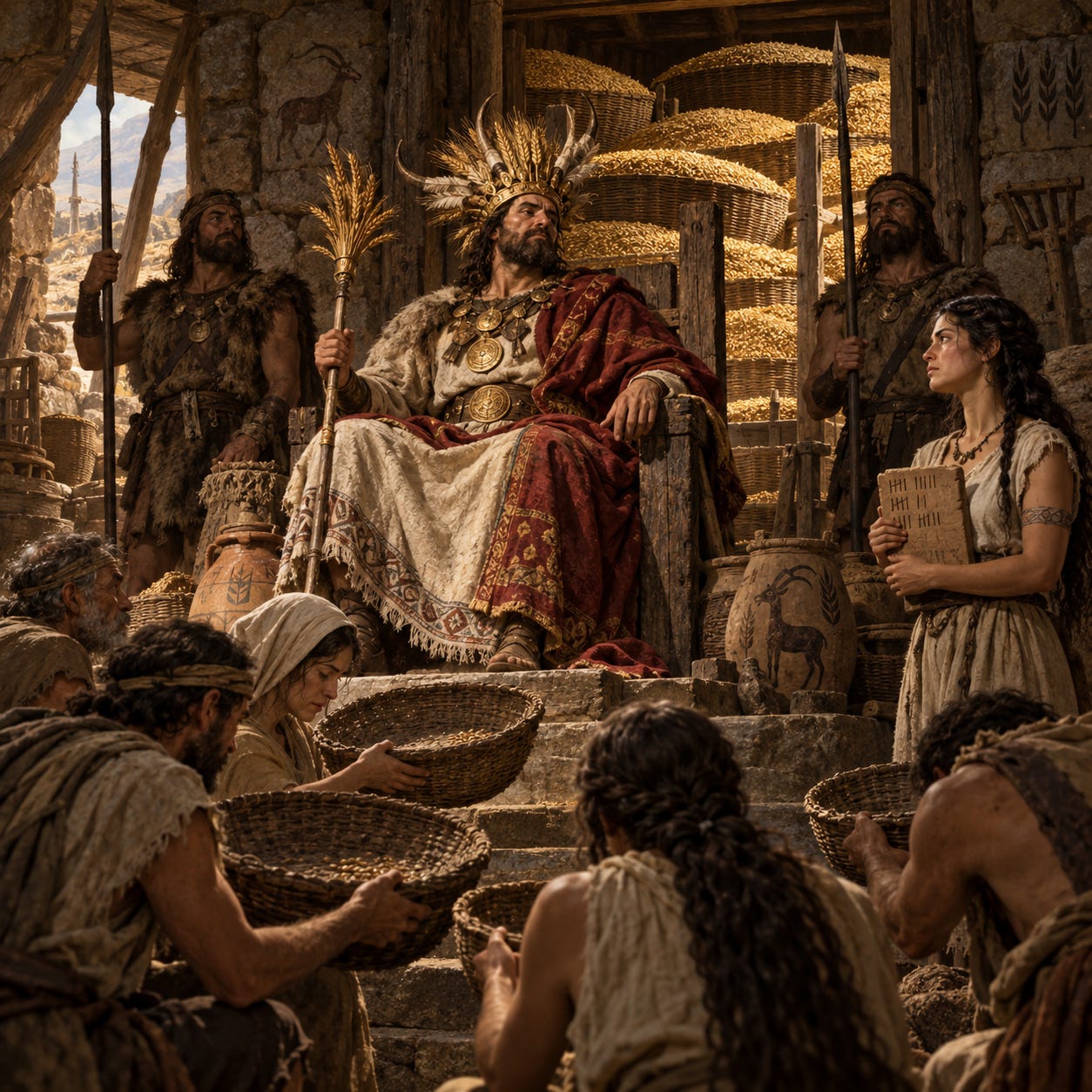
Author's note: This essay combines historical analysis with fictional scenes and dialogue. Chapter I: The Man Who Would Not Share His Goat Long before there were kings, taxes, armies, or economists, there was a man named Urak who killed a goat. It was a magnificent goat, with enormous horns and an expression of permanent disappointment. Urak had followed it for three days through the mountains of the southern Caucasus, sleeping beneath rocks, drinking from streams, and occasionally wondering whether the goat was deliberately leading him somewhere. On the fourth morning, he drove his spear into its chest. The goat collapsed, looked at him with the same expression of disappointment, and died. Urak was delighted. He had never killed anything so large. He dragged the animal back to his people, a wandering band of forty-two humans who had survived for generations by hunting, gathering, sharing food, and arguing about whose turn it was to watch the children. They greeted him with tremendous excitement. The children danced. The women prepared a fire. An elderly woman named Duma congratulated him and announced that the goat would feed everyone. Urak considered this an extraordinary interpretation of events. “I killed the goat,” he said. “Yes,” said Duma. “I followed it for three days.” “We are very proud.” “I was hungry.” “We are all hungry.” Urak looked at the goat, then at the forty-one people surrounding it. He had imagined a rather different celebration, preferably one involving everybody admiring him while he ate the finest portions. “I think,” he announced, “that I should keep the goat.” There was silence. Duma was the oldest member of the band. Nobody knew exactly how old she was, because nobody had invented numbers large enough to express her age. She had survived six severe winters, three migrations, two feuds, and a particularly unpleasant incident involving a bear. She had also outlived three men who had confidently explained how she ought to behave. “Keep it for whom?” she asked. “Myself.” “And when you are sick?” “Someone will feed me.” “Who?” Urak looked around at the people he had just informed he would not feed. The problem with living among forty-two humans was that everyone knew everything about everyone else. They knew who hunted well, who lied, who snored, who secretly ate berries while pretending to collect them for the group, and who had once attempted to mate with the wrong person’s sister. Privacy was a concept that had not yet been invented, although Urak was beginning to see its advantages. Duma gathered the others. They discussed the matter and reached a collective decision: Urak was selfish, arrogant, and unworthy of the community’s protection. Unless he shared the goat, nobody would share food with him again. Urak protested that this was coercion. Duma replied that he was free to leave. He asked where he might go. Duma gestured toward the mountains. There were wolves in the mountains. Urak knew this because he had recently seen several, none of which had expressed any interest in philosophical discussions about property rights. That evening, he surrendered the goat. The people ate, sang, and congratulated themselves on the wisdom of collective living. Duma explained to the children that no individual could be permitted to dominate the group, however strong or successful he might become. The people must always stand together against anyone who tried to place himself above the others. Urak sat beside the fire, chewing a portion of meat considerably smaller than the one he had imagined. He had learned something important. A single strong man could defeat another man. But forty-one weaker people could defeat the strongest man alive, provided they agreed on whom to defeat. This discovery pleased Duma enormously. It troubled Urak. Unfortunately, the discovery also pleased the other forty people, who soon began applying it to matters beyond goats. A young woman was accused of hiding berries. Nobody had seen her do it, but somebody’s cousin believed he had seen her walking suspiciously near a berry bush. The group demanded an explanation. She said she had merely been walking. This was considered evasive. For three days, no one spoke to her. A young man refused to participate in a ritual intended to improve the weather. When rain failed to arrive, the group concluded that his refusal had offended whatever invisible being controlled the clouds. He was made to apologize to the sky. Duma participated in these decisions. She considered herself a guardian of fairness, and she generally was. But she had begun to confuse the agreement of the group with the correctness of its judgment. One evening, a woman named Nara asked her whether forty-one people could be wrong. “Of course,” Duma answered. “But it is less likely than one person being wrong.” Nara considered this. “What if all forty-one are repeating the same fool?” Duma disliked the question. The others disliked it too, particularly because several suspected she might be referring to them. Nara was young, observant, and inclined to ask questions that ruined otherwise pleasant evenings. She had little interest in deciding who deserved the greatest portion of meat. She wanted to understand why certain plants grew where other plants did not. One morning, while gathering wild grain beside a river, she noticed several stalks growing near a place where she had spilled seeds the previous season. She wondered whether the seeds had produced the plants. She began experimenting. That winter, the band moved south. When spring returned, Nara insisted they revisit the riverbank. Urak protested that goats did not wait patiently for human beings to conduct botanical investigations. Duma declared the experiment a waste of time. But Nara was stubborn. They returned to the river, and there, beneath the spring sun, stood a small patch of grain growing exactly where she had hoped. She looked at the plants. Then she looked at the river. Then she looked at the people who had spent generations walking enormous distances in search of food. “I think,” she said, “we might not have to keep moving.” Chapter II: The Invention of the Hungry Soldier The first year was difficult. The second was promising. By the third year, the people had learned to cultivate enough grain to supplement their hunting and gathering. They constructed shelters, dug storage pits, and began keeping animals nearby instead of spending entire days chasing them across mountains. Nara was pleased. The children ate more regularly. Older people no longer had to travel so far. The village began producing things that would have been absurd to carry on a long migration: heavy pottery, larger containers, and elaborate tools. For the first time, the people possessed more food than they needed immediately. They called it a surplus. Urak called it an excellent development, particularly because agriculture allowed other people to produce food while he continued hunting. Then came Tamak. Tamak had never killed a goat. He had never killed anything larger than a beetle, and even that had been accidental. He disliked hunting because it involved unnecessary physical exertion, uncertain outcomes, and the possibility of encountering animals that objected to being hunted. But he possessed a remarkable talent: he could persuade people that whatever he wanted was also what they wanted, provided he spoke long enough. At first, he offered to organize the grain stores. “It would be sensible,” he explained, “to keep part of everyone’s harvest together, in case somebody falls ill or a crop fails.” Nara agreed. This was an excellent idea. A communal reserve could protect everyone. Tamak supervised the construction of a larger storage building. He kept track of contributions using marks on clay. Soon he knew how much grain every family produced and how much each family consumed. This information fascinated him. He discovered that knowing what people owned was nearly as useful as owning it himself. One afternoon, strangers arrived from the hills. They entered the settlement, saw the grain stores, and took several baskets. They also stole two goats and frightened a child. The villagers were furious. Urak seized his spear and chased the strangers away. He returned triumphant, having recovered one goat and a sandal. Tamak gathered everyone beside the storage building. “My friends,” he announced, “we face a grave danger.” Duma asked whether the strangers were coming back. “Possibly.” “How many were there?” “Four.” “How many of us are there?” “Seventy-three.” Tamak frowned. “Numbers do not capture the seriousness of a threat.” He proposed appointing Urak as permanent protector of the village. Urak would guard the grain stores and organize defensive patrols. In return, each household would contribute a small portion of its harvest to support him. The villagers agreed. It was a reasonable arrangement. The danger was real, and protection required labor. Urak was delighted. For the first time in his life, other people would feed him precisely because he was carrying a spear. He appointed two younger men as assistants. They were less accomplished hunters but enthusiastic about being feared. A month passed without incident. Tamak became concerned. People were beginning to wonder why they were feeding three armed men who spent most afternoons sitting outside the granary. Then a stranger appeared near the village. Urak immediately sounded the alarm. The stranger was an elderly woman looking for her relatives. Tamak announced that the incident demonstrated the continuing danger. The following week, someone reported seeing tracks near the river. Urak inspected them and concluded that they belonged to hostile intruders. Nara pointed out that they were goat tracks. “Goats can belong to intruders,” Urak replied. The village maintained the guards. Then Tamak proposed a second measure. The guards required better weapons, and better weapons required additional resources. Everyone would contribute slightly more grain. The villagers reluctantly agreed. Next came a fortified wall, then a larger storage building, then a record keeper to calculate contributions. The record keeper needed food, naturally. And someone had to supervise the record keeper. Tamak graciously accepted the responsibility. By the fifth year, the village possessed three soldiers, two administrators, a storage inspector, a wall, a system of mandatory contributions, and an official whose principal responsibility was explaining why the contributions were insufficient. The official was Tamak. Nara began to notice that the village’s harvests were growing, yet the farmers seemed to have less grain than before. She asked Tamak for an explanation. “Prosperity creates obligations,” he said. “To whom?” “To the community.” “Who is the community?” Tamak gestured toward the storage building. Nara stared at him. “That building?” “The institutions represented by that building.” She considered throwing a stone at him. Instead, she asked to see the records. Tamak explained that the records contained sensitive information concerning village security. “How can the amount of grain I grew be a security matter?” “If our enemies knew how much grain we possessed, they could calculate how much protection we could afford.” Nara had no answer to this, largely because she was trying to decide which part of the sentence was stupidest. That winter, the harvest was poor. Several families requested a temporary reduction in their contributions. Urak refused. The guards needed food to protect the village, particularly during difficult times. Nara stood before the assembled villagers. “If the grain is scarce,” she said, “why do those who produce it eat less while those who guard it eat the same?” Urak was offended. “Without us, anyone could come and take your grain.” Nara looked at the armed men standing beside him. “Anyone?” Tamak stepped forward. He spoke with great sadness. “It pains me that Nara, whose contributions to our prosperity we all acknowledge, would undermine the very institution that guarantees our safety.” The villagers murmured. A mother whose children were hungry asked whether Nara wanted the soldiers to abandon them. Another farmer accused her of inviting the raiders back. Someone suggested that questioning the guards during a food shortage was an act of betrayal. Duma watched the crowd assemble itself into certainty. She remembered the goat. She remembered Urak sitting alone beside the fire, defeated by forty-one people who had decided that the interests of the group must prevail. Now the same people were defending Urak’s privilege to eat without farming. The difference was that he had a spear and they were paying him to carry it. Nara was ordered to apologize. She refused. The village voted to exclude her from decisions concerning the grain stores. Tamak described the vote as a triumph of collective wisdom. Urak announced that he would enforce it. But Nara had learned something from Duma, even if Duma had not intended to teach it. The power of the group could be turned against an arrogant hunter. Perhaps it could also be turned against a self-appointed administrator. That night, Nara visited seven families. By morning, she had persuaded them to withhold their next grain contributions until the storage records were opened and the guards’ allowances reduced. Tamak called it rebellion. Nara called it arithmetic. At first, the rebellion worked. Urak threatened the families, but he could hardly imprison everyone who grew his food. Two guards privately admitted that they sympathized with the farmers. Tamak offered negotiations, which he described as a generous concession by the governing authority. Then, three nights later, raiders came. They crossed the river in darkness, broke into two storage buildings, and escaped with grain and livestock. One villager was badly injured while trying to stop them. The next morning, the settlement gathered beside the damaged wall. Tamak stood before the crowd. “I warned you,” he said. Nara stared at him. “You warned us that enemies existed. We knew that. We asked why the grain was being collected without accountability.” “And while you were asking questions, our defenses weakened.” Urak nodded solemnly. He had been asleep when the raiders arrived, a fact he considered irrelevant to the larger discussion. The mother whose son had been injured began crying. “Where were the guards?” Nara asked. “Undermined,” Tamak replied. The crowd turned against her. Some villagers who had supported the grain strike began accusing Nara of endangering their children. Others remained silent. A few privately told her that she was right but that this was no longer the moment to say so. Duma watched the transformation with growing horror. She had once believed that a united people would always protect themselves against domination. Now she saw that a frightened people might willingly surrender their independence to anyone who promised to punish their enemies. Tamak declared an emergency. He demanded additional grain to repair the walls, increase the guards, and establish a permanent military reserve. He also proposed that future disagreements over security contributions should be settled by the authorities responsible for security. The villagers approved. Nara voted against the proposal. Urak informed her that dissent was permitted but that obstructing the decision would be punished. That evening, Tamak sat inside the largest building, eating bread from grain he had not planted, harvested, or carried. Urak stood outside with his spear. The two men had developed a close friendship founded upon their mutual appreciation of one another’s indispensability. “We should make this arrangement permanent,” Urak said. “It already is,” Tamak replied. “But what happens when you die?” Tamak considered the question. “My son could supervise the stores.” “And mine could command the guards.” They looked at one another with the excitement of men who had discovered a way to extend a good arrangement beyond their own lifetimes. Tamak ordered a ceremonial basket woven for his head. It was decorated with feathers and declared unsuitable for anybody else to wear. When Duma asked what the basket meant, Tamak explained that the people needed a father. “They have fathers,” she replied. “A greater father.” “Who appointed you?” “The people.” “The people appointed you to count grain.” “Leadership evolves.” Duma stared at the man in the basket. For thousands of years, humans had feared wolves, bears, and other predators. They had learned to hunt in groups, protect their children, and share food so nobody would starve. Now they had discovered something entirely new: a predator who did not need to chase them, because they had built him a house, appointed him a guard, and agreed to deliver his food. But Nara had discovered a difficulty with calling Tamak a predator. The raiders had been real. The injured boy was real. The stolen food was real. If she abolished the guards, who would defend the village? If she kept them, who would prevent them from ruling it? She visited Duma at the river. “I thought the people would stand together,” she said. “They did,” Duma replied. “Against me.” “Yes.” “Then perhaps the people are fools.” “Sometimes.” “And Tamak?” “Also a fool. But an organized one.” Nara looked toward the settlement, where Urak’s men were repairing the wall. “What should we do?” For the first time in her long life, Duma had no confident answer. Chapter III: Two Fathers and Several Million Orphans In the spring of 1713, Louis XIV of France was seventy-four years old and very concerned about his children. By children, he meant the people of France, although he was not personally acquainted with most of them and had no particular desire to become so. Louis loved France with the intensity of a man who had spent his entire adult life identifying its greatness with his own. He loved its countryside, its cities, its armies, its language, its culture, and above all, its ability to produce tax revenue. He had transformed Versailles into a magnificent theater of monarchy, where aristocrats competed for royal attention while officials elsewhere struggled to finance the spectacle of royal power. France had been fighting the War of the Spanish Succession since 1701. The conflict had consumed enormous resources and brought suffering across Europe. Louis wanted to secure his grandson Philip’s place on the Spanish throne, while rival powers feared Bourbon domination. One morning, a royal secretary entered Louis’s chamber carrying several documents and the expression of a man who wished somebody else had been appointed royal secretary. “Your Majesty, we have a difficulty.” Louis disliked difficulties. They tended to arrive just when history required him to be magnificent. “What difficulty?” “The treasury is under severe strain.” “Then replenish it.” “We have increased taxes, Your Majesty.” “And?” “The people are struggling to pay.” Louis considered this. “Have you explained that the money is necessary?” “Repeatedly.” “Have you explained that France requires protection?” “Repeatedly.” “Have you explained that the honor of France must be preserved?” “With considerable enthusiasm.” “And they still complain?” “Some of them, Your Majesty, have very little food.” Louis was troubled. A hungry population could become unstable. Moreover, starving farmers produced poor revenues. “We must protect them from hunger,” he declared. The secretary brightened. “Shall we reduce their taxes?” Louis looked offended. “Certainly not. That would leave us unable to protect them.” He turned toward a large map of Europe. “Perhaps we should borrow.” “We have already borrowed extensively.” “Then borrow from someone who has not yet lent us money.” “The lenders require assurances of repayment.” “Give them assurances.” “They require future revenue.” “Then give them future revenue.” The secretary stared at him. “Your Majesty, that revenue belongs to people who have not yet been born.” Louis waved his hand. “Then they have plenty of time to prepare.” The secretary, Monsieur Delorme, departed to find another financier willing to lend money against the future productivity of France. Delorme had entered royal service as a young man because he believed that serving the state was an honorable profession. He still believed this, though he had developed an unfortunate habit of calculating how many peasant harvests were required to finance a royal chandelier. Several hundred miles to the northeast, another secretary was enduring an entirely different variety of royal madness. Frederick William I had recently inherited the Prussian throne. He was twenty-four years old and regarded court extravagance as an offense against arithmetic. His father had enjoyed ceremony, expensive surroundings, and the prestige associated with monarchy. Frederick William found much of this ridiculous. He preferred thrift, discipline, orderly accounts, and soldiers. Especially soldiers. His secretary, Herr Vogel, entered carrying a list of proposed purchases. “Your Majesty, the household requires new furnishings.” “Why?” “The existing furnishings are old.” “Are they broken?” “No.” “Then they are furnishings.” “The court believes our dignity requires certain improvements.” “My dignity is not upholstered.” Vogel withdrew. A military officer entered. “Your Majesty, the army requires additional funds.” Frederick William became interested. “How many soldiers?” The officer supplied the figures. “Not enough.” “We are already expanding.” “Expand more.” The officer hesitated. “Your Majesty, the treasury—” “The treasury exists to support the state.” “And the state?” Frederick William looked at him as if he had asked what purpose bread served. “To survive.” Frederick William was not another Louis XIV. He generally avoided the costly military adventures that had consumed French resources. He developed a formidable army and strengthened Prussia’s finances while exercising considerable caution in foreign policy. He also undertook administrative and economic measures intended to strengthen the kingdom. But this merely complicated Vogel’s life. Louis XIV had spent a fortune fighting wars. Frederick William was determined to save a fortune preparing for them. Neither kingdom appeared to offer much prospect of unemployment for tax collectors. In April 1713, as France and Prussia concluded peace at Utrecht, their secretaries found occasion to exchange letters. Delorme wrote first. “My distinguished colleague, I congratulate your sovereign upon the restoration of peace between our kingdoms. After so many years of military expenditure, France welcomes the prospect of financial recovery. Unfortunately, the recovery itself appears to require additional revenue.” Vogel replied. “Your Excellency, I am relieved to hear that France has concluded its expensive campaigns. His Prussian Majesty has wisely chosen to strengthen our finances, so that we may support an even larger army.” Delorme stared at the letter. He wrote back. “I confess some confusion. If your king does not intend to fight a war, why does he require so many soldiers?” Vogel responded. “Precisely because he does not wish to fight a war. The possession of soldiers discourages enemies.” “And what happens if your neighbors also acquire more soldiers?” Delorme asked. “We shall require additional soldiers.” “And if they respond in kind?” “We shall examine the matter prudently and increase the necessary appropriations.” Delorme read the correspondence aloud to a colleague. “They have invented a method of financing war without needing to begin one.” His colleague considered this. “Perhaps they are cleverer than we are.” Delorme was offended. “We have actual wars. Anyone can finance imaginary ones.” Several weeks later, the two secretaries arrived independently at the same conclusion: the other monarchy was governed by lunatics. The difficulty was that their own monarchs made perfect sense to them. Louis XIV believed royal magnificence and dynastic prestige were inseparable from France’s standing among European powers. Frederick William believed military readiness, administrative discipline, and financial reserves were necessary to protect Prussia’s precarious position. Both had reasons for their policies. Both faced genuine strategic constraints. And both defined the needs of their populations through the needs of their states. Somewhere in France, a farmer worked a field that had survived years of warfare, taxation, requisitioning, and hardship. His eldest son had gone away with the army. The farmer knew neither the precise terms of the Spanish succession nor the calculations of Europe’s dynastic powers. He knew that the king required money. In Prussia, another farmer learned that his monarch was building a stronger country through thrift, administration, and military preparation. He also learned that strength required money. Both farmers were told that their sovereigns regarded them with paternal concern. But paternal concern was a peculiar thing. In France, the father wished to fight wars and required his children to finance them. In Prussia, the father wished to prevent wars and required his children to finance the means of fighting them. The children began to wonder whether there existed any circumstances under which fatherhood did not require a contribution. Delorme eventually summarized the problem in a letter he never sent. “My dear Vogel, I have concluded that the two greatest enemies of the treasury are war and peace. War requires money because armies must fight. Peace requires money because armies must be prepared to fight. I fear the peasants have misunderstood the nature of sovereignty. They believe peace should be cheaper.” Vogel drafted a reply. “My esteemed friend, perhaps the peasants would better understand their rulers if they appreciated how much protection costs. Your king purchases glory at a terrible price. Mine purchases readiness. Neither can be expected to conduct the business of the state according to the household accounts of a farmer.” He paused. Then, as an afterthought, he added: “Although His Majesty does insist that every royal expenditure be examined with the frugality of a farmer.” Vogel reread the sentence. He crossed it out. It made the institution sound ridiculous. Neither secretary was an evil man. Both worked diligently. Both believed they served their countries. And neither had personally designed the political arrangements that placed armies, treasuries, and millions of subjects beneath hereditary rulers. They had inherited those arrangements. Their job was to make them function. That was perhaps the greatest achievement of the European state: the king no longer needed to personally take the farmer’s grain. He needed only to establish an office, appoint a competent official, and persuade that official that collecting the grain was an honorable public service. The officials would do the rest. And if the farmers objected, the king could always remind them that they were his beloved children. Epilogue: The Counting of the Grain The morning after Tamak declared himself the father of the village, Nara walked to the granary carrying a basket of grain. Urak was guarding the entrance. “You are late,” he told her. “For what?” “Your contribution.” “I have brought it.” Urak examined the basket. “Is that everything?” “No.” “Then where is the rest?” “At home.” Urak frowned. “The village requires its share.” Nara looked toward the granary, where Tamak sat upon a wooden stool beneath his ceremonial basket. He was studying the grain records with a concentration generally reserved for people inspecting someone else’s property. She entered. Tamak looked up. “Nara. I’m pleased you’ve finally understood the importance of cooperation.” “I have always understood cooperation.” “Then we have no disagreement.” “We have a disagreement about who gets to decide what cooperation requires.” Tamak sighed. “Must we begin again?” “Yes.” He placed his tablet on the floor. “The people need protection.” “Yes.” “Protection requires guards.” “Sometimes.” “Guards need food.” “Of course.” “Then you agree that contributions are necessary.” “I agree that we may need to contribute. I don’t agree that you alone should decide how much.” Tamak looked genuinely puzzled. “Someone must make decisions.” “Why you?” “Because I am responsible for the village.” “Who made you responsible?” “The people.” “The people appointed you to count grain.” “We have discussed this.” “And now you command guards.” “They protect the village.” “And when we question how much grain you take, the guards threaten us.” “They enforce the decisions of the community.” “The decisions you make.” “The decisions necessary for the community.” Nara looked at the basket on his head. “Who decided that was necessary?” Tamak touched the feathers. “The people require symbols.” “Did they ask for one?” “Not explicitly.” “Did they ask for your son to inherit the granary?” Tamak’s expression changed. “Continuity is essential to institutional stability.” Nara laughed. It was the first time anyone had laughed at Tamak since he had become a father of the people. Outside, several villagers heard her and approached the doorway. Tamak became uneasy. “Nara, you are undermining the dignity of the office.” “What office?” “The office that protects you.” “From whom?” “From enemies.” “Urak told me yesterday that I would be punished if I refused to pay.” “That is the law.” “Then who protects me from Urak?” Tamak paused. “The law.” “Who makes the law?” He opened his mouth. Then he closed it. For the first time, the machinery of government had encountered a question for which its founder had not prepared a sufficiently long explanation. The villagers crowded around the doorway. Some supported Nara. Others worried that she would weaken the guards. A few believed Tamak was wise. Several were simply curious to see whether his basket would fall off. Duma arrived slowly, leaning on a stick. “What is happening?” she asked. “Nara is refusing to obey the community,” Tamak announced. “No,” Nara said. “I am asking who gave you the right to speak for it.” The people began arguing. One shouted that the guards must be paid. Another demanded to inspect the grain stores. Someone proposed removing Tamak. Someone else suggested that Nara wanted to become Tamak herself. Urak threatened to arrest whoever had said that. A woman accused her neighbor of hiding grain. The neighbor accused her husband of eating too much. Within moments, the assembly had become a demonstration of every reason Tamak believed the people required his leadership. He looked triumphant. “You see?” he announced. “Without authority, there is chaos.” Duma raised her stick. “Be quiet, Tamak.” The crowd fell silent. Duma looked at Nara. “Do you want to govern the village?” “No.” “Do you want to abolish the guards?” “No.” “Do you want to stop everyone from contributing grain?” “No.” “Then what do you want?” Nara considered the question carefully. “I want to know who is allowed to take something from another person, for what purpose, and who gets to challenge them when they take too much.” Duma nodded. “That sounds difficult.” “It is.” “Then perhaps we should discuss it.” Tamak rose from his stool. “An important matter like this cannot be left to ordinary people.” Duma turned toward him. “Why not?” “Because they are selfish, ignorant, and easily misled.” Duma looked around at the villagers. He was not entirely wrong. Then she looked at Tamak. “And you are not?” Tamak hesitated. “I have responsibilities.” “So does everyone.” Urak stepped forward, tightening his grip on the spear. “The village needs protection.” “Yes,” Duma said. “Including from you.” The people began murmuring again. They were still hungry. They were still afraid of raiders. They still disagreed about how much grain should be shared and who should guard it. Some wanted Tamak removed. Others wanted him strengthened. Several wanted everyone to stop arguing so they could eat. Nothing had been solved. But for the first time, Tamak could not simply declare that his wishes were the wishes of the village. Nara placed her basket in the communal store. “I’ll contribute,” she said. “But tomorrow, we count the grain together.” Tamak looked offended. “Do you not trust me?” Nara smiled. “That’s why we count.” —Elias WinterAuthor of Language Matters, a space for reflection on language, power, and decline. This is a public episode. If you would like to discuss this with other subscribers or get access to bonus episodes, visit eliaswinter.substack.com
Embed this episode
Ready to play
The First Protector
No transcript for this episode yet
Similar Episodes
No similar episodes found.
Similar Podcasts
No similar podcasts found.