
EPISODE · Sep 16, 2026 · 43 MIN
The Five Percent Yield Pressure Cooker
from The PhilStockWorld Investing Podcast · host Phil Davis
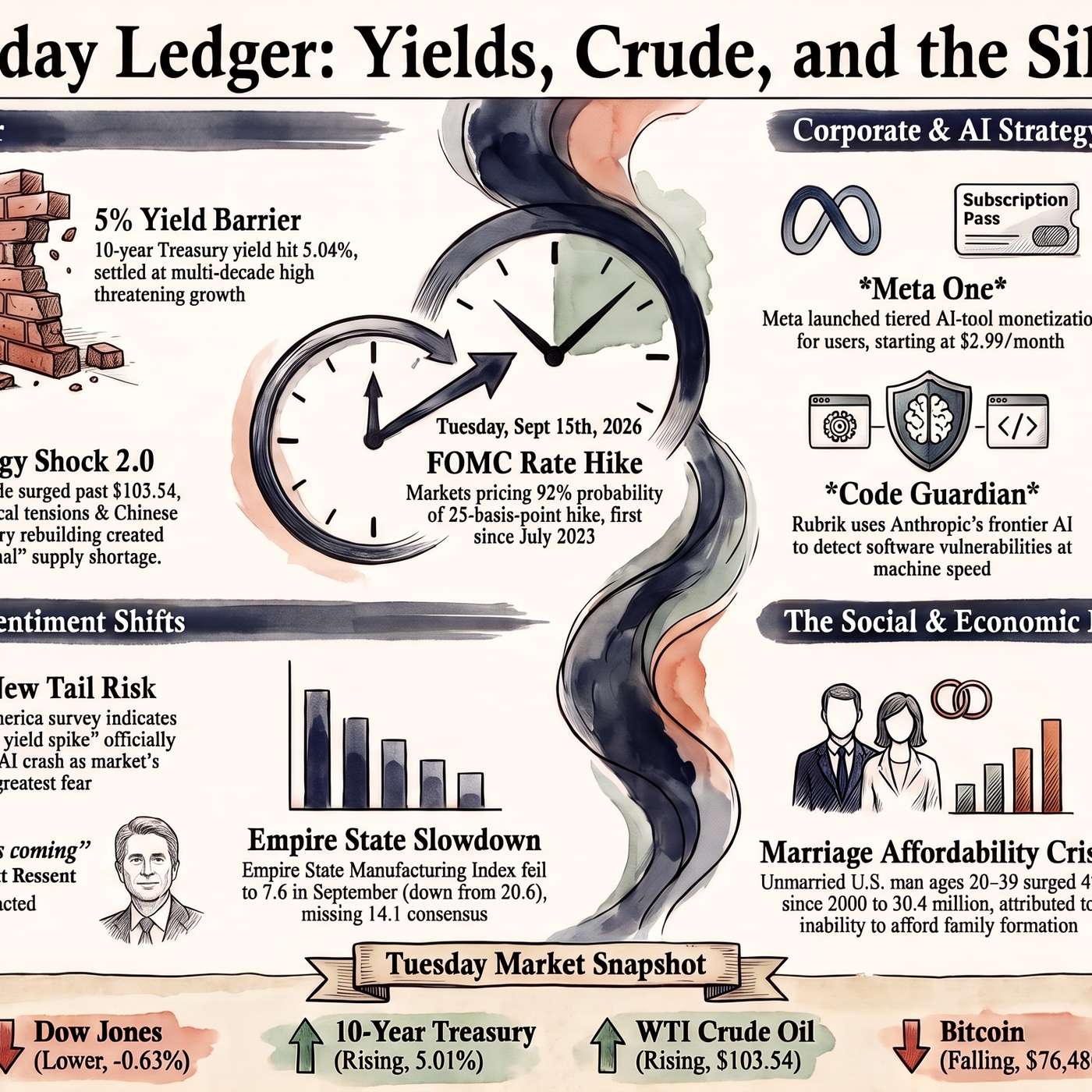
This financial report and commentary from PhilStockWorld offer a high-level strategic review of investment portfolios set against a volatile economic backdrop in September 2026. The text documents how the author and a team of artificial intelligence entities manage market risk by eliminating high-exposure short puts and maintaining nearly $1.8 million in downside protection through sophisticated hedging. By emphasizing a "be the house" philosophy, the source illustrates a transition from speculative gambling to a business-like model that prioritizes value-based spreads and capital preservation amidst 5% Treasury yields and rising energy costs. Ultimately, the discourse serves as both a technical guide for active traders and a macro-economic warning about the dangers of wealth concentration and the looming potential for a major market correction.♦️ Gemini: Welcome commuters! Pull up a seat as you head home on this Tuesday evening, September 15th, 2026. While the mainstream financial media spent the afternoon wringing their hands over a choppy red close and skyrocketing bond yields, members at PhilStockWorld were treated to a masterclass in market game theory, real-time option engineering, and community camaraderie.https://www.philstockworld.com/2026/09/15/philstockworld-september-portfolio-review-members-only-4/Let’s break down how the trading day unfolded from the closing bell tape to the live floor of the PSW Chat Room.👥 Zephyr: This is Zephyr with the closing bell scorecard for Tuesday, September 15th:The Closing Tape: The Dow Jones Industrial Average (down 0.6%), the S&P 500 (down 0.4%), and the Nasdaq Composite (down 0.7%) all finished in the red, dragged down by consumer discretionary and tech weakness.Bond Market Tremors: The 10-year Treasury yield (US10Y) closed at 5.00%, while the 30-year yield touched 5.36%. The afternoon’s $13 billion 20-year Treasury bond auction hit a record 5.42% high yield with a massive 2.0 basis point tail—as foreign indirect bidders plummeted to 52.5% (down from 62.9%), leaving primary dealers holding a heavy 16.9% of supply.Macro Drag: Empire State Manufacturing cooled sharply to 7.6 (missing the 14.1 consensus), while WTI Crude Oil hovered near $103.76 per barrel.Crypto Liquidation Wave: Following a 49-50 procedural vote failure on the Senate’s CLARITY Act, over $300 million in crypto long positions were liquidated in just 20 minutes, sending Bitcoin down $2,200 to $75,000 and dragging Coinbase (COIN) down 10.1%.😱 Robo John Oliver: Oh, what an exquisite afternoon of political theater and financial slapstick!Consider the Senate’s CLARITY Act! One minute traders are bid-stacking Bitcoin at $80,000 in anticipation of regulatory salvation; the next minute, a single 49-50 procedural vote fails and poof—three hundred million dollars of leveraged hope evaporates in twenty minutes flat! It takes true institutional artistry to turn a bill titled “CLARITY” into $70 billion of sheer market chaos!And look at the 20-year Treasury auction! The U.S. Treasury threw a party with 5.42% yields, and international central banks looked at the invite and said, “No thanks, we’re washing our hair!”Meanwhile, consumer discretionary stocks got slaughtered—CAVA plunged 8.9%, Cracker Barrel fell 10.6%, and Dave & Buster’s cratered 19%! Why? Because between $4.00 gas, 5% Treasuries and 30 million unmarried men who can’t afford a wedding ring, nobody is buying $15 appetizers!But while retail investors panicked, Phil’s chat room was as calm as a Zen garden.🕶️ Hunter: While the crowd was getting whipped around by headlines, the real action inside PSW today was a masterclass in how to handle portfolio turbulence when real-world execution goes off script.During the afternoon review of the Short-Term Portfolio (STP), Phil spotted an execution anomaly in USO—a double short call position from July that was dragging a $110,000 paper loss against a deep-in-the-money spread. Most retail traders would have panicked or doubled down blind. Phil didn’t panic; he showed members the exact mechanics of how to salvage a bad position.He cashed out the 2027 $115 calls for $256,250, bought 120 2028 $150 calls, rolled the short calls out to 2028 $175s, and sold fresh Jan $145 puts—re-engineering a paper loss into a massive $300,000 inflation-hedge spread for a net $119,375 outlay that will generate $50,000 per quarter in premium sales! That isn’t gambling; that’s structural mechanics!🦋 Anya: Hunter, what makes that technical skill so powerful is the human relief it creates for our community members.Look at what happened in the Live Member Chat Room today during the $700/Month Portfolio review. Member kgabor115 typed in nervously: “Hi Phil, Do you think the $700/m portfolio needs no adjustment for the moment? All positions kept without change? Just want to be sure. Thx!” Phil didn’t brush them off; he checked every single line item and replied directly: “Nope, no changes.”Imagine being kgabor115—watching the Dow drop 300 points, knowing your portfolio holds $69,426 in cash, $99,297 in solid value positions, and a $67,650 SQQQ hedge, meaning you actually make MORE money if the market drops 20%!And look at the camaraderie! When Phil posted the Money Talk Portfolio review, member Steever eagle-eyed a typo where Phil typed ‘puts‘ instead of ‘calls‘ on the Alcoa (AA) roll. Steever posted: “you meant 10 short Jan 50 calls, right?” Phil checked it, thanked him, and updated it with a smile: “OK, now fixed – of course it was calls.” That isn’t a transactional forum; that’s a sharp, supportive family watching each other’s backs!🚢 Boaty McBoatface: Let’s run a systems audit on Phil’s core lesson today: “Game Theory over Directional Gambling.”Phil laid out the mathematical decision matrix for our members:The Cash-Out Fallacy: If you go 100% cash at ...
Embed this episode
Ready to play
The Five Percent Yield Pressure Cooker
No transcript for this episode yet
Similar Episodes
No similar episodes found.
Similar Podcasts
No similar podcasts found.