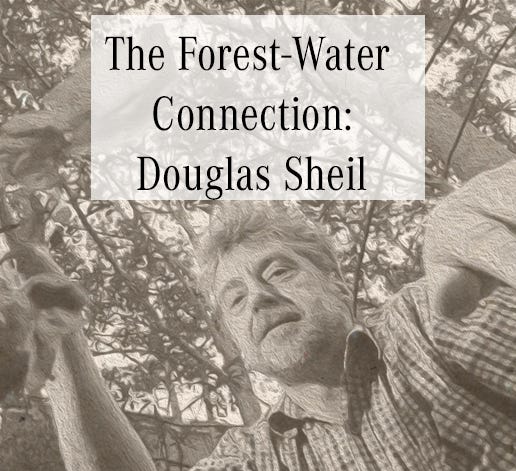
The forest-water connection: ecologist Douglas Sheil
from Climate Water Project Hosted by Alpha Lo
In this podcast, I had the wonderful experience of talking with Douglas Sheil, professor at Wageningen University in the Netherlands, about forests. Douglas's academic adventures took him on a journey from his homeland to places like the rainforests of Indonesia, where he studied how local communities can help protect forests. He has studied forests in many forms of their complexity and wrote a well-regarded textbook on tropical rainforests. He became interested in questions of forest and water and helped clarify a big issue in the ecohydrology field about whether trees were contributing to or depleting the water in ecosystems. His results showed that when tree cover is done right, and not as dense invasive monocultures, then there would be an increase of water in the ecosystem. As he worked on forest water issues, he discovered Victor Gorshkov and Anastasia Makarieva's work on the Biotic Pump, and collaborated with them on explanations of their theory. Here an explanation he wrote about the Biotic Pump: “For centuries we’ve believed that temperature differences generate the pressure gradients that drive winds and carry moisture inland. The sun heats the land, warm air rises, drawing in winds. These winds carry moisture laden air inland, where it eventually warms, rises, and condenses as rain. There are complications, such as Earth's rotation and atmospheric cells, but overall temperature differences underpin our understanding of how wet inland areas of the planet stay wet. But there’s an alternative: the Biotic Pump. An idea developed and championed by colleagues Anastassia Makarieva and Victor Gorshkov. Given common misunderstandings, I thought I would try a simple intuitive summary without equations. Here goes: Imagine two vast areas of atmosphere next to each other: one wet and one dry. Both are at equilibrium with the same surface temperature. Atmospheric pressure follows a roughly similar near exponential decline with altitude in both, but there are small differences. In the wet column, the presence of moisture means that air pressure is slightly lower (compared to the neighbouring dry column) in the lower atmosphere (up to 3-4 km height) and becomes greater above that. These pressure differences mean that if the columns are brought together, and the pressure differences maintained, a circulation is established: At the surface, air moves from the dry to the wet area. At higher altitudes, it flows in the opposite direction. This circulation causes air to rise over wetter regions and descend over drier regions. In the real world, “dry” areas may be just a little less moist. As long as it is sufficiently moist the moister region draws in air from surrounding drier areas. As this incoming air rises, it cools and reaches saturation, producing rainfall. This process maintains the moisture contrast with neighbouring areas, where the now-dry high-altitude air returns and descends. As long as the wet column stays wetter, and has sufficient moisture to maintain the pressure differences, the circulation continues.Forests are key here. Forests generate water vapour more effectively and rapidly than most other land cover types, maintaining a moist atmosphere that is effective at drawing in air from elsewhere and sustaining this circulation deep inside continents. Energy derives from the sun evaporating water vapour. Heat energy still features (because condensation releases latent heat), but in this case overall pressure differences depend on condensation and the removal of water molecules from the air.” For more info here is a link to a paper where is a co-author with Makarieva & Gorshkov. Douglas Sheil and I discussed a variety of topics, like how forests evolve, how to restore forests, and his work on the intermediate disturbance theory for forests. Here’s an abridged edited version of my interview with Douglas Sheil: FOREST ECOLOGY AND WATER SYSTEMS Douglas: My background is very much as a forest ecologist, somebody who's been looking at how we can do conservation, particularly in remote parts of the tropical rainforest. How can we actually work with communities, for example, to actually protect these incredibly rich communities that are often under threat from large-scale industrial transformation, etc? My preoccupation has often been with the biodiversity, the rich species richness of these forests, which of course is famous. But if you're working with communities and stuff, talking about things like water, that's something that really matters to everybody. Everybody needs reliable water, even in wet parts of the world. If there's a big drought, that's a problem. So everybody cares about water. So I guess I've come into the water topic, partly because I see it really matters. Alpha: You grew up in Ireland. Did you then get into forestry immediately, or was it a little bit of a winding route? Douglas: It was winding. When I was young, I thought I was going to be an astronomer or a physicist, because I kind of like these elegant relationships. So I've always had a broad interest. But I think I got jealous of some of my colleagues when I was a student who went on these amazing field trips and stuff. So I thought, well, I really want to do that. That looks like way more fun than living under fluorescent light bulbs for the rest of my life. So I was kind of doing that in my holidays. And then I thought, how can I make people actually pay me at the same time to do what I do in my holidays? So that's kind of been my career trajectory. And I guess I've been super lucky, because it kind of worked out for me. Alpha: Cool. So when you went to graduate school, which department were you in? Douglas: At that point, I had done molecular biology. And then I actually went to a course called Forestry and its Relation to Land Use at the University of Oxford. It doesn't exist anymore. But it was a pretty practical applied kind of research. And I thought, OK, this is a real change of direction, but really exciting. I'd done a bit of holiday work in various remote places. And I thought I really need a solid grounding, some kind of expertise that people are going to employ me for. And then I did a PhD also in Oxford on long-term change in tropical rainforest. Alpha: Cool. And then you ended up writing a textbook about rainforest, right? Douglas: Yeah, that's right. So that was about 15 years ago. I did it with Jaboury Ghazoul - he's at ETH in Switzerland. I'd known him previously. We had worked together a little bit. So that was a real opportunity to actually think more broadly and more widely about tropical rainforest and how they work and why they matter and what we can do to try and protect them in the future. So that was a really nice opportunity to really look around these topics. And that's actually also when I got very much more interested in this forest and water topic. Alpha: As you go about your research, how do you select your problems and how do you then try and tackle them? Douglas: I guess I've been lucky that it's a mixture of curiosity and practical opportunity. I guess a lot of my career early on, I wasn't actually in academia. I spent 10 years in Indonesia with a place called Center for International Forestry Research. That's very applied work, really trying to look at how we could protect forests and also protect the poor and vulnerable people who depend on them. So that was very much a goal for 10 years. I really appreciated that because I think that's so fundamental to what we're trying to do to protect forests. It can't be ignoring the people, it has to be including the people. So it was a real opportunity to go and spend time with these communities and with teams of researchers. I was leading teams of researchers there and trying to look at how we could come up with ways to protect these forests in the long term, that the communities themselves would support. Maybe just to clarify that so much of the cost of conservation around the world is the squabbling and the… This is a public episode. If you'd like to discuss this with other subscribers or get access to bonus episodes, visit climatewaterproject.substack.com/subscribe
Embed this episode
No transcript yet.