The Fourth Role
from How Healing Happens Podcast Hosted by Linnea Butler
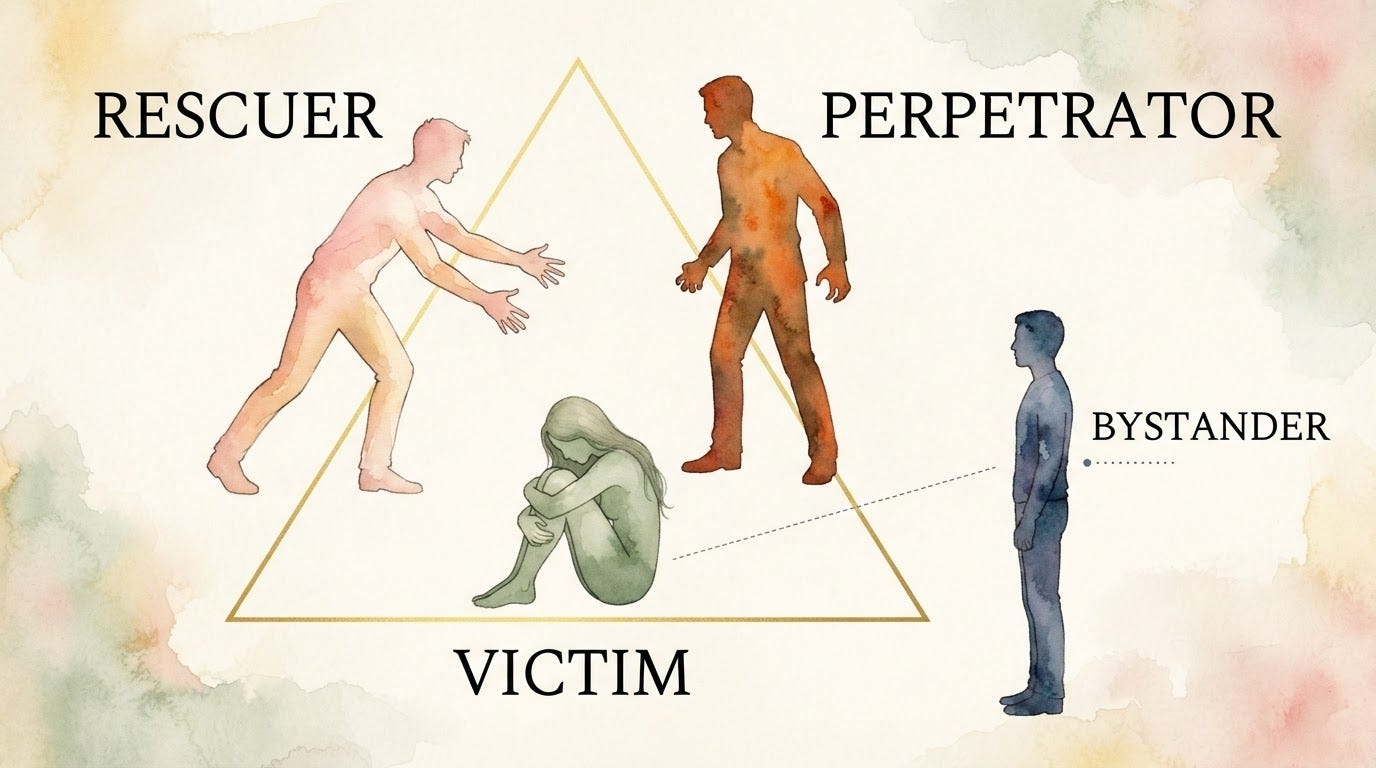
I read constantly as a child. It was how I “left” the house (and my body) without actually leaving it. What I reached for were fairytales and myths, which in hindsight I don't think was an accident. I was looking for the part of the story when a savior arrives. In 1968 a psychiatrist named Stephen Karpman published a paper called “Fairytales and Script Drama Analysis”. He was working in transactional analysis, and he noticed that the same three roles kept turning up in children’s stories. He called them the prosecutor, the rescuer, and the victim and placed them in what he named the Drama Triangle. He used examples of the Pied Piper, Little Red Riding Hood, and Cinderella to demonstrate the triangle, and saw that fairytales teach children the norms of society on the surface while underneath they hand them a small set of defined roles to occupy. Like most children, I accepted the roles without ever having a conscious awareness of them. As a therapist, I came to learn that something was missing from the triangle. In Cinderella, the stepmother and stepsisters are the prosecutors (or perpetrators), and Cinderella is the victim. The fairy godmother is the rescuer. But what about Cinderella's father? The triangle neglects to name a role for him. The Trauma Triangle and the Bystander Role The correlate to Karpman’s Drama Triangle is the Trauma Triangle, victim-perpetrator-rescuer. And the missing fourth role in trauma is that of the bystander, the one who observed but did not act. Petruska Clarkson named The Bystander Role in her article by the same name published in 1987, expanding on Karpman’s model. The role of bystander is hidden from view and usually the most painful role for trauma survivors to acknowledge. Cinderella’s father was a bystander. Either the bystander knew of the harm and did not act, or as in the story with Cinderella, they did not know and they should have. Anyone who has experienced trauma has played more than one, if not all of these roles. These days, I don’t honestly know anyone who is trauma-free. But then again, I am a trauma therapist. The Victim Role The victim is the person who was harmed. That is a real thing and I am not dismissing it… far from it. But we can get stuck in the role of victim until the helplessness that we once experienced becomes our identity. The unhealed victim seeks sympathy and avoids accountability. They crave rescue and give away their agency, often placing blame in order to avoid responsibility. Healing the victim part involves moving from helplessness to agency, from victim to creator. When the victim shifts their focus toward creativity, which is the essence of vitality and life energy, something deep inside changes. When we begin to create, we unlock blocked energy and allow it to flow again. The work of the victim is to reclaim AGENCY. I experienced a traumatic childhood. It's the reason I chose to specialize in trauma when I entered the field of psychology. As a child I often fantasized about a rescuer, just like in the fairytales that I lived in. I buried my nose in a book to escape, and my mom used to say that when I was reading a bomb could go off and I would never notice. When I moved past my fairytale stage, I began to fantasize about someone in real life coming to rescue me. I tried placing my first husband in the rescuer role, and then later my first therapist. Eventually I learned that the only one who could "rescue" me was me, by connecting with Self, holding myself accountable to integrity and setting healthy boundaries. Blame never solved any problem and usually only makes it worse. The Perpetrator Role The perpetrator is the one who harmed the victim. And yes, there are real and dangerous perpetrators in the world. We can begin to have compassion for perpetrators by understanding that they came to this role through their own experiences. Healing the perpetrator part involves moving from blamer and controller to responsibility and challenger. The perpetrator blames, criticizes, controls, and attacks. Their underlying fear is that of being victimized, because they once were. The work of the perpetrator is to move into ACCOUNTABILITY. Now, I would love to sit here behind my keyboard and claim that I never played this role, but that would not be true. And since my writing is part teaching, part empathizing, and part confessional I will share that I have caused harm in my life. I won't try and explain it away or excuse it but rather take accountability for it here in my writing, just as I did in those moments in my life. I used to be the owner of a healthcare clinic. We'd like to imagine that therapists are more human than others, but that's simply not true. There was a conflict between me and one of the therapists that slowly escalated until I blew up at her in a meeting and said, “You wanna see boundaries? I'll show you boundaries.” That was years ago and I'm still ashamed of that moment. As part of healing my perpetrator part, I must take accountability for those times. The Rescuer Role The rescuer plays the role of "the good guy" in the triangle. They're the one that comes to save, what one of my clients called "Captain Save-A-Ho”. She would don her rescuer cape when she felt out of control in her own life. Healing the rescuer part involves moving from fixer to carer or coach. For the unhealed rescuer, their self-worth depends on the rescuing which places them in a self-perceived "one up" position. They often do this without being asked, like the advice giver, and this can maintain the victim’s dependence. The work of the rescuer is to SUPPORT without fixing. I distinctly recall a moment in a meeting when I worked in biotech marketing and I perceived our CEO to be bullying a coworker. I called him out in public even though the coworker never asked for (or needed) my help. Not my wisest move professionally, but I survived it and learned from it. Helping professions are particularly susceptible to the rescuer. In my first placement as a therapist intern in the San Francisco Bay Area, I worked with a very ill and deeply traumatized woman. I had a dream one night of saving her from an earthquake. This was not a subtle message, but it was an excellent growth edge and I began to learn how to hold without needing to "save”. The Bystander Role and the “Safe” parent Look at the three roles we just examined side-by-side and you'll notice that they all are making a similar move in their healing process. Victim to Creator. Rescuer to Coach. Perpetrator to Challenger. The healing shift comes from David Emerald’s The Empowerment Dynamic, a common companion to Karpman’s model. It is a step out of a position that requires someone else to be a certain way, and into a position that requires internal alignment. The fourth role is a little different. The other three roles are all doing something. Karpman was mapping an interpersonal dynamic — who is acting on whom — and he built a map that cannot see the person standing outside the transaction. Healing the bystander role is done by becoming an active witness, not by moving into rescuer mode, but also not turning away. In my next article I will explore the power of witnessing. The work of the bystander is to WITNESS without looking away. One reason I think the fourth role was missed originally is that most of us would rather not look at it. Because the bystander was the one who did nothing when they could have. (I want to be very clear that sometimes we literally can not do anything. That is not what I’m speaking of here. That position is more similar to the victim than to the bystander.) When there has been abuse by a parent, the bystander is the "safe" parent, and that makes it more painful to come to the awareness of the harm of inaction. Before I became a therapist, a dear friend shared with me about the severe abuse she experienced from her father, along with her siblings. She described it like this: “It was like my father was the guard at the concentration camp. But my mom w… This is a public episode. If you'd like to discuss this with other subscribers or get access to bonus episodes, visit linneabutler.substack.com/subscribe
Embed this episode
No transcript yet.