
EPISODE · Oct 6, 2025 · 33 MIN
The Future of Higher Education in America
from Shifting Schools: Conversations for K12 Educators · host Jeff Utecht and Tricia Friedman
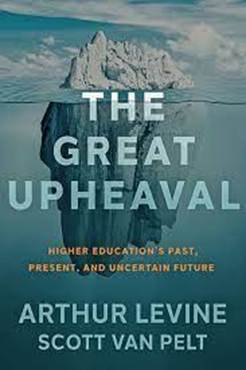
Today, a college diploma is no guarantee that graduates have the competencies that businesses need, including using emerging technologies, communicating, working in teams, and other necessary skills. So, it's fair to ask, "Do students really need a college degree"? Brandeis University President, and nationally respected higher education leader and researcher, Arthur Levine has been at the forefront of the changing role of higher education. Co-author of THE GREAT UPHEAVAL, HIGHER EDUCATIONS PAST PRESENT AND UNCERTAIN FUTURE, Levine argues that in the next 20 years, consumers of higher education will determine what higher education will be, and that every institution will have to change. Today, the United States is undergoing change of even greater magnitude and speed than it did during the Industrial Revolution as it shifts from a national, analog, industrial economy to a global, digital, knowledge economy. At the same time, public confidence in higher education has declined. Threatened by a demographic cliff in most states where fewer students will be graduating from high school over the next 20 years, the increased competition for students means that a larger number of higher education institutions will be closing or merging with other institutions. It is expected that as many as 20 to 25 percent of colleges, particularly liberal arts colleges and comprehensive regional colleges, will close in the coming years. Learn more about The Great Upheaval: The book reveals that five new realities, none of higher education's own making, will characterize the coming transformation: Institutional control of higher education will decrease, and the power of higher education consumers will increase. In a range of knowledge industries, the advent of the global, digital, knowledge economy multiplied the number of content providers and disseminators and gave consumers choice over what, where, when, and how of the content they consumed. The same will be true of higher education. The digital revolution will put more power in the hands of the learner who will have greater choice about all aspects of their own education. With near universal access to digital devices and the Internet, students will seek from higher education the same things they are getting from the music, movie and newspaper industries. Given the choice, consumers of the three industries chose round-the-clock over fixed-time access, consumer- rather than producer-determined content, personalized over uniform content, and low prices over high. In the emerging higher education environment, students are placing a premium on convenience—anytime, anyplace accessibility; personalized education that fits their circumstances and unbundling, only purchasing what they need or want to buy at affordable prices. For instance, during the pandemic, while college enrollments were declining, enrollment in institutions with these attributes, such as Coursera, an online learning platform, saw the number of students they serve jump. In the United States and abroad, Coursera enrollments jumped from 53 to 78 million. That 25 million student increase is more than the entire enrollment in U.S. higher education. New content producers and distributors will enter the higher education marketplace, driving up institutional competition and consumer choice and driving down prices. We are already seeing a proliferation of new postsecondary institutions, organizations and programs that have abandoned key elements of mainstream higher education. These emphasize digital technologies, reject time and place-based education, create low-cost degrees, adopt competency or outcome-based education, and award nontraditional credentials. Increasingly, libraries, museums, media companies and software makers have entered the marketplace, offering content, instruction and certification. Google offers 80 certificate programs and Microsoft has 77. The American Museum of Natural History has its own graduate school, which offers a Ph.D. in comparative biology, a Master of Arts degree in teaching, and short-term online courses that teachers can use for graduate study or professional development credit. The new providers are not only more accessible and convenient, offering a combination of competency- and course-based programs, they are also cheaper and more agile than traditional colleges and universities which will lead to more contraction and closings? The industrial era model of higher education focusing on time, process and teaching will be eclipsed by a knowledge economy successor rooted in outcomes and learning. In the future, higher education will focus on the outcomes we want students to achieve, what we want them to learn, not how long we want them to be taught. This is because students don't learn at the same rate and because the explosion of new content being produced by employers, museums, software companies, banks, retailers and other organizations inside and outside higher education will be so heterogeneous that what students accomplish cannot be translated into uniform time or process measures. The one common denominator they all share is that they produce outcomes, whatever students learn as consequence of the experience. The dominance of degrees and "Just-in-case" education will diminish; non-degree certifications and "Just-in-time" education will increase in status and value. American higher education has historically focused on degree granting programs intended to prepare their students for careers and life beyond college. This has been called "just-in-case education" because its focus is teaching students the skills and knowledge that institutions believe will be necessary for the future. In contrast, "just-in-time education" is present-oriented and more immediate, teaching students the skills and knowledge they need right now. "Just-in-time education" comes in all shapes and sizes, largely diverging from traditional academic time standards, uniform course lengths and common credit measures. The increasing need for upskilling and reskilling caused by automation, the knowledge explosion and Covid promises to tilt the balance toward more "just-in-time education, which is closely aligned with the labor market and provides certificates, micro-credentials, and badges, not degrees. This episode is made possible by our partner Poll Everywhere Poll Everywhere's new version makes student engagement faster, simpler, and smarter. With AI-powered poll creation and seamless LMS integration, it's built to transform lectures into truly interactive learning experiences. Try it out today with special promo code '25OFF'
Embed this episode
NOW PLAYING
The Future of Higher Education in America
No transcript for this episode yet
Similar Episodes
No similar episodes found.
Similar Podcasts
No similar podcasts found.