evaluating what's the optimal balance of physical in-person versus remote and or that hybrid when do we want to bring people back? Is that two days a week? Is that once a month for meetings or key meetings, etc.? The topics and opinions expressed in the following show are solely those of the hosts and their guests and not those of W4C Y Radio, it's employees or affiliates.
We make no recommendations or endorsements for radio show programs, services or products mentioned on Air or on our web. No liability, explicit or implied, shall be extended to W4C Y Radio, it's employees or affiliates. Any questions or comments should be directed to those show hosts. Thank you for choosing W4C Y Radio.
Welcome back everyone to the Keeps, Skeezers and Googleization Show. The home of Googleization Nation. We'll be talking about the crazy shift going on in the world of business, technology and HR. Here's your host, Aaron Wolf.
Hey, welcome to Googleization Nation and welcome back to another episode of Keeps, Skeezers and Googleization. We are live on YouTube, Facebook and Talk4TV and I appreciate you being here. We've got, I have a few great guests today. If you've been watching the headlines, if you are in business, if you are in a worker and you're looking for another job, you've probably recognized that we are experiencing a labor shortage.
I wrote about this in 20 years ago, Kinsey wrote about it 30 years ago. I talked about the talent war, the war for talent. I started to talk and write about it in about 1999, I believe, and then I published my first book in the early 2000s, about the perfect labor storm. It was really more than just at that point the millennials, but it was about the convergence of the generations, globalization, the internet, women in the workplace, changes in education, technology, it was the convergence of all these things which eventually involved into Googleization.
I know a lot of questions about what is Googleization and Googleization is really the convergence of the wire to tired and technology or business people and technology, which we all experienced in 2020. So one of those headlines that we've been experiencing lately or that we've been reading about lately is businesses are really struggling to find jobs. This is not just the blip on the radar, this is not going to resolve by the end of the year. Just this morning, a couple headlines that I pulled out and we'll be talking a little bit about that today with our guest, the labor after a pause in 2022.
So this is from the conference board. The expectation is that labor shortages, too few people buying for too many jobs, will increase through the end of this year and then in early 2022, it will improve, it will stabilize a little bit. But then it's going to accelerate again until the next recession. So typically in cycles five to seven years type thing, and I'm not an economist, so you can follow your favorite economist or that information, but we are going to continue to experience a very, very, very tight labor market and people, you got to get your act together.
And that's why we're here at Geeks, Dies, and Googleization. We talk about that every week. What can you do to help attract talent? There was another report that came out, Wall Street Journal, and I don't remember where the study was from, but they reported on it that there are now more job openings than there are qualified people to fill them.
National Federation of Independent Businesses found that 44%, I'm sorry, 92% of small businesses report that they are getting few or no qualified applicants. And so big challenge. Part of the transformation, and also an opportunity that's out there, is that hybrid workforce is with us. And we're 99% – we'll get into this with our first guest in just a minute.
But prior to the pandemic, 99% of companies required employees to be at work 80% or more of the time, that number now has been reduced to about 10% require their employees to be at work, not working, but at work more than 99% or more than 80% of the time. So big shift. And that has huge implications, not only for recruitment, but for retention, for engagement, for diversity inclusion. You name it, and companies are still trying to figure it out.
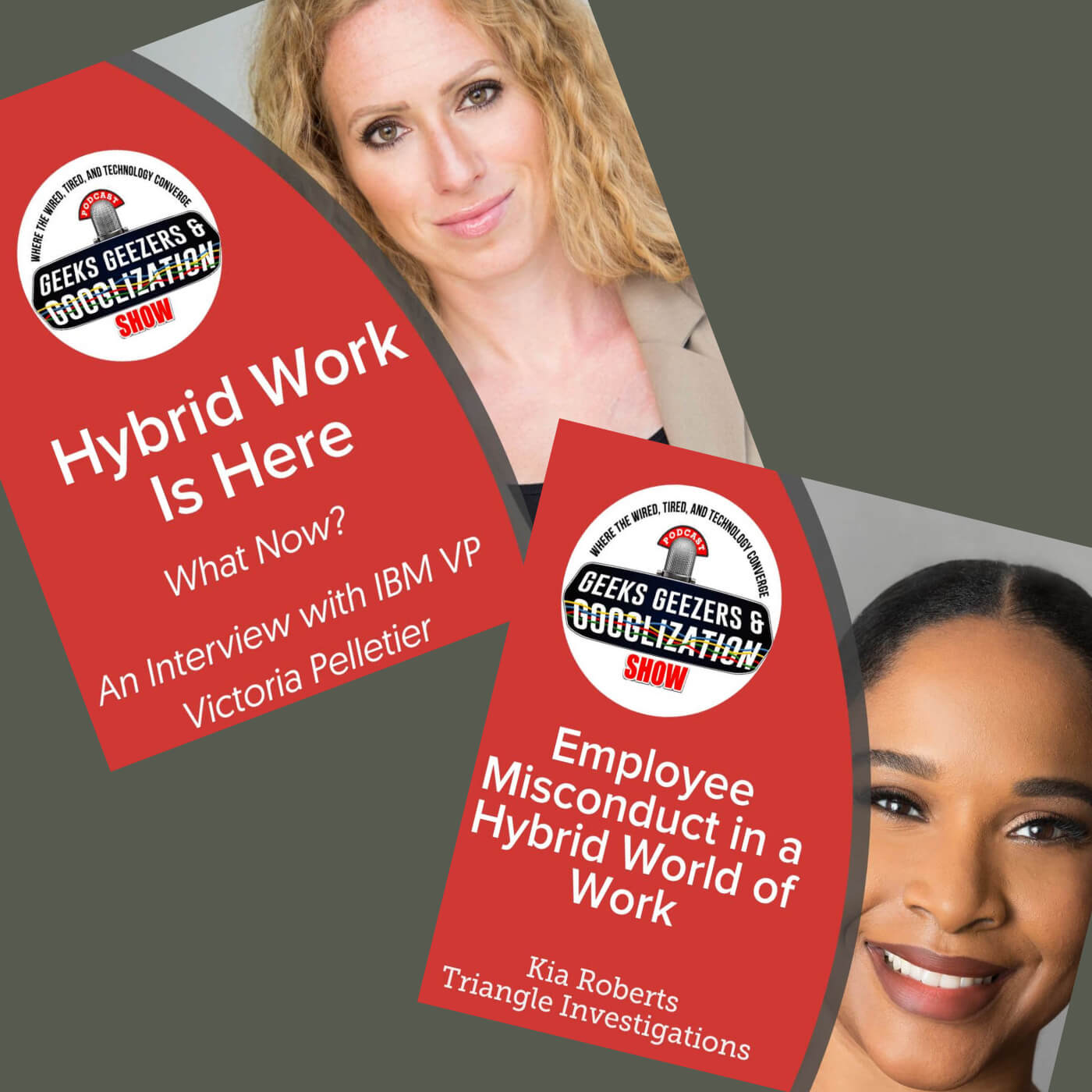
So our first guest today is going to be Victoria Pelletier. She is a vice president, IBM vice president of talent and transformation leader. If I got that right, vice president, North American talent and transformation leader. And our second guest, we're going to follow up with is Kia Roberts.
She's the founder and principal of Triangle Investigations. We're going to talk about some of compliance issues and some misconduct that needs to be addressed. And that can be anywhere from discrimination to sexual harassment to bullying. Now that people – doesn't go away just because we're working remote.
And Kia, if I didn't say this, was a former NFL director of investigations. So we've got two really phenomenal guests. Before we get there, I actually can show you a number of webinars that relate to this. I spoke with Ed Gordon last week.
And Ed, if you're not familiar with him, he's been a labor economist, wrote over 20 books. And the website, the interview is available on YouTube. You can watch it there. I also have two webinars that are available.
One is duct tape wonk, fix your F-ed up candidate experience, which is a real critical part. And then also we're talking about adaptability, how we need to change. We're living a world of digital transformation. And you can access those replays on the links that were – Roxille just displayed.
And we'll show that again throughout. And now, I want to also thank InGumo, InGomo, who just last week launched their new app to appreciate InGumo being one of our sponsors, and of course, Success Performance Solutions, which you'll hear both of them just a few minutes at the break. Right now, let's bring on Victoria, Eliteer. As I said, she's the IBM Vice President and North American talent and transformation leader.
That's a big title. You must have that on your door, the whole tag, right? Yeah, yeah. I've decided to cut that down.
We've got acronyms below it, IBM. So I just – I just – I kind of just signed up my emails, just VP, both my initials and my title. VP, VP, VP. Well, welcome.
Thanks. It's great to meet. We did it digitally over the week. I need to know each other, but I appreciate to be here.
And I reached out to you at the hybrid workforce. Certainly IBM, just studying the future of work. They've been all over it. I remember hearing – I don't think Gina's – she's no longer CHRO, I believe.
But I remember hearing her. She was still in opposition a little over a year. It must have been April or maybe April or last year. She was on a panel and they were talking about surprises, what changed or what caught in my scarred.
And I remember her saying – and I struck maybe as he was IBM with all this data and understanding that they go. I didn't know who – they didn't really have clear idea who the essential workers were. It's like everybody can go home except for the essential workers. Or everybody doesn't have – shouldn't report to work except for essential workers.
It's like, so who's an essential worker? You know, and I again brought a new term into – in the HR world. Now that we are coming back and coming back with a vengeance. Economy is hot.
It's not market's hot. Job market's hot. We are dealing with this thing called hybrid workforce. And somehow people think it's remote or it's at work on physical site.
And there's – I don't know how many shades of grey between there. What are you saying? What are you hearing from your client? What's going on on your end?
Well, I'm multitude of different things. So hybrid work, as you said, very much so, has become the new vernacular and explaining just quite frankly what I think is going to be just the new normal, the way in which we work. You know, we are social animals. So there is a desire to still – I'll say break bread.
I'm used to hopping on planes and going and seeing clients all of the time. I do – actually I don't miss the flight delays all the time, et cetera. But I miss that opportunity. So what I think we're going to see is this mix – and this is what companies are trying to – I'm working with clients right now.
CHROs and other executives of companies trying to figure out what's the right balance? As you said, there are essential workers. For IDMers, those were things like individuals who needed to sit and provide data centers, right? We're protecting the infrastructure and the data of other companies.
Or where we process transactions for financial services clients who wouldn't want that done in someone's home. So you're right. We needed to work through that. And as I'm working with companies like Manufacturing or Think Contact Centers, where it requires being in physical locations depending on the type of work that they're doing or the calls or contacts that they're doing.
Recognize that's going to continue to exist in physical workplaces. But the rest – and employees in particular – are looking for many of whom – and I think Mike is a role there. So they could care less whether I'm here at home or not. But for those with toddlers who are walking in behind – we see that on news channels, et cetera – they're looking to go and get out of these four walls and these four windows that we're staring at.
But also, as you mentioned, it's around this balance between productivity yet engagement. It requires a very different type of leadership in terms of how we need to be communicating, keep employees engaged, do you think of design thinking sessions or innovation or creativity. A lot of that down on a way forward in a room with all of those juices flowing. So it's much more so around evaluating what's the optimal balance of physical in-person versus remote and or that hybrid.
When do we want to bring people back? Is that two days a week? Is that once a month for meetings or key meetings, et cetera? Right.
And I guess, going back again, it's almost a binary choice. People are looking at the binary choice. And if you put it on a slider, 100% remote to 100% at work, the challenge is the slider is going to be constantly moving. It's going to be up and down.
This isn't going to be the last challenge we have, reaching out to top talent. We may have that, but they want to be home two days a week. So it's going to be a choice. Do you hire that person because you have not hired them because you have this policy that they have to be there 80% or 100% of the time?
Or do you make arrangements and then all of a sudden, childcare changes or their spouse's role changes, their job changes or this week their spouse is traveling and they have to rearrange their childcare. So again, I think it's, if people look at it as this perpetually moving sliding scale of what hybrid means, which tries people crazy because humans are addicted to certainty. We need to know. You mentioned something earlier though.
And again, I think this fits into that conversation. You said that, well, the data workers, the data center employees were essential. They needed to be on site. But even with involving technology, that's a security issue.
That's a confidentiality issue. That's a privacy issue. But with things like blockchain, will that change that? Well, that main, well, even data center people may not have to be there.
Yeah, yeah, you're right. I mean, this is what companies are evaluating now, what they once thought were essential to be in the office. I spoke to him at the large US state, headed their technology. I think I'm about 15 or 1600 people.
And the way in which they measure their team, their performance was seeing physical bumps and seats. And they asked, well, what if we were to have people some kind of a rolling hybrid environment, et cetera? And how are we going to manage their performance? And sort of look through the web experience.
How did you measure before? Right. So it's what was essential to be physically in offices, it just caused leadership to completely have to rethink that. And to how you were just even opening up the show as well.
When you look at the scarcity for the right kind of talent and the demand for skills, this is where I'm seeing a significant change. There is a much more rapid acceleration around digital transformation, modernizing infrastructures and the cloud environments and applications they reside upon, number one, and two, automation of work. So what gets left behind, but looking at those kind of skills, that's changing. So employers, when they're looking at this optimization of workforce and how is it connected to their business strategy, the conversation becomes much more around the skills that they're looking at.
And how do we find the skills that are required for this future of work? And where do we go to get those skills and do that? And therefore, that means looking much more broadly at global economy and workforce to deliver, even for those who might have traditionally only operated in certain physical hubs in certain geographic locations, it's a scarcity for skills. When you think of it, we all expect a consumer grade experience sitting at home, the ability to go on Amazon or similar electronic shopping carts and do a lot of our shopping from home.
So that's where there's this shift now in getting the right kind of skills. Do you buy that talent? But as you said, there's not necessarily enough of it out there. Are you developing the skills or investing in education and for the changing propensity of skills?
That's the other thing. The shelf life of skills is decreasing rapidly for less than three years, two years. So that's that balance now. And so therefore, getting workers with those skills in the environments in which they want to work is completely changing the way that businesses and leaders need to be thinking about it now.
Where are some of the skills that you're seeing are in the highest demand? A significant amount of technical skills right now. So things like CRM skills, Salesforce, one of the hottest skills out there. There's also migration.
I spend a lot of time with CHRO. So you look at the human capital management systems that are out there. They all need to be migrating to the cloud right now. Tax updates and it's important we all get paid.
And so we're seeing that shift in the cloud. So there's functional technical skills that are required. But what's really interesting is there's also a shift in the soft skills. As we automate more, what gets left behind for workers to do are higher value activities where you need critical thinking skills and the ability to be agile and pivot.
I don't mean agile in the waterfall technical sense. Just the ability to adapt and adopt new processes very quickly. And as leaders, again, operating this kind of environment, there's very different skills that we need in terms of leaders who can engage in a very different way, communicate in a very different way. Employees are also expecting much more transparency in their employers, right?
And connectedness to think of what's up from a social standpoint as well. So connectedness around values, you mentioned diversity, equity and inclusion. So those all are soft skills that are much more amplified than they were in years past. So where do we get these?
I mean, Chamber of Commerce just came out Monday, I think, or Tuesday of this week. And, you know, big declaration. We have a shortage of workers. I'm not sure that was headline news, but they emphasize the importance of that.
And, you know, certainly there's an initiative now to improve training. So much of the traditional BS, you know, frankly, we need to change education. We need to reskill. We need to upskill.
We need more training programs. We need apprenticeship programs. But a lot of those take time. I mean, and as you said, I mean, by the time you put a program in place, then it's a two or three year implementation, some of those skills just don't no longer need it or they've changed themselves.
So what are you seeing, you know, what's happening now with fast retraining, the fast upskilling, what are companies doing, and what do we need to do? What I'm seeing is a multi-pronged approach to that. And there are definitely the long term ones, as you said, things like looking at IBM, for example, P-TEX, which also helps our diversity initiatives. So we're going to underrepresented communities, getting kids at, you know, ages like grade nine and trying to get them interested in technology and building for future.
And that's long term. So short term, it's this optimization workforce. And this is where the HR business partner needs to become much more of the consultant to the business leaders. I go back to skills.
What are the skills that you need? And then you look at the data. It's actually one of the hottest jobs I'm seeing is actually data scientists around employee data. And so looking at a combination of looking in the rear rear mirror, what's worked, who have been our top performers in the past with what skills that they had.
But the next is then the bridge to the propensity to learn. And so what are the types of skills, projects, programs that people have worked on in the past have been successful and then career paths of others. And then look at the digital footprint as well to see who has the propensity to learn a new skill versus we know that buying it gets more and more expensive as the salary costs increase each time there's a hot versus the long tail to educate an existing workforce. So much more around that propensity to learn.
And then there's a balance of contingent workforce and the gig economy. And so it's a balance of all of those things. And it's becoming more and more difficult than it ever was. I talked with about VUCA.
I've written about VUCA for 15 years. I keep saying it over and over again. I don't know better acronym for 2020 than VUCA, which is all the tile on certain complex and ambiguous. And that's that is, you know, if there is a new normal, which nobody likes, you know, again, there is no such thing as normal or going back to that.
You know, I talk about next waves of normals that there's going to be multiple normals. We're each going to experience it a little differently. It could be different for industry, for people, for region. We're all going to have these different normals happening in different waves.
That's, you know, that's, that's, that's scary. It's terrifying. It's also fascinating. I mean, you know, people like you and a lot of people at IBM and a lot of consultants that I know are fascinated by, you know, where things are going to go.
But it's terrifying for if you're employer. That's a little like, you know, and trying to figure out your business model. You know, I talk a lot in addition to VUCA. I mean, the solution to that, we talk a lot about the soft skills and, you know, every, I can say every single day I get called by someone and say, can we test for work ethic?
We test for grit. What about resilience and, you know, throughout these buzz words and that's like, we have somebody who's resilient, now they'll be a good employee. And then we stick around. They may not quit impulsively, but that doesn't make him quality.
In fact, my guest next, one of my guests next week is David Huul. He has a new book and his book is called cognitive dissonance. And, you know, one of the skills we talk about in the AQ Adaptability Quotient is mental flexibility and the ability to have these multiple thoughts. And you hear, or have kind of opposing thoughts and having them in your head at the same time and make sense of them.
That's a skill that obviously a lot of people don't have because we've been getting addicted to this certainty. What do you, I guess, what's in this falls in line with the skills that we need, but what do you see as the biggest challenge that companies are having in training and getting the people up to speed because even with retraining, it's like, so if I, if I complete this course, if I go back to school for two years, then I get a job and I get a raise. No, no, no, that's not guaranteed. You have to do it, but we're not guaranteeing anything.
What do you think is the biggest, you know, one of the biggest challenges that I guess employers are facing even figuring out what do we need to train? Well, I go back to the connecting skills for the future with business strategy, right? So you think every business has a one, three, five year business strategy. So it's connecting that back to again, the skills that are going to be required to deliver the outcomes as part of the business strategy.
So, you know, figuring that out. And again, two, three years out. So you have the lead time to build or buy or automate, you know, those skills that are required. The next thing would be around the way we look at measuring performance is changing.
And you touched on that around flexibility and adaptability and how do you measure for that? And when I think of the way we look at, you know, so many business processes are being automated right now. And as I said earlier, what gets left behind are the higher value type of activities that require the ability to break the rules to deliver an outcome sometimes, not like with our next guest from our breaking some of the compliance issues. But you think of it in a contact center, right?
Well, you know, A and B, like this is what the rules I need to follow. Well, they don't always make sense. And so the expectation we have is very, very different. And so for employers, it also means looking at measuring performance very differently.
So being incredibly true performance and pay quite frankly. So being really clear that pay is linked to skills, demand for skills so it can come in upon the employees to also be educating themselves in building their skills. They are however looking for employers to invest in them as well. And that breeds in their mind job security.
We know that there isn't really job security, but if you continue to stay current with skills, it keeps you in demand and therefore somewhat secure. And so that's one element of pay. But then also the other pay component is paper performance. And so being really clear on outcomes that are expected.
And some of that comes with flexibility to be problem solvers, to be innovative and creative in delivering solutions in a very different environment. And that also means being iterative, right? Because we're going to go through that and sometimes the out of you can't manage what you can't measure. But some of those elements when you say this is the outcome that I want might initially be not as tangible.
So again, that's a very different type of leader who needs to lead in that way and coach and develop again be really transparent with expectations or I always talk about outcomes outcomes that we're expecting for the constituents we serve, whether those are employees, customer clients. And going back to talking about the hybrid workforce. So everybody struggling with this, we're going to bring some people back. We can't what I mean, what's the first thing I mean, the companies that are in the midst of in the throes of this, which is almost every company.
Especially I work with a lot of small businesses and this is completely new to them because they always thought they had to watch people literally managing by walking around. You're not going to walk around remotely. What are some of the things that, you know, well, any leader, but small business small business owners should be doing right now to evaluate the determine what shape or form hybrid takes. I'd say first and foremost, ask your employees.
I'm seeing some companies who are going all in and creating what they, you know, these hubs innovation hubs, they're reconfiguring offices with a smaller footprint without actually understanding. How many of their employees plan on returning to a physical work environment or want to, they can dictate it. Not the way the ask your employees. Shocking, right?
I'd say that first and foremost, but then also understand, I mean, what's the business that you're in? What is your business culture? I think of, you know, again, if you're innovating and creating products or designs or you think marketing, et cetera, there's a lot of that creativity that does happen when we come together. The distraction that comes in sitting in and behind a Zoom or a WebEx call is not the same.
So, you know, the answer is difficult, consult and speak. It depends. It's the answer, but it really does on what employees want. What's the work product or service that you're delivering and what's the type of culture and environment you're in?
And so that's where I think you, and then it becomes a blend. Like I think you need to. I think the expectations for employees that employees have are very different. So it's a balance between all of those elements.
And so each individual, small business owner is going to have to assess that. But again, based upon conversation with their employees, with their customers and assessing the needs of, you know, the work product services and outcomes they're expecting. And if the McKinsey study is right, where only 10% executives feel that they're going to be 80% or more or that 10% of the workforce is going to be at work 80% of the time, that leaves a lot of shades of gray going from 100% remote to whatever. So Victoria, I really appreciate it.
We can talk. I can talk to you forever. So a million more questions. Yeah, hopefully you'll come back and for people who want to reach out to you.
People want to learn more from you. How can they do that? They can find me on my website, which is Victoria dash paltia calm where you can certainly look me up on LinkedIn as well. Excellent.
Real quick question. I got just a few seconds here. You're from now. I have you back on the air.
What are we talking about? Quite honestly, I think we're going to be talking much more the same. This normal is going to shift as you said we want stability, but it doesn't exist. You know, so comfort and change, you know, don't don't exist.
I think we're going to be having similar conversation. That's my answer to when I ask that. Thanks very much. Thank you for being part of Geek Steezers and Googleization.
Stay safe. We will definitely be in touch. Thanks very much. Thanks.
Have a good day. Wow. You know, I again, we talk about the next waves of normals. I talk about the next waves of normals and it's great to hear some confirmation and I'm correct and I think Victoria, Palette, here for being our guest and talking about the hybrid workforce, but we've got another great guest coming up.
Kia Roberts from triangle investigations and also the former director of NFL, NFL director of investigation. So if I can get that out, right? But first we're going to take a quick break from our sponsors in go. Moo and success performance solutions.
So please stay tuned. We'll be right back. Hiring top talent shouldn't be left up to the role of the dice. And yet, that's exactly what many organizations do.
They roll the dice, cross their fingers and pray for a better outcome. Hiring the right employees. The first time is much too important and way too costly to leave to a game of chance. Your employees and your customers deserve better for 25 years.
Success Performance solution has been helped small and medium sized businesses hire smarter. They offer pre-employment and leadership assessments for typing and data entry to see sweet competence, whether it's production sales, healthcare, call centers, or management, success performance solutions can help. Visit their website at www.successperformanceolutions.com to schedule a free demo or call 800-803-4300. Imagine growing great employees and advancing emerging leaders for less than a dollar a day.
The Ngomu app will support your employees in a myriad of ways. From career and personal development to health and wellness. No need to schedule and hold trains. You just have an access over 90 coaches for live virtual group and one-on-one coaches for whatever topic they need or want to work on.
Anytime, anywhere. Learn more at Ngomu.com today. Welcome back everyone to GeekSqueezers and Googleization. Thank you for being part of Googleization Nation.
If you're not a subscriber yet, you're not a member of Googleization Nation. It is free and you will join. You can go to www.googleization.com very easy. You will get weekly updates, podcasts, webinars.
We've had a couple webinars going on recently and they're still available on the replay. We'll be having our new calendar come out in just a few days. You've got on Googleization Nation. Please you can catch our replay of my interview last week with Ed Gordon talking about the labor market meltdown and that's available up on YouTube.
So is my duct tape or actually on my webinar platform and you can get to that by going straight to successperformanceolutions.com. You can go to get.live.com or slash aqai520 and that's duct tape won't fix your broken candidate experience. And then you can also go to our adaptability webinar, how to grow and thrive in an f-dup world. We'll show those again at the end.
I appreciate being here. But right now we're going to continue show with our next guest, Kia Roberts. Kia is the founder and principal at Triangle Investigations. She's also the former NFL Director of Investigations and we're going to be talking about how that plays in on the current hybrid workforce or the new workforce, whether it's hybrid or not.
So we want to welcome Kia to the show. Hi, Kia. Nice to meet you. Well, Ira.
Thanks for being part of that. So you went from the NFL to your own business, investigating misconduct, sexual harassment, again, a good training ground, I guess. So how, I guess, what are some warning signs? I mean, what are some of the things that, as we heard part of the interview, I just had with Victoria, but as companies are evaluating moving to that hybrid workforce, that's 100% or 1%.
What are some of the changes that they need to be aware of? What are some of the policy changes they needed? It's absolutely critical that employers continue to do the really good and consistent and substantive work of keeping their finger on the pulse of the employee experience. So employers cannot say, oh, what people only hear 50% of the time, 25% of the time, it doesn't make a difference because the fact of the matter is, if an employee can make a substantive argument that they have been on the receiving of discrimination or delegation, sexual harassment, what now?
That employer now has a legal problem, right? And what's been so fascinating for our team over the last year is the ways in which misconduct appears while people are working remotely. So it's not all happening. We've had like zero slowdown in terms of our case loads and investigations because discrimination, harassment, retaliation, sexual harassment, unfortunately can all be performed remotely.
So it's crucial for employers to really keep their finger on the pulse of what's going on, even when they're not having that day-to-day interaction with employees. So there's obviously, I want to say, hopefully it's obvious to most people that are certain things, such as bullying, sexual harassment, whether it's in the workplace or whether it's virtual. Right. And so without sharing, obviously, I know some of these are confidential, I'm sure they can't be shared.
There would be some examples of things that you've seen maybe on the uprise or companies that need to be more aware of that, maybe more likely to happen through a virtual or through a remote or virtual platform than they would on site. Right. Absolutely. So we had an investigation last summer that I call our uniquely 2020 investigation in terms of the allegations that when employees were saying was happening.
So, for example, there was an African-American woman on the team who said that the manager would make her turn on her camera for meetings to keep an eye on her but didn't ask the white team to do so. In a way that to her felt like monitoring an excessive performance review. We've also seen some complaints with managers really not having good boundaries about work versus home now that we're all working remotely. So, you know, managers that expect people to respond to emails very, very late at night or on weekends or early in the morning because the live between work and home has gotten so blurred.
We also had a really interesting investigation where we really started to explore the balance of what is an employer entitled to know and not know with respect to your health status. So this was pre-vaccine. This particular employee stated that he got sick with coronavirus pretty early on in the pandemic and had a rough time but ultimately recovered. But that his manager was asking questions were you sick?
Did you have coronavirus in a way that felt to him intrusive and possibly violated of his medical privacy? So it's appearing in every way possible, you know, people being rude to each other and slack messages in teams chats and this person was gesturing in a certain way in the camera and that made me feel fearful even though we weren't in the same room. So, it's been all across the board but it's certainly happening. So, you're taking off, we're flying the plane and we're trying to figure out how to stay in the air and land it, right?
Right, right. What are, I guess some of the things that you mentioned though, and I've seen this in everything else including talent acquisition and engagement, people blame virtual, blame working remotely on the reasons. Yet many of these challenges, many of the problems, many of the problems, many of the problems, many of the wrongs. Right.
Really evident when everybody was at work. Am I correct? I mean, are you seeing any uniquely new problems or are these just the same problems in a new venue, new medium? They're the same problems showing up in a new medium.
That's a very good way of putting it. But employers and, you know, many of our clients are really, really, really fearful of the blowback that can come without really knowing what's going on and addressing it correctly. Right. So, I was watching TV and someone said this and I stole this line because I thought it was so good.
They said, with the rise of social media, what we're really starting to see is the democratization of the microphone, which is so good. So, if I'm at work and I am from historically underrepresented minority and I feel like I'm being treated this way at work, I don't have to go get an employment lawyer anymore. I don't have to go get a public relations person. I can just take to Twitter.
Or I can go on Facebook and maybe some employees will join me. And a lot of organizations right now are living in that perpetual fear of the other shoe dropping, right? Like, is everything okay? We don't want to learn about it via social media.
We don't want to learn about it via investigative report in the New York Times. And we certainly don't want to learn about it once we get a demand letter from a lawyer. Right. Well, everyone's having to think through these really new and creative ways of creating reporting processes and mechanisms for properly assessing the employee experience at any given time.
You know, so interesting. You talk about the democratization. And, you know, so last year, you know, social media is everybody sort of knows what it is. You know, here we had zoom.
And the reality is is that, you know, if you look, all of a sudden there was no C-suite and there was no cubicles. Everybody had an equal picture. Everybody and zoom or any platform that displayed everybody's face on the screen. Basically the microtized.
It was no longer walking into a mahogany, you know, office with a huge desk that separated us. We were all just faces on a screen. And, you know, some companies learned to take advantage of that. And other companies continue to be challenged of that because they liked that hierarchy.
They liked that protection. It was also the opportunities to see the, you know, the CEO who used to say, well, if they work at home, they're going to be distracted. And I was in the CEO at home. The doorbell is ringing.
The delivery guys there. The plumbers there. The grandkids are there. The cats jumps up on the desk.
And it's like, okay, now I see, you know, so again, everybody became human. And it was a real opportunity to become no more transparent. What can a company do? I mean, here we are.
I mean, we have a few minutes left. What are some things companies can do? And I guess it's twofold. What can they do to prevent calling you?
And the second is when should they call you? Right. So with respect to the first question, what can they do to prevent calling you? One of the best things organizations can do for themselves just out of the back is get a really solid, good code of conduct outlining exactly what is acceptable with respect to employees behavior.
So that code of conduct serves as a guardrail, right? Saying these are the parameters for your employee experience and behavior. But then it also serves as a very effective risk management tool. For God forbid, if you're a standalone someone does file a lawsuit, you can say, you know, we had this code of conduct in place.
Employees were told that this is what was expected of them. So that's the first thing you can do to prevent calling you kind of get that code of conduct behavior structure in place first. Now, do you help? I just want to interrupt you a second.
Do you want people to develop that? Or is there a good source you can send people to? Again, it shouldn't be a copy and paste. I assume that's what they're going to do.
So we have organizations write and craft their codes of conduct down. We can do that anyway that the employer would like it done. We can do a listening session with your team. We can do an analysis of your misconduct sets and really kind of identify problem points and pain points within the employee experience.
And we work together in lockstep to write that code of conduct. You brought that up. You can be found at triangleinvestigations.com. And if you mention the show, you do get a price of 50% off your code of conduct.
We call it the most inexpensive insurance policy you will ever have with respect to that code of conduct. And then with respect to when you do call us, what are we working through? So we are giving you, we can either perform an investigation because something has happened, like a very general misconduct investigation, digging into specific allegations, or we can help you build up an entire accountability structure. So that's the creation of your code of conduct, creating reporting processes and mechanisms for people to report misconduct.
And then walk through what a consistent and thorough investigation should look like and how the parties involved in the investigation are ultimately informed of the outcome of it. And we walk you through that end to end. And then we leave and you have a wonderful thing that hopefully stops you from being sued in the future. That's my lawyer coming over with the relationship perspective, trying to protect our clients in that way.
So what happens when that also doesn't, I mean, it's not 100% foolproof. So you got the code of contact, you did the training, everybody's aware of it, but people are still going to violate it. We're still dealing with human beings. It goes off the rails.
You know, what are some of when should somebody call you? So if you have a specific incident that someone has already left saying that they've been a victim or receiving in of or witness misconduct, call us then. But if you have any questions at all, any holes that you're starting to kind of perceive within is your code of conduct tight enough. Are people really reporting misconduct?
That's become a huge issue, right? So, you know, a lot of organizations know that there's things going on. How are people reporting it? Are things bubbling up to the level of management where it needs to go for it to be correctly addressed, right?
So there's really, you know, really spending a lot of time figuring that out. And just we can do a complete analysis with you of where your requests are and with you to create really good, strong, risk management, focus solutions. I mean, you bring up a great point there. Just because you don't hear it.
It doesn't mean it's not there. Yes. So how, you know, and survey, obviously surveying your employees is one thing. But what are some, you know, what are some ways you can recommend that people can, you know, find out.
I mean, if it's quiet, it's either good news or it's just waiting to simmer over. Absolutely. How could a company, you know, what could a company do to find out if it's really quiet? Right.
So our organization has an app that we've developed. It's called Telly. It's available on Google Play and the App Store. And that works as a reporting mechanism for employees to report misconduct within their organization.
They make the report on the app within 24 hours of having received a submission, leave make contact with the reporting party. Within 72 hours of having received a submission, we provide the client with an investigative roadmap and we do the investigation from there. So that has been, you know, kind of a hot ticket item over the last year. This was actually developed pre-pandemic and has certainly got to be especially useful over the last year.
You know, when there's no HR door to go knock on, which there has not been for the last year for the majority of employees, you still want to keep an understanding of what's going on. So that's an example. And then there are hotlines and then there are designated people within the organization that are saying, you know, we're all working remotely. But if something happens, this is a designated person that we'd like you to be in touch with so that organizations can really wrap their arms around what's going on.
Excellent. So you already gave the website, but we'll do it again. If you didn't, if you heard the last, I try to wrap up each guest's appearance with my, if this question is 12 months from now. I'd love to have you back here.
What's going on? What are we going to be talking about? 12 months from now, we are going to be talking about employers implementing very new creative and unique solutions for keeping their finger on the pulse of what's going on with employees from a misconduct perspective while employees work in a hybrid or remote situation. The liability for the company is exactly the same, whether you're seated in a cubicle or whether you're at home and people are engaged in misconduct as violated with labor laws.
Yeah, excellent. And I agree with you. I assume we're, you know, as most of my guests say, we're going to be talking much about the same things, just a little bit more complex, a little bit more advanced, maybe a little bit more ambiguous on how to get involved. I'm really curious on how to approach this.
I really appreciate it. Thank you for being here. Thanks for having me. Yeah.
And then again, I mean, just what you're talking about, we talk a lot about talent acquisition, employee experience, and experience diversity, inclusion, and technology. All of this is, so I don't know how you achieve any of that. How do you improve your brand if you don't have a safe, if people don't feel psychologically safe? How do you improve diversity, inclusion?
How do you reach diversity or reach inclusion? I can't say diversity, but inclusion if we don't have that. So that's a vital role and something that I'm not sure a lot of people thought about until now. So thanks very much for sharing that.
Thank you again for having me. I really appreciate it. Okay. And triangle investigations.
You can reach Kia. Yeah. Try investigations.com. Thank you so much again.
Thank you. Appreciate it. And here we are at the end of another geek skis and Googleization show. Thank everybody for being part of it.
Thank you for being part of Googleization Nation. If you'd like to get updates on future shows like this, our guests and also some webinars that we've had and are coming up, please subscribe to Googleization Nation. And again, you'll get mostly weekly update, very, very occasionally. There's something hot off the press.
I'll send you another one. And every now and then, you've got a break from us. Essentially weekly, you'll hear from us and get updates and stay tuned whether we're talking about talent acquisition and employee engagement, candidate experience, diversity, inclusion. And we have great guests like we did today.
Victoria Bellatiere, IBM, EP, leader, North American leader for transformation and talents talking about the hybrid workforce and also Kia Roberts from triangle, community, triangle investigations, triangle investigations. You can reach both of them. Please share the show with your friends, your colleagues. Hopefully you found it worthwhile.
Also, if you're interested on on replays, or you can't make our live life TV, the live streaming each week, we are available on almost every podcast platform you can think of Apple Spotify, iHeart. You name it. We're there. And really, again, appreciate you being here.
Thank you again in GOMO and success from performance solutions for being part of the show for allowing us to be here, for being our sponsor. And until next week, don't let the shift. Hit your plans.