
EPISODE · Nov 20, 2023 · 1H 55M
The Gettysburg Address, Civil War History, and Recognizing Totalitarian Manipulation
from The Kim Monson Show · host Kim Monson
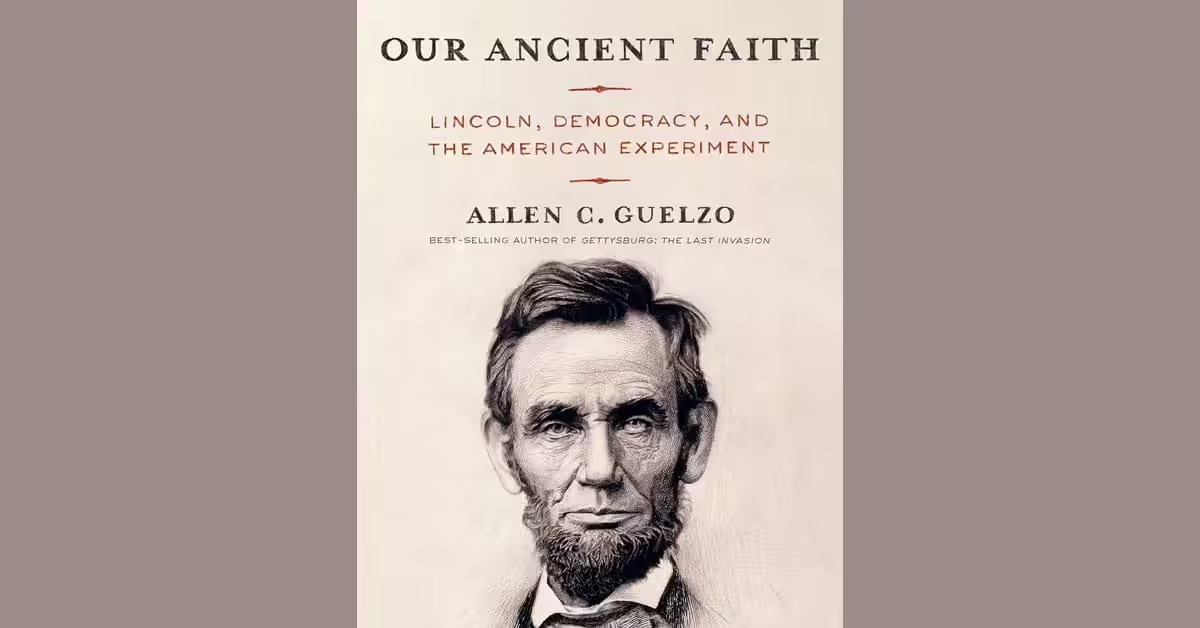
On November 20, 2023, the day after the 160th anniversary of the Gettysburg Address, Kim Monson explores pivotal moments in American history with Princeton historian Allen Guelzo and Army veteran Brad Miller. This Thanksgiving week broadcast examines the ideals that shaped America through the lens of the Civil War and modern threats to liberty. The Battle That Shaped America Start listening at 0:49 – Hour 1 Allen Guelzo, Senior Research Scholar at Princeton University and former professor at Gettysburg College, breaks down Robert E. Lee’s strategic gamble during the 1863 invasion of Pennsylvania. Guelzo explains that Lee understood the Confederacy lacked the industrial and economic might of the Northern states, making a prolonged war unwinnable. The Confederate strategy centered on scoring a decisive victory that would fatigue Northern public opinion and force the Lincoln administration into negotiations. Guelzo describes how Lee’s timing exploited Republican losses in the 1862 elections, when Lincoln’s party lost 35 House seats and key governorships in New York and New Jersey. With Pennsylvania and Ohio gubernatorial races approaching in fall 1863, a Confederate victory at Gettysburg could have fractured Northern political will and secured Southern independence. “So Lee’s gambling, but it’s a good gamble. It’s an intelligent gamble. And it had a lot going for it, because not only is he looking at the state of mind of Northerners, he’s also looking at what’s happened at election time.” Allen Guelzo, Senior Research Scholar, Princeton University Slavery as the Root Cause of War Start listening at 10:27 – Hour 1 Guelzo addresses the historical debate over Civil War causation, identifying sectionalism, federalism, and slavery as contributing factors. He notes that while some non-slaveholding Southerners fought for the Confederacy, slave ownership was more pervasive than simple calculations suggest. Joseph Glathar’s analysis of Lee’s Army of Northern Virginia revealed higher rates of slave ownership among soldiers than in the Southern population generally. The historian draws a parallel between antebellum justifications for slavery and the dehumanization that precedes genocide. When self-interest conflicts with ideals, Guelzo argues, people invent rationalizations that permit atrocities. Jefferson captured both paths in his life: the ideal in the Declaration of Independence, and self-interest in his behavior as a slaveholder. “So, at the end of the day, if people ask me to put my finger on one thing and call it the cause of the civil war, there’s simply no question. It was slavery.” Allen Guelzo, Senior Research Scholar, Princeton University The Hegelian Dialectic and Control Mechanisms Start listening at 65:58 – Hour 2 Brad Miller, a West Point graduate and former Lieutenant Colonel who resigned from the Army after refusing the COVID-19 vaccine mandate, teaches a course on dystopian literature at IPAK-EDU. Miller explains how the Hegelian dialectic, often described as problem-reaction-solution or thesis-antithesis-synthesis, functions as a control mechanism when powerful networks manipulate both sides of oppositional constructs. Miller connects this philosophical framework to the Delphi technique, developed by the RAND Corporation, which creates the illusion of public consensus while steering decisions toward predetermined outcomes. He cites Rosa Koire’s book Behind the Green Mask on Agenda 21 as exposing how...
Embed this episode
NOW PLAYING
The Gettysburg Address, Civil War History, and Recognizing Totalitarian Manipulation
No transcript for this episode yet
Similar Episodes
No similar episodes found.
Similar Podcasts
No similar podcasts found.