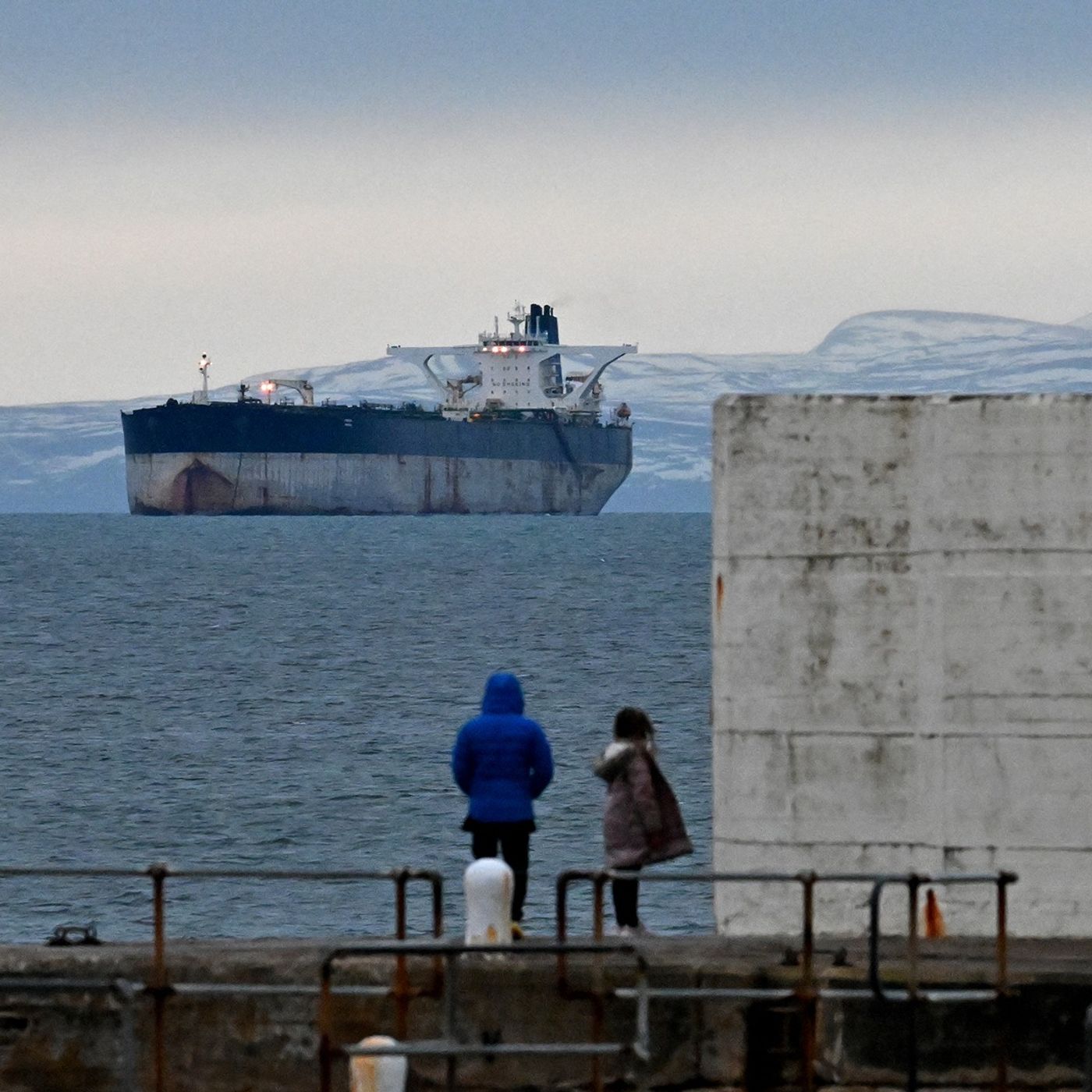
From The New York Times, I'm Rachel Abrams, and this is The Daily. President Trump says that the United States has now seized an oil tanker off the coast of Venezuela. The U.S. has seized a sixth oil tanker. A seventh-sanctioned oil tanker.
funding petrostates like Venezuela, Iran, and Russia. Today, my colleague Christiane Tribert on what these ghost fleets are exactly and how their days might be numbered. It's Tuesday, January 27th. Christiane, welcome to The Daily. Thank you.
So Christian, the U.S. has been seizing and stopping oil tankers coming in and out of Venezuela for weeks now. And at first, it seemed like part of a pressure campaign against President Nicolas Maduro. But then obviously, the U.S. captured Maduro. And I think a lot of people assumed that this effort, this pressure on the ships would stop. But instead, it's actually not only continued, but expanded. You are the newsroom's resident expert on these oil tankers. You've been tracking all of this as part of our visual investigations team. So let's start at the very beginning. What is a ghost fleet or shadow fleet?
That's a very good question. Besides shadow fleet and ghost fleet, there's a third term, which is dark fleet. So it's interesting because there's not a well-defined definition. It's basically a term for oil tankers that use deceptive practices to kind of hide that they're transporting, sanctioned oil, oil that's sanctioned by the United States. And these ships want to hide that they're picking up this oil and delivering this oil. Why do I know a lot about it? It's because that after the full-scale invasion of Ukraine by Russia in February 2022, there was this same sudden surge in interest like ghost fleet, dark fleet, shadow fleet. And my manager asked me, like, Chris, can you find out?
what are actually the ships of this fleet? So that's how it started for me. But there are hundreds of tankers, maybe even thousands. We don't really know. And basically, these tankers are shipping sanctioned Russian oil or sanctioned Iranian oil and Venezuelan oil. They're always shipping oil for either of these three countries or sometimes for all three. Most of the oil goes to China and a significant portion goes to India as well. And these ships have decided to do that. There's a lot of money to make if you're shipping sanctioned oil. And they're trying to hide that. Got it. OK, so do you have any sense, given the fact that this is literally called a shadow fleet, of how much of the world's oil is transported this way?
It's hard to say, right, because they're obviously trying to deceive everyone that they're actually shipping this oil. But it's probably around like 10 to 20 percent of oil tankers worldwide that have engaged in this kind of activity, which is quite a bit. But given it's only related to Russia, Iran and Venezuela, the share of the oil in the world market is about three to nine percent, according to the data that's available. So obviously sanctions are meant to hurt countries economically. But what are the goals in these specific cases?
So the point of these U.S. sanctions is to basically limit the revenue that's going to the Kremlin to fund their war effort in Ukraine, to Iran, which the U.S. says, you know, they're using revenue from oil to fund their activities with Hezbollah and other other activities that the U.S. doesn't like. And the same with Venezuela. It's propping up the Maduro government at the time. But what we have seen is that they're successful in shipping this oil around the world and still earning significant amounts of money on that oil. Basically, nobody's stopping them, even though technically there are sanctions in place. Yes, that's exactly right. These ships have been shipping that oil and there's not really any kind of enforcement on these ships. So the shipments of oil just continue.
But all of that changed in December. OK, so let's talk about what happened in December. What specifically did we start seeing? In December, there's this very large military pressure campaign on the Maduro government in Venezuela by the U.S. There's a buildup of a huge military force ahead of, of course, Maduro's capture. But also the Trump administration said any oil tankers that want to ship Venezuelan oil that is not going to the United States, we're going to stop these vessels, port them and potentially even seize them.
And that it was not just like an empty threat. It actually started happening. We begin with the Trump administration's dramatic escalation with Venezuela and the Nicolas Maduro regime, seizing an oil tanker off the coast of Venezuela. We saw one tanker being stopped, another tanker being stopped. Commandos took over another tanker, fast roping onto the deck and moving up to the bridge. And another tanker being chased for weeks. And this one tried to get away. It resulted in a sort of slow motion chase. So basically, suddenly, after years of not enforcing these sanctions, the U.S. now seems very serious about stopping these coast fleets. Absolutely. And it had a...
very interesting effect on this very large group of hundreds if not thousands of tankers that are part of the shadow fleet because we saw that other tankers were already going to venezuela that kind of like turned around and we're like oh we don't want to get boarded by a u.s navy vessel they were spooked they were spooked and at the same time the tankers that were already in venezuela were kind of like we probably should stay in venezuela and probably shouldn't leave and then in the beginning of january the united states of america has successfully carried out a large-scale strike against venezuela and its leader president nicolas maduro who has been captured The United States enters Venezuela and captures Maduro. And it's chaos. And I got this call from Anatoly, our colleague in Venezuela. And he's like, hey, Chris, I am being told that four tankers have left port. And I'm like, OK, let me check. And indeed, on satellite imagery, it was visible that these four tankers had departed Venezuelan waters and were sailing north. But not only that, I also realized that besides these four tankers, there were 12 others that just disappeared.
What do you mean by disappeared? They disappeared on satellite imagery. They were there the day before, and the next day they were gone. So it seemed all these tankers left in a coordinated effort to defy the partial blockade by the United States on Venezuelan oil exports. And one expert I talked to said this is a zombie race. A zombie race? Right. So when you leave altogether in a group of 16, the odds that you're going to get caught are way smaller than when it's just one vessel leaving or two vessels leaving. Because the United States has a huge military force buildup around Venezuela, but...
We saw that, you know, over the holidays for three weeks, they chased one tanker. Imagine having to chase 16 of them. So the odds for these tankers leaving in a coordinated effort, the odds of being captured by the United States are way smaller. Strength in numbers. Strength in numbers, indeed. Which is very striking that you can imagine that, oh, Maduro is being captured and all these ships are basically deciding on themselves, are we going to go make a run for it or not? And it seemed the group of 16 indeed did.
So me and my colleagues were thinking, what's going on? Where have these tankers gone? And will they be able to outrun the Americans? Which would be wild, right? Because this is arguably the most powerful military in the world. And are they continuing to evade these sanctions on them? Or will they eventually get caught? So we set out and tried to find out. We'll be right back.
Law transforms agreement into reality. A word becomes an agreement. An agreement becomes a contract. A contract becomes law. Today, Harvey, the AI platform for legal work, is writing the next chapter. More than 200,000 lawyers are building with Harvey, accelerating review, sharpening negotiations, and more. This is how the future of agreements is being crafted now. Harvey. Learn more at Harvey.ai. Harvey does not provide legal advice. Users should always independently review and verify any output from Harvey. Hi, this is Carolyn Ryan, managing editor of The New York Times. At The Times, we strive to help everyone stay informed. And at this critical moment, we're making all of our election coverage free in our app.
This election has an expansive battleground map. States that hadn't been in play before are suddenly competitive. We have more than 100 reporters out there talking to voters. I wonder if I can just call Will to get the actual numbers. Hey, how are you? How many voter interviews do you think we've done? Our plan is to talk to 30,000 voters this year. Okay, you're awesome. Thank you very much. Thank you. Don't you love the New York Times? On election night, we are the place to go for race results. Our maps are updated minute by minute. Our data team can show you what votes have come in, what votes are yet to be counted, and how that might affect the overall results. Come experience all of our election coverage for free right now in the New York Times app.
Christian, before the break, you described this kind of cat-and-mouse game that the U.S. has been playing with these ships, and this question of whether the U.S. will ultimately be successful in enforcing its sanctions, specifically with these 16 oil tankers, which, as you described, seem to have just sort of disappeared from Venezuelan waters. You mentioned that you and our colleagues wanted to set out to find out where they'd gone. Tell us how you started doing that.
Yeah, so these ships engage in a lot of deceptive practices. And because they use these deceptive techniques, it's pretty hard. But if you know where to look, you can get some pretty good clues. So how do you even know where to look? So, for example, every oil tinker needs to send out a location signal, which is for safety. They're very big. And, you know, if they don't send out a location signal, another ship doesn't see them in low visibility, for instance, it's going to be a disaster. So there's an agreement.
All the big large ships should send out this transponder signal. But the transponder signal also allows anyone on the planet to kind of see where these ships are. It's what's called marine traffic. And, you know, you can see thousands of vessels that you can just track in real time. But from all those 16 ships that disappeared from Venezuelan waters, we couldn't track any of them. Why? Because they either switched off their transponder signal, which means going dark, or they faked their location signal to pretend they're actually off the coast of West Africa or Asia, a method that's known as spoofing. They're spoofing their location signal. OK, so I understand all of that. I think it sounds like it's VPN, but for ships, right? Right.
But then how do you actually go about figuring out where the ships are? So we basically just look at satellite imagery. It shows the coast, it shows the water, and it shows ships in the sea. And I can see there is a tanker with a red deck. There is a larger tanker with a green deck. And we're trying to identify which tankers they are. Do you have satellite images on your computer to show me that we can kind of describe a little bit? I'm going to move my seat over.
Okay, so now what we're looking at is a tab on this marine traffic website that looks like a map of Venezuela with thousands of arrows that are red or purple or green. Tell us what these different color codings mean and what is an individual arrow. So every arrow is a ship that's sending out a location signal. Green means it's carrying cargo. Purple means it's like a pleasure craft, so like a yacht or cruise ship. And red are tankers, and that's what we're interested in. Okay. And what you can see here is three vessels, right? I see three red arrows. Yep, okay.
But if we look at the satellite image, we can see that there are way more ships there. There are way more than three oil tankers on the satellite image. And yet, when we look at the Marine website, you're saying there are only three ships that are sending out transponder signals. Exactly. So all these ships that send out a legitimate signal, they're usually okay because they have nothing to hide, right? They're showing that they're in Venezuela and they're saying, like, that's for anyone to see in the world. Anyone in the transportation can see, hey, they're sending out this signal from Venezuela. But I'm very interested in the ships that appear in the satellite image, but that are not sending out the signal. So they're not visible on that website. So then I can try to identify these ships by zooming in on the satellite image, seeing what color the deck is, how long it is, how wide it is.
And then I can check that information against the database of tankers that I've built up over the past few years together with my colleagues that list tankers that are in the Shadow Fleet by name. But it's very tricky because they change their names, not only in online registries or shipping registries, but also when you would see the ship in person. There's a group called tankertrickers.com company that is specialized in this and they have a photographer on shore in Venezuela that kind of like secretly takes photos of these tankers. These photos are usually not published, but we have access to them and we can get an insight on how do these shit actually look like from the ground, right? Sometimes we try to find out which tankers they are by...
trying to see if there's any sailors on board, any crew members that are maybe posting a TikTok video or Instagram videos. What are they posting about exactly? Is it like, hi, I'm on a ship? About their lives. And they're like excited. Maybe it's the first time in their lives in Venezuela. They're like, hey, look where I am. It's so pretty. And they're showing their family members. They're showing their fellow merchant Navy crew members like where they are. And it's all community online. And, you know, it's interesting, like the oil is sanctioned and they're engaged in what the U.S. sees as illegal activity. But of course, like if this oil is being picked up in Venezuela, then brought to China and you're a crew member on board of the ship.
Why would you really care about U.S. sanctions? It feels like if you're going to go through all this effort to obscure your name and location, you would tell the people that work on your ship, please don't post a TikTok? You would think so, but it seems we as human beings just love to share things on social media. I guess so. What can you learn from these photos and videos then? What is very fascinating is that we've seen ships that are obscuring their own name in very rudimentary ways. We've seen bedsheets being hung over the hull to obscure the name. And in many instances, actually, we've seen them just completely painting over their actual name and just putting on the name.
not of a fake ship, but of a real ship that is kind of like the same in its appearance. But a ship that actually, when you go to databases, you realize it's a ship that has been sent to the scrapyard. It doesn't exist anymore. So it's a lot of ways of obscuring their real identities, but that makes it also kind of fascinating and fun to find out, can I find out which tanker it is? Okay, so they're hiding where they are. They're hiding their real names. What else are they doing in order to operate in secret? So they also change their flags. So all these large vessels need to be registered in the country and then they're flying the flag of this country. So they can, for instance, say like, oh, we're flying the flag of Cameroon or the Marshall Islands or Panama or Ghana.
But actually, when you go to the shipping registries of these countries, it turns out that they're at times not even registered there. So they're flying a fake flag. And what we've seen recently a lot is ships changing their flags to Russia. And why Russia? Because they think it will protect them against the U.S. Like boarding a vessel, like U.S. is boarding vessels and saying, hey, you're not flying a real flag. But boarding a ship that actually flies an official Russian flag is a whole other thing. It could cause a major diplomatic crisis between these two superpowers. And that's interesting because if that's what they're trying to do, claim Russian protection, it hasn't worked.
Because the United States has already boarded two vessels that are flying an official Russian flag. But just to go back to the 16 tankers that left Venezuela right after Maduro was captured, what were you able to find out about those tankers and where they went? So if these 16 vessels disappeared, we found a couple that were sailing in the Caribbean Sea, but also a couple that were already far out in the Atlantic Ocean. So we contacted the United States and said, like, are you aware of these ships? Are they going to be stopped? Like, what's going on? You contacted the military. You contacted the military. My colleagues did. And they said, yeah, we're tracking them and we're trying to see some of them. And that actually happened. At least three of the vessels that we reported on that had disappeared were indeed stopped and boarded by the United States.
But what's also very interesting to me is that some of these vessels actually seem to have made it through. There is a group that's still sailing out there and is by now probably close to Africa. The zombie race worked out for them. And there is another group of tankers that turned around and went back to Venezuela and seems to be obeying U.S. orders right now. And what does that mean? It's hard to know exactly what's happening. But after Maduro was captured, the U.S. basically started directing where Venezuela's oil is allowed to go and where these tankers can ship it. And they are shipping Venezuelan oil now to storage sites in the Caribbean.
hoping to sell that Venezuelan oil on the global world markets, but under the U.S. directive. So what you kind of see is that some of these shadow fleet vessels are now working for what the U.S. wants. I'm still kind of struck by the fact that these ships are going through all of this effort to evade the authorities, which seems to have worked, except here you are, Christiane, you have been able to track so many of them. So I sort of wonder if you've been able to track so many of them through TikTok or other means, satellite images. Why has this been able to go on for so long? So these sanctions...
come from the U.S. Treasury Department. But they're not usually the enforcer of these sanctions, right? We see that now. Like, these ships are not being stopped by a ship from U.S. Treasury Department. They're being stopped by the U.S. Navy or, you know, the U.S. Coast Guard. And a lot of it relied on kind of, like, self-regulation, meaning, like, you're, let's say, an oil trader or a shipper or whatever. You probably don't want to touch that Iranian oil because if you do, you may get in trouble with the U.S. authorities. And that means, like, the next time you get a job in, like, picking up oil in the U.S. and bringing it somewhere, you're probably not going to get that job because you touched Iranian oil in the past. But there's also something else that's been going on and has been allowed to go on. And that's to do with...
Insurance. Insurance, absolutely. Because you can imagine if an accident happens with one of these big ships laden with oil and it hits something in a port and there's a huge oil spill, that's going to cost billions and billions of dollars. So all these ships need to have insurance and many ports in the world, doesn't matter whether it's Houston or whether it's a port in Iran or a port in China, these ports will say like, hey, do you have legitimate insurance? Because, you know, if something happens, we want to make sure that someone pays for the cleanup. So, okay, I understand why you might want an insurance company to insure your boat full of oil. But if you are in a legally operating boat full of oil, how do you get insurance? I mean...
there are not that many insurers in the world that can take this on. And most of these insurance companies are based in Western countries. So what has been happening is that many of these shadow fleet oil tankers are lying to these insurers when they ask for insurance. But what has happened recently, maybe partly because of the reporting we did on that, and also just in general, an increased scrutiny on these ships, these American and Western insurance companies are yanking insurance away from these ships. So now these ships are getting insurance from less reputable companies or sometimes companies that may not really exist that are often linked to Russia, which is also pretty scary, right? Because...
Let's say something happens with one of these Shadowfleet tankers, who the hell is going to pay for it? Do you have any sense, Christian, as to how this pressure campaign on the shadow fleet might end? So one striking thing that has happened after Trump met with European leaders at Davos is that Macron tweeted and said, hey, we as France also stopped and boarded a tanker that was carrying Russian sanctioned oil. So that's a striking spillover effect of Trump's Gumpo diplomacy, where at least a one time ally, France, is now doing the same thing as the US is doing, which is stopping and boarding these shadow fleet tankers. But also what I'm looking at right now is at a completely different side of the world.
very much linked, and that's Iran. President Donald Trump is ramping up pressure on Iran. Yeah, he says big force is heading to the region as the country continues to kill protesters in the streets. On Thursday night, Trump said that he's moving an armada of military vessels towards the region. And the next day, on Friday... The Trump administration is issuing new sanctions on Iran's shadow fleet of oil vessels as the president sends Iran a stern warning. The U.S. Treasury Department announced a new set of sanctions specifically targeting oil tankers because the U.S. wants to put more pressure on Iran given their crackdown on the anti-government protests. So...
What I find very interesting is that when we remember how this started in Venezuela, where you had the U.S. military building up its forces around Venezuela and the U.S. threatening and then stopping and boarding tankers linked to Venezuela's oil trade, we see something similar happening with Iran right now. The U.S. is moving its military vessels there. We see that actually happening on satellite imagery. And the question is now, are we going to see something similar happening regarding Iran is what we saw happening in Venezuela. If this effort to stop.
ghost fleets does in fact expand. I wonder how much that threatens, not just ghost fleets, but threatens a disruption of the global oil market generally. I mean, you could imagine maybe that's one of the reasons why sanctions have not been super well enforced before. Totally. You know, Iran and Russia are reliant on their income that they have from exporting their oil. And there may be less shippers willing to transport their oil. And that means that it will be harder for them, for Iran and for Russia to get their oil out. And it will get more expensive to get that oil. And as I said before, like China and also India are the biggest buyers of this Iranian Russian oil.
in most instances, and will be more expensive for China to buy this oil. But just to focus on the U.S. for a second, do we have any sense of how any of that could affect oil prices here domestically? Like what would change in the United States? The global oil market doesn't like when there's uncertainty. So each time a ship is getting seized, there's a small uptick in the price of oil. But it kind of like washes out over time. And what we hear Trump saying is that, you know, this is the reason why the United States is doing what it's doing in Venezuela. A major reason is the oil.
if not the primary reason, right? So the idea behind that from the Trump administration seems to be we want to get oil prices down for the United States. But the question is whether that will indeed happen. Okay, and beyond the impact that this all might have on the global oil market, what about the broader geopolitical impacts of enforcing these sanctions, seizing these oil tankers? Like, could the countries the U.S. is targeting retaliate in some meaningful way? Well, I'm very curious, what is the reaction going to be of Iran and Russia? Because so far, they haven't done much, except...
sending out written statements. It's not that they sent their own navy to retaliate by seizing oil tankers of the West, but as pressure increases on them and if their cash flow even is more reduced because of these actions by the United States and now also by France, are they feeling they have to take action to kind of get their oil moving around the world? Like, how are they going to generate income? Because they will need that money to continue to be in power. And if the US and now also allies of the US are stopping these vessels, what's going to happen? So the question of how these governments are going to survive is the main question on my mind moving forward.
Here's what else you need to know today.
Greg Bovino, the Border Patrol official in charge of President Trump's immigration enforcement in Minneapolis, is expected to leave the city, according to two U.S. officials. The decision to move him out came days after he made the unsubstantiated claim that Alex Preddy, the man who was shot and killed by federal agents, was planning to, quote, massacre law enforcement officers. Bovino's departure comes as President Trump moves to tamp down anger over the second fatal shooting in the city. Trump's border czar, Tom Homan, will now direct ICE operations in the state.
And Israel has said that it's recovered the remains of its last hostage from Gaza on Monday. It paves the way for the next phase of President Trump's peace plan for the Strip, which calls for Israel to reopen the Rafah border crossing between Gaza and Egypt. That would allow Palestinians who fled during the war to return home for the first time. Israel had refused to reopen the border until the remains of the last captive were returned. contains music by Marian Lozano, Diane Wong, and Dan Powell, and was engineered by Chris Wood. That's it for The Daily. I'm Rachel Abrams. See you tomorrow. I'm MJ Franklin, and this week on the Book Review Podcast, Switzy by Emma Klein. Hands down, the novel with the most impressive control I've read this year. Someone is losing their mind, and they're approaching their death. Completely moving, elegantly written. And I've got lost in the prose of it, which sometimes feels like poetry to me. What does a life add up to? What does it all mean? Listen to the Book Review wherever you get your podcasts.