The Ghost in the Machine: When Recall Becomes Authority
from NextGen AI (nxtg.ai) Hosted by Asif Waliuddin
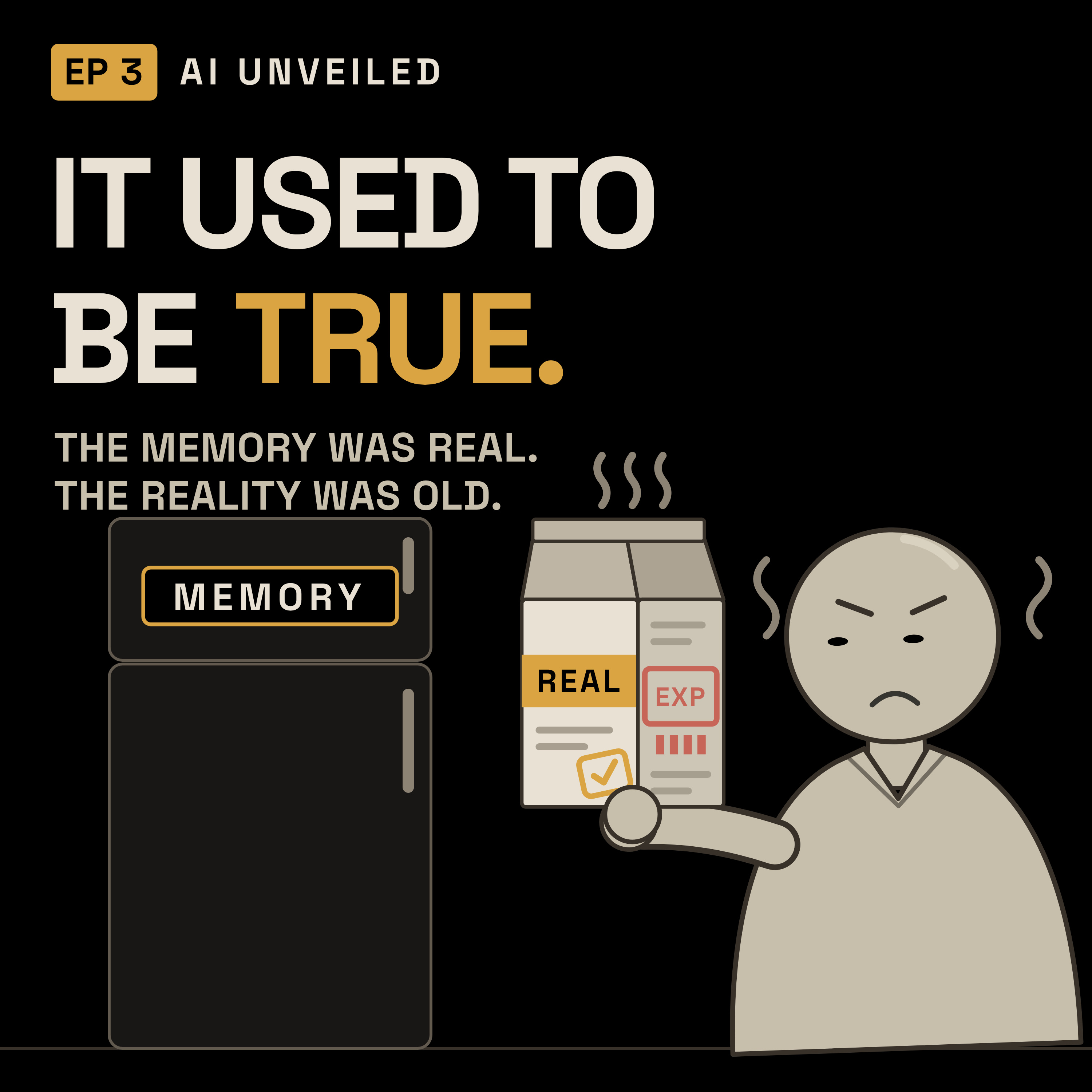
Faultline — free AI Claim Verification: faultline.nxtg.ai An AI agent gives you an answer. You ask where it got the answer. It gives you the source. The source exists. It's your source. The record is authentic. The information was reviewed. And the answer is still wrong. It used to be true. That is the opening of The Ghost in the Machine — The Memory Trust Trap: When Recall Becomes Authority, Episode 3 of AI Unveiled - The Honor System. Asif Waliuddin explains why the most dangerous AI memory is not a hallucination: it is a record that was real, well sourced and legitimate when it was written, and is being treated as current. The memory was real. The reality was old. Storage isn't endorsement. Retrieval isn't validation. Provenance isn't current authority. And remembering isn't knowing. Working notes and research: nxtg.ai/insights Chapters 00:00 — The answer was true 01:23 — Episode 3: The Ghost in the Machine 01:51 — Memory is actually awesome 03:17 — The little magic trick 04:34 — This isn't theoretical anymore 05:49 — And then it gets weirder 07:06 — The security people found the evil version 08:24 — The most dangerous memory used to be true 09:05 — This is the actual architecture problem 10:13 — The counterargument 11:15 — Forgetting is actually a feature 12:17 — Try to break it 13:28 — The reveal 14:23 — The Honor System gets deeper 15:06 — Now somebody puts their name on it SOURCES & EVIDENCE • Suresh, Mak, Bhatnagar, Methani & Gutierrez Munoz (Microsoft Research) — "Grounding Agent Memory: Environment-Probing Curation for Enterprise Agents" (September 2026, preprint). Trajectory-only memory curation can preserve errors and stale knowledge; with environment probing, CLBench pass rate went from 39% to 73%. One benchmark, production-like harness. https://www.microsoft.com/en-us/research/publication/grounding-agent-memory-environment-probing-curation-for-enterprise-agents/ • OWASP GenAI Security Project — "Memory Is a Feature. It Is Also an Attack Surface" (May 2026) and ASI06 Memory & Context Poisoning. A security-mechanism reference, not a prevalence statistic. https://genai.owasp.org/2026/05/13/memory-is-a-feature-it-is-also-an-attack-surface/ • Habler & Chang (Cisco) — persistent memory compromise in Claude Code (April 2026). A research demonstration; Anthropic changed the specific path in v2.1.50. https://blogs.cisco.com/ai/identifying-and-remediating-a-persistent-memory-compromise-in-claude-code • Pulipaka et al. — "Hidden in Memory: Sleeper Memory Poisoning in LLM Agents" (May 2026, preprint). Benchmark results under attack conditions, not production incident rates. https://arxiv.org/abs/2605.15338 • Torres, Shrestha & Misra — "When Agents Remember Too Much" / GhostWriter (July 2026, preprint): injection now, activation later, in tool-using agents. Experimental setups. https://arxiv.org/abs/2607.06595 • Chen et al. — MemSecBench (July 2026, preprint): memory write, persistence, execution and repair. Controlled benchmark. https://arxiv.org/abs/2607.27080 • Microsoft Research — AgenticRAG (May 2026, preprint). Constructive counterevidence: better retrieval materially improves factuality; it does not settle whether a retrieved record is current. https://www.microsoft.com/en-us/research/publication/agenticrag-agentic-retrieval-for-enterprise-knowledge-bases/ Benchmark numbers describe test settings, not field prevalence; "memory authority inversion" is our term. NOTE ON INTERNAL EVIDENCE The NextGen AI story in the cold open is a first-person internal operating pattern, told without internal identifiers or implementation details. It is not a third-party study. Next: The Hallucination in a Suit.
Embed this episode
No transcript yet.