
EPISODE · Dec 18, 2024 · 16 MIN
The Global Financial Stack: A Guide to Modern Payment & Banking Architecture
from Ahrvo Network Podcast · host Ahrvo Labs
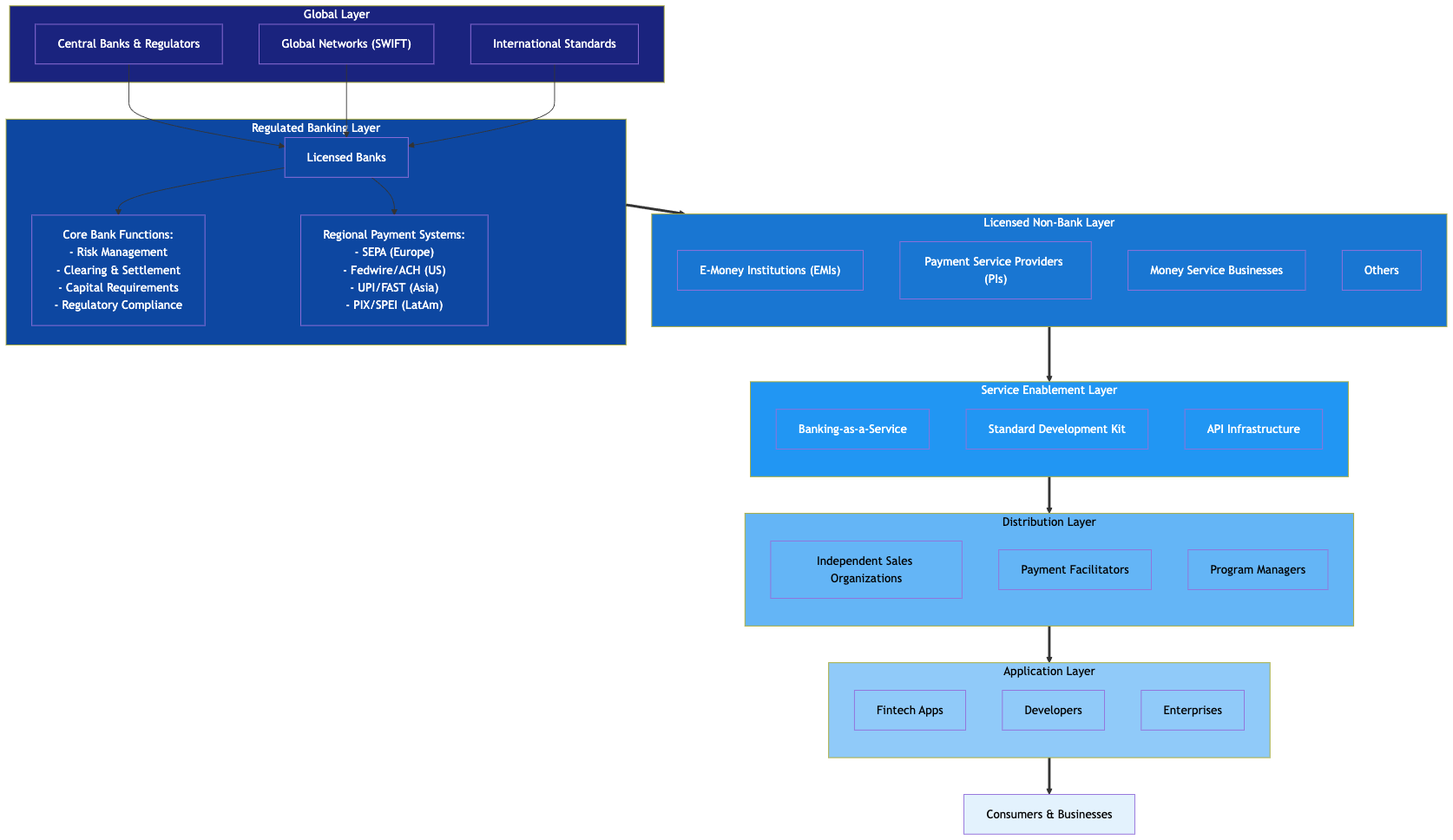
This podcast provides a summary and analysis of "The Global Financial Stack: A Guide to Modern Payment & Banking Architecture". The document outlines the increasingly complex and layered structure of the global financial ecosystem, moving beyond traditional direct bank-customer relationships. It emphasizes the importance of understanding the roles and interdependencies of different players within this multi-tiered system. The document explores the regulatory landscapes across various regions and the implications of this layered system for businesses selecting financial partners.Key Themes & Ideas:* Layered Financial Ecosystem:* The modern payment and banking landscape is not a simple, direct relationship but a multi-layered stack of interconnected entities.* The stack consists of:* Regulatory and Banking Layer: Fully licensed banks and highly regulated institutions form the foundation.* Licensed Non-Bank Providers Layer: Entities such as MSBs, EMIs, PIs, and BaaS providers rely on the foundational banking layer.* Distribution and Application Layer: Fintechs, ISOs, payment facilitators, and program managers focused on user-facing products and innovation.* This layering explains market saturation, regional compliance differences, and partner selection challenges.* The Regulatory and Banking Foundation (Layer 1):* This layer is the bedrock of the financial system and is composed of fully licensed banks and regulated institutions.* Key Responsibilities: Maintaining liquidity and complying with regulations (e.g., maintaining liquidity ratios, and abiding by regulatory requirements). "Banks must maintain liquidity ratios and abide by domestic regulatory requirements, ensuring they can meet settlement and withdrawal demands at all times."* Handling clearing and settlement. "They handle the secure transfer of funds between institutions, manage dispute resolution, and maintain accurate, reliable records for all transactions."* Acting as agents for downstream entities (Licensed Non-Bank Providers). "Banks often represent licensed non-bank providers as agents, taking on final reporting, settlement, and compliance responsibilities for downstream entities."* Providing core banking functions (lending, credit, interbank access). "Foundational players facilitate lending, credit issuance, and access to interbank networks, providing a stable backbone for all financial operations."* Global Payment Networks: The document highlights key global payment networks, such as:* Fedwire (U.S.), SEPA (EU), Faster Payments (UK), RTGS Systems in Asia, PIX (Brazil), and M-Pesa (Kenya). These networks provide the backbone for fast, reliable settlements.* Licensed Non-Bank Providers (Layer 2):* Includes entities with specialized licenses like MSBs, EMIs, PIs, and BaaS providers.* These providers rely on the infrastructure and oversight of the foundational banking layer.* They focus on services such as:* Issuing electronic money.* Facilitating cross-border transfers.* Offering digital wallets.* Regional Variations: The document emphasizes regional variations in licensing and regulations for this layer, with examples from the EU (PSD2), Asia, Latin America, and Africa.* Agency Relationships: Non-banks heavily rely on banks for core operations (e.g., holding customer funds, processing settlements, and ensuring compliance). "Although these relationships vary by jurisdiction, the common thread is that regulated banks maintain ultimate accountability, allowing non-banks to focus on innovation and user experience."* Distribution and Application Layer (Layer 3):* Composed of fintechs, ISOs, payment facilitators, and program managers who focus on user experience and innovation.* They do not hold their own banking or payment licenses but integrate with the upper layers for core financial services.* Key Functions: Tailoring services, aggregating payment methods, and developing niche solutions.* Creating advanced mobile payment experiences, integrating local payment methods, and layering financial products on top of licensed partners.* Market Saturation: The distribution/application layer is often crowded due to low entry barriers. The document states, "Where entry barriers are low, the marketplace at the application and distribution layers becomes crowded."* Compliance: Despite not being licensed, this layer still requires alignment with upstream partners' AML, KYC, and reporting standards.* The Application Layer: Innovation Frontier:* This layer empowers developers to integrate financial services into their offerings using APIs, SDKs, and other tools.* The focus is on user-centric design and rapid deployment.* Key Components: Developer tools, APIs, and SDKs to embed functionalities* No-code/low-code platforms to reduce technical barriers* Open-source frameworks to enable bespoke solutions* Sandbox environments for testing and refinement* Market Saturation and Differentiation:* The document acknowledges that saturation, particularly in the application layer, creates a highly competitive landscape.* Strategies for Differentiation: Focus on specialization, addressing niche needs (e.g., SMEs needing cross-border financing), and leveraging regional nuances. "To stand out, providers must specialize."* Consolidation: The document suggests that consolidation will likely occur as the market matures, with larger players acquiring smaller ones. "As ecosystems mature, consolidation is likely. Market leaders adept at navigating both local and international regulations could acquire smaller players."* Increased regulation on non-banks is also expected.* Navigating the Ecosystem:* Success requires understanding the multi-layered nature of the financial system, regional differences, and compliance requirements.* Businesses must ask key questions such as:* How many layers separate them from the foundational bank?* How robust is the provider's compliance framework?* Are fees transparent and are local payment systems properly supported (e.g. SEPA, UPI, PIX, etc)? "How many layers separate you from the foundational bank service? How regionally attuned and robust is the provider’s compliance framework? Are fee structures transparent, and can the provider seamlessly navigate local payment systems"* Future of the Ecosystem* Expect more alignment between layers, stricter regulatory oversight, further technological advancements and expanded financial inclusion. "The future will likely bring more alignment between layers, stricter oversight, new technological leaps, and expanded financial inclusion."* Those with a good understanding of the layers, their interdependencies, and evolving regulations will be best positioned to succeed.Conclusion:The global financial ecosystem is a complex and interconnected system characterized by its multi-layered structure. Businesses seeking to navigate this ecosystem effectively must understand the roles and interdependencies of each layer, the regulatory landscape in different regions, and the importance of compliance. Market saturation creates a competitive environment, but also drives innovation and competition. Those who can adapt to regional nuances and build strong compliance frameworks will be best positioned to thrive. This is a public episode. If you would like to discuss this with other subscribers or get access to bonus episodes, visit ahrvo.substack.com
Embed this episode
Ready to play
The Global Financial Stack: A Guide to Modern Payment & Banking Architecture
No transcript for this episode yet
Similar Episodes
No similar episodes found.