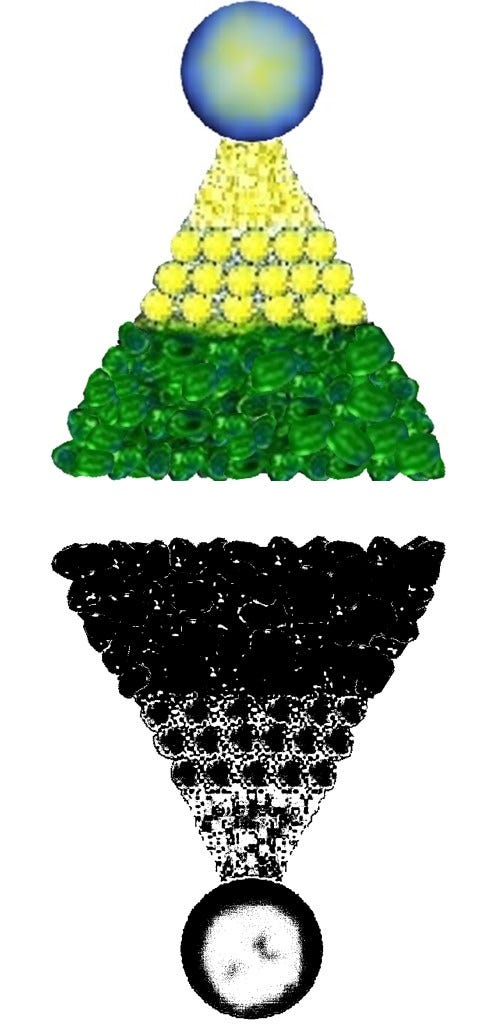
The Gnostic Antichrist
from Gnostic Reformation, Clear and Simple Hosted by Cyd Ropp
Welcome back to Gnostic Insights and the Gnostic Reformation on Substack, and I’d like to welcome our new readers and listeners. What is the Antichrist? By definition, of course, the Antichrist would be the opposite of the Christ. So, before we understand the Antichrist, it would be helpful to understand what we can about the Christ. Christ, according to the Tripartite Tractate of the Nag Hammadi Scriptures, is composed of the Aeons of the Fullness, both in their aggregated entirety known as the Pleroma of the Fullness of God, or the hierarchy of the Fullness of God, along with their personal individual forms, which are the Aeons, the infinite infinity of variations of the Son that are called the Fullnesses or the Aeons or the Totalities. So the Christ is powered by the full force of the Holy Spirit, the Son, and the Fullness of God. The Christ has all the mojo of the ethereal plane. In order to restore memory, reason, and redemption to the second-order powers, the Aeons of the Fullness, every one of them individually and all of them collectively, gave glory in unison to their Father while praying for a helper to bring peace to the deficiency and forgiveness to Logos. Out of their focused prayer, a unique fruit emerged, one that contained all of the capabilities and powers of the Fullness along with all of the love and eternal qualities of the Father, and that is what we call Christ or the Christ. So here’s how the Tripartite Tractate describes the Christ. “They gathered together asking the Father with beneficent intent that there be aid from above from the Father for his glory, since the defective one could not become perfect in any other way unless it was the will of the Pleroma of the Father, which he had drawn to himself, revealed, and given to the defective one.” And the defective one, in this quote, has to do with the Demiurge that arose from the Aeon known as Logos. “Then from the harmony and a joyous willingness which came into being, they brought forth the fruit which was a begetting from the harmony, a unity, a possession of the Fullnesses, revealing the countenance of the Father of whom the Aeons thought as they gave glory and prayed for help for their brother with a wish in which the Father counted himself with them. Thus it was willingly and gladly that they brought forth the fruit. And he made manifest the agreement of the revelation of his union with them, which was his beloved Son. “But the Son in whom the Fullnesses are pleased put himself on them as a garment through which he gave perfection to the defective one and gave confirmation to those who are perfect, the one who is properly called Savior and the Redeemer and the Well-pleasing One and the Beloved and the One to Whom Prayers have been Offered and the Christ and the Light of those Appointed in Accordance with the Ones from Whom He was brought Forth, since he has become the names of the positions which were given him. Yet what other name may be applied to him except the Son, as we previously said, since he is the knowledge of the Father whom he wanted them to know.” This paragraph describes the fruit of the Aeons called the Christ, that he possesses all of the traits, that is the names of the positions and all of their characteristics, all of the virtues of all of the Aeons of the God Above All Gods, and all of that essentially adds up to the original Son of the Father that came directly from the Father. So the Son and Christ aren’t exactly the same because the Christ was created later than the Son. However, the Son and the Christ share the same characteristics, so by this time it is the Son. That’s kind of confusing, but they are different entities because they were created in different ways. The Son is directly emanated from the Father itself, from the original consciousness. The Son is the monad version of the otherwise illimitable Father. But the Christ is the Fullness of God, both as the Fullness itself and the individual Aeons that had differentiated out of the Son, all rolled up together, with the blessing of the Father. So it’s a slightly different character, yet they do have all the characteristics. So I can see why the Tripartite Tractate finally rolls it up into saying, you might as well say, it’s the Son. And this is interesting about the Christ. “Not only did the Aeons generate the countenance of the Father to whom they gave praise, but they also generated their own. For the Aeons who give glory generated their countenance and their face. They were produced as an army for him, as for a king, since the beings of the thought have a powerful fellowship and an intermingled harmony.” And by the way, we’re talking about the Fullness of God. We’re talking about the hierarchy of the Fullness of God and all the Aeons, the infinite number of Aeons that dwell in the Fullness of God. And so when the Christ was formed, he came forth not simply as Jesus Christ with the face of Jesus. He came with the face of every single Aeon of the Fullness of God. So he’s a composite individual, whereas the Son is actually a singularity, at least in the beginning, before he differentiates into the Fullness. But the Christ stays a multiplicity rolled up into one. All is one. That’s the difference between the Son and the Christ. The Son is One and stays One and then differentiates later. But the Christ comes in as all of the differentiations, plus the Son, plus the blessing of the Father. The Aeons of the Fullness are known as the First Order of Powers. We living creatures are the Second Order of Powers. The Army of the Christ is the Third Order of Powers. Because of the fractal nature of all things, “as above, so below,” there is not only a Third Order Power for every First Order Power—the Aeons that comprise the Fullness of God—there is a Third Order Power for every Second Order Power. These Third Order Powers overlay us Second Order of Powers when we repent and are redeemed. Redemption is the maneuver that installs the Third Order of Powers within our souls, bringing the remembrance of the Father, love, and error correction to us living creatures. So what is the Antichrist then? The Antichrist is the shadow of Christ. The pleroma of the Antichrist mirrors the Third Order pleroma of Christ. The Antichrist is not alive. We know that because it arises from the Fall and therefore it is not infused with the light and life of the Pleroma, the Father, and the Son. Nor is it Aeonic, as it is not considered a fruit of the Pleroma. So it cannot express Aeonic traits, such as the various facets of love known as virtues, nor operate through the cooperative nature we call the Simple Golden Rule. There are many episodes devoted to the virtues and to the Simple Golden Rule. So if you go to GnosticInsights.com and do a search in there, well, just read through all the titles of the assembled podcasts that are all living there. See, in your podcast host, you’ve only got the latest. But if you go to the homepage, Gnostic Insights, they’re all there. So you can go back to the beginning of the podcast and catch up with us that way. The Antichrist arises after the Fall, and so it does not recognize the hierarchical structure built upon the harmony of the Fullness. In place of that harmony, the Antichrist operates through the application of power, and its only goal is power. The Antichrist does not know the hierarchy of the Fullness, nor does it come from their assigned roles and places. Lacking the Pleroma’s cooperative design, the Antichrist exists in a state of perpetual disturbance driven by self-centered ambition. Now, this is all the same as the description of the Demiurge at this point, because the Antichrist is like his head henchman. See, he’s the Antichrist. He’s the inverse of the Christ. So if the Christ is the savior of all of us second-order powers because we’ve forgotten the goal and we’ve been estranged from the love of God, the Christ brings back the correction, the correcting algorithm, I lik… This is a public episode. If you'd like to discuss this with other subscribers or get access to bonus episodes, visit cydropp.substack.com/subscribe
Embed this episode
No transcript yet.