
EPISODE · Jun 2, 2026 · 23 MIN
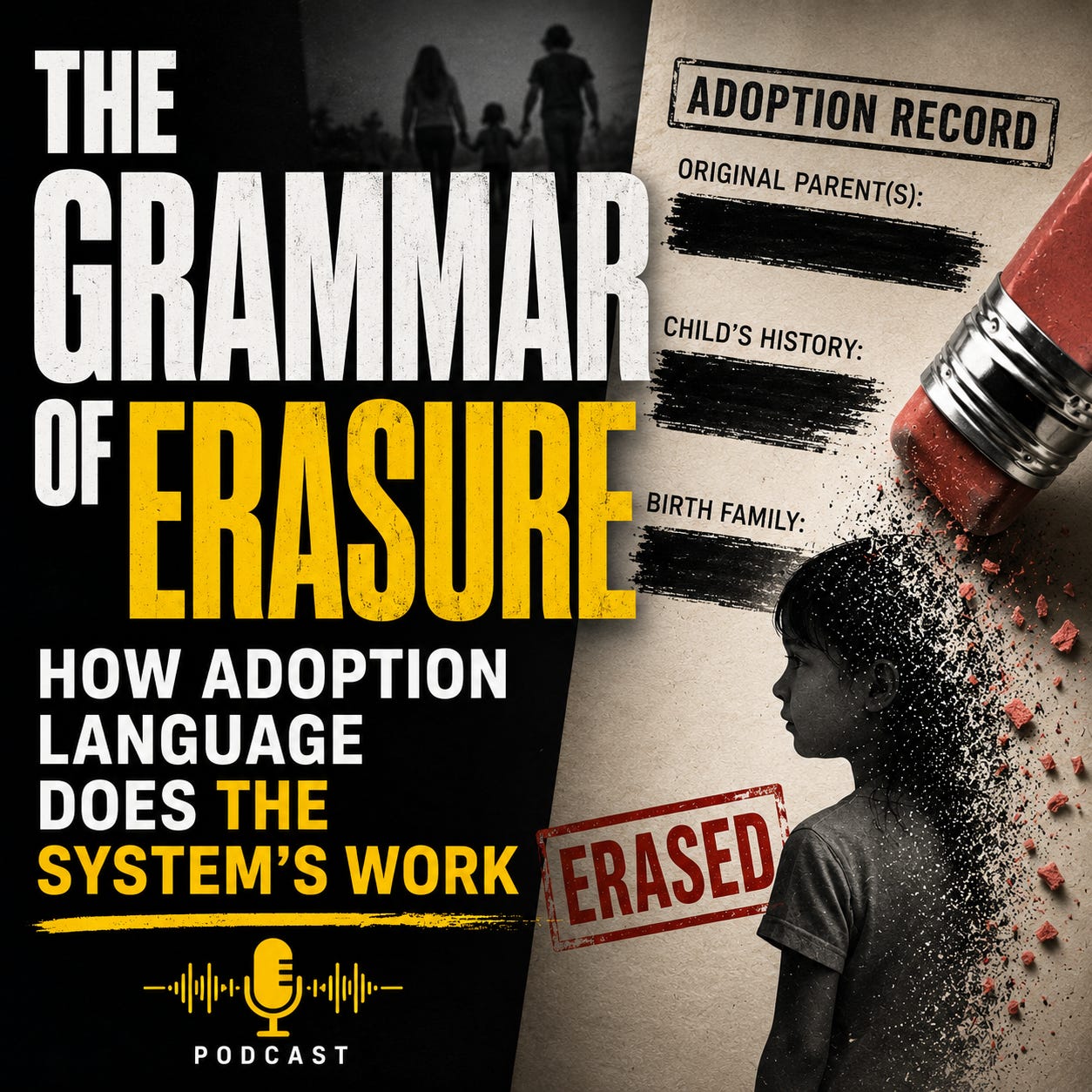
The Grammar of Erasure: How Adoption Language Does the System's Work
from The Experience of Adoption · host Thoughtless Delineation
There is a sentence I want you to read carefully.“This amazing family from North Carolina recently matched with an expectant mother who is due in September.”Read it again. Count the clauses. The family is the subject. The family does the matching. The expectant mother — a pregnant woman who has not yet given birth, who has not yet made any final legal decision, who is living inside one of the most consequential moments of her life — appears in a subordinate clause. As context. As the biological condition that makes someone else’s milestone possible.By the third sentence of the same post, she is gone. The post moves on to “their little one.” The child — unborn, belonging to no one yet in any legal or ethical sense — has already been claimed in language. The possessive is casual, confident, and completely unremarkable to anyone reading without knowing what they’re looking at.That is the point. The Grammar of Erasure doesn’t announce itself.I’ve been reading adoption industry social media posts for a long time. Not with the casual half-attention most people bring to a Facebook feed, but forensically — the way you read a document when you know something is being hidden inside it. What I’ve found is not lies. The industry rarely lies in the conventional sense. What it does is more durable and more difficult to challenge: it positions.A sentence can be factually accurate and structurally violent simultaneously. The expectant mother did match with a family. The child will be due in September. “Their little one” is the kind of phrase people use without thinking about it. None of these things are false. But the architecture of the sentence — who is the subject, who appears in a subordinate clause, who disappears by paragraph three — encodes a set of assumptions about whose story this is. And once those assumptions are encoded in enough sentences, across enough posts, across enough years, they stop being assumptions and start being reality.This is what the Architecture of Silence looks like in 2026. Not sealed records alone. Not amended birth certificates alone. Grammar.Let me show you six mechanisms. I pulled the first five from posts published by adoption and child welfare organisations in a single 24-hour period. Five posts, three organisations, five different policy registers. The sixth has been running for decades. The same machinery running in all of them.YOUTUBEMECHANISM 1: THE POSSESSIVE CLAIM“Their little one.”The child is not born. The first parent has not relinquished. The legal process has not begun. And yet the language has already performed the transfer. Possession is established before birth, before consent, before law. The adoptive family is the subject of the sentence. The child is their object. The first parent has already been subordinated.I know this mechanism from the inside. The language of adoption shapes what adopted people are allowed to feel about their own origins. If you are “their child” before you are anyone else’s — in the public grammar, in the agency newsletter, in the congratulatory Facebook post — then the question of what you were before that possession is already foreclosed. The subsonic hum of biological origin is real. The adaptive signal of the assigned family is also real. What the Grammar of Erasure does is insist that only one of those signals counts, and insist on it before you’re even born.MECHANISM 2: THE CONVERSION METRIC“This match came after only their fourth profile submission!”In sales, a conversion is the moment a prospect becomes a customer. The exclamation mark here is doing something. It celebrates persistence. It frames the adoption process as a consumer journey with a successful outcome. Fourth submission, result achieved.The child is the conversion event.I do not think the person who wrote this post is a villain. I think they have absorbed the industry’s language so completely that “fourth profile submission” reads to them as a warm human detail — evidence of the family’s commitment. That is how institutional language works. It normalises the transaction by making the transaction invisible. The child is not a child in this sentence. The child is the successful outcome of a submission process. And nobody is supposed to notice.MECHANISM 3: THE NEUTRAL RATIOA Home for Every Child is a government initiative designed to increase the ratio of foster homes to children in foster care. Half the country has now joined it. States that join by June 30 are eligible to compete for $7 million in bonus awards, given to states with “the best and most improved home-to-child ratios.”A ratio is mathematical. Mathematics appears neutral. But this ratio can improve in two ways: more homes recruited, or more children entering care. The initiative controls for one variable. The bonus award structure does not distinguish between them. A state that over-removes children — particularly Indigenous children, Black children, children from families whose poverty is being misread as neglect — while also recruiting foster homes, will score well on this metric.“May the best states win,” the post concludes.I have read that sentence many times. It still stops me. Children in foster care are not a competition category. The families at risk of separation are not the stakes in a challenge. The language of sport and market competition applied to child welfare doesn’t reveal a callousness in the person who wrote it. It reveals how thoroughly the institution has normalised the frame. When children become a metric, the metric becomes the child. Nobody asks what’s underneath the number.What goes unmentioned in A Home for Every Child’s announcement is the Indian Child Welfare Act. ICWA exists precisely because this ratio logic was applied to Indigenous families for over a century — and the result was the systematic destruction of tribal communities through the mass removal of children. The initiative’s expansion into Montana, a state with significant Indigenous population, contains no reference to ICWA compliance, tribal notification requirements, or the specific vulnerabilities of Indigenous children to being counted as ratio-improvers rather than rights-bearing members of sovereign nations. The metric is not neutral for any child. For Indigenous children it is structurally catastrophic. That this goes unnamed in the announcement is not an oversight. It is the Architecture of Silence operating precisely as designed.MECHANISM 4: THE UNMARKED SOURCEA report from the Manhattan Institute celebrates ACF’s elimination of 74% of its “regulatory dark matter.” The Daily Signal reports exclusively on Operation Hope’s 87% recovery rate for missing foster children in 48 hours.The Manhattan Institute coined the phrase “regulatory dark matter.” It is their term, invented to make child welfare practice guidelines sound like bureaucratic waste. The Daily Signal is The Heritage Foundation’s media outlet. Neither is identified in the posts sharing their work. They are presented as sources. Neutral. Informational.When source bias goes unnamed, advocacy functions as analysis. The specific guidelines eliminated matter. ACF’s regulatory rollback included guidance on trauma-informed care in foster placement, requirements for kinship placement preference before non-relative care, and frameworks for assessing disproportionate removal of children from families of colour. These are not abstractions. Kinship placement preference is the mechanism that keeps siblings together and maintains cultural and community connection for children who cannot remain with parents. Trauma-informed care protocols are what distinguish a placement that stabilises a child from one that re-traumatises them. When the Manhattan Institute calls these “regulatory dark matter” and ACF eliminates them, the language performs the same function as “their little one” — it makes structural violence legible as a bureaucratic improvement. The reader who does not know what was in those guidelines cannot object to their removal. Naming them is not a detail. It is the argument.“Outdated and irrelevant” is a characterisation, not an audit finding. But once it circulates as a report from a research organisation, it carries the epistemological weight of research. This is not a disclosure failure. It is a strategy.MECHANISM 5: LOCATED ≠ SAFEOperation Hope located 87% of Mississippi’s missing foster children within 48 hours. The post presents this as an unambiguous success.Foster children do not predominantly go missing because of external trafficking. They go missing because the system fails to provide safe, stable, supported placements. They run from placements where they are being harmed. They age out and disappear into structural poverty. They lose contact because nobody is tracking them with any genuine commitment to their welfare. “Located” returns them to the system that produced the crisis. It is not the same as safe. It is not the same as supported. It is not the same as the cause being addressed.The metric celebrates symptom management. The cause — a chronically under-resourced, structurally coercive system operating in one of the poorest states in the country — is not named in the post. It is not named because naming it would require a different kind of accountability than a 48-hour recovery rate can provide.MECHANISM 6: THE APOLOGY THAT DOESN’T REPAIRIn March 2026, a UK cross-party parliamentary inquiry recommended the government issue an unqualified formal apology to an estimated 215,000 women coerced into relinquishing babies between the post-war years and the 1970s. The Prime Minister acknowledged a “strong case” for apology. He has not committed.In May 2026, a Canadian Senator and MP called on Ottawa to formally apologise to an estimated 300,000 women separated from their babies through the same era’s forced adoption machinery. A petition tabled in the House of Commons compels a government response within 45 days. As of this writing, no apology has been issued.These are not different stories to the five posts I read in a single 24-hour period. They are the same story at a different scale. The UK government’s “strong case” is the grammatical equivalent of “their little one” — a phrase that acknowledges proximity to the truth while carefully not touching it. The 45-day clock on Canada’s petition is a bureaucratic ratio applied to grief. Acknowledge fast enough to satisfy the metric. Repair nothing.The Grammar of Erasure does not end when the system apologises. An apology delivered in the passive voice, without named perpetrators, without material redress, without legal change, is another form of positioning. It makes institutional accountability legible as institutional conscience. The harm gets a sentence. The system stays intact.The women who testified before the UK inquiry and who signed the Canadian petition did not live inside a grammar exercise. They lived inside a machine. The machine is still running. It has simply updated its language.None of these six mechanisms require the people deploying them to be conscious of what they are doing. That is what makes the Grammar of Erasure so durable. It does not require a villain in the room. It requires a language that has been built, over decades, to make institutional interests legible as humanitarian ones — and that language is now so embedded in how the adoption and child welfare industry talks to itself and to the public that it no longer needs to be constructed deliberately. It is inherited. It is assumed. It is the default.Non-Adoptee Bias is the cultural condition that makes this grammar invisible to most readers. When the subject position is always the adoptive family, the agency, the governor, the initiative — never the child, never the first parent, never the family at risk of separation — the reader absorbs the frame without noticing it. The frame matches the dominant cultural assumption: adoption is rescue. Foster care expansion is welfare. Locating a missing child is success. These assumptions are not interrogated because they are not visible as assumptions. They are just the way things are described.The Architecture of Silence, in its 2026 form, is distributed. It is not one institution suppressing one record. It is thousands of posts, press releases, reports, and announcements each making the same grammatical choices — each individually defensible, collectively constituting a system in which the adopted person’s perspective, the first parent’s experience, and the family at risk of separation are structurally absent from the public conversation about their own lives.This Substack is reader-supported. To receive new posts and support my work, consider becoming a free or paid subscriber.What do you do with this?You read carefully. You notice the subject of the sentence. You ask who is in the subordinate clause and who has disappeared by paragraph three. You name the source when the source has an agenda. You name what was eliminated when something is called “outdated.” You name ICWA when a foster care initiative in Montana doesn’t. You distinguish between located and safe, between ratio and welfare, between apology and repair.And you say it out loud. In comments, in essays, in conversations that the industry would prefer not to have. Not with outrage — outrage is easy to dismiss. With precision. With the specificity that comes from having lived inside the system and knowing exactly what the language is doing because you have felt it done to you.The Grammar of Erasure runs across six mechanisms now — the possessive claim, the conversion metric, the neutral ratio, the unmarked source, the symptom metric, and the institutional apology. None of them require a villain in the room. All of them require a reader who doesn’t ask what’s underneath the number, what’s in the clause, what’s been left out of the announcement.That reader is being manufactured, every day, in thousands of posts, press releases, reports, and parliamentary statements. The counter is not outrage. Outrage is precisely what the grammar is designed to absorb. The counter is precision — low, certain, persistent. The subsonic hum of naming what is actually there.It cannot seal a truth that keeps being spoken.Thoughtless Delineation is written by Shane Bouel. If this essay reached you, share it with one person who needs to read it. Paid subscriptions make this work possible.Reports This is a public episode. If you'd like to discuss this with other subscribers or get access to bonus episodes, visit thoughtlessdel.substack.com/subscribe
Embed this episode
NOW PLAYING
The Grammar of Erasure: How Adoption Language Does the System's Work
No transcript for this episode yet
Similar Episodes
No similar episodes found.
Similar Podcasts
No similar podcasts found.