
EPISODE · May 26, 2026 · 1H
The Hidden and the Formalized: Female Queerness in Ancient Egypt
from Afterlives of Ancient Egypt with Kara Cooney · host Jordan Galczynski, Kara Cooney, and Amber Myers
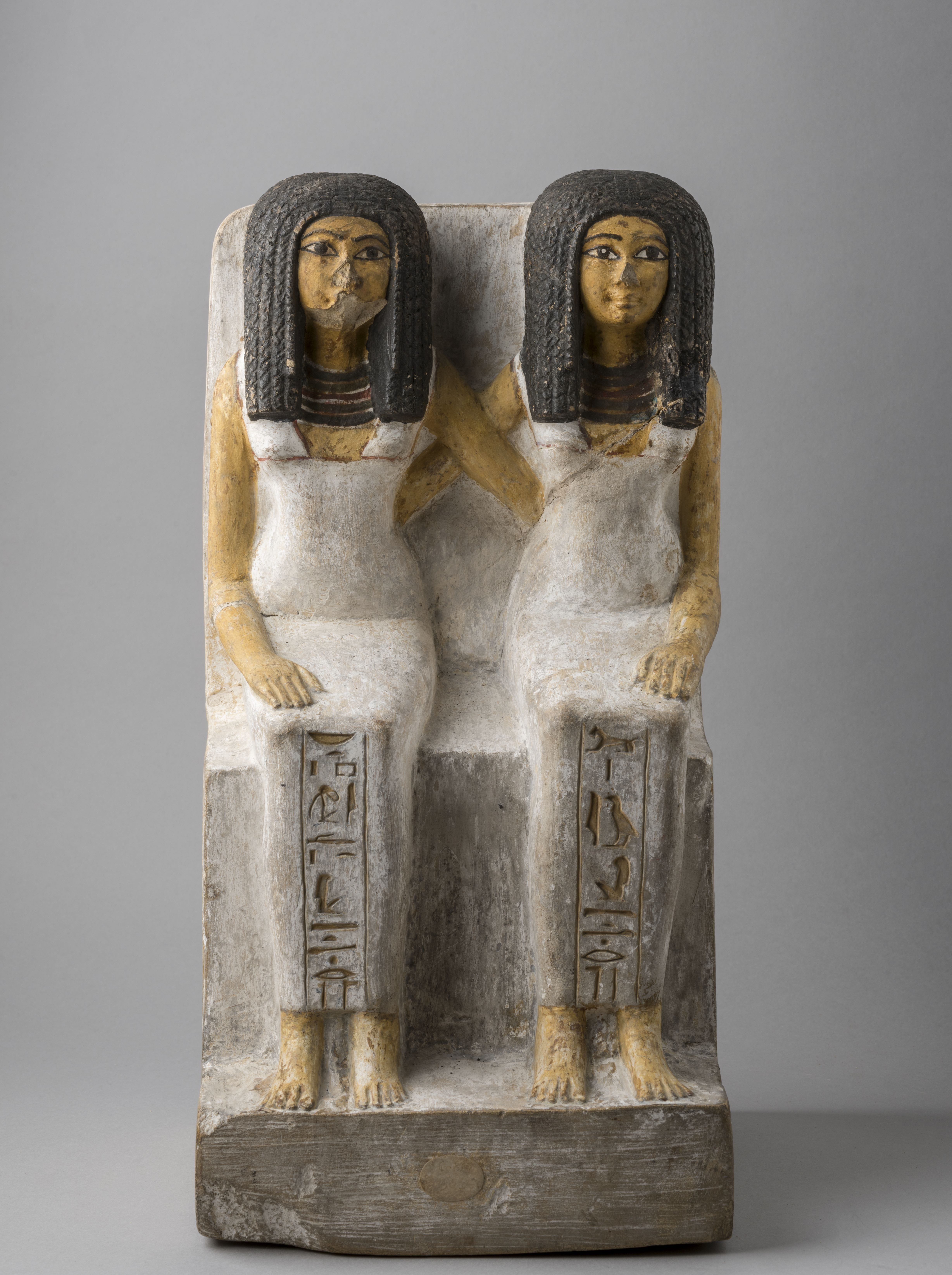
Thank you paid subscribers, KinchStalker, Phoenix, Tomas Johansson, and many others for tuning into this live video with Jordan Galczynski and Amber Myers! You filled the chat with such sharp and interesting questions. This is exactly the kind of conversation we love — primary sources, spirited disagreement, duck genitalia, and the occasional new moon. We’ll be back soon. CW— mature themes; sex; sexuality; sexual assaultWhat does it mean to look for queer lives in the ancient world? We don’t want to impose today’s freedoms onto a patriarchal past, but we also don’t want to erase the biological reality that queer people have always existed in the world. That tension—generative, unresolved, and genuinely fun to argue about—animated our latest live conversation, and we’re thrilled so many of you joined us for it.Two Women, Arms EntwinedWe kicked things off with a pair statue currently held at the Museo Egizio in Turin. Amber had shared it earlier in the week and it immediately sparked debate among the three of us. Dating to the Thutmosid period and likely from a tomb in the Theban necropolis, it shows two women — Idu and Rui — seated side by side in white linen shifts and elegant bipartite wigs, arms wrapped around each other in precisely the embrace you’d expect to see between a husband and wife. The museum’s own description calls the relationship between them “unclear.”Which is, of course, the perennial problem.Are they friends? Sisters? Mother and daughter? Could they be something more? Kara was the self-described cynical voice in the room, skeptical that ancient Egyptian society would have allowed a formally commemorated queer female relationship — while also being completely open to the possibility that a very real relationship could have existed behind the scenes, just one that could and would never be named outright. Jordan pointed out something quietly fascinating: Idu holds the title nebet per — Mistress of the House — while Rui carries no title at all, no indication of kinship or any named social role. That asymmetry suggests a dependent relationship, but of what kind, we simply can’t say. They seem to have wanted to show themselves as the core of their household.What we can say is that someone commissioned this statue, paid for it, and had it placed in a tomb context so that both women would receive offerings in the afterlife. That’s not nothing. Whatever Idu and Rui were to each other, there was care—plus money, and intention—and a desire to keep this person in one’s eternal company.The group also floated an intriguing hypothesis: what if Idu had outlived her husband, inherited his property, and then got to live exactly as she chose? Two women, a shared household, just friends, obviously. Roommates even. The ancient world’s version of companions traveling down the Nile together — who, as Jordan noted, everyone quietly understood were probably lovers, but who would never in a thousand years have said so in a formal inscription.The Notorious Tomb of Niankhkhnum and KhnumhotepFrom there we moved to the far more famous case of the two manicurists of the Old Kingdom royal court: Niankhkhnum and Khnumhotep, buried together at Saqqara in a shared tomb decorated with images of the two men nose-to-nose, embracing in ways typically reserved for married couples. Scholars have argued they were brothers, conjoined twins, or colleagues — with Kara noting, drily, that “conjoined twins” seems like a remarkable amount of effort just to avoid the word gay. But who knows? This scene is unique and perplexing. We should not try to flatten the complexity of the image: we can acknowledge that queer people existed in the ancient world without pretending they enjoyed anything like modern queer freedom or visibility in society.What the Texts Actually Say (or Don’t)So what does the written record give us? Rather less than you might hope, and rather more ambiguous than anyone would like.Jordan pulled up Book of the Dead 125—the famous Negative Confession—the list of sins the deceased declares they have not committed before the scales of Ma’at. One entry reads something like: I have not copulated with a catamite — or, depending on your translation, I have not copulated with a boy, or I have not laid with a man. The Egyptian word in question, Kara noted, is a hapax legomenon: it appears nowhere else in the corpus, which makes translation genuinely treacherous. The word catamite, the group agreed, implies pederasty — a prohibition against the sexual exploitation of a prepubescent boy — which is something categorically different from a prohibition against adult same-sex desire. The distinction matters. More investigation (after the podcast!) revealed the phrase to translate into something like “I did not fuck a fucker of fuckers,” which implies a refusal to have slept with someone who is already sleeping with others. But who knows? You decide; see the Egyptian below!* “I have not penetrated the penetrater of a penetrater (Variant: “I have not copulated with a boy”); I have not masturbated” (n nk.i nkk nkk n dAdA.i) * nkk [nkk] = 𓈖𓎡𓎡𓂺𓀀 (Thesaurus Linguae Aegyptiae); lit. the one who fucks; male sex worker; homosexual?* We presume they are attaching the male gender to this noun because of the presence of a penis in the word, but Book of the Dead 125 is the only use of this word!* Also see Betwixt the Sheets, “History of Homophobia”Contending of Horus and Seth gave us rather more vivid primary source material. The story is, to put it mildly, a lot: Seth attempts to assault Horus in their sleep; Horus outsmarts him by catching the semen in his hand; his mother Isis disposes of the evidence—by cutting Horus’s hand off and growing him a new one as one does—and fashions a trap, placing Horus’s semen into the lettuce Seth habitually eats; and when Seth boasts of his conquest before the gods, the divine tribunal calls the semen forth — whereupon it emerges from Seth’s own head like a crown, to the hilarity of everyone assembled. The story is funny, and also pointed: what makes Seth’s act monstrous is not same-sex desire per se, but domination, humiliation, and the horror of being placed in the feminized, receptive position. As Kara observed, the ancient Egyptian antipathy here is not really about queerness. It’s about misogyny. To be penetrated is to be made a woman, and being made a woman is, within this patriarchal framework, a degradation. The female body’s hiddenness, Jordan added, made female queerness simultaneously the most subversive and the most invisible form of desire—something that likely happened constantly and simply never showed up in the legal or mortuary record because it threatened no man’s property and produced no illegitimate heirs.A brief and gleeful tangent addressed the so-called “Hatshepsut graffito” at Deir el-Bahri — a piece of erotic wall art that scholars persistently attribute to the female pharaoh on no stronger grounds than that it’s located in a cliff above her mortuary temple at Deir el Bahari, a space that, Kara pointed out, was built up by approximately everyone. The figure is wearing something that might be a wig, might be a nemes headdress, but the group voted: no, It’s a wig. Moving on.On Morality, Property, and Free LoveOne of the conversation’s richest threads concerned why ancient Egyptian society seems, comparatively speaking, to have been rather relaxed about sexual transgression. No stoning for adultery. No virginity tests. Premarital sex left relatively unpoliced. Kara connected this to land ownership — or rather, the lack of it. In a society where the Nile flood periodically erased field boundaries and where the great institutions (the Temple of Amun, the royal palace) were the primary landowners, the tight relationship between sexual morality and property inheritance that drove so much ancient Mediterranean legislation simply didn’t apply in the same way. You couldn’t easily lose heritable land over a sexual scandal when most people didn’t own heritable land to begin with.This also explains why female queerness, in particular, would have been almost entirely invisible to official record-keeping: no property changed hands, no paternity was threatened, no inheritance could be disputed. The patriarchal system cared deeply about women’s bodies as reproductive resources — but only insofar as those bodies produced legitimate heirs. What happened otherwise, behind closed doors or in a shared household, was simply not the law’s business.The picture shifts, the group agreed, with the arrival of the Greeks. Ptolemaic Egypt imported stricter social structures around female bodies: veiling, endogamous marriage to keep property within families, the concept of illegitimacy as a barrier to succession. These were new ideas, and not Egyptian ones.Priests, Priestesses, and the Gods’ Wives of AmunA subscriber question about priestly celibacy sent us down another rewarding path. The short answer is: Egyptian priests were, for most of the pharaonic period, married members of elite society who served on a rotating schedule, and the prescriptions around ritual purity—no sex, no fish, no leather—applied only during their active service, much like a young man in Thailand entering a temple for a period of education and contemplation before returning to ordinary life. The longer and thornier answer involves the Divine Adoratrices of the Late Period, the so-called God’s Wives of Amun, who held extraordinary political and religious power, adopted their successors rather than bearing biological children, and named no husbands in their records. Were they celibate? Almost certainly not in any enforced sense. They were the most powerful women in Egypt. Whatever they did, they did as they chose. Lovers were not memorialized on stone monuments, after all, and we should not expect them to have been.Closing with Psychedelics (As One Does)We ended, naturally, on psychedelics. Kara had recently received word of a study on a Bes jar—those delightful vessels bearing the face of the apotropaic dwarf deity—owned by the Tampa Museum of Art, in which residue analysis revealed a cocktail of the blue lotus (Nymphaea caerulea), Syrian rue, and other psychoactive substances. The blue lotus, long associated with sensuality and altered states in Egyptian iconography, turns out to have been rather more than decorative. Whether mushrooms or other psychedelics made their way into the Egyptian ritual pharmacopeia remains an open question, one we’d love to dig into further.Show Notes & Further Reading* Homosexuality in Ancient Egypt — Wikipedia* Pair statue of two women seated against a back slab — Museo Egizio* Tomb of the Two Brothers Niankhkhnum and Khnumhotep — Egyptian Monuments* Evans & Woods 2016. Further evidence that Niankhkhnum and Khnumhotep were twins. Journal of Egyptian Archaeology 102, 55–72.* Reeder 2000. Same-sex desire, conjugal constructs, and the tomb of Niankhkhnum and Khnumhotep. World Archaeology 32(2), 193–208.* Reeder 2008. Queer Egyptologies of Niankhkhnum and Khnumhotep. In Graves-Brown (ed.), Sex and Gender in Ancient Egypt.* Vasiljević 2008. Embracing his double. Studien zur Altägyptischen Kultur 37, 363–372.* Baines 1985. Egyptian twins. Orientalia 54(4), 461–482.* The Contending of Horus and Seth — Wikipedia* Book of the Dead 125, Negative Confession — UCL Digital Egypt* Betwixt the Sheets: “A History of Homophobia”* Tanasi et al. 2024. Multianalytical investigation reveals psychotropic substances in a Ptolemaic Egyptian vase. Scientific Reports 14. DOI: 10.1038/s41598-024-78721-8* Greco, van Oppen, Samorini, Tanasi & Tykot 2024. A Bes mug in Tampa. In van Oppen de Ruiter & Bianchi (eds.), Under the Spell of Bes, 105–116. Abercromby Press.* Tanasi, Davide, Branko F. van Oppen de Ruiter, Fiorella Florian, Radmila Pavlovic, Luca Maria Chiesa, Igor Fochi, Chiaramaria Stani, Lisa Vaccari, Dale Chaput, Giorgio Samorini, Alberto Pallavicini, Sabrina Semerano, Anastasia Serena Gaetano, Sabina Licen, Pierluigi Barbieri, and Enrico Greco 2024. Multianalytical investigation reveals psychotropic substances in a Ptolemaic Egyptian vase. Scientific Reports 14 (article no. 27891). DOI: 10.1038/s41598-024-78721-8.* Greco, Enrico, Branko van Oppen, Giorgio Samorini, Davide Tanasi, and Robert H. Tykot 2024. A Bes mug in Tampa. In Oppen de Ruiter, Branko F. van and Robert Steven Bianchi (eds), Under the spell of Bes, 105-116. Wallasey: Abercromby Press.Ancient/Now is a reader-supported publication. To receive new posts and support my work, consider becoming a free or paid subscriber. Get full access to Ancient/Now at ancientnow.substack.com/subscribe
Embed this episode
NOW PLAYING
The Hidden and the Formalized: Female Queerness in Ancient Egypt
No transcript for this episode yet
Similar Episodes
No similar episodes found.
Similar Podcasts
No similar podcasts found.