
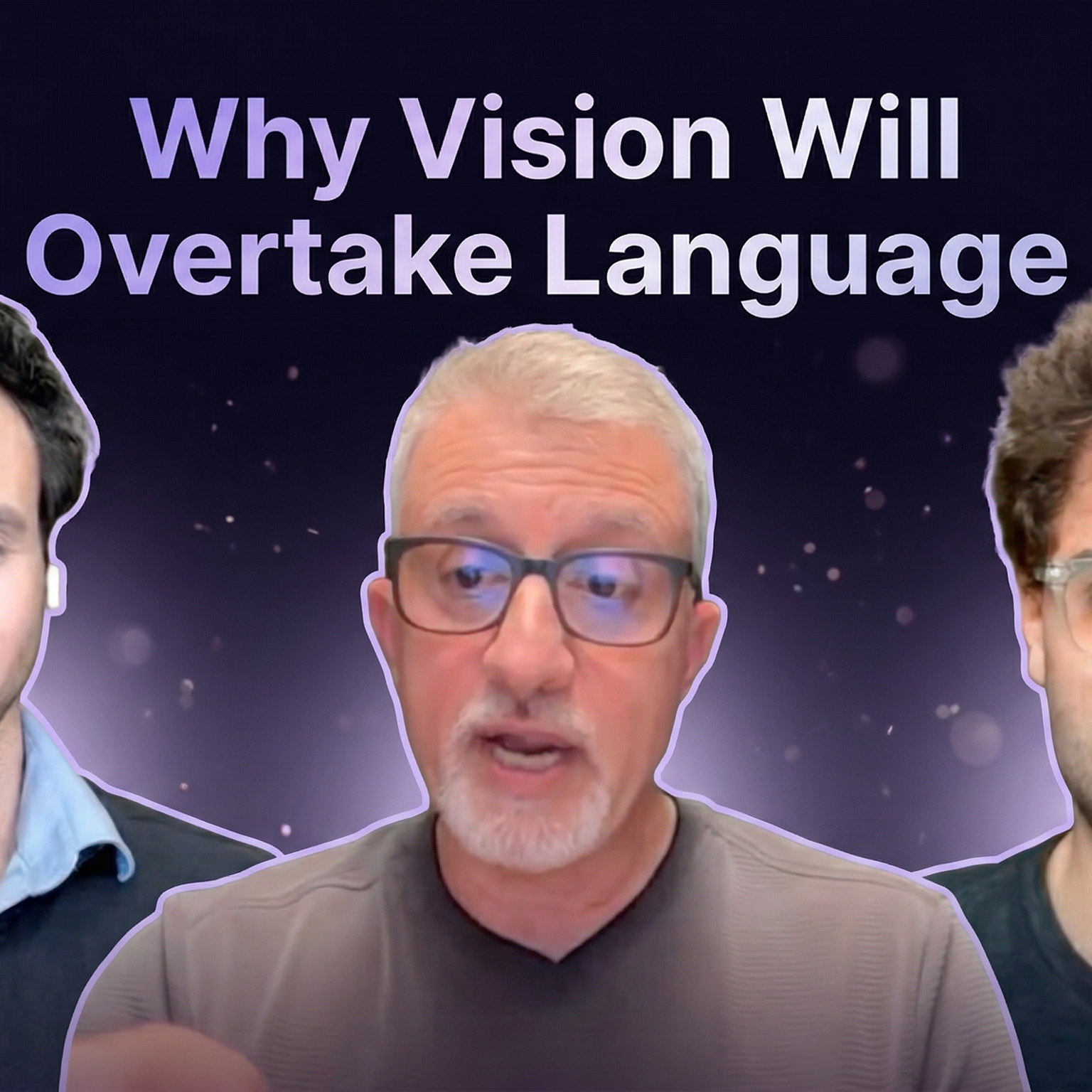
EPISODE · Apr 10, 2026 · 1H 24M
The Hidden Engine of Vision with Peyman Milanfar (Google)
from The Information Bottleneck · host Ravid Shwartz-Ziv & Allen Roush
How Denoising Secretly Powers Everything in AIPeyman Milanfar is a Distinguished Scientist at Google, leading its Computational Imaging team. He's a member of the National Academy of Engineering, an IEEE Fellow, and one of the key people behind the Pixel camera pipeline. Before Google, he was a professor at UC Santa Cruz for 15 years and helped build the imaging pipeline for Google Glass at Google X. Over 35,000 citations.Peyman makes a provocative case that denoising, long dismissed as a boring cleanup task, is actually one of the most fundamental operations in modern ML, on par with SGD and backprop. Knowing how to remove noise from a signal basically means you have a map of the manifold that signals live on, and that insight connects everything from classical inverse problems to diffusion models.We go from early patch-based denoisers to his 2010 "Is Denoising Dead?" paper, and then to the question that redirected his research: if denoising is nearly solved, what else can denoisers do? That led to Regularization by Denoising (RED), which, if you unroll it, looks a lot like a diffusion process, years before diffusion models existed. We also cover how his team shipped a one-step diffusion model on the Pixel phone for 100x ProRes Zoom, the perception-distortion-authenticity tradeoff in generative imaging, and a new paper on why diffusion models don't actually need noise conditioning. The conversation wraps with a debate on why language has dominated the AI spotlight while vision lags, and Peyman's argument that visual intelligence, grounded in physics and robotics, is coming next.Timeline0:00 Intro and Peyman's background1:22 Why denoising matters more than you think Sensor diversity and Tesla's vision-only bet15:04 BM3D and why it was secretly an MMSE estimator17:02 "Is Denoising Dead?" then what else can denoisers do?18:07 Plug-and-play methods and Regularization by Denoising (RED)26:18 Denoising, manifolds, and the compression connection28:12 Energy-based models vs. diffusion: "The Geometry of Noise"31:40 Natural gradient descent and why flow models work34:48 Gradient-free optimization and high-dimensional noise45:13 Image quality and the perception-distortion tradeoff48:39 Information theory, rate-distortion, and generative models52:57 Denoising vs. editing54:25 The changing role of theory57:07 Hobbyist tools vs. shipping consumer products59:40 Coding agents, vibe coding, and domain expertise1:05:00 Vision and more complex-dimensional signals1:09:31 Do models need to interact with the physical world?1:11:28 Continual learning and novelty-driven updates1:13:00 On-device learning and privacy1:15:01 Why has language dominated AI? Is vision next?1:17:14 How kids learn: vision first, language later1:19:36 Academia vs. industry1:22:28 10,000 citations vs. shipping to millions, why choose?Music:"Kid Kodi" - Blue Dot Sessions - via Free Music Archive - CC BY-NC 4.0."Palms Down" - Blue Dot Sessions - via Free Music Archive - CC BY-NC 4.0.Changes: trimmedAbout: The Information Bottleneck is hosted by Ravid Shwartz-Ziv and Allen Roush, featuring in-depth conversations with leading AI researchers about the ideas shaping the future of machine learning.
Embed this episode
NOW PLAYING
The Hidden Engine of Vision with Peyman Milanfar (Google)
No transcript for this episode yet
Similar Episodes
No similar episodes found.
Similar Podcasts
No similar podcasts found.