
EPISODE · May 27, 2026 · 11 MIN
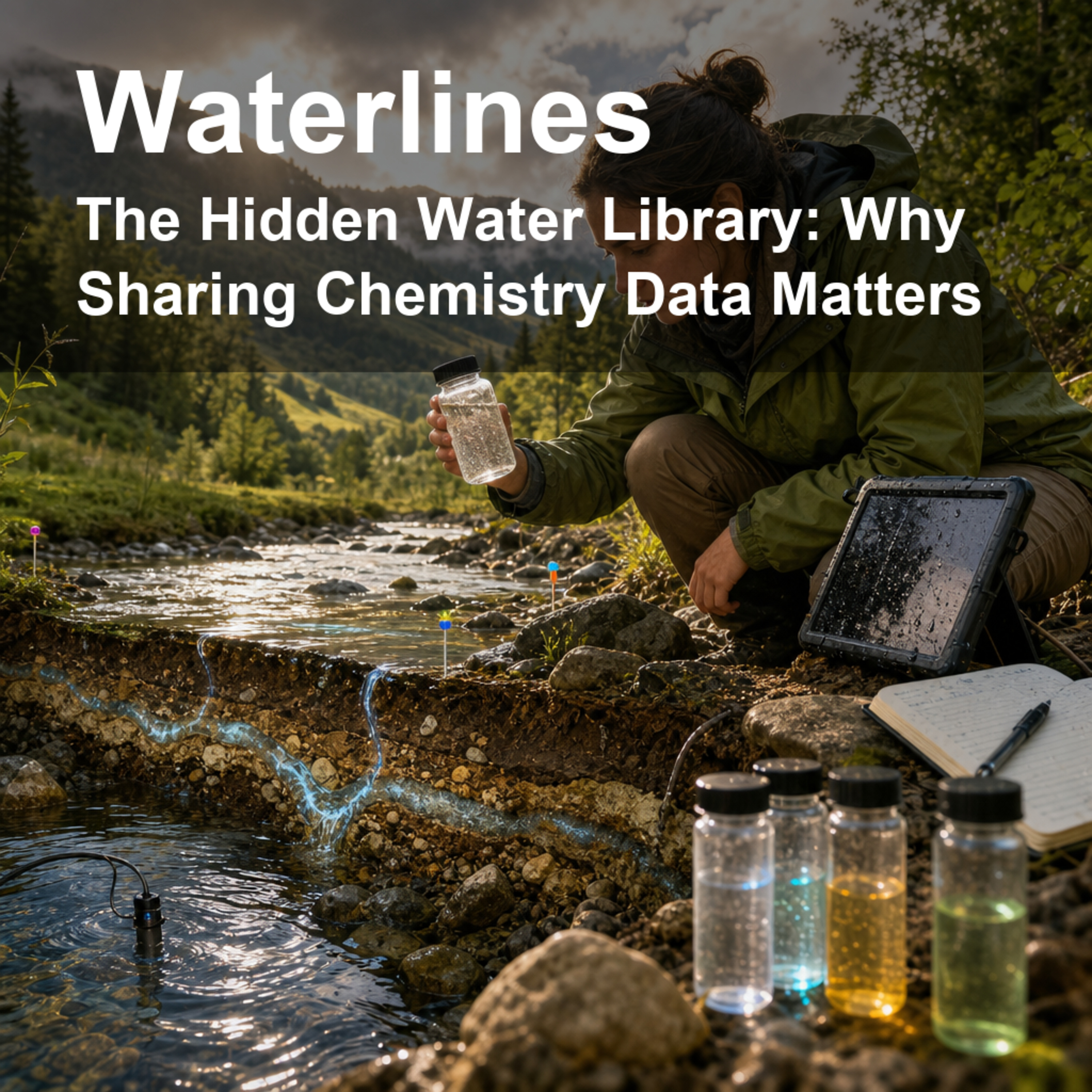
The Hidden Water Library: Why Sharing Chemistry Data Matters
from Waterlines: How Water Shapes Our World · host jaywen
Every water sample tells a small story: what flowed through a farm field, a mine, a city pipe, a forest soil, or a fractured rock underground. But if those stories stay trapped in notebooks, spreadsheets, or journal supplements, communities lose a powerful tool for spotting pollution, tracking climate-linked change, and understanding Earth’s life-support systems. In this episode, Waterlines follows a paper about the future of low-temperature geochemistry data—basically the chemistry of water, soils, rocks, air, and life at Earth’s surface—and asks a practical question: how do we make scattered environmental measurements useful to everyone who needs them?We unpack why water chemistry data are surprisingly hard to share. A single soil or stream sample can spawn measurements of pH, minerals, metals, isotopes, organic matter, and more, each needing context: where it came from, how it was collected, how it was filtered, what instrument was used, and what units were reported. The paper argues that the field needs both well-organized specialist databases and flexible general repositories—a lively “street bazaar” of data—plus better search tools, unique sample IDs, trusted archives, and training for the next generation of scientists.Citation: Brantley, Susan L., Tao Wen, Deborah A. Agarwal, Jeffrey G. Catalano, Paul A. Schroeder, Kerstin Lehnert, Charuleka Varadharajan, Julie Pett-Ridge, Mark Engle, Anthony M. Castronova, Richard P. Hooper, Xiaogang Ma, Lixin Jin, Kenton McHenry, Emma Aronson, Andrew R. Shaughnessy, Louis A. Derry, Justin Richardson, Jerad Bales, and Eric M. Pierce. 2021. “The future low-temperature geochemical data-scape as envisioned by the U.S. geochemical community.” Computers & Geosciences 157:104933. https://doi.org/10.1016/j.cageo.2021.104933.Disclosure: This Waterlines episode uses AI-generated voices to present a scripted public-science conversation based on the cited paper.
Embed this episode
NOW PLAYING
The Hidden Water Library: Why Sharing Chemistry Data Matters
No transcript for this episode yet
Similar Episodes
No similar episodes found.
Similar Podcasts
No similar podcasts found.