
EPISODE · Jan 19, 2026 · 13 MIN
The High Stakes of AI Mission Drift Litigation
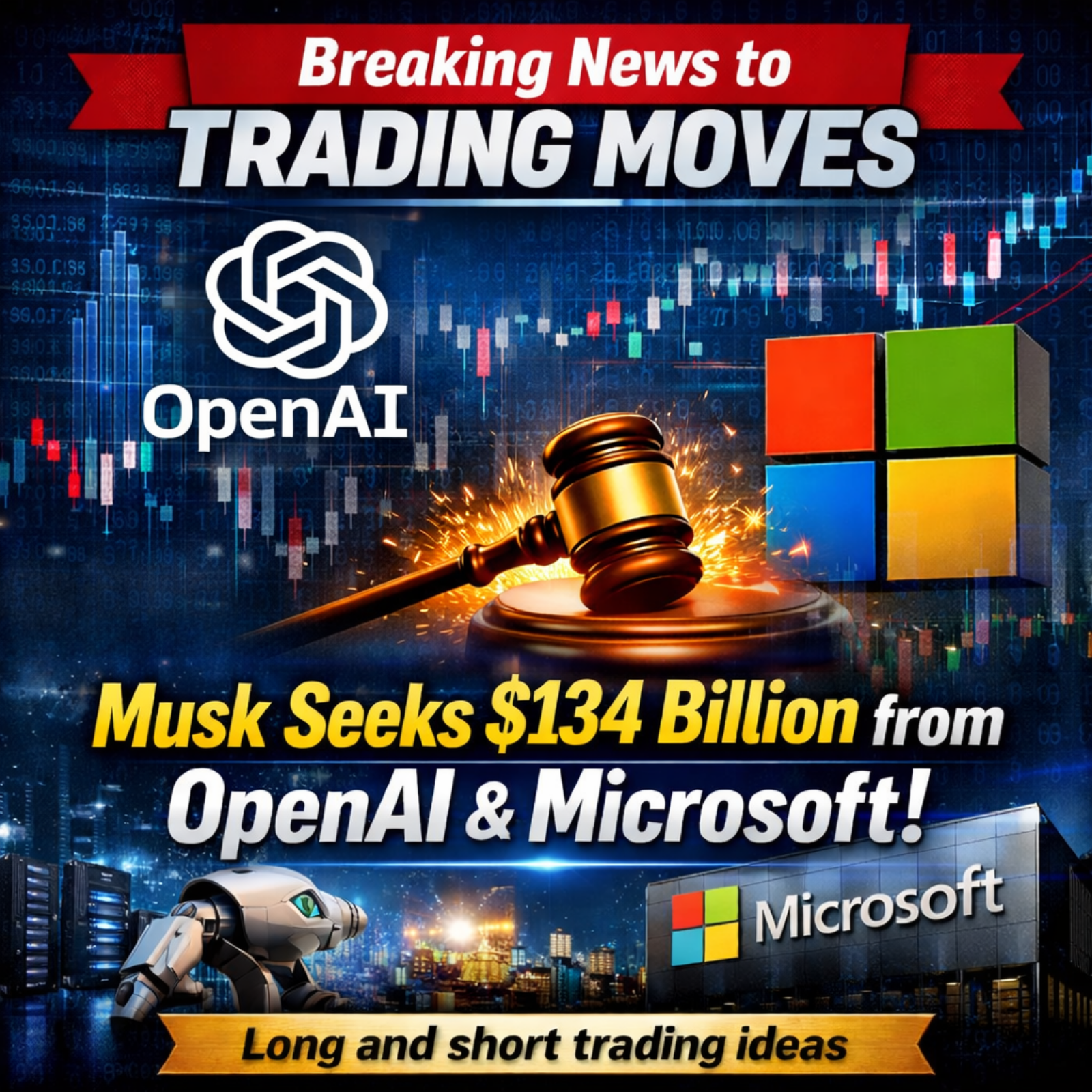
from Breaking News To Trading Moves
Musk seeks up to $134B from OpenAI and Microsoft, escalating AI “mission drift” lawsuitElon Musk is asking a federal court for up to $134B in damages from OpenAI and $MSFT, arguing they earned “wrongful gains” tied to his early support of OpenAI. The dispute centers on claims that OpenAI abandoned its original nonprofit mission as it evolved into a highly commercial, for-profit structure. A jury trial is scheduled for April 2026 in Oakland, California.Why markets careThis is a governance-and-control headline for AI: who owns the upside, what “mission” promises mean, and how much legal risk sits on top of the AI monetisation story. Even if the case takes months, the overhang can influence valuations, partner negotiations, and how quickly big AI buildouts get signed.What to watch next1. Court rulings that narrow or expand damages theories and what evidence gets allowed at trial2. Any shift in OpenAI partner posture and contract cadence (compute, distribution, enterprise integrations)3. Whether this sparks copycat governance challenges across AI partnershipsWinners1. AI platform alternativesWhen a key AI stack is under legal/gov scrutiny, enterprises often diversify vendors to reduce dependency and negotiation leverage shifts to other major model/cloud ecosystems.Names: $GOOGL (Alphabet Inc.), $META (Meta Platforms, Inc.), $AMZN (Amazon, Inc.)2. Legal analytics, eDiscovery, and compliance toolingBig-ticket IP/governance lawsuits can drive higher demand for litigation support, legal research, and compliance workflows across the sector.Names: $TRI (Thomson Reuters Corporation), $RELX (RELX PLC)3. Cybersecurity and AI governance controlsWhen AI governance becomes a board-level topic, budgets often move toward monitoring, data controls, and policy enforcement around AI deployments.Names: $CRWD (CrowdStrike Holdings, Inc.), $PANW (Palo Alto Networks, Inc.)Losers 1. Direct “OpenAI economics” exposureAny perceived risk to OpenAI’s structure, economics, or deal velocity can pressure the closest public-market beneficiaries tied to distribution and infrastructure partnerships.Names: $MSFT (Microsoft Corporation), $ORCL (Oracle Corporation)2. AI compute supply chainIf litigation uncertainty causes even a temporary slowdown in big training/inference expansion, hyperscale ordering patterns can wobble, hitting hardware and AI server suppliers on sentiment.Names: $NVDA (NVIDIA Corporation), $SMCI (Super Micro Computer, Inc.)3. Enterprise apps tightly linked to OpenAI integrationsPlatforms that market key workflows around OpenAI model access can see a near-term sentiment hit if customers fear roadmap or pricing volatility, even if contracts remain intact.Names: $CRM (Salesforce, Inc.), $NOW (ServiceNow, Inc.)#StockMarket #Trading #Investing #DayTrading #SwingTrading #AI #ArtificialIntelligence #BigTech #CloudComputing #Microsoft #OpenAI #TechStocks #MarketNews
Embed this episode
Ready to play
The High Stakes of AI Mission Drift Litigation
No transcript for this episode yet
Similar Episodes
No similar episodes found.
Similar Podcasts
No similar podcasts found.