
EPISODE · Feb 8, 2026 · 1H 4M
The Hitchhiker's Guide to Markup Estimation (De Ridder et al. 2026) | FT50 ECTA
from Revise and Resubmit - The Mayukh Show · host Mayukh Mukhopadhyay
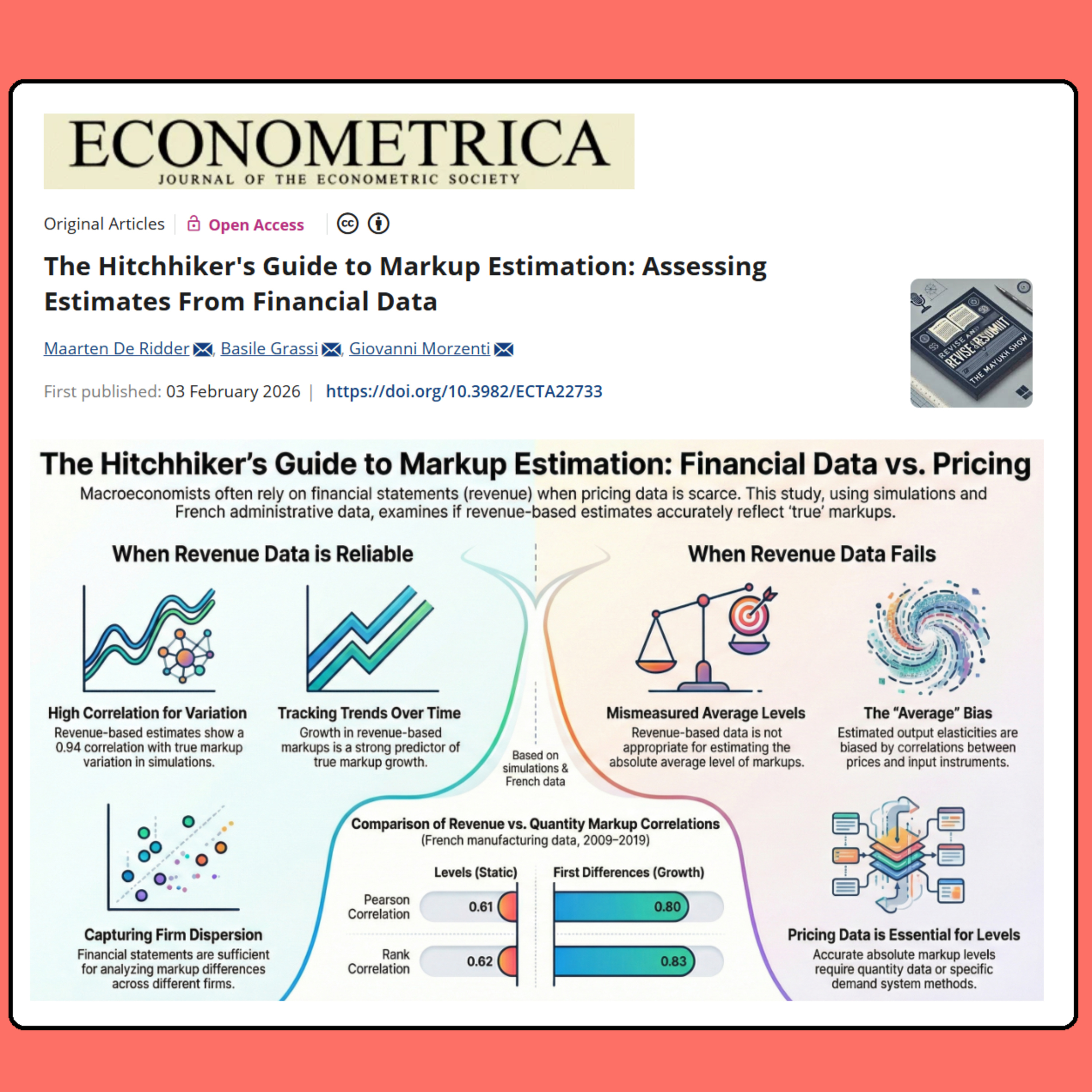
English Podcast starts at 00:00:00Bengali Podcast starts at 00:19:09Hindi Podcast starts at 00:34:01Danish Podcast starts at 00:49:41ReferenceDe Ridder, M., Grassi, B. and Morzenti, G. (2026), The Hitchhiker's Guide to Markup Estimation: Assessing Estimates From Financial Data. Econometrica, 94: 137-168. https://doi.org/10.3982/ECTA22733Youtube Channelhttps://www.youtube.com/@weekendresearcherConnect over linkedinhttps://www.linkedin.com/in/mayukhpsm/Welcome to Revise and Resubmit 🎙️✨A few years ago, I found myself staring at a spreadsheet the way you stare at an X-ray. You know it contains the truth. You also know it is not the whole truth. Numbers can be crisp, even beautiful, and still leave out the one variable you need. In my case, it was price. The data had revenues, costs, categories, footnotes, and the comforting authority of audited financial statements 📑🔍. But the thing I wanted to measure, how much power a firm has to mark up over cost, lives in the space between price and quantity. And that space is often blank.That is why today’s paper grabbed me by the collar.Published online on 3 February 2026 in Econometrica, one of the most prestigious journals in economics and a proud member of the FT50 list 🏛️📈, Maarten De Ridder, Basile Grassi, and Giovanni Morzenti offer: The Hitchhiker's Guide to Markup Estimation: Assessing Estimates From Financial Data.Here is the clinical problem, stated plainly. Macroeconomic outcomes depend on how markups are distributed across firms and over time. Markups shape investment, wages, inflation dynamics, and the basic question of whether markets feel competitive or concentrated. Yet the best firm level datasets we often have are financial statements, wide coverage, long time spans, and frustratingly short on what matters most for markups: the prices firms charge.The authors do something both careful and unusually practical 🧠🧪. They build an analytical framework to separate what financial statement data can measure from what it cannot. Their finding is precise: revenue-based approaches generally cannot pin down the average level of markups without pricing data. But they can do a surprisingly solid job at capturing two things researchers routinely care about: trends in markups over time and dispersion of markups across firms.Then they pressure-test this claim. They validate the logic with simulations from a quantitative macro model, and they bring in supporting evidence from firm-level administrative production and pricing data, including French manufacturing, to show that revenue-derived markup estimates correlate strongly with pricing-based estimates when you focus on movement and variation rather than the absolute level 📊🧾. They also propose a consistent estimator for settings where pricing information is missing, plus a modified two-stage procedure to handle measurement error.I like papers that tell you not just what to do, but what not to pretend. This one draws the boundary line clearly. Use financial data for the slopes, the differences, the changing shape of the distribution. Be cautious about claiming the exact height of the average markup without prices.Subscribe to Revise and Resubmit on Spotify 🎧 and to our YouTube channel, Weekend Researcher ▶️. You can also find the show on Amazon Prime and Apple Podcast 🔊🍏.And with sincere thanks to Maarten De Ridder, Basile Grassi, Giovanni Morzenti, and John Wiley & Sons Ltd on behalf of The Econometric Society 🙏📘, here is the question I cannot stop thinking about: if our best data can reliably track how markups move but not where they truly sit, how should that change the way we argue about market power in the real world? 🤔
Embed this episode
Ready to play
The Hitchhiker's Guide to Markup Estimation (De Ridder et al. 2026) | FT50 ECTA
No transcript for this episode yet
Similar Episodes
No similar episodes found.
Similar Podcasts
No similar podcasts found.