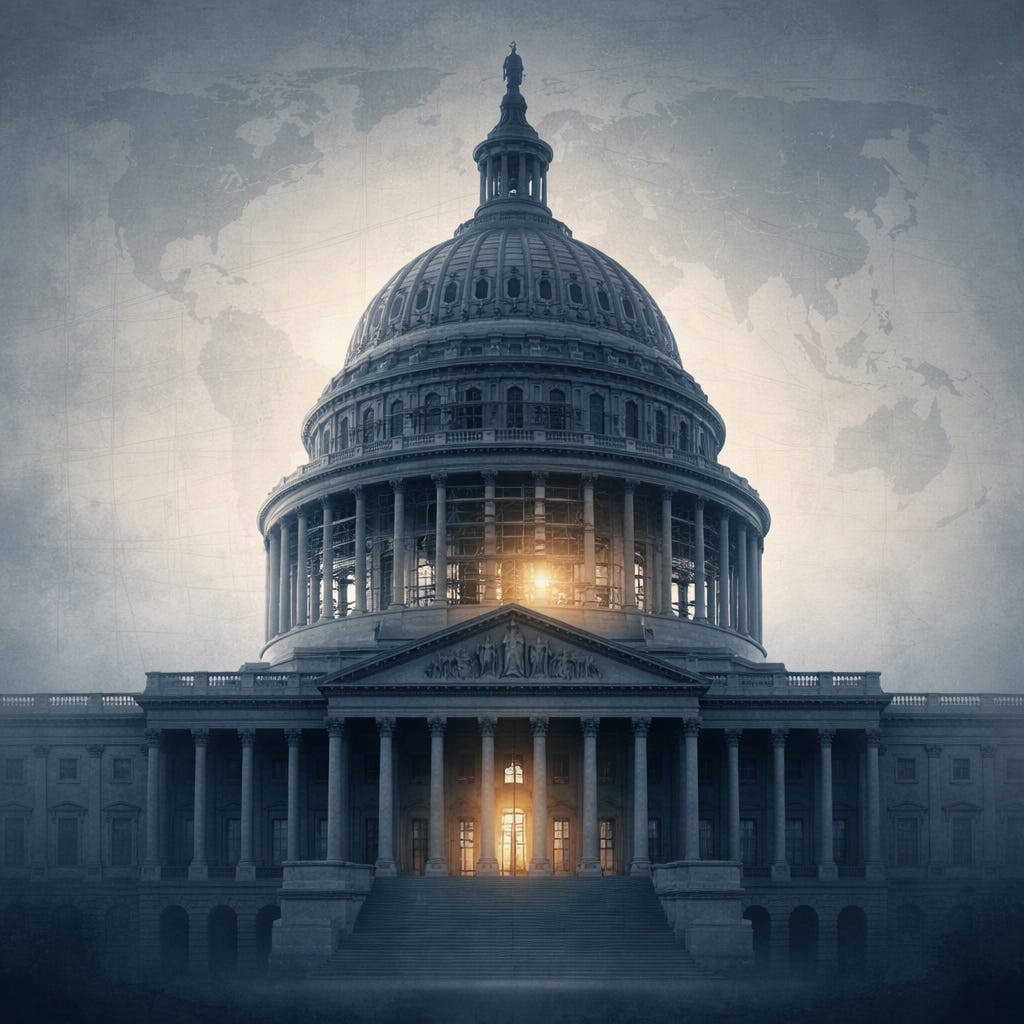
The Hollow Empire
from Language Matters by Elias Winter Hosted by Elias Winter
I. The Unipolar Dream and Its Quiet Funeral For a brief stretch at the end of the twentieth century, the world behaved as if history had made a final executive decision. American carrier groups moved across the oceans, American dollars flowed through every serious transaction, American software ran on the screens of rich and poor alike, and American stories about “leading the free world” provided the soundtrack. Even those who loathed the empire mostly argued about how to resist it, not whether it was real. There was one center; everything else was orbit. That was the unipolar moment. It did not end the way schoolbooks like to end eras. There was no climactic battle, no formal surrender. The belief simply frayed. The Iraq War showed that the sheriff would happily blow a hole in the saloon wall chasing imaginary weapons and then spend years insisting the dust was democracy. The 2008 financial crisis revealed that the global monetary core was a casino disguised as a cathedral; when the structure collapsed, its high priests rescued themselves first and called it stabilization. Russia’s annexation of Crimea proved that borders in Europe were once again negotiable by force and that economic sanctions, while painful, were not a veto. The election of an American president who treated allies like delinquent tenants made explicit what had been implicit for years: a large share of American voters no longer wanted to underwrite other people’s security at all. Underneath those shocks sat an older architecture: the dollar system. For decades, American power was not only ships and bases. It was also a lattice of payment rails, reserve holdings, and sovereign debt that made Washington the quiet counterparty to almost everything. When the United States began to weaponize that system more openly – freezing reserves, cutting banks off from networks, turning sanctions into a default response – it preserved leverage in the short term and advertised risk in the long term. Rivals and uneasy partners drew the obvious lesson: if your prosperity depends on a switch in Washington, you had better build a backup grid. What replaced the dream of a single sun was not a dignified, balanced “multipolar order.” It is something more unstable: a crooked triangle. One corner remains the United States: still unmatched in global military reach, still issuing the world’s primary reserve currency, still housing the headquarters of the most powerful technology platforms, still sitting at the center of a vast dollar-denominated web of debt. But it is politically fractured, strategically inconsistent, and increasingly tired of its own script. The second corner is China: industrially formidable, strategically patient, knit into global supply chains from cobalt mines to smartphone factories, and yet hemmed in by geography, demographics, and fear of internal fracture. The third corner is Russia: a mid-sized economy with the arsenal of a superpower and the psychology of a resentful ex-empire, willing to weaponize chaos, energy, and nuclear risk in ways more cautious powers are not. Around this warped geometry, medium powers have discovered that they are no longer just clients. India buys discounted Russian oil while courting Western capital and technology. Turkey hosts NATO bases and Russian gas. Saudi Arabia entertains Washington and Beijing in the same gilded rooms, certain that both need its oil and its money. Brazil, South Africa, Indonesia, Mexico, and others learn to balance, hedge, delay decisions, and extract concessions. This is no longer the “non-aligned movement” as moral statement. It is a very practical refusal to let one empire’s financial plumbing or another’s security guarantees define the limits of possibility. At the same time, the map of power is being rewritten by physics. The twenty-first century is an energy transition conducted in the middle of a climate crisis. The empire that once treated oil chokepoints as the main arteries now discovers that control over lithium, rare earths, high-voltage grids, and semiconductor fabrication is just as strategic as tankers in the Strait of Hormuz. Europe’s dependence on Russian gas was one form of vulnerability; its dependence on imported solar panels, batteries, and critical minerals is another. The question is no longer only who controls the sea lanes, but who can keep the lights on when supply chains snarl and rivers run low. The anxieties of this era cluster on the edges of most people’s maps. Venezuela, once a symbol of ideological struggle, now matters in Washington largely as a potential pier – a place where Chinese capital or Russian warships might one day sit too close to Florida, or where new offshore energy and infrastructure projects might plug into rival circuits. Iran is no longer just a “rogue regime,” but a regional hinge with drones, missiles, and political networks stretching from the Gulf to the Mediterranean, plugged into Russian warfighting and Chinese energy demand. Greenland, briefly a global joke when a president suggested buying it, sits under ballistic flight paths and future Arctic shipping lanes, with rare earths and radar sites embedded in ice that is turning to water. Sahel states, Pacific islands, Central American corridors: all become bargaining chips and pressure points in a game where climate, migration, minerals, and security are fused. These places are not central because they are powerful in themselves. They are central because an empire that spent the twentieth century thinking in terms of central fronts and European plains suddenly finds itself worrying about flanks: the Caribbean, the high north, the digital sea, the Strait of Hormuz, the Taiwan Strait. In each theater, the cost of miscalculation is raised by the presence of nuclear weapons. Russia’s willingness to brandish its arsenal as a shield for conventional aggression, and the visible wobble in Western resolve, send a signal far beyond Europe: if the umbrella is unreliable and the center is a pendulum, serious countries will quietly consider their own deterrents. Europe, meanwhile, has been living like a very cultured teenager whose rent is mysteriously paid every month. For three generations it outsourced serious violence to the United States. NATO and the American nuclear umbrella allowed conscription to end, shipyards to rust, and political imagination to turn inward to welfare states, climate policy, and regulation. The European Union could define itself as a market with a conscience, a combination of trade rules and human-rights rhetoric resting quietly on American logistics and Russian gas. Germany’s pre-2022 energy policy – closing nuclear plants while deepening dependence on Russian pipelines – made sense only inside that comfortable assumption. When the gas stopped and the tanks rolled, the illusion evaporated. Eastern European states had always suspected the arrangement; their national histories are written in tank tracks. For them, American brigade deployments are not think-tank abstractions but the difference between a deterrent and an invitation. For southern Europe and Britain, migrant boats and asylum crises are the domestic front of the same story: a world system fraying at its edges, and the bill arriving on their shores. You can tell an era is ending when its phrases keep being used after their meaning has gone. Officials still invoke “the rules-based international order” on panels that feel like religious services held after the congregation has quietly lost its faith. Policy papers still call the United States “indispensable,” even as allies quietly war-game scenarios in which Washington is absent, paralyzed, or preoccupied. Rivals no longer ask whether American power can crush them in a straight fight; they ask how much internal chaos it takes to keep that power from being used at all. The unipolar moment did not end because a disciplined rival stormed the fortress. It ended because the custodian stopped behaving as if guardiansh… This is a public episode. If you would like to discuss this with other subscribers or get access to bonus episodes, visit eliaswinter.substack.com
Embed this episode
No transcript yet.