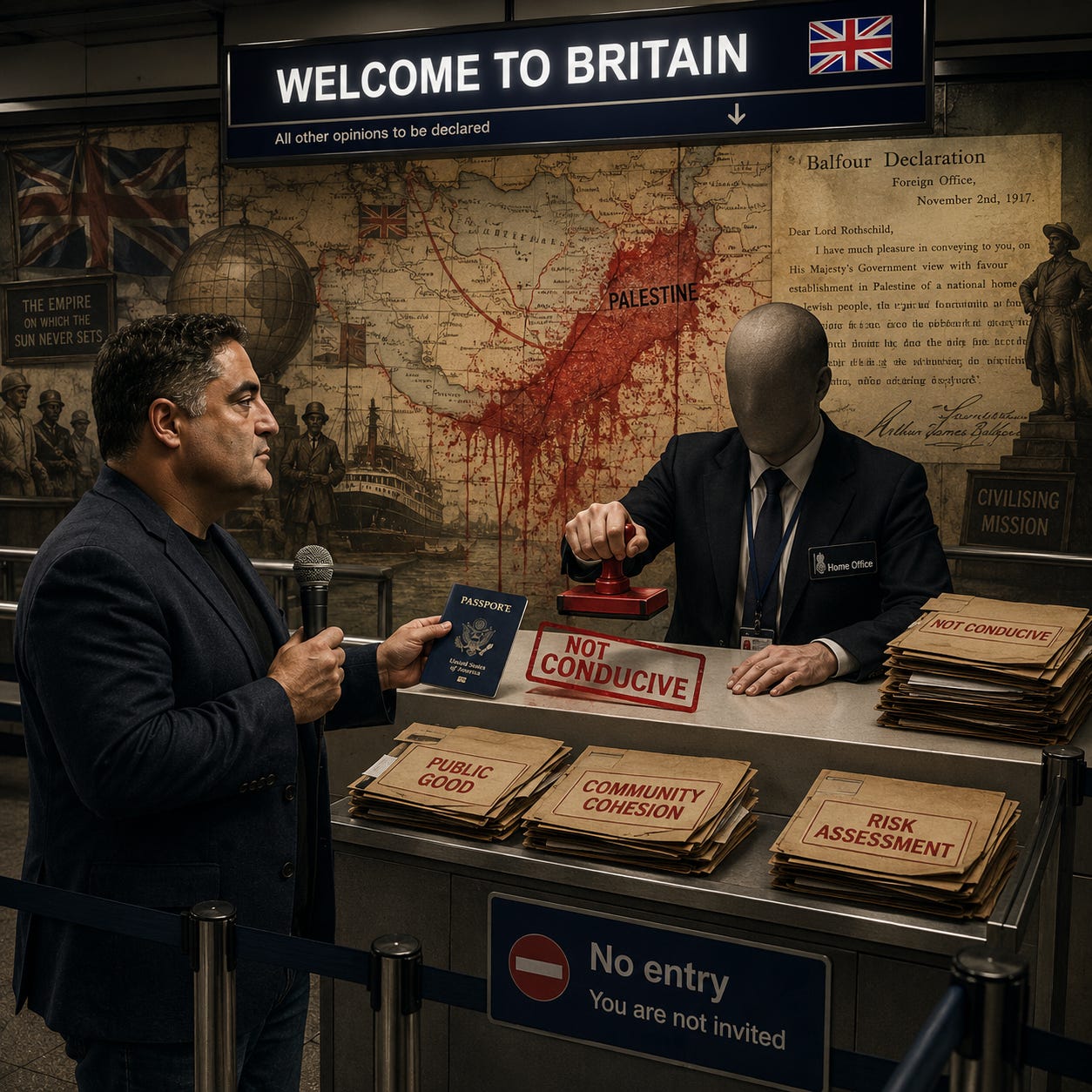
The Home Office Discovers Civilization
from Language Matters by Elias Winter Hosted by Elias Winter
There are empires that fall with drums. There are empires that fall with fire. There are empires that fall with statues pulled down, palaces stormed, generals shot in courtyards, flags lowered over harbors, foreign regiments evacuating by ship under a sky made orange by history. And then there is Britain. Britain falls by form. Britain falls by committee. Britain falls by memo, guidance note, risk assessment, ministerial discretion, border authorization, public order review, safeguarding language, and the solemn invocation of phrases so bloodless they could only have been designed by people whose institutions learned to commit violence in wool. “Not conducive to the public good.” There it is. The imperial haiku. Not illegal.Not convicted.Not dangerous in any material sense.Not leading an army.Not smuggling weapons.Not entering the country with a private militia and a map of Kent. Just not conducive. A man talks too loudly on the internet. A man criticizes Israel in language the state, its friends, and its anxious clerks have decided cannot be permitted to arrive in person. A man arrives carrying the wrong arrangement of opinions. A man from America, that loud colonial mistake Britain never quite forgave, proposes to enter the kingdom and participate in public discourse. The kingdom trembles. The Home Office gathers itself. A minister clears her throat. The administrative state, having reviewed the vibes, concludes that civilization cannot proceed. Cenk Uygur must be kept out. According to reporting in The Times, Uygur’s UK electronic travel authorisation was cancelled after Home Secretary Shabana Mahmood concluded that his presence would not be “conducive to the public good,” with the reported rationale including concerns about antisemitism, public order, and past comments on grooming gangs. The Home Office declined to comment. (The Times) Not because Britain is fragile, of course. Britain is never fragile. Britain is ancient, dignified, stable, mature, serious, parliamentary, common-law, Magna Carta, Churchill, Shakespeare, tea, queues, and the sacred right of every person to be silently judged by a woman in a cardigan. But it turns out this great civilization, this island that once administered famine, partition, opium, concentration camps, ethnic hierarchy, and half the world’s railway timetables, cannot withstand a Turkish-American YouTuber saying rude things about Israel. The empire that drew borders across continents is now frightened by a podcast guest. This is what decline looks like when it wears a tie. Not boots in the street.Not torches.Not the theatrical vulgarity of fascism.No, Britain is subtler than that. Britain criminalizes through politeness. It does not say, “We are afraid of dissent.” It says, “We have concerns regarding public cohesion.” It does not say, “Certain political arguments embarrass the state.” It says, “Your presence may not be conducive to the public good.” It does not say, “We helped create the Palestine problem and are now very annoyed by people who keep mentioning it.” It says, “Community tensions must be managed.” Managed. That beautiful imperial word. The Irish were managed.The Indians were managed.The Kenyans were managed.The Palestinians were managed.The miners were managed.The poor were managed.The migrants are managed.The protesters are managed.The speech is managed.The guilt is managed. Britain’s genius has always been to convert moral catastrophe into administration. This is why the Balfour Declaration remains one of the most British documents ever written. Not because it was uniquely long. It was brief. Almost courteous. A tidy little note announcing that one people’s national aspirations would be honored in a land where another people already lived, while those other people were referred to with the imperial delicacy of a clerk describing furniture left in a rented flat. The “existing non-Jewish communities.” What a phrase. Not Arabs.Not Palestinians.Not a people.Not a nation.Not a political subject. Existing.Non-Jewish.Communities. A civilization of ghosts, described negatively, as an obstacle category. And then, a century later, the descendants of that same imperial bureaucracy inspect the wound they helped open and say, with straight faces, that sharp speech about the matter may endanger community cohesion. This is the British talent at its highest form: arson followed by fire-safety regulation. First, help structure the catastrophe.Then, police the vocabulary of those who describe it.Then, call yourself moderate. The moderate is always the most dangerous figure in a decaying empire. The extremist at least knows he is holding a weapon. The moderate holds a clipboard and thinks it is innocence. And now we come to the Starmer government, that damp chapel of managerial repression. Labour, we are told. Labour. The party of workers, unions, miners, dissent, public dignity, solidarity, the old red flag lowered now into a drawer beside the emergency polling report. But this is not Labour as class politics. This is Labour as institutional reassurance. This is Labour after the soul has been removed and replaced with a focus group. Starmerism is not socialism. It is not even liberalism. It is the political theology of the well-briefed prosecutor. Its highest virtue is not justice, but order. Its deepest fear is not cruelty, but mess. It does not ask, “What is true?” It asks, “What can be defended on broadcast?” It is the ideology of men who have mistaken procedural competence for moral life. So when the country groans under housing failure, wage stagnation, regional abandonment, collapsing services, post-imperial humiliation, and a population trained for centuries to know its place, Starmerism does not offer a reconstruction of the social contract. It offers discipline. It offers border seriousness. It offers public order. It offers reassurance to people whose politics consist of asking whether the punishment can please be applied to someone else. And, of course, it offers the Home Office. Ah, the Home Office. Every country has a ministry where the national shadow goes to find employment. In Britain, it is the Home Office: that great cathedral of suspicion, where empathy enters wearing a visitor badge and is never seen again. The Home Office is not merely a department. It is a temperament. It is the institutional form of a curtain twitch. It is a little old empire peering through the blinds and asking whether that foreigner has the right tone. It has watched the world Britain made return to Britain, and it has not enjoyed the experience. The Jamaican nurse.The Pakistani shopkeeper.The Syrian refugee.The Polish builder.The Nigerian doctor.The Iranian dissident.The Palestinian activist.The Turkish-American broadcaster. All these people, arriving with their histories, their accents, their inconvenient memories, their ability to speak. And Britain, which loved the world very much when it could extract from it, suddenly discovers the sacred importance of borders. Empire is when we come to you.Immigration is when you come to us.The first is destiny.The second is a crisis. And beneath this crisis, always, is the white British poor — the eternal prop in the national theater. There has never been a Britain without poor white people. Never. Before immigration, before multiculturalism, before the tabloids discovered the phrase “small boats,” before brown men could be blamed for housing markets designed by landlords and austerity imposed by men named Rupert and Nigel and George, there were poor white British people. There were slums. There were workhouses. There were children coughing coal dust into handkerchiefs they did not own. There were debt prisons. There were factory girls whose bodies were eaten by machinery and men whose lives were spent underground so that aristocrats could illuminate rooms in which they discussed civilization. Read Dickens. Read Mayhew. Read any honest account of the Industrial Revolution that has not been laundered by heritage television. Britain did not need migr… This is a public episode. If you would like to discuss this with other subscribers or get access to bonus episodes, visit eliaswinter.substack.com
Embed this episode
No transcript yet.