The Human Brain on Hope: Why We’re Built for the “Not-Yet” 🧠🌅 episode artwork

EPISODE · Feb 17, 2026 · 15 MIN

The Human Brain on Hope: Why We’re Built for the “Not-Yet” 🧠🌅

from The Deep Dive Lab: Unraveling Materials Science · host Son Hoang

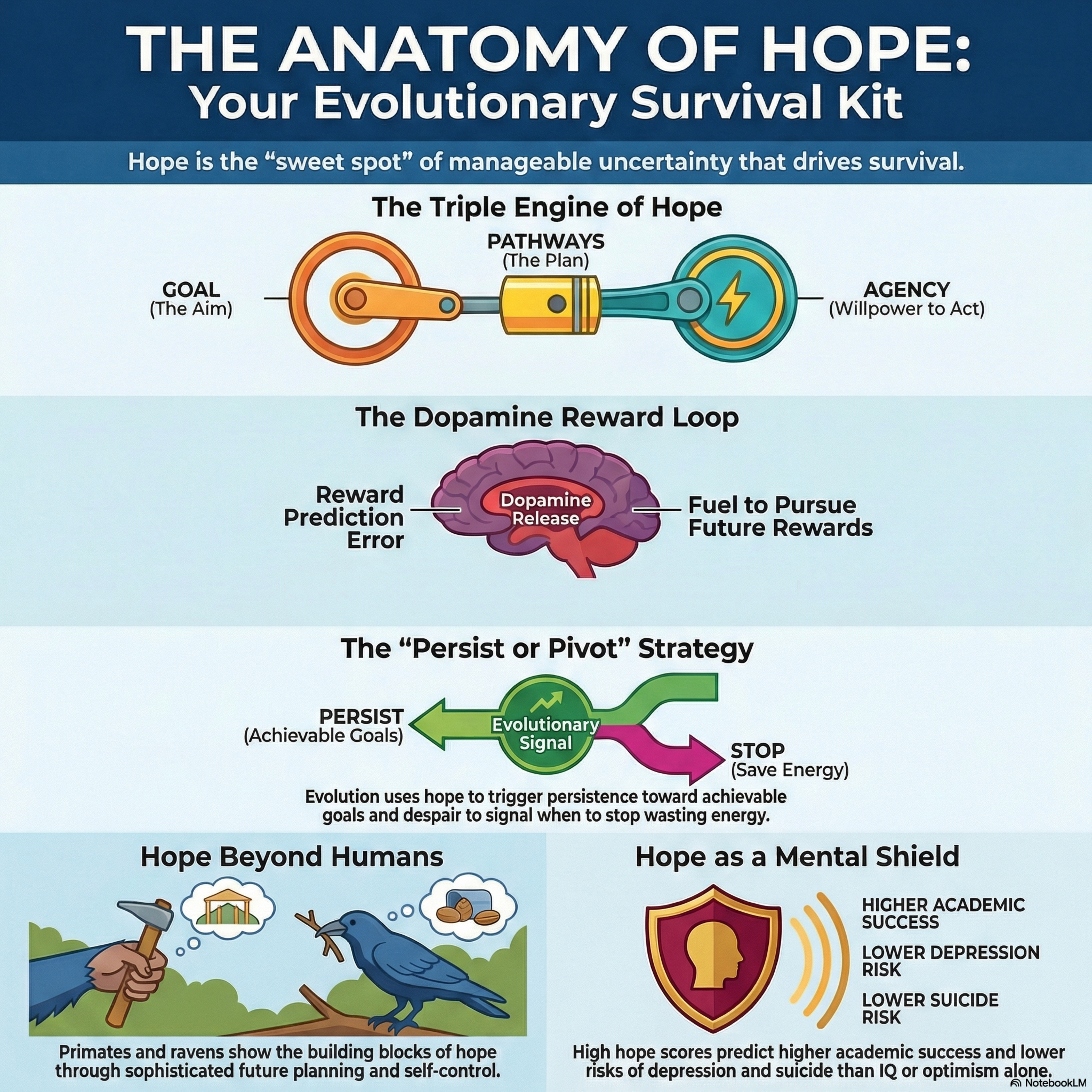
To be human is to live suspended between what is and what could be. We endure uncertainty, setbacks, and friction because our brains are wired to project forward — to imagine a future that does not yet exist and act as if it might.Hope is not poetic decoration. It is a cognitive survival system.Neuroscience shows that individuals with high trait hope exhibit greater neural efficiency in the medial orbitofrontal cortex — the brain region responsible for reward valuation and goal tracking. The hopeful brain is not louder. It is quieter, more focused, less hijacked by anxiety.Psychologist Charles Snyder reframed hope as a structured mental framework built on:🎯 Goals — clear, meaningful targets🛤 Pathways — flexible strategies when obstacles arise⚡ Agency — the willpower to keep goingHope is distinct from optimism. Optimism says, “Things will work out.”Hope says, “Here’s how I’ll make them work.”Even despair plays a role — acting as an adaptive signal to redirect effort when a goal is truly unattainable.In therapy, increases in hope often precede recovery. Hope is not the result of healing. It is the engine of healing.In a world defined by systemic uncertainty, cultivating hope is not naïve — it is neurologically strategic.What future are you actively building?#HumanNature #Neuroscience #HopeTheory #MentalHealth #CognitiveScience #Resilience #deepdivelab

To be human is to live suspended between what is and what could be. We endure uncertainty, setbacks, and friction because our brains are wired to project forward — to imagine a future that does not yet exist and act as if it might.Hope is not poetic decoration. It is a cognitive survival system.Neuroscience shows that individuals with high trait hope exhibit greater neural efficiency in the medial orbitofrontal cortex — the brain region responsible for reward valuation and goal tracking. The hopeful brain is not louder. It is quieter, more focused, less hijacked by anxiety.Psychologist Charles Snyder reframed hope as a structured mental framework built on:🎯 Goals — clear, meaningful targets🛤 Pathways — flexible strategies when obstacles arise⚡ Agency — the willpower to keep goingHope is distinct from optimism. Optimism says, “Things will work out.”Hope says, “Here’s how I’ll make them work.”Even despair plays a role — acting as an adaptive signal to redirect effort when a goal is truly unattainable.In therapy, increases in hope often precede recovery. Hope is not the result of healing. It is the engine of healing.In a world defined by systemic uncertainty, cultivating hope is not naïve — it is neurologically strategic.What future are you actively building?#HumanNature #Neuroscience #HopeTheory #MentalHealth #CognitiveScience #Resilience #deepdivelab

NOW PLAYING

The Human Brain on Hope: Why We’re Built for the “Not-Yet” 🧠🌅

0:00 15:29

No transcript for this episode yet

We transcribe on demand. Request one and we'll notify you when it's ready — usually under 10 minutes.

No similar episodes found.

No similar podcasts found.

Frequently Asked Questions

How long is this episode of The Deep Dive Lab: Unraveling Materials Science?

This episode is 15 minutes long.

When was this The Deep Dive Lab: Unraveling Materials Science episode published?

This episode was published on February 17, 2026.

What is this episode about?

To be human is to live suspended between what is and what could be. We endure uncertainty, setbacks, and friction because our brains are wired to project forward — to imagine a future that does not yet exist and act as if it might.Hope is not poetic...

Can I download this The Deep Dive Lab: Unraveling Materials Science episode?

Yes, you can download this episode by clicking the download button on the episode player, or subscribe to the podcast in your preferred podcast app for automatic downloads.
URL copied to clipboard!