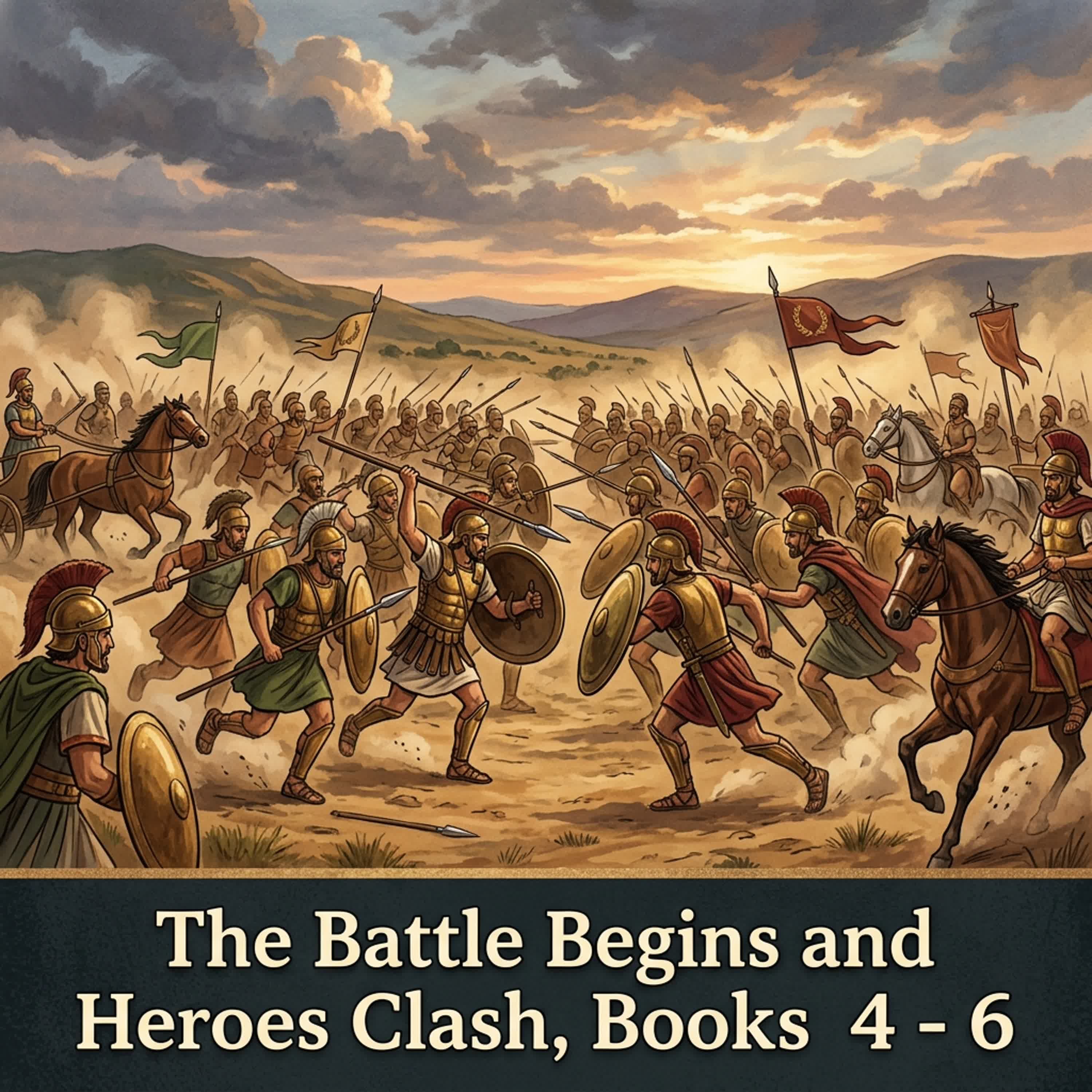
The Iliad - 2 - Chapters 4-6
from Wisdom for the Present: Western Wisdom Literature Hosted by Kanu Emeruwa
How often do we find ourselves running on autopilot, driven by external expectations or the relentless demands of our "honor economies"? Homer's ancient epic The Iliad serves as a powerful diagnostic tool for human nature, exposing the psychological realities we face under catastrophic pressure. Far from being just a dusty archive of ancient battles, the text explores the deep tensions between our public roles and private selves, the anatomy of rage, and the search for agency when our personal futures feel completely out of our control. In Book 4, we witness how easily human systems collapse when external forces destabilize a hard-won peace. The Greeks and Trojans have sworn a solemn truce to end the bloodshed, but this fragile social fabric is shattered by divine transaction and human vulnerability. Minerva exploits the vanity and ambition of Pandarus, whispering empty promises of glory to provoke him into firing the arrow that shatters the ceasefire. Pandarus uses the pinnacle of human craftsmanship—his beautifully polished mountain-goat bow—not to preserve civilization, but to plunge it back into a blood-soaked chaos. This systemic rupture triggers an immediate crisis of leadership as Agamemnon catastrophizes, panicking about his personal legacy and public shame rather than managing the military emergency. Operating within a toxic shame culture where public esteem is the only currency of worth, Agamemnon weaponizes humiliation, calling his troops exhausted fawns and publicly declaring that Diomedes degenerates from the greatness of his father, Tydeus. Rather than succumbing to depression, Diomedes metabolizes this toxic shame into pure rage, triggering a terrifying aristeia powered by menos—an intense, supernatural surge of battlefield vitality. Yet, as Diomedes begins wounding the gods of love and war, his ambition spirals into hubris until Apollo delivers a brutal boundary check on human limits. As the gods depart the field in Book 6, the supernatural fire fades, leaving exhausted men grinding each other to dust in a logic-defying storm of tribal violence. Yet, amidst this suffocating slaughter, Diomedes and the Lycian commander Glaucus meet in no-man's-land. Glaucus famously reframes their violent pursuit of eternal fame, noting that human lives are as transient and fleeting as decaying autumn leaves. Recognizing their ancestral bond of xenia (guest-friendship), they drive their spears into the dirt and choose radical connection over conflict. By exchanging Glaucus’s gold armor for Diomedes’ bronze, they perform a radical devaluation of material wealth, proving that shared humanity is infinitely more valuable than the blood-soaked polarization of their war. Leaving the battlefield, the narrative pulls back inside the walls of Troy to show Hector carrying the isolating weight of others' failures. He rejects his mother's offering of numbing wine, confronts his brother Paris's comfortable, pathologically insulated withdrawal from the crisis, and ultimately meets his wife, Andromache. Faced with her devastating plea to stay safe on the defensive wall, Hector is trapped in a systemic double bind. Though he knows Troy is doomed and Andromache will face enslavement, he chooses to return to the front line rather than accept the social death of cowardice. In an unforgettable moment, Hector unbuckles his terrifying horsehair helmet so his frightened son can recognize him. By setting his armor in the dirt, Hector shows us how to be fully present for those we love, demonstrating that even when our fates are sealed, our capacity to hope and love is the ultimate victory of the human spirit. In This Episode * The Fragility of Peace and Human Manipulation: How Pandarus's vanity was exploited to break a hard-won truce. * Toxic Leadership vs. Sustainable Motivation: Analyzing Agamemnon's use of shame, comparing his anxious reaction to a CEO in a PR crisis. * Shame Culture vs. Guilt Culture: How ancient kleos (glory) and public esteem drove actions, and its modern equivalents in corporate or social settings. * The Power and Peril of Menos: Examining Diomedes’ adrenaline-fueled aristeia and the boundary check delivered by Apollo when ambition turns to hubris. * Xenia and Radical Connection: How Diomedes and Glaucus chose hereditary guest-friendship over tribal conflict, swapping gold for bronze armor to assert their shared humanity. * Shedding the Armor: Hector's rejection of numbing coping mechanisms and the physical act of unbuckling his helmet to connect with his terrified son, Astyanax. * Hope in the Face of Doom: The tragic irony of Hector’s prayer for his son, showing the ultimate defiance of the human spirit to love and hope even when destruction is guaranteed. Practical Reflection In times of high pressure, do you motivate others by casting a supportive vision, or do you instinctively rely on shame, guilt, and imposter syndrome to get quick results? What professional or social "armor" are you currently refusing to take off when you return home to the people who depend on you the most? Where in your life are you pushing past your natural limits, trying to battle "gods" or control things that are fundamentally outside your agency? Suggested Substack Excerpt Step into the psychological meat grinder of Books 4-6 of Homer’s The Iliad. We explore toxic leadership, the illusion of invincibility, and the radical, beautiful choice to shed our professional armor and embrace shared humanity in a divided world. AI Disclosure This episode was created using Google NotebookLM Audio Overview, based on human-curated source material, structured guidance, and editorial review. AI is used as a tool for clarity and delivery, not as a replacement for thoughtful study or engagement with the original texts. Copyright © 2026 Wisdom for the Present / Kamashcu Production Studios. All rights reserved. This is a public episode. If you would like to discuss this with other subscribers or get access to bonus episodes, visit wisdomforthepresent.substack.com
Embed this episode
No transcript yet.